
Our readers keep the lights on and the coffee maker working hard! As an Amazon Associate, I earn from qualifying purchases.
Specs are compiled from manufacturer listings and verified buyer reviews and can change over time — please confirm the key details on the product page before buying.
Stepping into a snowshoe for the first time is a leap of faith — will you sink, slip, or skim the surface? The real answer lives in three numbers: your weight, the shoe length, and the weight of your winter boots. This guide cuts through the marketing to match you with the pair that keeps you on top of the powder, not buried in it.
I’m Mohammad — the founder and writer behind Calories Fit. This guide is built by comparing the manufacturers’ published specifications and the patterns across verified customer reviews, so you get each pick’s real strengths and trade-offs instead of marketing spin.
We break down flotation, bindings, and traction so you can pick the best women’s snow shoes for your winter trails without second-guessing your choice.
Our Picks at a Glance


How To Choose The Best Women’s Snow Shoes
Snowshoes are simple tools with one demanding job: keep you floating. The wrong length for your weight means post-holing through crust, and the wrong binding means a frozen, frustrating battle every time you stop. Match these three specs to your body and your trail and you will land on the right deck.
Match the length to your weight
Every snowshoe carries a maximum weight recommendation, and that number is the ground truth. A shorter shoe (around 21–22 inches) suits lighter hikers and packed trails, while a 30-inch deck is built for heavier loads and deep powder. Check your weight plus your winter pack, then subtract a little margin — a shoe rated at 210 pounds will feel planted under a 150-pound hiker with a daypack, but float best under someone closer to its limit.
Bindings: simple beats clever in the cold
You will take your snowshoes on and off several times during a hike, so a binding that needs gloves off and ten minutes to tighten will ruin your morning. Double-ratchet systems (two click-adjustable straps) cinch fast and hold tight, hook-and-loop straps (Velcro-style) are nearly simple to use, and wrap-around designs hug boots like a glove but can be fiddly. Choose the binding that matches how often you stop — that is the moment a good binding earns its keep.
Traction is what keeps you upright
Crampons — the metal teeth underfoot — do the gripping on ice and packed snow. Heel lifts flip up to take strain off your calves on steep climbs. If your trails include sidehills or frozen lakes, look for aggressive teeth and a solid pivot; if you are mostly on groomed paths, simpler traction is plenty.
Quick Comparison
| Model | Best For | Max Weight | Length | Frame Material | Amazon |
|---|---|---|---|---|---|
| Retrospec Drifter★ Best Overall | First-time hikers on mixed terrain | 210 lbs | 30″ | Aluminum | Amazon |
| G2 Snowshoes SetBest Value Kit | Complete kits with poles and gaiters | 250 lbs | 30″ | Aluminum / HDPE | Amazon |
| Retrospec Drifter BundleTrail-Ready Bundle | All-terrain casual hikers | 250 lbs | 30″ | Aluminum | Amazon |
| Crescent Moon Eco EVA | Runners and minimalist walkers | 180 lbs | 22″ | EVA Foam | Amazon |
| Odoland Snowshoes Set | Budget-minded families | 250 lbs | 25″ | Aluminum | Amazon |
| Yukon Charlie’s Sherpa | Recreational hikers 151-200 lbs | 200 lbs | 25″ | Alloy Steel | Amazon |
| Tubbs Xplore W | Joint-friendly recreational walks | — | 25″ | Aluminum | Amazon |
| MSR Evo Trail | Trail purists who value grip | 180 lbs | 22″ | Plastic / Alloy Steel | Amazon |
| MSR Lightning Ascent | Steep alpine ascents | 180 lbs | 22″ | Alloy Steel | Amazon |
In‑Depth Reviews
1. Retrospec Drifter Snowshoes
Our pick — over 4★ from 700+ verified ratings; the strongest balance of quality and price.
The snowshoe that turns a winter walk into a habit — light, quick, and genuinely confidence-inspiring.
The build quality here is the thing that wins people over, and it shows in the details. The aluminum frame keeps each step easy, while the double-ratchet binding gets you strapped in fast — no fumbling with frostbitten fingers on a cold morning. The heel lifter flips up to reduce leg strain on steep climbs, and the full-floating pivot system moves naturally with your stride so you feel balanced rather than clunky.
What everyone raves about is how easy these are to get on and off, paired with a surprising amount of grip on icy surfaces. The mesh carrying bag is a genuinely useful extra for storage and transport. There are some mixed notes on long-term durability — a few owners note the ratchet tightening feels a little questionable and may not last forever. Buyers report “Have used them 3 times so far work well. ratchet tight ing a little questionable. May not last long” — a fair caution for heavy users.
Weighing in with a 210-pound maximum weight recommendation, this 30-inch deck suits a wide range of hikers. The heel riser can feel slightly uncomfortable for some, and the riser retention may wear quickly, but the ratchet straps themselves are excellent for getting a snug fit. For the crowd favorite status — a strong 4.4 stars across 700+ owners — this is the pair most first-timers will be happiest with.
What owners love
- Easy on/off even with gloves
- Heel lift eases steep climbs
- Solid grip on icy surfaces
- Carry bag included for storage
What to watch
- Ratchet tightening feels questionable to some
- Heel riser can be slightly uncomfortable
- Long-term durability is mixed
Reach for these if: you want a trusted, easy-to-use first pair that handles mixed terrain while staying affordable.
Look elsewhere if: you are a heavy user planning to log dozens of trips a season — the ratchet system may be your first failure point.
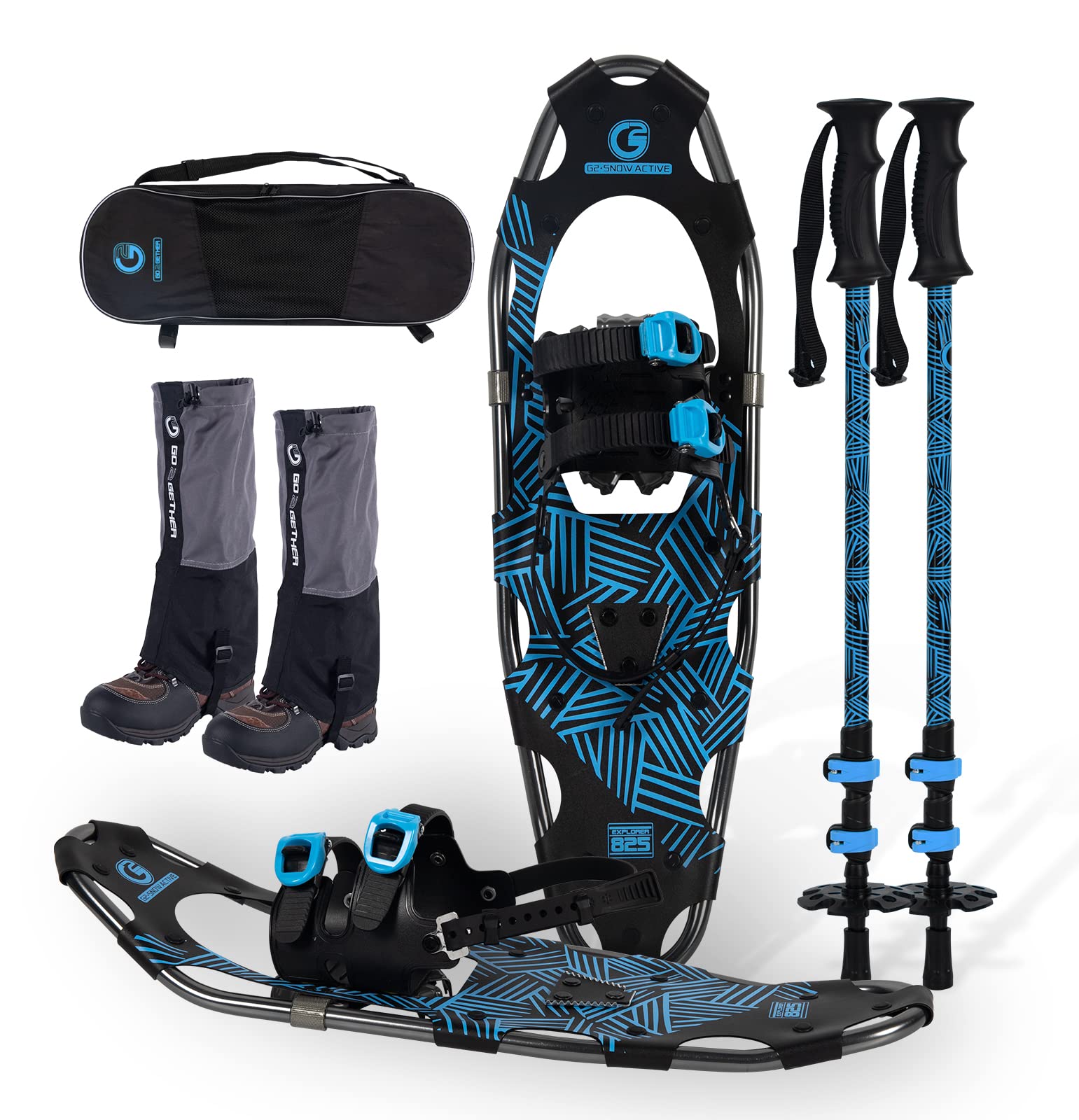
2. G2 Light Weight Snowshoes Set
A complete winter kit that skips the awkward “what else do I need” question entirely.
This is the set that arrives with everything: snowshoes, trekking poles, a tote bag, and waterproof gaiters. The poles adjust easily to a comfortable height, and the gaiters keep snow out of your boots on deeper days. The fast-ratchet binding is designed for low temperatures — a one-pull buckle that works even when your hands are frozen.
Owners praise the build quality most, with the included accessories a close second. The sharp aluminum crampons give excellent grip on snow or ice, and the flex pivot bar with heel lift makes walking feel more natural on flat and uphill. As owners put it: “These light weight snow shoes are absolutely perfect. I would recommend them to anyone. I love that them came with poles and gators. I couldn’t be happier.”
What wins people over is how well this kit floats — the HDPE deck provides nice flotation so you save energy and go further. There is no dedicated uphill setting on the binding, but owners mention the shoes work just fine for a trip anyway. At 30 inches with a 250-pound capacity, this is a generous, complete package for beginners and families alike.
Kit complete: poles, gaiters, bag, and a 1-year warranty with 24-hour response make this the least-fuss way to start snowshoeing.
One honest note: no toe stop means a slight forward slide on steeps — a minor quirk, not a dealbreaker.
3. Retrospec Drifter Snowshoes & Trekking Poles Bundle
The bundle that holds its own on steep hills and deep powder without demanding a climbing budget.
This is the upgraded sibling of the top pick, and the difference is the extra gear. It pairs a 30-inch aluminum snowshoe with adjustable trekking poles and a carrying case, all built for all-terrain hiking. The full-floating pivot system tackles steep climbs while reducing leg strain — the same clever design as the solo Drifter, but with stability poles to back it up.
Owners praise the quality most, with functionality a close second. The double-ratchet bindings secure quickly even with gloved hands, and the aircraft-grade alloy frames paired with rugged polyethylene decks keep you floating above deep snow. The adjustable poles are a standout — terrain-specific attachments keep you balanced on any surface, and customers note they “worked well. Easily adjusted, tightened and held up in my first 3 days of testing both soft, hard snow, steep hills, up and down.”
This bundle carries a 250-pound maximum weight recommendation — a 19% higher capacity than the solo Drifter’s 210 pounds — making it the better choice for taller or heavier hikers. The recurring gripe is the strap adjustment, which some find loosens during walking. Carbon buildup on crampons in wet snow is a minor issue some manage with cooking spray.
Why it earns its place
- Excellent weight distribution prevents ankle soreness
- Simple straps and good crampons for hills
- Adjustable poles with snow-specific tips
- Holds up across multiple snow types
The trade-offs
- Straps can loosen during long walks
- Deep powder kicks snow onto legs
- No bag for removable pole baskets
Pick this if: you want a do-everything kit that goes from packed trails to steep hills without complaint.
skip it if: you are a minimalist who never uses poles — the solo Drifter saves you the extra gear.
4. Crescent Moon Eco EVA Snowshoes

A foam deck that bends like a sneaker — the closest thing to walking on air you will find in snow.
These are not your grandfather’s snowshoes. The EVA foam construction makes each pair weigh just 2 lbs 8 oz, and the rocker platform bends and rolls with your foot like an athletic shoe. The teardrop shape preserves your natural stride, making walking in snow feel almost easy — a genuinely different experience from traditional aluminum frames.
The hook-and-loop binding is the star here. It is incredibly intuitive — more like slipping into sneakers than fighting with straps. Reviewers point out the velcro is “so easy to get on and off” compared to plastic or rubber straps that always ended up breaking. The ice spikes provide durable traction, and the whole thing is small enough to feel nimble on pack trails.
The 22-inch size is rated for hikers up to 180 pounds, with the manufacturer suggesting 200 pounds on trail and 175 pounds off-trail. This is not a deep-powder breaker — the small size means limited flotation — but for packed and wet trails, it shines. A 3-year manufacturer warranty backs the build.
Featherweight freedom: the natural-stride feel and easy velcro make these the most beginner-friendly deck here.
Know the limit: small size means less flotation — skip these if you plan to break trail in deep powder.
5. Odoland Snowshoes with Trekking Poles
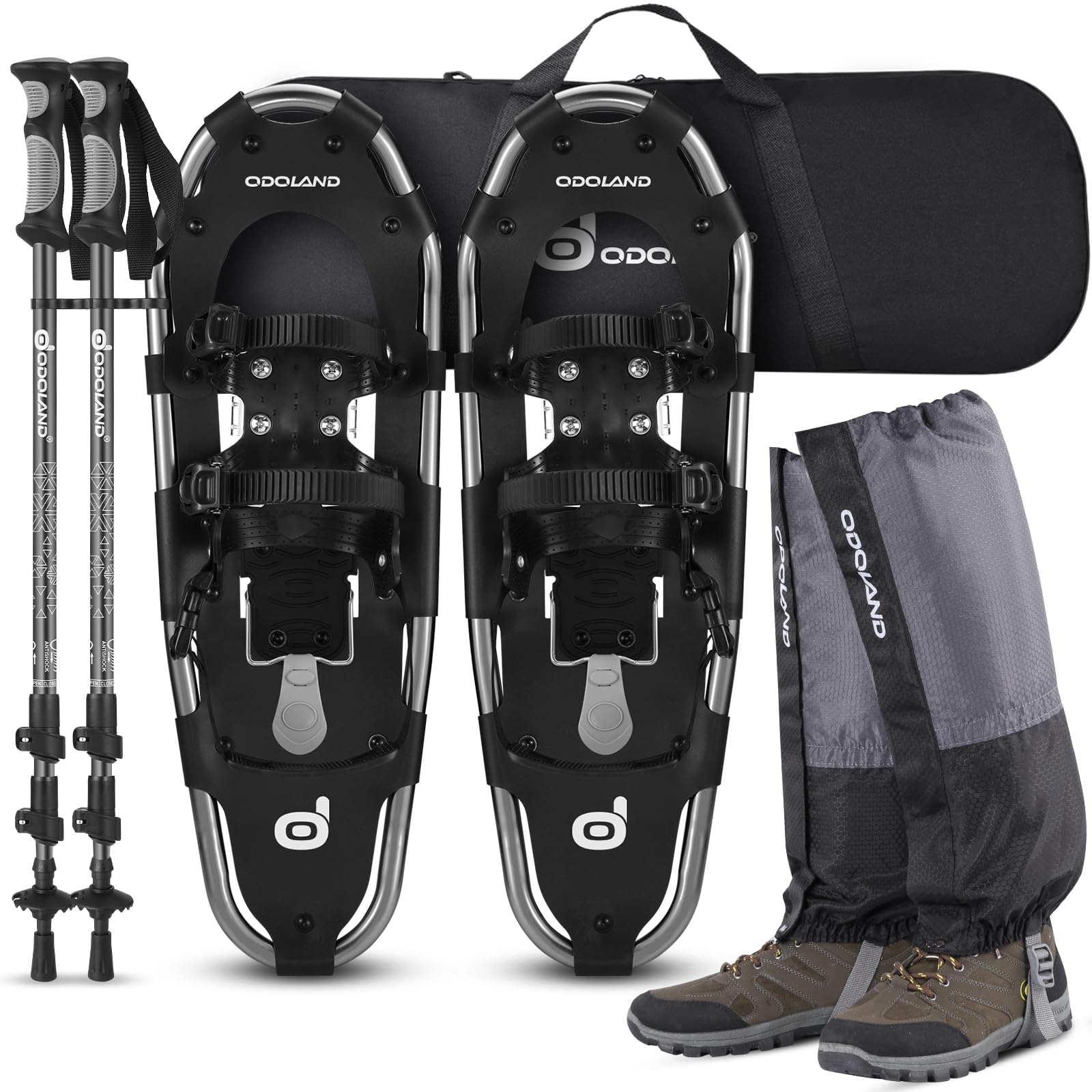
The kit that hands you poles, gaiters, and a bag — then asks very little in return.
This is the set for families who want one box to cover everyone. The 21-inch size suits 80-120 pounds, the 25-inch fits 120-160 pounds, and the 30-inch handles 160-250 pounds — so a household can buy multiple sizes knowing the system works across ages. The aluminum frame with a large flat surface provides maximum flotation, and each shoe carries two sets of reinforced sawtooth traction for icy, hard surfaces.
The telescoping poles adjust from 25.5 to 54 inches, easy to change even with gloves on. The pongee-fabric gaiters provide water, tear, and puncture resistance. Quality is the most-praised aspect, with owners calling them “a great beginning set for the money” and noting they work effectively in 16+ inches of snow.
Durability is the honest catch here — some shoppers say the walking sticks don’t lock properly, and a few units broke within minutes of first use. The cleats can damage shoes without a cardboard spacer in the bag. This is a starter kit, not a mountaineering tool, and it knows it.
Everything included: poles, gaiters, and a carrying case make this the lowest-friction way to get a family on the snow.
Fair warning: durability is mixed, so treat this as a casual-season option rather than a decade-long investment.
6. Yukon Charlie’s Sherpa Snowshoe Kit
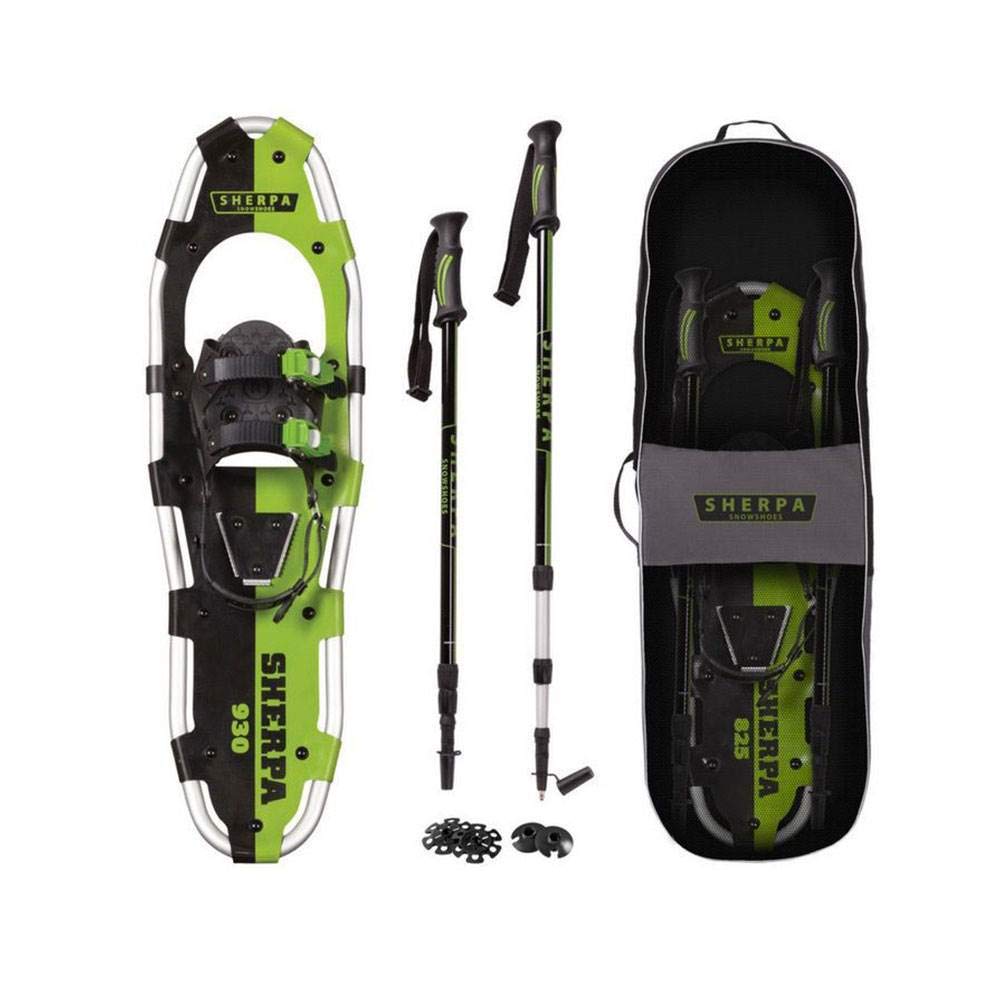
A 4.2-pound deck that disappears under your boots while the Quick Click binding gets you moving in seconds.
Built for the recreational snowshoer, this 8×25-inch frame is designed for users from 151 to 200 pounds. The Quick Click II ratcheting binding and Rapid-Lite Flex heel strap get you in and out of the shoe faster than most systems in this range. The HDPE material stiffens the deck for maximum power transfer through deep snow — so your energy goes forward, not into flexing the shoe.
Owners praise the quality most, with ease of use close behind. This is a unisex design that has tackled everything from a 12-day blizzard to 30 inches of fresh snow. The included poles and travel bag are genuinely useful, especially since the sharp grips on the bottom need safe storage between trips.
The honest comparison: this sits above the budget kits in price, and most owners say it feels better and is much easier to take on and off than cheaper options they have used. Strap durability gets mixed feedback — a few report straps broke after two uses, so the binding is the part to watch. A 6’3″, 230-pound owner wearing size 14 boots had no issues with the strap, which says a lot about the adjustability.
What stands out
- easy on/off in seconds
- Stiff HDPE deck for efficient power transfer
- Handles steep terrain and deep snow well
- Comfortable with large boot sizes
The catch
- Strap durability is the weak point for some
- Premium price over entry-level kits
Choose this if: you want a step up from entry-level that feels solid on varied terrain without climbing-grade complexity.
Consider alternatives if: you are a hardcore mountaineer — this is a recreational tool, not an alpine weapon.
7. Tubbs Xplore W Snowshoes
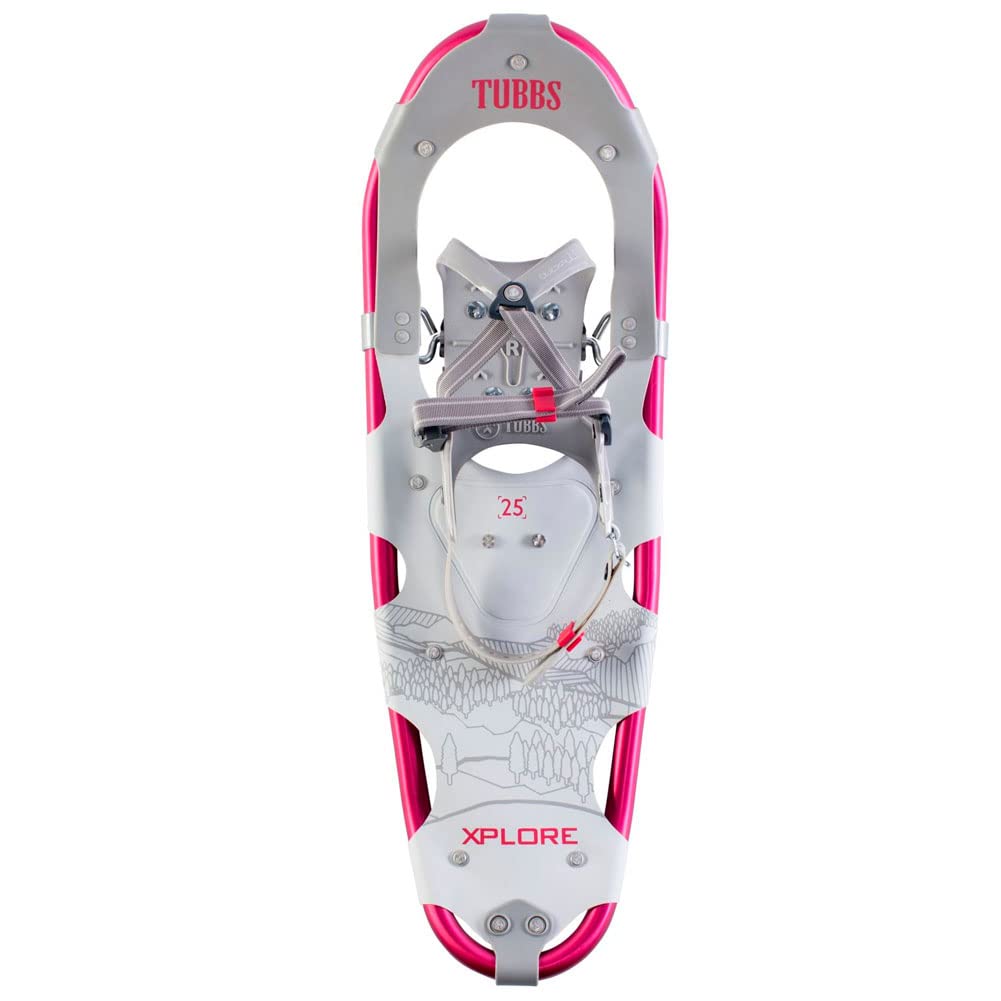
A raspberry-red deck so gentle on joints it feels like walking on clouds — even for a novice.
The Fit-Step frame absorbs shock to protect your hip, knee, and ankle joints. For those with joint pain, this cushioning turns a painful outing into a comfortable one. The rotating toe cord bites deeply into the snow for traction, and the recreational crampon gives secure grip on packed conditions uphill, downhill, and sidehill.
What wins people over is the comfort. As owners describe it, “It was so nice on my joints that I felt almost weightless.” The Quick Pull binding cinches easily and open up with one buckle push — simple enough for a first-timer. The Soft Tec decking provides lightweight flotation with a smooth, soft texture that does not feel harsh underfoot.
The 3.9-pound weight makes this one of the lighter decks in its class, and the 25-inch size suits recreational walking. The honest caveat is the heel strap — one owner reported the strap buckle broke on the first outing, so it is worth checking the binding before a long trip. This is a comfort-first shoe, not a backcountry expedition tool.
Comfort first: the joint-friendly frame and cloud-like feel make this the easy choice for recreational walkers.
Watch the binding: the heel strap has been a rare failure point — inspect it before trusting it on a remote trail.
8. MSR Evo Trail Snowshoes

The 22-inch deck with steel teeth that bites into packed trails and just keeps cutting.
This is the snowshoe for hikers who care about traction above all else. Steel crampons and traction rails provide reliable grip and lasting bite, while the injection-molded UniBody deck delivers just the right amount of flex. The Paraglide binding stretch mesh hugs your feet securely and works with nearly any footwear — from light hikers to snowboard boots.
Owners praise the quality most, with ease of use a close second. The glove-friendly binding straps and buckle tabs make getting in and out quick and simple. Made in the USA, this 22-inch pair is rated for 180 pounds, and buyers report it floats well in fresh snow at 145 pounds plus a 15-pound pack. In 12 inches of new light snow, it cuts through effectively.
The clever extra here is the attachment points for 6-inch modular flotation tails (sold separately). That means you can add flotation for deep powder or heavier loads without buying a whole new shoe. The one honest caveat: the plastic shells can be noisy on hard pack, and a 200-pound owner needed the extra-wide attachment to prevent sinking.
Why it leads on grip
- Serious steel crampon traction on packed snow
- Bindings fit nearly any footwear
- Modular tails add flotation when needed
- Lightweight and easy on/off
Know before you go
- Noisy shells on hard-packed trails
- Heavier users need the wider attachment
- Buckle directions are confusing at first
Grab these if: your trails are packed and icy and you want a shoe that grips hard and lasts.
Think twice if: you plan to break deep powder — the 22-inch deck will need the optional tails.
9. MSR Women’s Lightning Ascent

The 3.88-pound mountain weapon that climbs steeps like a trail shoe and grips like a crampon.
This is the serious climber’s snowshoe. At 3.88 pounds per pair, it is ultralight for its class, with a tapered frame designed for snowshoers with a narrow stride — which makes it a genuinely better fit for many women than unisex decks. The 360-degree traction frames deliver edge-to-edge grip on traverses, while the steel DTX crampons provide serious bite on alpine steeps.
The Paragon bindings are the standout feature. A one-piece contouring strap wraps securely around your boot for a glove-like feel that eliminates rigid pressure points. The Ergo Televator heel lift flips up to ease calf strain on steep climbs. Owners in the Washington cascades call them the standard, with one noting, “There’s a reason that most people out here think they are the best!”
The 22-inch deck carries a 180-pound load, and bindings fit women’s shoe sizes 4.5-14. This is a premium investment, and the honest trade-off is the binding: the wrap-around lock mechanism is difficult to clamp in with some boots. But for solidity on ascents and descents, owners mention the base “doesn’t slide around at all” — exactly what you want on steep terrain.
Alpine confidence: the edge-to-edge grip and heel lift make this the pick for women who take their winter hiking seriously.
The investment caveat: premium price and a finicky binding lock mean this is for dedicated snowshoers, not casual first-timers.
Understanding the Specs
Flotation and deck length
The length of the snowshoe determines how much surface area presses down on the snow. A longer deck spreads your weight further, keeping you on top of deep powder instead of sinking. Shorter decks are nimbler on packed trails but offer less flotation. Match the length to your body weight — the manufacturer’s maximum weight recommendation is the number to trust.
Bindings and closures
The binding is the part that holds your boot to the deck, and it is the difference between a pleasant hike and a frozen struggle. Ratchet systems cinch tight with a pull, hook-and-loop straps are the simplest, and wrap-around designs hug the boot like a glove. Glove-friendly buckles matter more than you think — you will be adjusting them in the cold.
Traction and crampons
Crampons are the metal teeth under the deck that bite into ice and packed snow. Aggressive teeth with multiple points give better grip on steep terrain and traverses. Heel lifts flip up under your heel on climbs to reduce calf strain — a feature that becomes essential on long uphill stretches.
Frame materials
Aluminum frames offer a good balance of strength and weight, and are the most common choice. EVA foam decks are ultralight and flexible, ideal for running and casual walking. HDPE (a stiff, durable plastic) adds rigidity for efficient power transfer. Steel and alloy-steel options add durability at a weight cost. Choose based on whether you prioritize lightness or ruggedness.
FAQ
How do I know what size snowshoes to buy?
Can I use men’s snowshoes as a woman?
What is a heel lift and do I need one?
Do I need trekking poles with my snowshoes?
What is the difference between a crampon and a traction rail?
How much weight can snowshoes hold?
How do I put snowshoes on and take them off easily?
What is the best snowshoe for deep powder?
How should I store snowshoes after a hike?
Final Thoughts: The Verdict
Across the board, the best women’s snow shoes winner is the Retrospec Drifter because it pairs a proven, easy-to-use binding with a 210-pound capacity at a price that respects a first-timer’s budget. If you want the complete kit with poles and gaiters, grab the G2 Snowshoes Set. And for steep alpine ascents where traction is everything, the MSR Lightning Ascent is the one to reach for — the crowd favorite that buyers in the cascades swear by.
How We Picked
We do not accept paid placement. Every pick is matched to a real buyer and a real use-case; we do not hands-on test units.
Sources & Methodology
Specifications: manufacturer listings and product documentation. Review insights: verified customer reviews, as of August 2026. Pricing: not shown on this page (it changes often); check the current price via the retailer link.
As an Amazon Associate, Calories Fit earns from qualifying purchases. This does not affect which products we feature.