
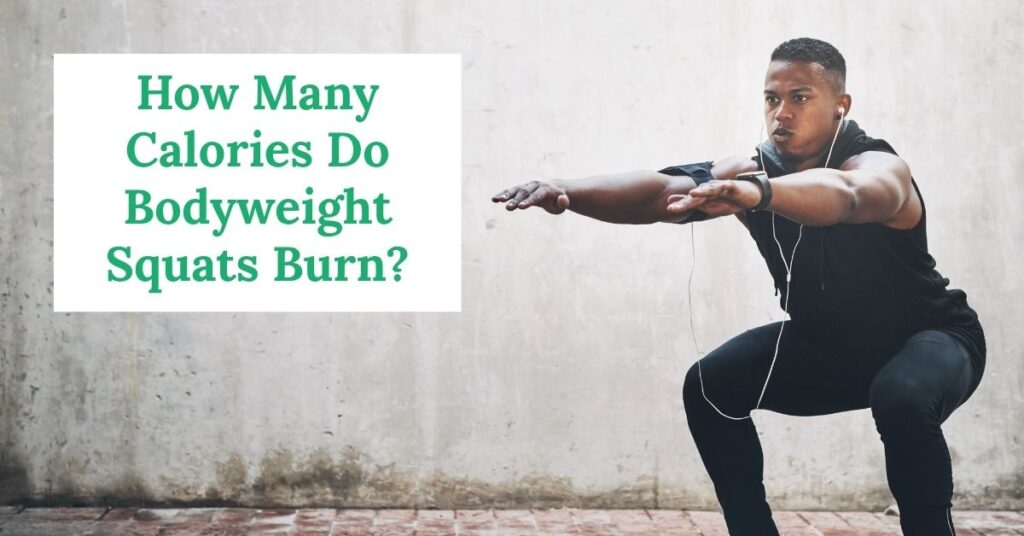
Bodyweight squats burn about 4–10 calories per minute, depending on your weight, pace, and range of motion.
Injury Risk
Breath Rate
Calorie Burn
Basic Air Squats
- Bodyweight only
- Controlled 2–0–2 tempo
- Full hip-knee-ankle alignment
Great Starter
Tempo & Paused
- 3–5 sec down
- 1–2 sec hold at depth
- Sets of 8–15 reps
More Time Under Tension
Jump Squats
- Explosive up
- Soft landings
- Short work:rest intervals
Higher Burn
Calories Burned By Bodyweight Squats: Real-World Ranges
Straight math puts steady air squats at a metabolic equivalent (MET) of about 5. That value comes from the Compendium listing for “resistance training, squats” and reflects a controlled pace with full range. A simple formula converts METs to calories per minute: calories/min = 0.0175 × MET × body weight in kilograms. That conversion is widely taught in university sports medicine programs and clinical rehab courses.
Quick Estimates You Can Trust
If you weigh less, your per-minute burn drops; if you weigh more, it rises. Deeper reps, shorter rests, and jump variations lift the MET. The Centers for Disease Control and Prevention classifies 6.0+ MET activity as vigorous and 3–5.9 MET as moderate, so steady air squats sit near the upper edge of moderate, while jump squats typically land in vigorous territory.
Table 1: Calories From Air Squats (MET 5) By Body Weight
This table applies the standard equation using a MET of 5 for bodyweight squats. Numbers are rounded for easy planning.
| Body Weight (kg) | Calories In 10 Minutes | Calories In 30 Minutes |
|---|---|---|
| 50 | 44 | 131 |
| 60 | 53 | 158 |
| 70 | 61 | 184 |
| 80 | 70 | 210 |
| 90 | 79 | 236 |
| 100 | 88 | 263 |
What Moves The Number Up Or Down
Depth and tempo change the cost. A slow eccentric lowers speed but increases time under tension, which can keep oxygen demand up. Denser sets—like 40–60 seconds of work with brief rest—raise the average minute-by-minute burn. Foot stance, arm position, and whether you “sit back” or stay upright adjust which muscles work hardest, but the math still stems from MET × weight.
Meal planning lands easier once you map your daily calorie needs. Make the squat math serve that bigger picture, not the other way around.
How To Estimate Your Burn With MET Math
You only need two inputs: body weight and a reasonable MET. For standard air squats, use 5. For jump squats or non-stop sets with short rests, use 8. Plug the value into the equation below and multiply by minutes trained. The Compendium sheet lists both the 5-MET line for squats and an 8-MET line for vigorous calisthenics; the CDC page clarifies how those levels map to intensity categories.
The Equation, In Plain Words
Calories per minute = 0.0175 × MET × body weight (kg). That 0.0175 factor comes from 3.5 mL O2 per kg per minute divided by 200, a standard conversion used in exercise testing textbooks and clinic handouts.
Example: 70 kg Person
Air squats at MET 5 → 0.0175 × 5 × 70 = 6.125 kcal/min. Ten minutes ≈ 61 calories; thirty minutes ≈ 184 calories. Jump squats at MET 8 → 0.0175 × 8 × 70 = 9.8 kcal/min. Ten minutes ≈ 98 calories.
Technique Tweaks That Change Energy Cost
Want a bit more burn without adding equipment? Use time cues. Try “3-0-1” (three seconds down, no pause, quick up) for one set, then swap to “2-1-2” on the next. Reach hip crease below the knee if your mobility allows; depth adds work. Keep knees tracking over mid-foot and brace your trunk so each rep stays consistent.
Cadence And Work:Rest
A steady cadence with 45–60 seconds of work and 15–30 seconds of rest per minute drives the average higher than stop-start sets. For jump squats, use short bouts like 20 seconds on and 40 seconds off to protect landing quality and keep power crisp.
Range Of Motion And Stance
Full depth recruits more muscle. A slightly narrower stance shifts effort forward; a wider stance turns up hip work. Both choices are fine if they’re pain-free and stable. The more muscle mass you recruit, the more oxygen you use, which bumps the MET within a realistic band.
Where Squats Fit On The Intensity Scale
On the CDC intensity spectrum, 5 MET sits near the high end of moderate. Add speed, add a jump, or trim rest, and you cross into vigorous work at 6 MET or more. That context helps plan weekly time targets alongside walking, cycling, or running.
External Checkpoints You Can Use
Breathing speaks louder than reps. If you can talk in short phrases, you’re near moderate. If talking feels choppy or you need to pause often, you’ve entered vigorous. The talk-test description on the CDC page pairs well with MET math for day-to-day planning.
Progressions That Influence Calorie Burn
Progress the pattern first, then the density. Here are clean steps that change the cost while keeping form front-and-center.
Air To Tempo
Start with sets of 10–15 at a smooth pace. When quality feels locked in, add 3–5 second descents and short pauses. Your burn rises because the set lasts longer while muscles keep working.
Tempo To Jump
Layer in small jumps with soft landings and quick resets. Keep reps low and sharpen the landing. Short intervals bring the average up through both intensity and density.
Circuits With Squats As The Anchor
Pair air squats with push-ups, reverse lunges, and mountain climbers. Keep stations to 40–50 seconds with a brief transition. The Compendium treats this style like circuit training, which commonly sits near 8 MET in practice.
Table 2: Styles, Assumed METs, And Sample Burn
Below are practical comparisons using a 70 kg person and the same formula. Values help with session planning and logging.
| Style | Assumed MET | Calories In 10 Minutes (70 kg) |
|---|---|---|
| Air Squats (Steady) | 5.0 | 61 |
| Tempo / Paused | 3.8 | 47 |
| Jump Squats / Circuits | 8.0 | 98 |
MET sources: the Compendium lists 5.0 for squats and 8.0 for vigorous calisthenics and circuit sessions. The CDC intensity page explains how those numbers map to effort in plain terms.
Smart Ways To Program For Burn Without Equipment
Stick to simple blocks. Try 3–5 rounds of 45 seconds work and 15 seconds rest. Keep count if you like, but time drives consistency better than chasing a round number of reps. Rotate stances—standard, slightly wider, narrow—to spread load across hips and thighs.
Three Plug-In Blocks
- Steady Sets: 5 × 60 seconds air squats, 30 seconds rest. Target smooth depth and even breathing.
- Tempo Ladder: 30 seconds 3-0-1 squats, 30 seconds 2-1-2 squats, 30 seconds rest; repeat 4–6 times.
- Power Bursts: 20 seconds jump squats, 40 seconds rest × 8–10. Stop a set if landings get loud or knees wobble.
Pair Squats With Light Cardio
Sandwich short squat sets between brisk walks or jump-rope bouts. The blend keeps heart rate up while your legs still get strength work.
Tracking Your Sessions With Honest Numbers
Estimate weight in kilograms by dividing pounds by 2.2. Note the style you used, the time under tension, and rest. Keep the same template across weeks so changes reflect real progress, not random switches.
External Reference Links For Accuracy
The Compendium sheet lists activity codes and METs, including an entry for squats. The CDC pages define moderate and vigorous ranges and show how to gauge effort during movement. Both help anchor your logs to standard references instead of guesswork.
Safety Notes That Keep Reps Clean
Set feet at roughly shoulder width with toes turned out a touch. Keep your chest tall and your ribs stacked over the pelvis. Push knees out to track over the second toe. If depth feels pinchy, raise the heels on a small book or limit range to the pain-free zone. Spread work across days if knees get grumpy.
Breathing That Supports The Lift
Inhale on the way down, brace the midsection, then stand and finish the exhale. That rhythm keeps the trunk stable and reduces wobble through the knees.
Putting Squat Calories Into Your Day
Use the tables to set a small daily target—maybe 60–120 calories from squats tucked into a larger movement plan. If you’re tightening intake, this block makes the energy ledger easier to balance. When you want a wider plan that mixes meals and steps with strength work, a calorie deficit guide ties the pieces together.