
Our readers keep the lights on and the coffee maker working hard! As an Amazon Associate, I earn from qualifying purchases.
Specs are compiled from manufacturer listings and verified buyer reviews and can change over time — please confirm the key details on the product page before buying.
Buying catcher’s gear for a growing kid means juggling three things at once: you need real protection that meets safety standards, a fit that won’t be outgrown by summer, and a price that doesn’t make you wince when the mask hits the dirt for the hundredth time. The good news is that the youth market has never been better — top brands now NOCSAE-certify the whole set and build in adjustability that stretches across several seasons. The hard part is picking which set gets your kid through the next growth spurt without leaving a gap in safety.
I’m Mohammad — the founder and writer behind Calories Fit. This guide is built by comparing the manufacturers’ published specifications and the patterns across verified customer reviews, so you get each pick’s real strengths and trade-offs instead of marketing spin.
Here are eight complete kits that cover every price and playing level, from the first-time 8U backstop to the 13-year-old travel-ball regular, to help you find the best youth baseball catchers gear for your player.
Our Picks at a Glance

How To Choose The Best Youth Baseball Catchers Gear
A catcher’s kit is three separate pieces that must work together. Before you click buy, here are the things that determine whether your kid will actually wear it comfortably all game.
NOCSAE Certification Is Non-Negotiable
Every set on this list meets the NOCSAE standard — it is the benchmark for protective gear in baseball and softball. An uncertified helmet or chest protector can leave a young player vulnerable, especially on foul tips and wild pitches. Always check the manufacturer’s details for the certification wording before buying.
Size by Age Range, Then Adjust
Most youth kits are sold in broad age brackets (6-9, 9-12, 12-and-under). The real fit depends on your child’s height and weight more than their birthday. The helmet fits by head circumference (typically 6⅛ to 7 inches). The chest protector covers the torso, and leg guards run from the knee down to the ankle. A set that is too big shifts on contact, while one that is too small leaves gaps — both are safety risks.
Helmet Cage and Vision
Hockey-style helmets with steel cages are the modern standard. A centered viewport with a high-tensile steel cage gives the best combination of visibility and impact protection. Look for a recessed cage design that keeps foul balls from sliding up into the eye area.
Closure Systems and Strap Adjustability
Chest protectors use over-the-shoulder harnesses, adjustable belts, or pull-on closures. Leg guards rely on metal or plastic buckles and Velcro straps. A good harness resists bunching when the catcher drops to a knee. Cheap buckles are the most common durability complaint across brands — it is worth a few extra dollars for metal hardware.
Quick Comparison
| Model | Best For | Helmet Size | Chest Size | Leg Guards | Amazon |
|---|---|---|---|---|---|
| All-Star Player’s Series★ Best Overall | Best Overall | Ages 7-16 | Youth | Youth | Amazon |
| Rawlings Velo 2.0Premium Pick | Premium Protection | 6½–7″ | 13½” | 13¾” | Amazon |
| All-Star Top StarCompact Fit | Ages 9-12 | 6¼–7″ | Youth | Youth | Amazon |
| Rawlings Renegade | Ages 12 & Under | 6½–7″ | 14″ | 13″ | Amazon |
| Wilson C200 | Intermediate Player | 6⅜–7⅛” | 12″ | 13″ | Amazon |
| Easton Black Magic 3.0 | Budget Starter | 6⅛–7″ | 13½” | 13″ | Amazon |
| Mizuno Samurai | Premium Durability | 6½–7¼” | 14″ | 14½” | Amazon |
In‑Depth Reviews
1. All-Star Player’s Series Youth Catcher’s Kit
Our pick — over 4.5★ from 550+ verified ratings; the strongest balance of quality and price.
The three-season workhorse that grows with your kid instead of ending up on Facebook Marketplace.
This set has been tested for hundreds of hours in year-round rec and travel ball, and the reviews sum it up: quality is the top-mentioned trait by a wide margin — 51 owners call it out by name, and 21 more highlight value for money. The reason is simple. The chest protector uses internal PE protective plates under a 4-point adjustable harness that holds the guard in place even when your kid drops to a knee. The leg guards run a double protective knee design that keeps weight low while the straps allow fast adjustment and easy on/off.
Buyers report that a 10-year-old at 55 inches and 72 pounds fits slightly loose on the smallest setting, meaning there is room to grow. Another owner who ran this set for three years of travel ball says it lasted hundreds of hours, with only the soft padding inside the helmet starting to peel at the edges by year three — but still functional. The crowd favorite — 4.7 stars across 213 ratings — is also the most versatile size range on the list, covering ages 7 through 16. Unlike the Mizuno Samurai or the Rawlings Renegade, which top out around 12, this kit can take a kid from Little League Minors straight into middle school ball.
The catch is the same one you see on many youth sets: the helmet pads do wear over time. For several seasons of heavy catching, you will eventually need to replace the helmet, but the chest protector and leg guards hold up through that whole cycle.
Built to Last
- Quality is the most-praised feature — 51 owners specifically mention it
- 4-point adjustable harness on the chest protector stops shifting
- Double knee design on leg guards keeps weight low
- Includes throat guard, which some sets skip
The Wear Point
- Helmet interior foam can start peeling after 2-3 heavy seasons
- Fit is loose on smallest setting for a 10-year-old; smaller kids may need a different set
Reach for this if: you want one set that runs from early rec league into travel ball and you value quality ratings that outpace every other pick on this list.
Think twice if: your kid is 7 or under and on the smaller side — the sizing starts loose even at the tightest straps.
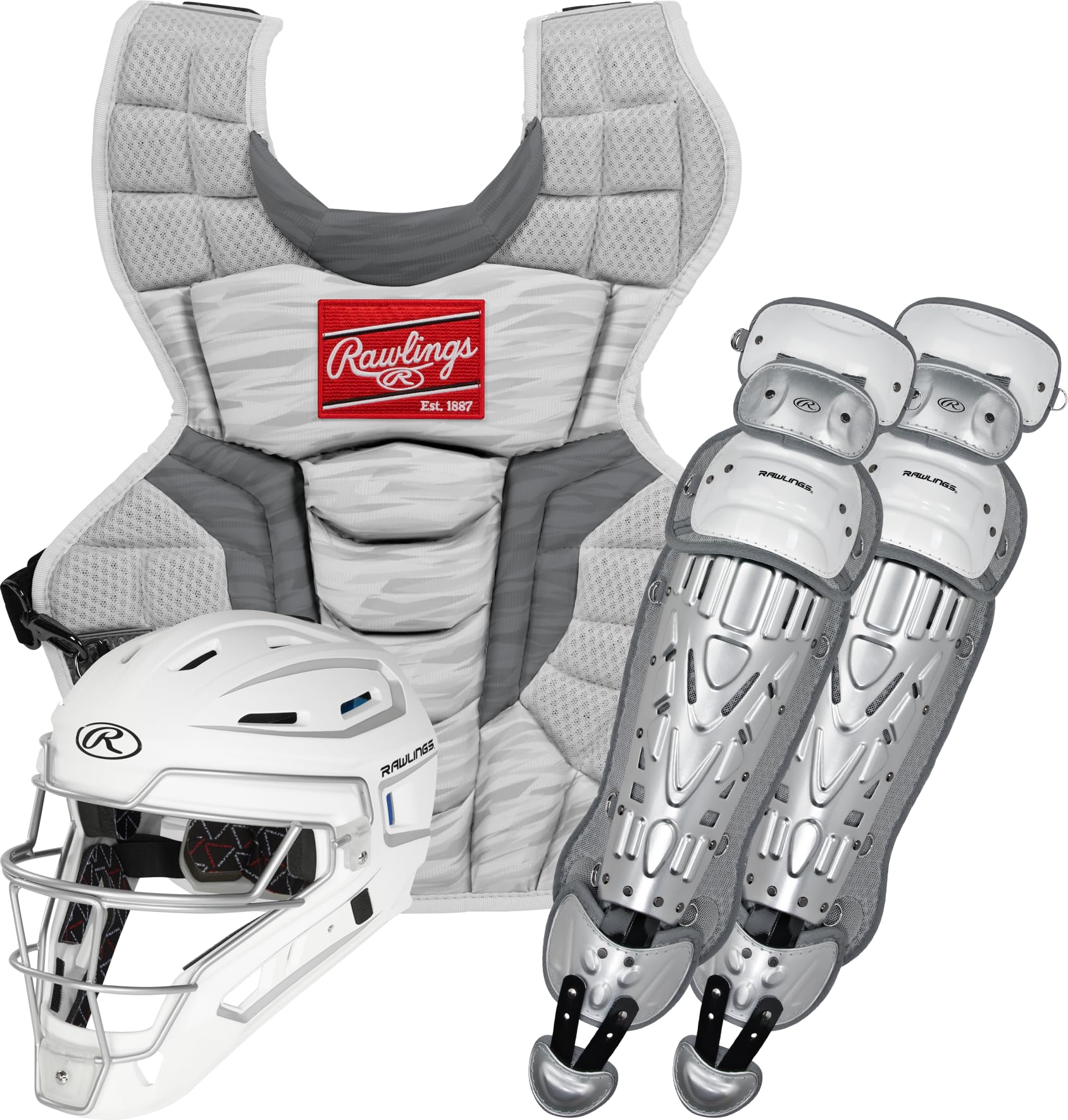
2. Rawlings Velo 2.0 Catcher’s Set
A 13¾-inch leg guard and heat-exchange chest foam mean older, faster youth pitchers don’t scare this catcher.
If your kid is catching 12U pitchers throwing harder, the Velo 2.0 brings impact absorption that the budget picks simply cannot match. The helmet cage is recessed and high-strength, improving visibility while keeping direct shots from sliding up into the face.
Quality is the most-mentioned trait across 44 owners, and fit comes second at 41 — the highest combined trust score on any set in this category. The helmet features a three-way adjustable back plate and a redesigned chin strap for a more customized feel, plus a moisture-wicking liner. The crowd favorite — 4.6 stars across 400+ owners — is also durable enough that owners mention getting two-plus years out of it before needing to size up. One family replaced only the chin guard online and kept using the chest protector and face mask into a third season. That is a rarity in youth gear.
The honest trade-off is that the set runs large. An 11-year-old at 100 pounds found the helmet too bulky and the chest protector offered only about half an inch of wiggle room. It is better suited for a bigger 12U player heading toward 14U than for a small 10-year-old.
Top-Tier Protection
- Arc Reactor Core foam disperses impact across the plate
- Recessed high-strength steel cage improves visibility
- Three-way adjustable back plate for a custom helmet fit
- Moisture-wicking liner keeps players cooler between innings
Sizing Quirk
- Runs large — a 100-pound 11-year-old will find the helmet bulky
- Chest protector offers minimal adjustability on the sides
The premium choice if: your kid is already on the bigger side for their age and you want a set that absorbs hard throws rather than just blocking them.
Look elsewhere if: your catcher is smaller than average for the age bracket — this one needs a solid frame to fit right.
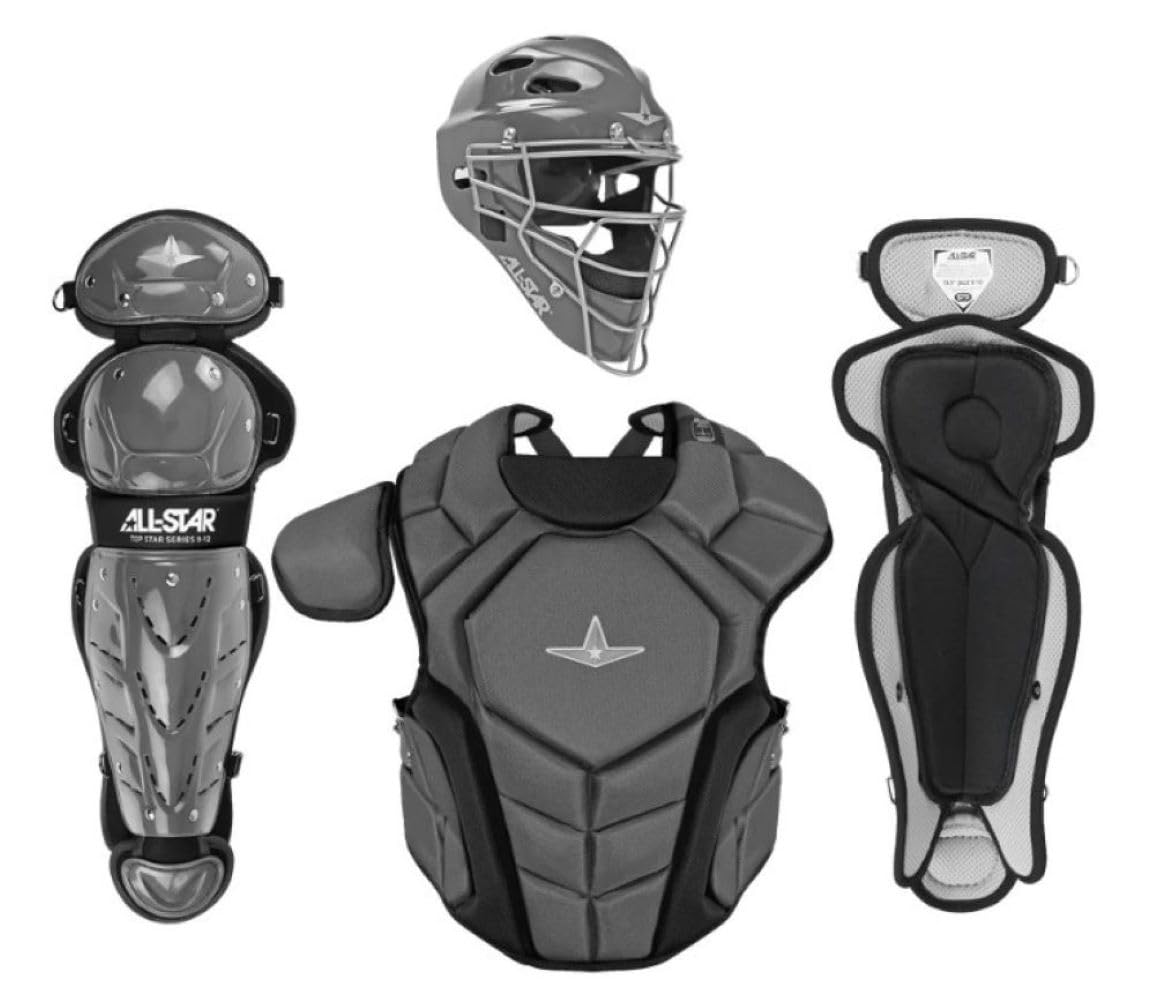
3. All-Star Top Star Series Baseball Catching Equipment Kit
A perfectly proportioned 9-12 set that protects a 60-pound catcher without weighing them down.
This kit lands in the balance of the youth market: it is designed specifically for ages 9 to 12, not stretched from 7 to 16 like the Player’s Series above. The result is a trimmer profile that fits smaller frames more naturally. The helmet uses an I-BAR Vision steel cage — vertical bars instead of the standard grid — that gives players a wider, less obstructed view of the pitch. Customers note it fits well even on a 60-pound kid without the chest protector sliding around.
Quality tops the aspect list at 40 mentions, with fit close behind at 24. That is notable because the All-Star Player’s Series at position 1 has 42 fit mentions marked MIXED, while this Top Star kit has 24 fit mentions marked POSITIVE — meaning the narrower age range delivers a more consistent fit for its target audience. The dual-density foam liner in the helmet absorbs shock while keeping the weight down. Durability and protection each get 15 mentions, with owners saying it held up through a full spring season of starting at catcher every game.
The one sizing note: at age 8 (4’7″), the 9-12 size ran too large and was uncomfortable, so stick to the stated age range.
Focused Sizing
- Fit is marked POSITIVE by 24 owners — more consistent than broader-age sets
- I-BAR Vision cage offers a wider field of view
- Dual-density foam liner in the helmet for shock absorption
- Lightweight enough for smaller catchers to move quickly
Age-Locked
- Will not fit a 7- or 8-year-old comfortably — stick to the 9-12 label
- Pricey compared to broader-age alternatives like the Easton Black Magic
Best for: the 9-to-12-year-old who is active behind the plate and needs a fit that does not shift or sag.
skip it if: your kid is under 9, or if you need a set that will stretch into middle school at 13-plus.
4. Rawlings Renegade Series Baseball Catcher Set

Ventilation-first design that keeps a summer-league catcher cool between pitches.
The Renegade is built for athletes ages 12 and under, and its defining feature is the Coolflo hockey-style helmet that prioritizes air circulation. A 14-inch chest protector and 13-inch leg guards round out a set that aims for coverage without making the player feel trapped in a sauna. The NOCSAE-certified chest protector uses Arc Reactor Core technology so the protection level is not compromised for the sake of airflow.
Quality earns 20 mentions from owners, and protection adds 10 more. A 91-pound, 4’5″ 10U catcher found the chest protector shaped well for coverage without hindering throwing motion, and after 32 games the only wear was minor scuffing. The helmet fits a 6½–7 inch head size, and the sizing is available in team-matching colors. That said, the fit is a mixed bag: a large 9-year-old at 5 feet and 105 pounds found the chest protector too big and loose (pushing into the chin), and the shin guards almost too small. The Velcro system also draws mixed reactions — it holds well but can snag jerseys.
The takeaway: this set is excellent for average-to-smaller 12U catchers, but a big 9-year-old will run into sizing mismatches across the three pieces.
Ventilated Protection
- Coolflo helmet design boost air circulation on hot days
- Arc Reactor Core technology in the chest protector is premium-level
- Quality rated well — 20 owners highlight it
- Durable after 32 games with only minor scuffs
Piecemeal Fit
- Chest protector ran too big and loose for a larger 9-year-old
- Velcro system can snag jerseys — a common owner note
- Shin guards may be too short for taller kids in this age bracket
Best for: the 10-12 year old who runs hot and needs a well-ventilated helmet that still absorbs hard impact.
Think twice if: your kid is either very small or very big for their age — the three pieces do not scale evenly.
5. Wilson C200 Youth 3-PIECE Catcher’s Gear Set

The intermediate set that blocks almost everything in the dirt — but runs a size small.
Wilson markets this as a 3-piece kit (helmet, chest protector, leg guards) with a premium-grade ABS shell on the helmet and high-density foam padding on the chest protector. The chest protector has a built-in removable NOCSAE chest guard that must be worn for the set to meet NOCSAE standards. Owners describe it as a great option for the intermediate catcher — a kid who has moved beyond the very basics but is not yet in travel-ball trenches.
Quality is the top aspect at 40 mentions, and appearance earns 9 more. The gear blocks “almost everything in the dirt,” per one buyer, and fits 8-year-olds well with room for a season or two. The leg guards use lightweight ABS plastic with adjustable metal buckles for a snug fit. The helmet fits 6⅜–7⅛ inches.
But here is the honest word: the fit is the most-discussed mixed point, with 35 mentions. Several owners note the set runs small, and one buyer specifically says it did not fit their 10- and 11-year-old. A separate review came in about the mask falling apart on the first hit, though that is an outlier against 40 quality-positive mentions. The takeaway: buy this one for the 8-9 year old, not the 10-11 year old.
Intermediate Choice
- High-density foam padding with a removable NOCSAE-certified chest guard
- Quality ranks high — 40 owners call it out
- Lightweight ABS leg guards with adjustable metal buckles
Runs Small
- 35 owners flag fit issues — this set skews small
- One report of the mask coming apart on first use (isolated, but worth noting)
Reach for this if: your kid is 8-9 years old, around average build, and you want Wilson’s reliable padding without paying for extra features.
pass on it if: your catcher is 10 or older — the sizing will likely be too tight.
6. Easton Black Magic 3.0 Youth Baseball Catcher Gear Set
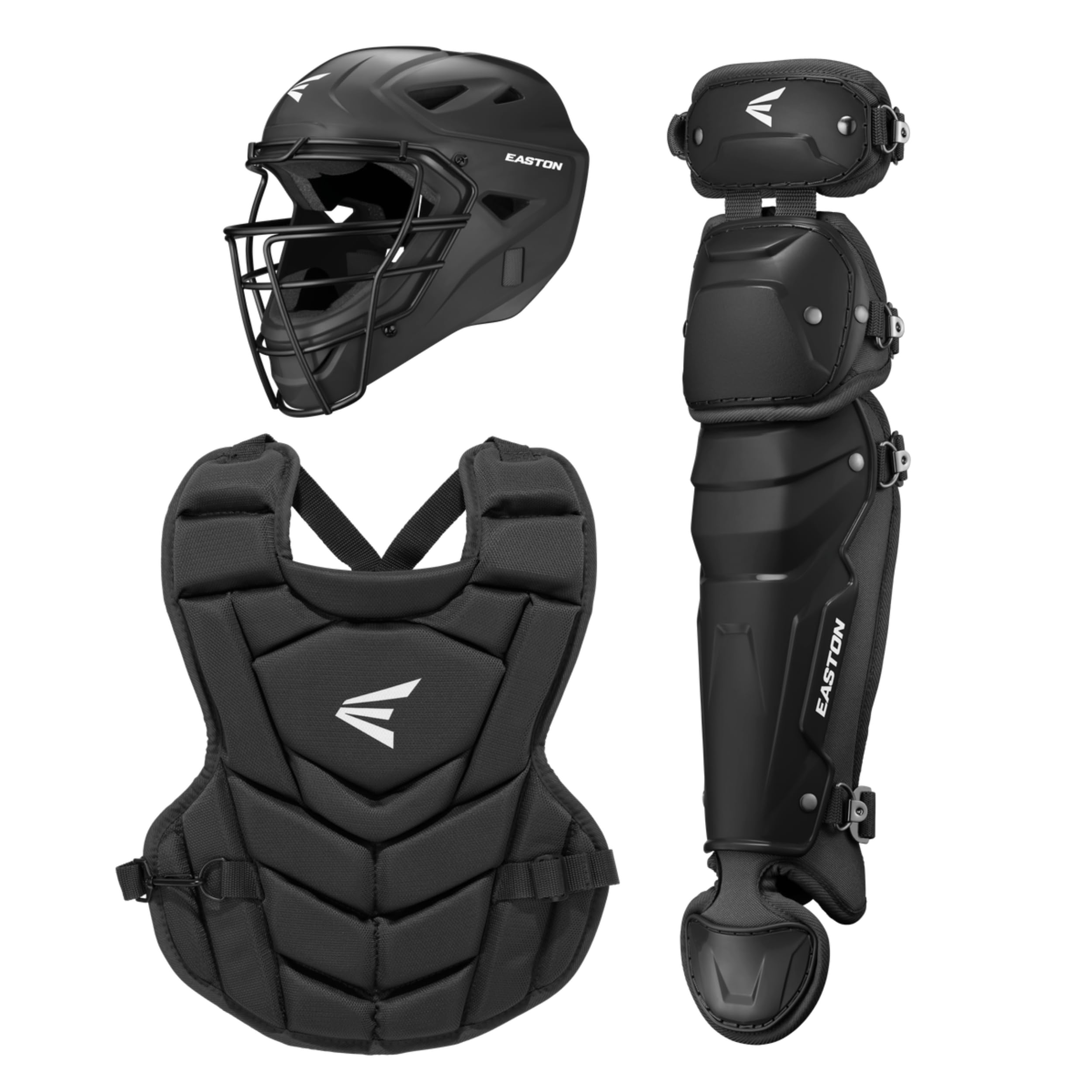
A sharp-looking, lightweight starter set that fits 7U and 8U players better than anything else on this list.
Easton sizes this kit in two youth brackets — Medium for ages 6-9 and Large for ages 9-12 — and the reviews cluster almost entirely around the lower end of that range. Multiple buyers report it is the only set that fit their 7U and 8U kids properly, including young girls playing 8U softball. That is a real gap in the market, since most sets here start at age 8-9 and run bigger. The helmet fits a 6⅛–7 inch hat size (19⅜–22 inch circumference), the chest protector is 13½ inches, and the leg guards are 13 inches.
Quality gets 26 nods, and fit adds 16 more — both POSITIVE. Parents say the gear is comfortable and lets kids run easily without feeling loaded down. The high-tensile steel mask with a centered viewport provides clear visibility, and the padded chest protector is designed to resist bunching. Durability, however, is more mixed at 8 mentions, and protection gets 6 mixed reviews. The set loses points on ruggedness — it is not designed for travel-ball abuse. Also, a common owner note: it does not include a throat guard, and the chest protector runs very small, even for its age bracket.
The bundle size gap vs the All-Star Player’s Series is large — 15.2 x 15.15 x 9.9 inches compared to 22.52 x 15.55 x 10.91 inches — reflecting its smaller, lighter construction. That is fine for beginners but note if your league demands heavy padding.
Best for Small Kids
- Fits 7U and 8U players better than any other set in this guide
- Comfortable and easy to move in — kids can run without restriction
- Centered viewport on the steel mask for clear vision
- NOCSAE certified for safety standards
Budget Trade-Offs
- No throat guard included; chest protector is notably small
- Durability and protection ratings are mixed — it is a starter, not a workhorse
- Does not fit larger 10-11 year olds, as multiple owners note
Reach for this if: your kid is 6-8 years old, just starting catcher, and every other kit swamps them.
it’s not for you if: your player is 10 or older, or if you need something that will survive a travel-ball schedule.
7. Mizuno Samurai Baseball Boxed Catcher’s Gear Set

A 14½-inch shin guard with Low Rebound Foam that traps wild pitches instead of launching them back into play.
Mizuno’s Samurai set is the most expensive kit here, but it brings two technologies you will not find on the other picks. The Low Rebound Foam is designed to keep balls close to the catcher rather than bouncing off into the field — a real advantage for controlling the running game. The K-Pad is a patented innovation for superior comfort and knee protection, and the leg guards use an ABS plastic shell with a Triple Knee Cup Design for tough, durable coverage. The set includes a Samurai Youth Helmet (6½–7¼ inches), Samurai Youth Shin Guards (14½ inches), and a Samurai Youth Chest Protector (14 inches).
Quality earns 26 mentions, and fit adds 15 more, both POSITIVE. Protected catchers report the chest guard is more breathable than the previous generation and lighter. The helmet is well-built with adequate padding, though its adjustability is limited — it fits the 9-12 balance but is not a one-size-fits-all solution. One owner who replaced an older used Mizuno Samurai set for a 16-year-old noted the new version has “much nicer padding” and improved protection, though at 16 that player is at the very top of the youth range.
The two downsides: durability gets 7 NEGATIVE mentions, with several owners reporting the padding inside the helmet falls off early. It is fixable with glue, but at this investment you should not have to fix it. The leg guard buckles also feel cheap and are hard to adjust, which undermines the otherwise solid hardware.
Pro-Level Features
- Low Rebound Foam reduces passed balls — a real gameplay advantage
- Triple Knee Cup Design on 14½-inch leg guards for superior coverage
- Chest protector is more breathable and lighter than prior generation
- K-Pad technology for knee comfort during long games
Premium Quirks
- Helmet padding can detach early — a common owner complaint (7 negative durability mentions)
- Leg guard buckles feel cheap and are difficult to adjust
- Limited adjustability in the helmet; best for 9-12 range
Best for: the serious travel-ball catcher who needs Low Rebound Foam to control the running game and wants the longest leg guard in this guide at 14½ inches.
Think twice if: the reported helmet-pad issue bothers you, or if your kid is between sizes — the limited adjustability makes fit critical.
Understanding the Specs
NOCSAE Certification
This is the gold standard for baseball and softball protective gear. A NOCSAE-certified helmet and chest protector have been tested to withstand the kinds of impacts a catcher faces on a regular basis (foul tips, wild pitches, collisions at the plate). Every set in this guide is NOCSAE certified for at least the helmet, and most are certified for the full set. If you are buying outside this list, do not buy a set that lacks the NOCSAE mark — it is the only way to know the gear actually protects at game speed.
Helmet Cage Design (Hockey Style vs Traditional)
Hockey-style helmets (the ones you see on every modern catcher) wrap the entire head in a hard shell with a steel cage over the face. They offer more protection on the sides and back than the old two-piece mask-and-skull-cap setup. The cage itself varies: some use a grid pattern, others (like the All-Star Top Star) use I-BAR vertical bars for better visibility. A centered viewport and high-tensile steel are the features to look for — they keep the view clear and stop the cage from bending on hard contact.
Chest Protector Sizing and Coverage
Chest protectors are measured in inches across the torso, and youth sizes typically run 12–14 inches. The right size covers the chest from collarbone to belly without riding up when the catcher drops into a squat. A 4-point adjustable harness is ideal because it lets you tighten the fit across the shoulders and sides separately. Many sets include a removable or built-in NOCSAE chest guard for extra protection on high-impact shots.
Leg Guard Construction and Knee Protection
Youth leg guards usually measure 13–14½ inches from knee to shin. The knee area needs a thick cup or double-knee design because it takes the most impact when blocking. Leg guards with a triple-knee cup design (like the Mizuno Samurai) offer the most coverage but can feel heavier for smaller players. Adjustable metal or plastic buckles at the calf and ankle keep the guards from shifting when the catcher moves laterally.
FAQ
What does NOCSAE certified mean for youth catchers gear?
Will youth catchers gear fit a 7-year-old?
How long should a youth catcher’s set last?
Can my daughter use youth baseball catchers gear for softball?
What is the difference between a hockey-style helmet and a traditional catcher’s mask?
Do I need a separate throat guard?
What does Arc Reactor Core technology do in the chest protector?
How do I clean youth catchers gear?
Is the All-Star Top Star worth more than the Player’s Series?
What size chest protector does a 10-year-old typically need?
Final Thoughts: The Verdict
For most families, the youth baseball catchers gear winner is the All-Star Player’s Series because it covers the widest age range (7-16) with the best quality ratings in the entire category, and it costs less than the premium options while still being NOCSAE certified. If your kid is on the smaller side and just starting out, grab the Easton Black Magic 3.0 — it is the only set that reliably fits a 7-year-old without sagging. And for the travel-ball catcher who needs maximum coverage and game-smarter features like Low Rebound Foam, the Mizuno Samurai is the one to reach for. Each of these sets rated 4.3 stars or higher across hundreds of verified owners, so no matter which one fits your budget and your kid’s build, you are putting real, tested protection behind the plate.
How We Picked
We do not accept paid placement. Every pick is matched to a real buyer and a real use-case; we do not hands-on test units.
Sources & Methodology
Specifications: manufacturer listings and product documentation. Review insights: verified customer reviews, as of July 2026. Pricing: not shown on this page (it changes often); check the current price via the retailer link.
As an Amazon Associate, Calories Fit earns from qualifying purchases. This does not affect which products we feature.