
Our readers keep the lights on and the coffee maker working hard! As an Amazon Associate, I earn from qualifying purchases.
Specs are compiled from manufacturer listings and verified buyer reviews and can change over time — please confirm the key details on the product page before buying.
The right deck turns yoga into a game kids actually want to play. A great deck replaces power struggles with a playful pick-a-card moment that moves bodies, settles emotions, and brings the family together. The right set makes the difference between poses that stick and cards that get ignored.
I’m Mohammad — the founder and writer behind Calories Fit. This guide is built by comparing the manufacturers’ published specifications and the patterns across verified customer reviews, so you get each pick’s real strengths and trade-offs instead of marketing spin.
The best thing about a well-designed set of yoga cards for kids is that it turns mindfulness into something children actually want to do, not something they are told to do — and the right deck for your home or school depends on the age of your child, the setting, and how much structure you need.
Our Picks at a Glance


How To Choose The Best Yoga Cards for Kids
Some are designed for solo play in a calm-down corner, while others are meant for a rowdy classroom of twenty. Match the deck to your child’s age, setting, and if you want structured learning or pure fun.
Age Range and Number of Poses
For toddlers and preschoolers, 18 to 20 simple poses offer enough variety without overwhelming. Older kids (ages 6+) handle 40 to 60 poses, especially with game mechanics like memory matching or Go Fish.
Format: Cards vs. Dice vs. Game Decks
Classic flashcards let you pick a pose by flipping through the deck. Dice sets add randomness and surprise — roll the dice and hold whatever pose comes up. Game decks, like those based on Uno-style rules, introduce turn-taking and competition that keep kids engaged for longer sessions. Think about your child’s attention span and if you need the deck to serve solo practice or group play.
Durability and Portability
Cards made from thick cardstock or laminated plastic survive spills, sticky hands, and being stuffed into a backpack. Wooden dice hold up even longer but are bulkier to carry. If the deck is destined for a classroom or a family that travels, look for a sturdy storage box and materials that will not bend after the first week.
Quick Comparison
| Model | Best For | Poses / Pieces | Format | Age Range | Amazon |
|---|---|---|---|---|---|
| Yoga for Children★ Best Overall | Best Overall | 50+ poses | Sturdy cards | 3–8 years | Amazon |
| Covelico 52-Card DeckBest Value | Card game fun | 20 poses | Playing cards | 3–8 years | Amazon |
| Homotte Wooden Dice SetMost Interactive | Interactive play | 12 cards + 6 dice | Wooden dice | 3+ years | Amazon |
| ABCs of Yoga for Kids | Literacy + yoga | 56 poses | Sturdy cards | 2–8 years | Amazon |
| Partner Yoga Poses | Group bonding | 40 partner poses | Cards | 3–8 years | Amazon |
| Yugo Yoga Cards | Award‑winning game | 96 cards | Game deck | 6+ years | Amazon |
| Little Yogi Deck | Emotional regulation | — | Cards | 4–8 years | Amazon |
| Bonbaloo Kids Yoga Cards | Preschool spinner game | 18 poses | Cards + spinner | 3+ years | Amazon |
| Yoga 4 Classrooms | Classroom use | 67 cards | Large cards | Elementary | Amazon |
In‑Depth Reviews
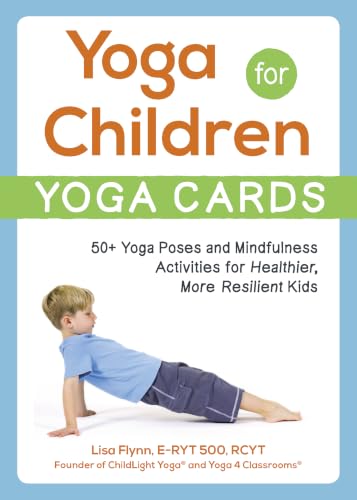
1. Yoga for Children—Yoga Cards: 50+ Yoga Poses and Mindfulness Activities
Our pick — over 4.5★ from 600+ verified ratings; the strongest balance of quality and price.
The crowd favorite that packs over 50 poses into one beautifully sturdy box.
Parents and yoga teachers alike keep coming back to this deck because the cards are genuinely built to last — the sturdy cardstock holds up to daily flipping by little hands, and the boxed set format keeps everything organized. Each card shows a real child modeling the pose, which makes it far easier for a young yogi to copy the shape than an abstract drawing would. The instructions on the back are written in plain steps that a parent can read aloud without needing any yoga background themselves.
What really sets this deck apart from the others is the color-coded system — Mindful Me, Time to Breathe, Strike a Pose, and Rest & Relax. That means you can pull just two or three calming cards before bedtime without the whole deck spilling out, or grab the active poses for an afternoon energy burn. The 1.52-pound weight and 5 x 1.4 x 7-inch dimensions make it a solid presence on a shelf, not something that slides under the couch. It is noticeably thicker than the 52-card Covelico deck so it feels like a real resource, not a flimsy game.
The only real word of caution is that the loose cards can scatter if a preschooler grabs the whole stack. A few owners mention wishing for a ring or a closure to keep them contained during play. But for the sheer depth of content, the clear photography, and the high rating from hundreds of families, this is the deck to start with.
What Wins People Over
- Over 50 poses with real-kid photography for accurate demonstration
- Color-coded categories (mindful, breathing, poses, rest) make it easy to pick the right cards
- Sturdy construction that survives regular use in classrooms and homes
The Honest Trade-Off
- Loose cards can scatter easily with very young children; no ring or closure included
Reach for this if: you want the most complete, highest-rated deck with real photos and clear categories that works for both home and classroom settings.
Consider another if: you need a portable, contained set for car rides or restaurant waits — the box is sturdy but the cards come out individually.
2. Yoga Cards for Kids, 52 Card Game with 20 Poses, Ages 3+ | By Covelico
The deck that turns yoga into an actual game of memory and Go Fish.
This 52-card deck from Covelico takes a completely different approach than the rest. Instead of a stack of pose flashcards, it is a real card game — you play Memory, Go Fish, or Snap with the cards, and each card features a different yoga pose. That means the child is focused on finding a match or collecting pairs, and the movement happens naturally as a side effect of play. A future Physical Educator reviewed them and reported that kids had fun picking their choice of physical activity; homeschool PE groups find them especially useful for adding variety to their routines.
The cards measure 4.5 x 3 x 0.1 inches — a standard playing-card size that fits neatly in small hands. What you sacrifice in variety you gain in replayability: because the game is different every time, kids ask for it rather than needing to be prompted. A 4-year-old nephew used these independently, which is the real test of a kid-friendly design.
The downside is that the game mechanics mean you are not doing a flowing sequence of poses; it is more of a stop-and-start experience. But if your goal is simply to get a child off a screen and onto a mat, this deck accomplishes that with no resistance at all.
Why it stands out: The card-game format (Memory, Go Fish, Snap) keeps kids engaged long after a flashcard deck would be abandoned. It is also the most portable option at just 0.1 inches thick — slips into a diaper bag or purse easily.
Perfect for: families who want a screen-free game night option that sneaks movement in through play. Teachers running homeschool PE groups also praise its versatility.
Not ideal if: you want a structured yoga sequence or a deeper library of poses — this is a game first, a yoga deck second.
3. Homotte Wooden Yoga Dice Set for Kids Fun Workout Game
The dice-rolling surprise that creates a new yoga routine in seconds.
If your child loses interest in a static deck of cards, the Homotte dice set changes the entire equation. You get 4 posture dice, 1 instruction die, 1 time die, and 12 yoga cards — all packed into a sturdy wooden box that measures 5.5 x 3.94 x 2.36 inches. Roll the dice, and a unique combination of pose, direction, and duration appears instantly. A 5-year-old can use these with little parental guidance because the pictures on the dice are clear and the routine is random, which feels like a game rather than a lesson.
The solid wood construction is a clear upgrade from paper or foam alternatives. Owners consistently praise how well-made the dice feel and note there is no unpleasant odor. The set is also easy to take outside or on a trip since everything fits in the box. A preschool class used the dice for movement breaks and counting repetitions, and the kids responded well to the element of chance — it keeps the practice fresh even when you use it daily. The 12 included cards add extra pose variety beyond what the dice offer on their own.
The trade-off is that rolling dice produces short, random bursts of activity rather than a flowing sequence. If you are looking for a calm, meditative practice, the dice format is less suited to that — it naturally leans toward high-energy, giggly play. But for a kid who thinks yoga is boring, this set rewrites the story entirely.
What Makes It Fun
- Solid wood dice are more durable than paper or foam and have no smell
- Random rolling creates endless unique routines — no two sessions are the same
- Includes a wooden storage box so everything stays together
One Thing to Know
- The dice format favors short, playful bursts rather than a calm, flowing sequence
Best for: kids who resist structured yoga and need an element of surprise to stay engaged. Also a great pick for an active family game.
skip it if: you are looking for a quiet mindfulness tool for winding down — the dice setup is inherently stimulating and playful.
4. The ABCs of Yoga for Kids Learning Cards

The deck that teaches the alphabet and yoga poses at the same time.
This set from Stafford House Books uses a clever hook: each card features a letter of the alphabet, a corresponding yoga pose, and a short rhyming poem on the back that explains how to do the movement. So “A” might be Airplane pose and “B” might be Boat pose — the child learns the letter and the motion together. The cards measure roughly 4.5 x 5.5 inches, which is larger than a standard playing card, making them easy for small hands to grip and for a group to see. At 57 pages in print length and 14.4 ounces, this is a substantial deck that feels like a real learning tool.
What owners praise most is the educational content — 28 mentions of content quality make it the most-praised aspect by a wide margin. A parent of a child with Tourette’s, OCD, and ADHD reported that the cards were calming and improved focus and sleep, which speaks to the thoughtful design. The cards are sturdy enough to withstand a 3-year-old’s enthusiastic handling, though getting them back into the box can be a bit fiddly because the top-opening box is snug. The poems on the back are a nice touch for a parent who is not sure how to verbally guide a pose — just read the rhyme aloud and follow along.
Compared to the Yoga for Children deck, the ABCs set has a slightly lower pose count (56 vs 50+) but adds the literacy element. If your child is in the 2-to-8 age range and you are already working on letter recognition, this deck pulls double duty without feeling like homework.
The standout feature: Each card pairs a letter with a pose and a rhyming poem, so literacy and movement happen together naturally. The educational value is the single most-discussed reason owners buy this set.
Ideal for: preschool and early elementary kids who are learning their letters and benefit from kinesthetic learning. Also a thoughtful pick for a classroom or homeschool environment.
Consider another if: you need a deck that is purely about yoga without the academic layer — the alphabet theme is central to the design.
5. Partner Yoga Poses Cards for Kids & Toddlers

The only deck built specifically for two — parent and child, or two friends.
Every other deck in this guide is designed for solo or group practice where each child does their own pose. This one flips the entire concept: every single card features a partner pose that requires two people working together. You get 40 partner poses, a handy pose index, and detailed instructions that make it easy even for a yoga beginner to guide the session. The cards are 5 x 3 x 1 inches and printed on 16pt card stock, which buyers report holds up well to little hands in a preschool setting.
The real magic here is the social and emotional layer. Kids ages 6 to 12 in yoga classes not only enjoyed the partner poses but were inspired to invent their own variations — that is the kind of engagement you cannot get from a solo flashcard. A preschool teacher uses these with her class and reports that the children love them, noting that some poses are easy while others present a real challenge that they can build up to over the school year. The educational value earns the most praise from owners, alongside the card quality itself. The deck is also light enough at 0.29 pounds to keep in a teacher’s bag for impromptu brain breaks.
The one thing to note is that you absolutely need a partner for every pose. If your child is an only child and you are not always available to participate, some poses will go unused. But for play dates, sibling pairs, or a parent looking for a structured bonding activity, this deck is unique in the category.
Why It Works
- All 40 poses require two people, building teamwork and empathy naturally
- Clear illustrations and written descriptions make it easy for both kids and adults
- Portable design (0.29 lbs) fits in a teacher’s or parent’s bag for on-the-go use
The Practical Limit
- Every pose needs a partner — solo play is not an option with this deck
Perfect for: play dates, sibling bonding, parent-child morning routines, or a classroom icebreaker. Yoga teachers with classes ages 6-12 find it especially valuable.
Look elsewhere if: your child usually practices alone or you need a deck that works for independent play and group play both.
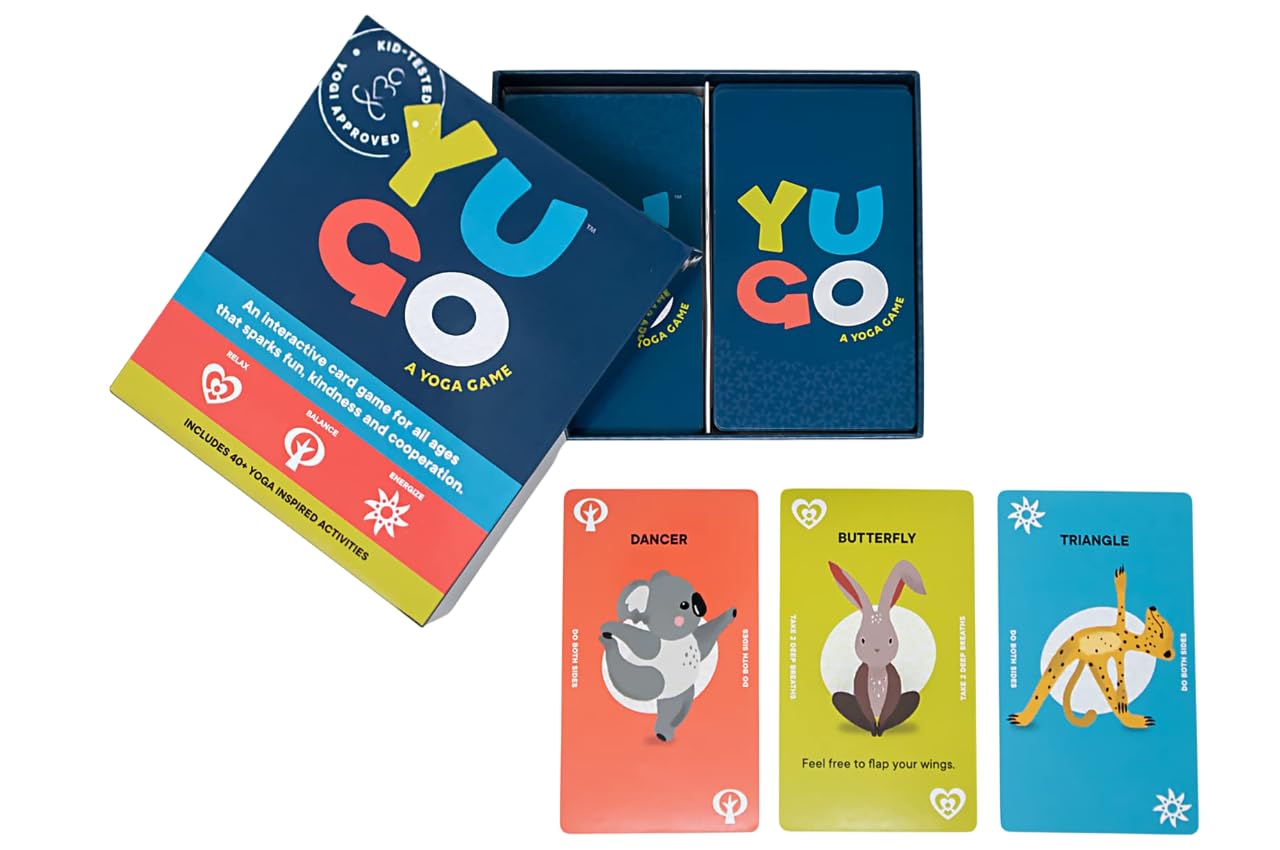
6. Yugo Yoga Cards for Kids & Families
The award-winning card game that makes yoga feel exactly like playing Uno.
Yugo takes the familiar mechanics of a classic card game — draw, skip, reverse, wild cards — and replaces the numbers with yoga poses and animal characters. The result is that the whole family ends up doing downward dogs and tree poses without anyone feeling like they are “doing yoga.” The deck includes 96 thick, laminated playing cards, which is far more than any other set here, and the instructions are short enough that a 6-year-old can explain the rules in under a minute.
The awards speak for themselves: Parents’ Pick Award, National Parenting Product Award, and Mom’s Choice Awards Gold Winner. The founder is a certified yoga therapist and mom who designed the game to support kids dealing with trauma, mental health challenges, and everyday stress. The animal characters (fox, cat, bear) guide the poses with personality, and the action cards — fire (draw), air (skip), water (reverse), and earth (you pick) — keep the game moving fast. One family enjoyed it so much that every member wanted their own set, which is about as strong an endorsement as you can get.
The only small catch is that the paw direction in some pose illustrations can be slightly unclear for absolute beginners. But because the game is designed for ages 6 and up, most children can figure it out by watching an adult or sibling. If you want a deck that works equally well for family game night, a classroom brain break, or a travel activity, Yugo is the most versatile premium option here.
Why it earns the premium spot: 96 laminated cards with multiple play styles (solo flow or group game) make this the deepest, most replayable deck in the category. The awards from parenting organizations add independent credibility.
Best suited for: families with kids ages 6 and up who love card games. Also excellent for teachers looking for a structured group activity that doubles as PE.
Not the right pick if: your child is younger than 6 — the game mechanics require basic reading and turn-taking skills.
7. Little Yogi Deck: Simple Yoga Practices to Help Kids Move Through Big Emotions
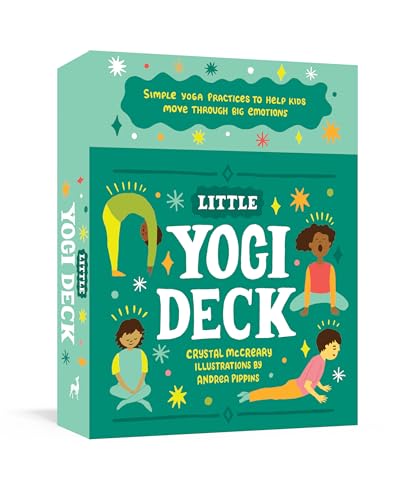
The deck organized by feeling, not by pose — helping kids name and move through emotions.
This deck from Bala Kids takes a fundamentally different approach. Instead of categorizing cards by difficulty or body part, the Little Yogi Deck is sorted by emotion. A child who feels angry can pull from the red cards; a child who feels sad or anxious can reach for the blue and green cards. Each card then guides them through poses and breathwork specifically chosen to address that emotional state. The cards are large — 5.75 x 7.4 inches — with beautiful, inclusive illustrations that feature Black and Brown children, which owners consistently praise for its representation.
A Pediatric Occupational Therapist uses these cards to work on core strength, fine motor skills, and self-regulation, reporting that they teach kids to reset and calm their bodies. Parents found that the guided steps are clear enough for a young child and a yoga novice to follow together. The emotional-content aspect earns the second-highest praise from owners after the general content quality, which confirms that this deck fills a very specific niche: it is a tool for emotional literacy, not just physical exercise. The cards require adult participation, which some see as a positive — it turns yoga into a shared, co-regulating experience.
The trade-off is that you are getting fewer poses than a traditional deck because each card carries emotional context and breathing instructions rather than just a pose. And the 1.42-pound weight means it is better suited for home or classroom shelf than for packing in a carry-on. But for a child who struggles with big feelings and needs a concrete, physical way to process them, this deck is the most thoughtfully designed option available.
What Stands Out
- Cards are organized by emotion (anger, sadness, anxiety) so kids can self-select their practice
- Large, beautiful illustrations with diverse representation earn widespread praise
- Guided steps are clear enough for young children and adults with no yoga experience
The Consideration
- Fewer physical poses than a traditional deck because each card integrates emotional context and breathing
Ideal for: parents and therapists working on emotional regulation with children ages 4-8. Also a beautiful gift for a family navigating big life changes or anxiety.
Choose a different deck if: you want pure physical exercise or a large variety of poses without the emotional framing.
8. Bonbaloo Kids Yoga Cards – 18 Durable Pose Cards for Focus, Balance & Calm
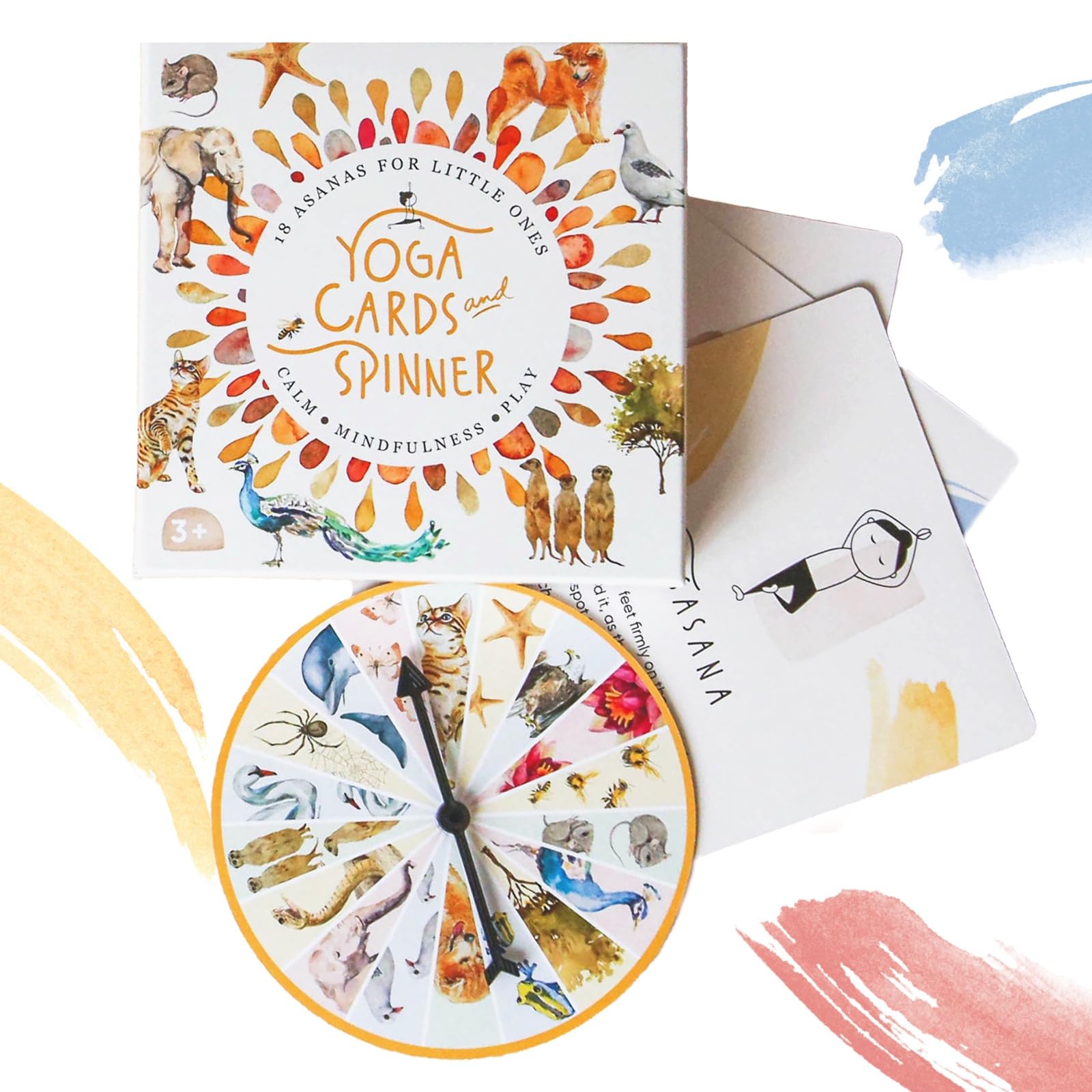
The spinner-and-card combo that turns yoga into a game for the youngest players.
This set from Bonbaloo is designed specifically for the preschool crowd — ages 3 and up — with exactly 18 extra-durable cards that can handle the enthusiastic handling of a toddler. The clever twist is the included spinner: you spin to land on an animal, then find the matching card and do the yoga pose associated with that animal. It turns the activity into a simple cause-and-effect game that a 3-year-old can grasp immediately. A 6-year-old who is interested in yoga found the spinner fun and the visuals beautiful enough to practice on her own without adult guidance.
The cards measure 5.9 x 5.9 x 1.55 inches, which is a large, toddler-friendly square that is easy for small hands to flip and spread across the floor. Owners love the illustrations — they are the second most-praised aspect after the gameplay itself. The Montessori-inspired approach means the focus is on concentration, self-regulation, and fine motor skills in addition to the physical pose. One owner mentioned that the cards seem built to withstand years of use, which is exactly what you want from a preschool toy.
The honest limitation is that a few owners noted some text translation issues — the English on a couple of cards has awkward phrasing that slightly undermines the mindfulness message. It is not a dealbreaker for most families, but if precise language matters to you in a mindfulness tool, you might prefer the Little Yogi Deck which has cleaner copy. For pure toddler engagement, however, the spinner mechanic is tough to top.
The key feature: The spinner element adds a physical-game layer that standard flashcard decks lack, making this ideal for very young children who need a concrete, visual prompt to stay engaged.
Excellent for: toddlers and preschoolers ages 3-6 who need a simple, visual, and interactive introduction to yoga. Great for calm-down corners and small groups.
Consider a different deck if: you need a deep library of poses or if precise English-language mindfulness phrasing is a priority for you.
9. Yoga 4 Classrooms Activity Card Deck – 67 Cards for Mindfulness in Schools
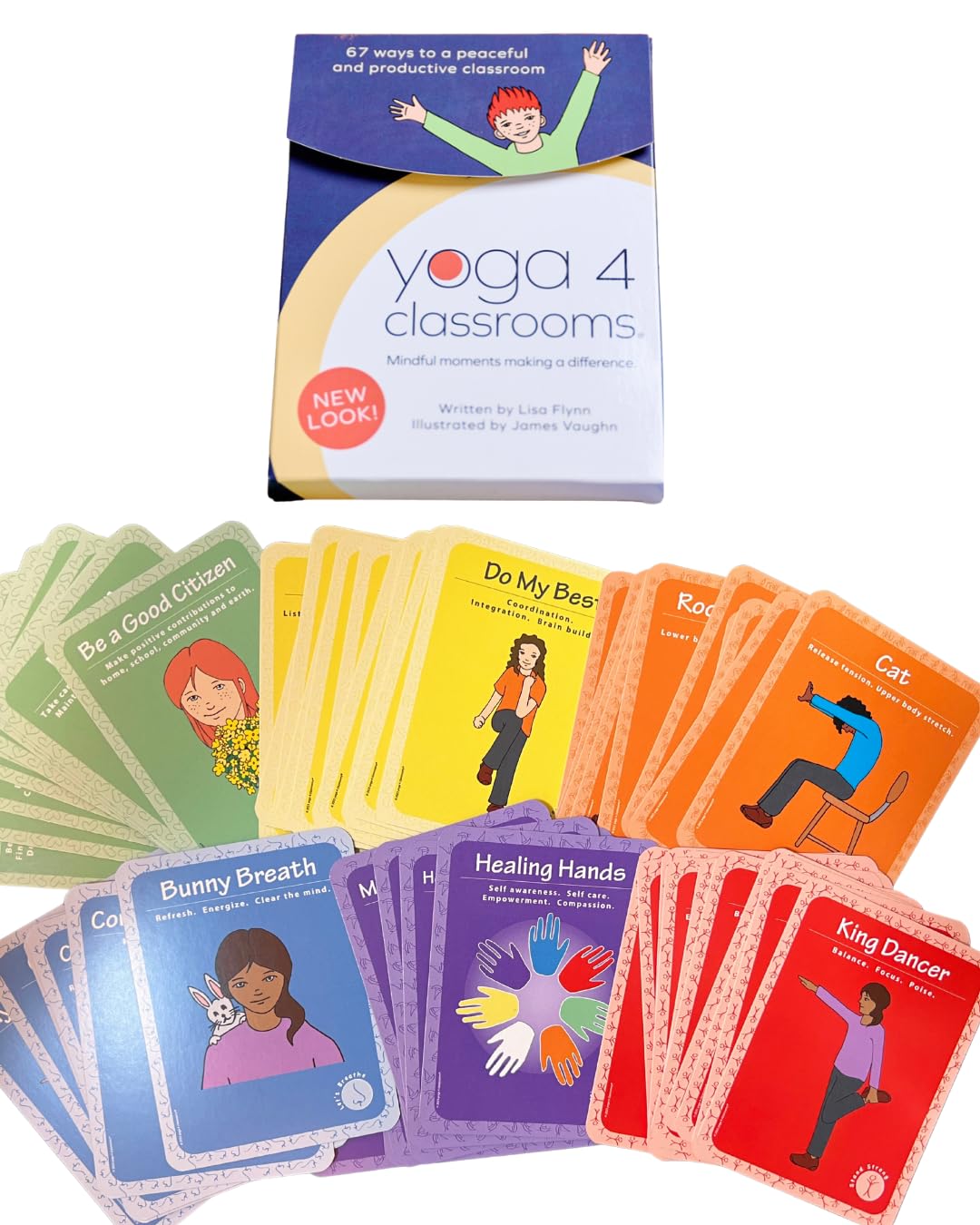
The professional-grade deck already used by over 50,000 educators worldwide.
If you are a teacher, a school counselor, an occupational therapist, or a physical therapist, this is the deck designed specifically for your setting. Yoga 4 Classrooms comes from ChildLight Yoga and includes 67 cards, each measuring 6 x 8 inches — large enough that a small group of students can see the pose from across the circle. The cards cover basic movements, breathing exercises, meditations, and mindful activities, all planned and explained clearly for a busy educator who does not have time to plan a yoga session from scratch.
Classroom use is the single most-praised aspect by a huge margin — 24 mentions from owners confirm that this deck was built for this environment. One teacher in an autistic support classroom used the cards for an action research project intended to last six weeks; students enjoyed them so much that the class used them daily through the rest of the school year and planned to continue the next year. Another teacher reported that her students are learning to self-regulate stress with the exercises, and the staff even uses a couple of cards to start their own meetings. The large card size (13 mentions) is the second most-praised aspect, which makes sense — you can hold one up and the whole class sees it immediately.
The only trade-off is that this deck is not portable in the way a standard playing-card deck is. At 6 x 8 inches and made of thick cardboard, it is meant to live on a classroom shelf or in a therapy bag, not in a pocket. But if you are an educator who wants a ready-to-use, evidence-informed resource that integrates movement and mindfulness into the school day without extra prep time, this is the undisputed champion in the category.
Why Educators Love It
- 67 large-format cards (6×8 inches) are visible to an entire classroom at once
- Already adopted by over 50,000 educators worldwide — a proven classroom resource
- Covers basic movements, breathing, meditation, and mindful activities in one deck
The Practical Caveat
- Large size makes it less portable than standard card decks — best kept in a classroom or clinic setting
Made for: teachers, counselors, OTs, PTs, and school psychologists who need a ready-to-use, large-format deck for group mindfulness and movement breaks.
Not the best fit for: home use with a single child or for travel — the large cards are tune for classroom visibility, not backpack portability.
Understanding the Specs
Number of Poses and Cards
The total number of poses or cards in a deck determines how long the activity stays fresh for a child. A deck with 18 to 20 poses is great for toddlers and preschoolers who benefit from repetition and simplicity. A deck with 40 to 60 poses works better for older kids who need variety to stay engaged. Game decks with 50 to 100 cards add replayability through different rule sets, not just pose variety.
Card Size and Material
Standard playing-card size (roughly 4.5 x 3 inches) is easy for small hands to hold and shuffle, but harder to see from across a room. Large-format cards (6 x 8 inches) are designed for classroom or group use where visibility matters. The material — cardstock, laminated cardstock, or solid wood for dice — directly affects how long the deck survives daily use by enthusiastic little hands. Laminated cards resist spills and bending; wooden dice are nearly indestructible but heavier to carry.
Age Range and Reading Level
Most decks recommend an age of 3 years and up for simple picture-based poses. Once a child reaches age 6, they can handle game mechanics like Memory, Go Fish, or Uno-style rules that require basic turn-taking and reading. Emotional-regulation decks are often aimed at ages 4 to 8 because the child needs enough self-awareness to connect a feeling with a physical practice. Always check the recommended age range — a deck meant for 6-year-olds will frustrate a 3-year-old, and vice versa.
Format: Flashcards vs. Game vs. Dice
Flashcard decks give you control — you pick the cards and sequence the practice. Game decks (Memory, Snap, Go Fish, Uno-style) make yoga a byproduct of play; the child focuses on the game and the movement happens naturally. Dice sets introduce randomness and surprise, which works well for high-energy kids who resist structure but can backfire if you need a calming, predictable routine. Choose the format that matches your child’s personality and your daily setting.
FAQ
What age are yoga cards for kids designed for?
How many poses do I need in a deck?
Can I use these cards in a classroom setting?
Are yoga cards for kids durable enough for rough play?
What is the difference between a yoga card deck and a yoga card game?
Can these cards help with emotional regulation?
Are there yoga cards that teach the alphabet or other skills?
How do I choose between cards and dice?
Can my child use these cards independently?
How do partner yoga cards work?
Final Thoughts: The Verdict
For most families, the yoga cards for kids winner is the Yoga for Children deck because it combines over 50 poses with real-child photography, color-coded categories, and the sturdiest build in the category — a combination that has earned it the highest rating and the most loyal following among parents and teachers alike. If you want the interactive fun of a card game that sneaks movement into family game night, grab the Yugo game deck, which is award-winning and loaded with 96 laminated cards. And for a classroom or therapy setting where visibility and structure matter most, the Yoga 4 Classrooms deck with its 67 large-format cards is the professional-grade tool already trusted by tens of thousands of educators.
How We Picked
We do not accept paid placement. Every pick is matched to a real buyer and a real use-case; we do not hands-on test units.
Sources & Methodology
Specifications: manufacturer listings and product documentation. Review insights: verified customer reviews, as of July 2026. Pricing: not shown on this page (it changes often); check the current price via the retailer link.
As an Amazon Associate, Calories Fit earns from qualifying purchases. This does not affect which products we feature.