
Our readers keep the lights on and the coffee maker working hard! As an Amazon Associate, I earn from qualifying purchases.
Specs are compiled from manufacturer listings and verified buyer reviews and can change over time — please confirm the key details on the product page before buying.
A real yanagiba should pull through a slice of raw fish in one clean motion, not saw or tear. The challenge is that most knives sold as “sashimi knives” are actually double-bevel chef’s knives in disguise, or they arrive dull right from the start. This guide cuts through the noise to find the single-bevel slicers that genuinely preserve the texture and taste of your fish.
I’m Mohammad — the founder and writer behind Calories Fit. This guide is built by comparing the manufacturers’ published specifications and the patterns across verified customer reviews, so you get each pick’s real strengths and trade-offs instead of marketing spin.
Whether you are setting up a home sushi bar or adding a dedicated slicer to a pro kit, these eight knives represent the real spectrum of quality for anyone searching for the best yanagiba sushi knife on the market today.
Our Picks at a Glance

How To Choose The Best Yanagiba Sushi Knife
A yanagiba is not a general-purpose chef knife. It is a long, narrow slicer built for one job: pulling through raw fish in a single stroke without crushing the cells. The wrong blade geometry — or the wrong steel — will tear the fish instead of slicing it, ruining both texture and presentation. Here are the three non-negotiable specs to check before you buy.
The Single-Bevel Edge Is the Whole Point
A true yanagiba has a flat grind on one side (called the Shinogi) and a slight concave hollow on the back (the Urasuki). This asymmetry is what allows the blade to glide through protein with almost no resistance, keeping the cut surface smooth and the fish intact. A double-bevel knife, no matter how sharp, will push and tear by comparison. If the listing does not explicitly state “single-bevel,” it is not a yanagiba.
Steel Hardness and the Sharpening Trade-Off
Yanagiba blades are measured on the Rockwell scale (HRC). A harder steel — 60 HRC or higher — holds a razor edge longer but takes more patience to sharpen on water stones. Softer stainless blades around 58 HRC are easier to maintain but will dull faster under regular use. For a home cook who slices fish a few times a week, a mid-range hardness around 60-62 HRC offers the best balance. Pro chefs who sharpen weekly may prefer the higher ceiling of a 63-64 HRC carbon steel blade.
Blade Length for Your Fish Size
The classic rule is that the blade should be longer than the widest fish you plan to slice. A 240mm (9.4-inch) blade handles most home kitchen work, especially for salmon and smaller tuna. A 270mm (10.6-inch) or 300mm (11.8-inch) blade is better for large yellowfin or whole fish, letting you pull through the entire fillet in one motion. Going too short means multiple passes, which increases the chance of uneven slices.
Quick Comparison
| Model | Best For | Blade Steel | Hardness (HRC) | Blade Length | Amazon |
|---|---|---|---|---|---|
| Yoshihiro Shiroko Kasumi★ Best Overall | Pro-level carbon slice | High Carbon White Steel | 62-63 | 11.8″ | Amazon |
| Shun Dual CorePremium Pick | Premium stainless precision | VG10/VG2 Damascus | — | 10.5″ | Amazon |
| FINDKING Prestige SeriesBest Value | Gift-ready Damascus showpiece | SKD11 Damascus | — | 10.5″ | Amazon |
| Masahiro Fukui Yanagi | Heavy pro kitchen use | MBS-26 Stainless | 58-59 | 270mm | Amazon |
| HOSHANHO Sushi Knife | Budget-friendly sharpness | 10Cr15CoMoV High Carbon | 62 | 10″ | Amazon |
| HEZHEN 270mm Yanagiba | Olive wood aesthetic | X7Cr17MoV Stainless | 58±2 | 270mm | Amazon |
| TWR Tosa Hamono White Steel | Bare-bones Japanese value | White Steel | — | 9.4″ | Amazon |
| MITSUMOTO SAKARI Tungsten | Entry-level budget pick | Tungsten Alloy | — | 11″ | Amazon |
In‑Depth Reviews
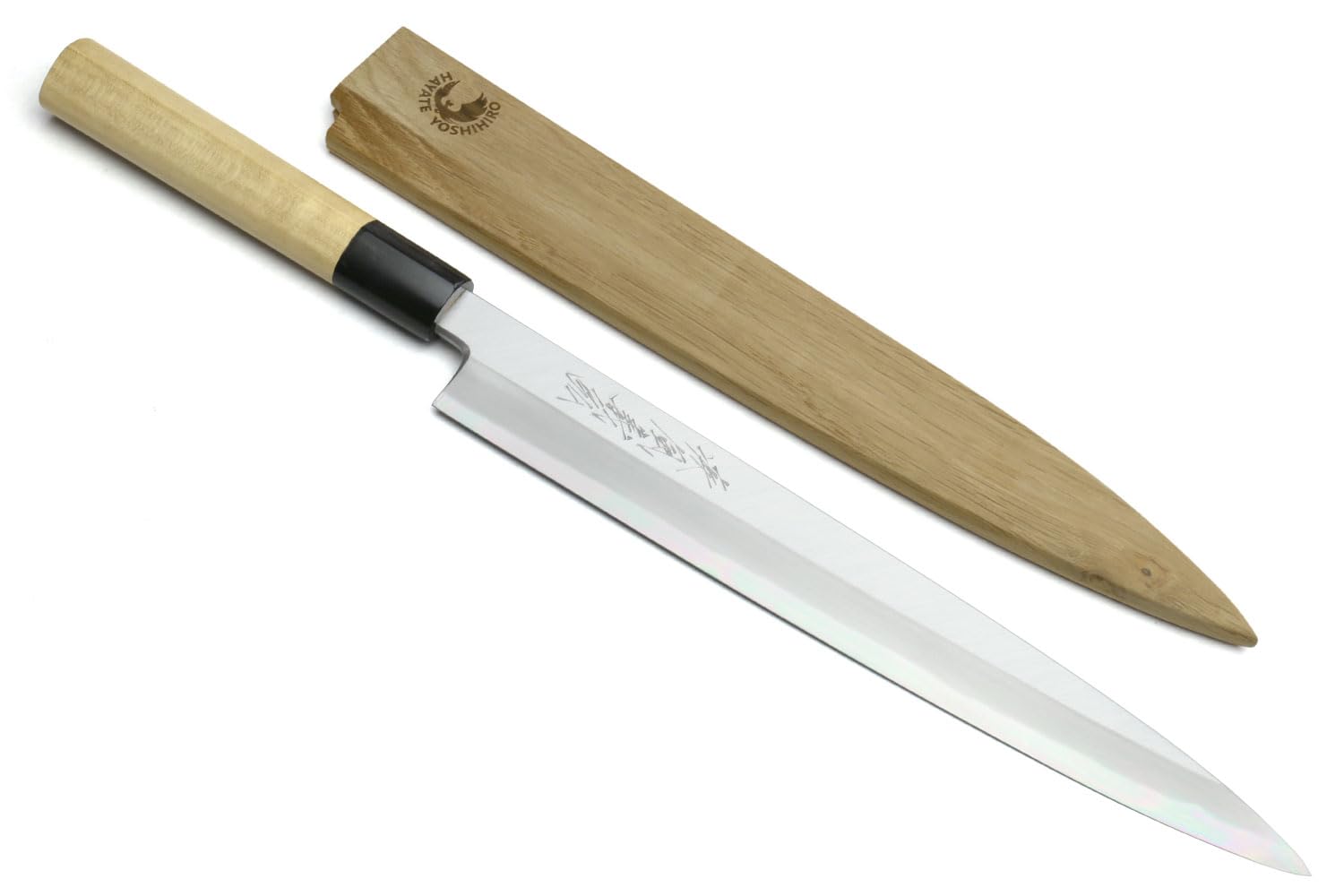
1. Yoshihiro Shiroko High Carbon Steel Kasumi Yanagi Magnolia Handle
Our pick — over 4★ from 90+ verified ratings; the strongest balance of quality and price.
The handmade Japanese classic that sets the standard for clean carbon-steel slicing.
This is the knife that home sushi enthusiasts graduate to after outgrowing supermarket blades — and the one many professional chefs keep as their daily driver. Forged from White Steel #2, it hits a hardness of 62-63 HRC on the Rockwell scale, a range that lets the blade take and hold a frighteningly sharp edge while still being responsive on water stones. The Shinogi (flat front grind) and Urasuki (concave back) work together so the blade passes through fish with minimal cell damage, preserving the texture and taste of the sashimi.
At 12.5 ounces and 11.8 inches of blade length, this knife is noticeably heavier than the MITSUMOTO SAKARI below (which comes in at 7.04 ounces with an 11-inch blade). That extra weight and length give the Yoshihiro real authority on large fish — you can pull through a whole salmon fillet in one stroke without forcing it. The D-shaped magnolia wood handle fits the right hand naturally, and the included wooden saya (sheath) protects the edge during storage. Buyers report it arrives “razor sharp” and that after months of regular use “no edge work needed.” The trade-off is that this is a carbon steel blade: it requires immediate drying after use and regular oiling to prevent oxidation. It is not a low-maintenance knife.
The Carbon Edge Advantage
- Genuine Japanese White Steel #2 at 62-63 HRC — takes an exceptional edge
- True single-bevel geometry with Urasuki hollow for non-stick slicing
- 11.8-inch blade handles large tuna and salmon in one pull
- Handcrafted in Japan with a magnolia D-handle and saya included
The Maintenance Reality
- Carbon steel will oxidize if left wet — requires immediate drying and oiling
- Heavier than many alternatives (12.5 oz) may fatigue some home cooks
- Needs water stone sharpening, not a pull-through sharpener
Your best bet if: you want a true artisan carbon-steel yanagiba from Japan that will reward your care with years of pro-quality slicing.
Think twice if: you prefer a low-maintenance stainless blade or are not ready to hand-wash, dry, and oil a knife after every use.
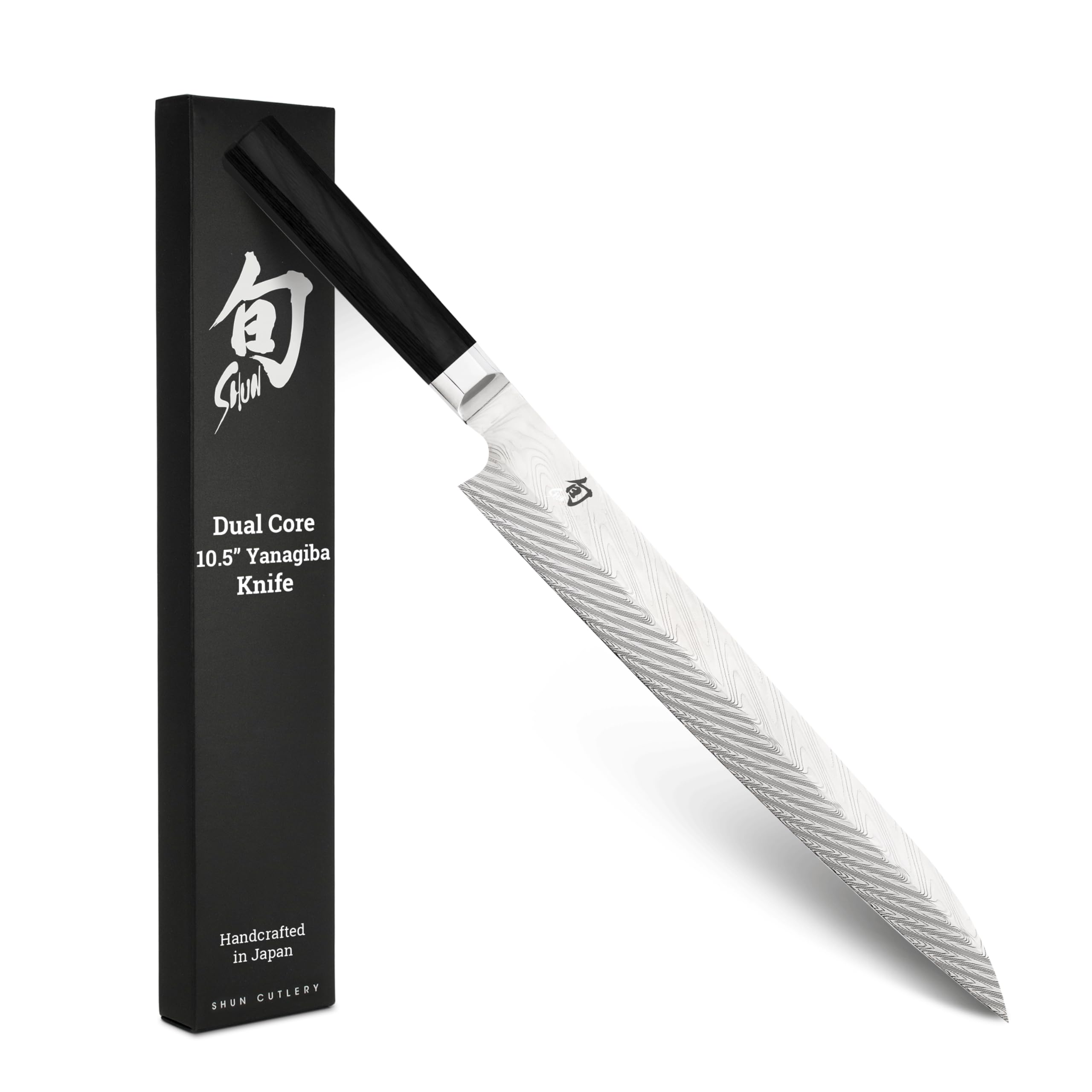
2. Shun Dual Core 10.5″ Yanagiba Knife
The layered Damascus blade that pairs elite sharpness with stainless-steel practicality.
Shun is a household name in Japanese cutlery, and the Dual Core series is their answer to a persistent problem: how to get the edge retention of high-carbon steel without the rust paranoia. The blade is built from 71 alternating micro-layers of VG10 and VG2 high-carbon stainless steel, sharpened to a 16-degree edge. That is a steeper angle than most Japanese knives, which translates to a very aggressive, precise cut right from the start. Buyers reported breaking down a 50-pound tuna with this blade, and one owner called it “a true pleasure” to use for nigiri and sashimi.
The 10.5-inch blade is long enough for most home slicing tasks, and the octagonal Pakkawood handle is ambidextrous, so both left-handed and right-handed users get a secure grip. At 8.96 ounces, it is lighter than the Yoshihiro and feels nimble in the hand. A saya sheath is included for storage. The catch is the price — this is the most expensive knife on the list by a wide margin — and a few owners noted that the initial impression of “heaviness” depends on your hand strength. Customer service gets high marks: one buyer whose knife arrived without the sheath received a replacement quickly after an email exchange.
What the Damascus Delivers
- 71-layer VG10/VG2 Damascus steel — excellent corrosion resistance and edge life
- 16-degree bevel for razor-sharp slicing on raw fish
- Octagonal Pakkawood handle works for left and right hands
- Handcrafted in Japan with a saya sheath included
The Premium Trade-Offs
- Highest price point — a serious investment for home cooks
- A few buyers found it heavy or hard to maneuver for precise cuts
Reach for this if: you want a top-tier stainless yanagiba that holds an edge through heavy use and comes from a brand with reliable customer support.
Look elsewhere if: your budget does not extend to the premium tier — the Masahiro below offers pro-grade stainless for a fraction of the cost.
3. FINDKING Prestige Series Yanagiba Knife, 10.5″
The Damascus showpiece that delivers genuine single-bevel performance without a four-figure price tag.
Most knives in this price range slap a damascus pattern on a double-bevel blade and call it a yanagiba. The Prestige Series is a real single-bevel slicer made from Japanese SKD11 alloy steel, with a Damascus finish that is structural rather than cosmetic. It comes in at 10.5 inches of blade and 2.3 pounds — noticeably heavier than the HOSHANHO (6.4 ounces) — which gives it authority on larger cuts but may feel substantial in hand. The ebony octagonal handle with sapele mahogany and copper spacers looks like it belongs in a professional sushi counter, and it arrives in a fitted walnut saya and a wooden gift box.
Customer reviews consistently praise the “sharp out of box” experience and the “stunning” presentation, with many calling it a great value for the price. The knife is heavier (around 250-258g according to owners), so it is not the best choice for prolonged delicate work. One chef who works at a Japanese restaurant reported that it “surpasses” a Yoshihiro blue steel Kiritsuke in balance and feel. The recurring caveat: the sharpness does not last indefinitely, and you need water-stone sharpening skills to maintain the edge. Without those skills, the knife loses its advantage quickly.
The Damascus Package
- Single-bevel SKD11 Damascus steel with real structural Damascus layering
- Ebony octagonal handle with copper spacers — premium grip and balance
- Includes walnut felt-lined saya and wooden gift box
- Sharp on arrival, with many owners praising the out-of-box performance
The Weight & Sharpness Catch
- Heavier than most alternatives (2.3 lbs) — not ideal for long, delicate sessions
- Sharpness requires water-stone maintenance; dulls if you don’t know how to sharpen
Perfect for: home cooks who want a beautiful, functional yanagiba with genuine heritage details and are willing to maintain the edge on stones.
Better to skip if: you need a lightweight daily slicer for marathon prep, or you prefer to avoid regular water-stone sharpening.
4. Masahiro Fukui Stainless Steel Yanagi Blade 270mm

The stainless-steel workhorse that holds its edge through months of pro kitchen abuse.
This is the knife that experienced sushi chefs recommend to line cooks who need a dependable yanagiba that will not rust mid-shift. The blade is made from Masahiro’s own MBS-26 stainless steel, a formulation with 0.9% carbon and 13% chromium plus molybdenum and vanadium, hardened to HRc 58-59. That is softer than the carbon-steel Yoshihiro, but it sharpens easily on standard stones and is far more forgiving in a busy kitchen where a knife might sit wet for a few minutes. It weighs about 6.1 ounces, making it one of the lighter options on the list, and at 270mm it handles large tuna with ease.
A pro chef reported that after three months in a busy sushi bar “it holds edge well under heavy use” and performs comparably to knives costing three to four times as much. The quality (10 mentions) and sharpness (7 mentions) are the most-discussed positive aspects. The downsides are that it is not a full tang, which some owners mention, and a few found the handle too smooth to grip securely. It also runs thinner and lighter than a traditional yanagi, which means you may need to apply more downward pressure during the cut. This is a mid-range compromise that leans hard on value and function, not flash.
The Pro-Grade Stainless
- MBS-26 stainless steel with molybdenum/vanadium — easy to sharpen and rust-resistant
- Light build (6.1 oz) reduces hand fatigue during long prep sessions
- Holds edge well under heavy 3-month pro use per owner reports
- 270mm blade length for large fish in one stroke
The Fit & Finish Reality
- Not a full tang — some buyers feel it compromises balance
- Thinner and lighter than traditional yanagi, requiring more cutting effort
- Handle can feel too smooth for a secure grip when wet
Get this if: you need a no-fuss stainless yanagiba that can survive the pace of a pro kitchen while staying affordable.
skip it if: you demand the full-tang heft and traditional feel of a classic carbon-steel yanagiba.
5. HOSHANHO Sushi Knife, 10″
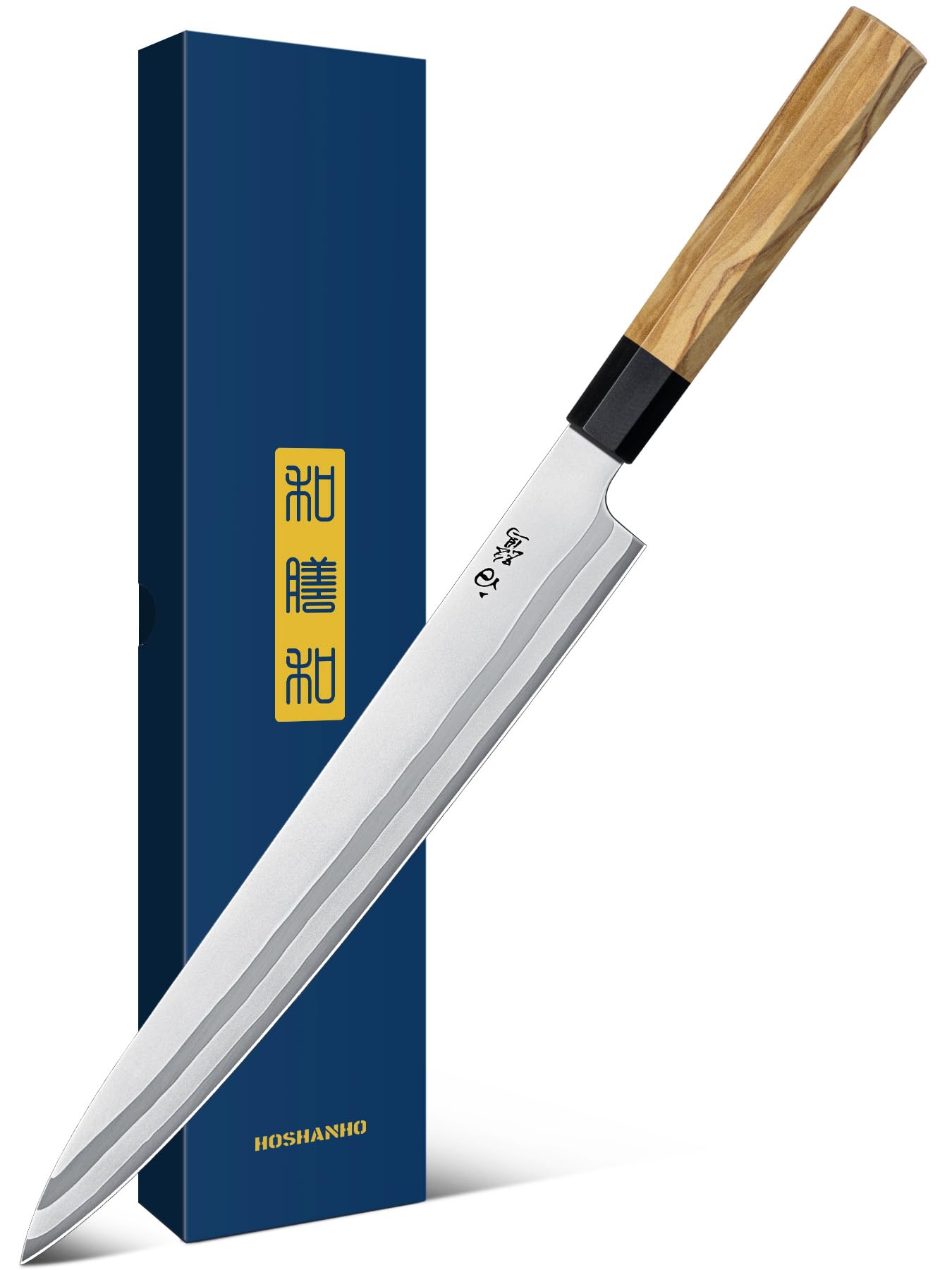
The budget-friendly knife that punches above its weight with real 62 HRC hardness and a 12-degree edge.
Most entry-level yanagiba knives use softer stainless steel that rolls or dulls after a few uses. The HOSHANHO breaks that pattern by using Japanese 10Cr15CoMoV high-carbon stainless steel heat-treated to 62 HRC — the same hardness range as many blades costing three times as much. The 12-degree bevel angle is also notably sharper than the industry standard of 15 degrees, which means it takes less force to pull through fish. Owners call it “super sharp” and note that it is “excellent quality for the price,” with many reporting that it became their favorite knife for home sashimi and poke.
The octagonal olive wood handle is precision-machined for a rounded, non-slip grip, and at 6.4 ounces it is light enough for extended slicing sessions. The biggest missing feature is a saya sheath: buyers explicitly mention that a sheath “would make it perfect” and that it is “the cherry on top” that the knife lacks. Without a sheath, you need to store it carefully in a knife block or magnetic strip to protect the edge. The blade is 10 inches long, which is shorter than the Yoshihiro’s 11.8 inches, so it works best for home-scale fish rather than large whole tuna.
The Sharpness-Per-Dollar Value
- 10Cr15CoMoV steel at 62 HRC — genuine hardness for a budget price
- 12-degree bevel — sharper than typical 15-degree yanagiba edges
- Octagonal olive wood handle offers a comfortable, non-slip grip
- Lightweight (6.4 oz) for fatigue-free use
The Missing Storage
- No saya sheath included — must purchase or store separately
- 10-inch blade is shorter than pro-length options, limiting large-fish work
Pick this if: you want the highest hardness-to-price ratio on the list and are comfortable sourcing your own sheath for safe storage.
Look elsewhere if: you need a longer blade (over 10.5 inches) for large fish, or you want an all-in-one package with a protective cover.
6. HEZHEN 270mm Yanagiba Knife

The forged stainless blade with a handsome olive wood handle and a lifetime warranty.
The HEZHEN 270mm yanagiba is built from X7Cr17MoV forging stainless steel, heat-treated to a hardness of 58±2 HRC. That is on the softer end of the yanagiba spectrum, which means it is easier to sharpen at home but will need more frequent touch-ups. The single-bevel edge is finished at 15°±1, and the blade undergoes a 12-step manufacturing process to ensure consistency. The olive wood handle is a standout feature — it is a high-density European noble wood that is manually ground and polished, with stainless steel and G10 gaskets for a clean transition.
Buyers have mixed reactions. Some call it a “perfect” wedding gift for a fisherman, and one owner says it is “one of the best knives around.” But other reports note that rust spots appeared on the blade after two weeks of light use, contradicting the stainless steel label. A few also mention the knife feels “a little uncomfortable” due to its size and weight (8.8 ounces). The seller offers a lifetime warranty, which provides some confidence for a mid-range purchase, but the rust issue is a real caveat — you should dry this knife immediately after every use, stainless claim notwithstanding.
The Handle and Warranty
- High-density olive wood handle with stainless steel and G10 gaskets
- Lifetime warranty from the manufacturer — rare at this price point
- Single-bevel edge at 15° for traditional sashimi slicing
- Solid forged construction from X7Cr17MoV steel
The Stainless Question
- Rust spots reported after two weeks of light use by multiple buyers
- Broader and heavier (8.8 oz) than some may prefer for delicate work
- Mixed feedback on initial sharpness from the start
Consider this if: you love the look of olive wood and want a budget-friendly yanagiba backed by a lifetime warranty for confidence.
Better to avoid if: you want a true stainless blade that will not rust with minimal care — the Masahiro or Shun are safer bets.
7. TWR Tosa Hamono White Steel Yanagi 240mm

The raw Japanese carbon blade that rewards those willing to sharpen it themselves.
This is the knife that Japanese home cooks buy when they want a real white-steel yanagiba without paying for fancy packaging or a saya. It is made from white steel (essentially a high-carbon steel) forged with iron, weighing about 5 ounces with a blade length of 240mm. The fit and finish are minimal: one buyer describes the blade as having “sticky adhesive, rough blade finishing, and a wavy handle installation.” Another notes that it “cuts well from the start” but that the tip benefits from an immediate touch-up on a stone.
The overwhelming consensus from owners is that this is a “good value for the money” if — and only if — you know how to sharpen a single-bevel blade. One Japanese reviewer wrote that after sharpening on a King #1000/#6000 stone, the knife “cuts sashimi well.” Another called it “cheap compared to UK prices” but admitted that the quality is commensurate with the price. At this price point, you trade hand-finishing for raw steel potential. It is not a knife for a beginner who wants instant perfection from the start, but for someone who enjoys the process of dialing in an edge, it is a steal.
The Raw Steel Potential
- Genuine white steel (high carbon) forged with iron — takes an excellent edge
- Lightweight at roughly 5 oz — very nimble for delicate slicing
- Costs a fraction of artisan brands for the same steel type
- Japanese-made with a traditional single-bevel geometry
The Rough Finish
- Blade and handle finishing is rough — sticky labels, wavy installation reported
- No saya or storage cover included
- Needs immediate sharpening on water stones for serious edge performance
- Not suitable for buyers who want a ready-to-use knife from the start
Best for: experienced sharpeners who want an affordable white-steel yanagiba to grind and polish to their own standards.
Not for: buyers who expect a finished, ready-to-use product with a sleek fit and a protective sheath.
8. MITSUMOTO SAKARI 11″ Japanese Sashimi Knife

The most affordable 11-inch single-bevel slicer, but consistency is the gamble.
For the price, this is a long (11-inch) single-bevel yanagiba made from tungsten alloy, with a Manchurian ash wood handle and a claimed 15-degree edge. It is the lightest full-length option on the list at just 7.04 ounces — that is 78% lighter than the 12.5-ounce Yoshihiro, which makes it genuinely easy to maneuver for extended prep. The packaging is thoughtful, with a kraft paper box and a cleaning cloth included. At this price point, it is the most accessible way to get a traditional single-bevel geometry in a knife longer than 10 inches.
The catch is that quality control is uneven. The summary across reviews is mixed: some buyers received a knife that was “sharp out of box” and “excellent quality,” while others found it “dull” with “an uneven edge and a small ding near the handle.” One owner reported that the blade was “so dull you can’t cut anything with it” and threw it in the trash rather than return it. The manufacturer appears to stand behind the product — a buyer who returned a defective unit reported “excellent customer service” and a perfect replacement. If you buy this knife, plan to inspect it immediately and be prepared to use the return policy. It is a budget entry, not a reliable heirloom.
The Budget Reach
- Genuine single-bevel 15-degree edge at an entry-level price
- 11-inch blade length is generous for large fish
- Very lightweight at 7.04 oz — easy to handle for long sessions
- Manchurian ash wood handle offers a natural non-slip texture
The QC Gamble
- Consistency issues: some units arrive dull, with uneven edges or damage
- Tungsten alloy sharpness is mixed per customer feedback
- No saya sheath included for edge protection
- Best suited for buyers willing to test and return if needed
Good for: the budget-conscious cook who wants to try a single-bevel yanagiba for the first time and is okay with a potential exchange.
Pass on this if: you want guaranteed out-of-box sharpness and a knife that is ready to use on day one without inspection.
Understanding the Specs
Single Bevel (Shinogi & Urasuki)
A true yanagiba is sharpened on only one side, with a flat front face (Shinogi) and a slight concave hollow on the back (Urasuki). This design lets the blade slide through fish without pushing or tearing the flesh. Double-bevel knives will always require more force and produce rougher cuts. If a knife claims to be a yanagiba but does not mention single-bevel, it is likely a marketing label on a standard chef knife.
Rockwell Hardness (HRC)
The Rockwell scale measures how hard the steel is. A higher number — 60 to 64 HRC — means the blade will hold a sharp edge for much longer but will be more brittle and harder to sharpen on standard stones. A lower number, like 56 to 59 HRC, means the steel is softer and easier to sharpen but will dull faster under regular use. For a home sushi enthusiast, 60 to 62 HRC offers the best balance. For a pro chef with sharpening skills, 63+ HRC is ideal.
Blade Length and Fish Size
A yanagiba blade should be longer than the widest fish you plan to slice. A 240mm (around 9.5-inch) blade works for salmon and smaller tuna. A 270mm (10.6-inch) or 300mm (11.8-inch) blade is needed for large yellowfin or whole fish, letting you pull through the entire fillet in one motion. Longer blades also give you more control over the angle of the cut, which is essential for even sashimi slices.
Carbon Steel vs Stainless Steel
Carbon steel (white steel, blue steel) takes a sharper edge than most stainless steels and is preferred by many sushi chefs. The trade-off is that it rusts easily — you must dry it immediately after use and oil the blade regularly. Stainless steel (VG10, MBS-26, 10Cr15CoMoV) resists rust and requires less maintenance but generally cannot match the ultimate sharpness of high-carbon steel. The choice depends on how much care you are willing to give your knife.
FAQ
Is a yanagiba knife only for sushi and sashimi?
What is the difference between a yanagiba and a sujihiki?
Can a left-handed person use a standard yanagiba?
How do I sharpen a yanagiba knife?
How long does a yanagiba knife last?
Do I need a saya sheath?
What does the term “Kasumi” mean on a yanagiba?
Is a longer yanagiba always better?
Can I use a yanagiba for other kitchen tasks?
What steel type holds the sharpest edge on a yanagiba?
Final Thoughts: The Verdict
If you want one dependable pick, the best yanagiba sushi knife is the Yoshihiro Shiroko Kasumi because it delivers genuine Japanese white-steel craftsmanship, a true single-bevel geometry, and a 300mm blade that handles large fish in one pull — all at a price that undercuts artisan brands by a wide margin. If you want a low-maintenance stainless knife with pro-grade edge retention, grab the Shun Dual Core. And for the budget-conscious cook who wants a real single-bevel yanagiba without a huge investment, the HOSHANHO is the one to reach for.
How We Picked
We do not accept paid placement. Every pick is matched to a real buyer and a real use-case; we do not hands-on test units.
Sources & Methodology
Specifications: manufacturer listings and product documentation. Review insights: verified customer reviews, as of July 2026. Pricing: not shown on this page (it changes often); check the current price via the retailer link.
As an Amazon Associate, Calories Fit earns from qualifying purchases. This does not affect which products we feature.