
Our readers keep the lights on and the coffee maker working hard! As an Amazon Associate, I earn from qualifying purchases.
Specs are compiled from manufacturer listings and verified buyer reviews and can change over time — please confirm the key details on the product page before buying.
Your home gym floor has one job: protect your joints without tearing under your equipment. Foam mats feel great underfoot but collapse under a heavy barbell, while pure rubber handles weight but feels hard on your knees. The best workout room flooring balances that trade-off—and this guide compares 9 of the most popular mats to find the one that fits how you actually train.
I’m Mohammad — the founder and writer behind Calories Fit. This guide is built by comparing the manufacturers’ published specifications and the patterns across verified customer reviews, so you get each pick’s real strengths and trade-offs instead of marketing spin.
The crowd favorite here earns its spot with 4.7 stars and hundreds of owners praising its durability and grip, so let’s dive into what makes a great workout room flooring option.
Our Picks at a Glance


How To Choose The Best Workout Room Flooring
Before you click “add to cart,” you need to know what you’re training for and where the mat is going. A yoga-and-stretching space has different needs than a garage gym with a squat rack. Let’s break down the three biggest decisions.
Thickness vs. Density: What’s the Real Difference?
A thicker mat isn’t automatically better. High-density materials can be thin but firm, offering support without bottoming out. Thick, soft foam feels plush initially but can compress or tear under heavy, repeated impacts. For equipment like treadmills or squat racks, density matters more than sheer inches.
Roll Mats vs. Interlocking Tiles: Which Layout Fits?
Large roll mats give you a smooth, professional surface that’s quick to lay down, but they’re best for a single open area. Interlocking tiles let you customize coverage around racks and equipment and can be removed if you move, but they have seams that can collect dust and may separate during intense workouts.
Material Matters: PVC, EVA, and Recycled Rubber
Polyvinyl chloride (PVC) mats are shoe-friendly and durable but can have an initial odor. Ethylene-vinyl acetate (EVA) foam is lightweight and soft but may not handle the sharp edges of heavy dumbbells. Recycled rubber is the heavyweight champion for durability but is often heavier and pricier, making it harder to move around.
Quick Comparison
| Model | Best For | Thickness | Dimensions | Material | Amazon |
|---|---|---|---|---|---|
| [1] GymCope Large★ Best Overall | Versatile home gyms | 0.27″ | 96″L x 72″W | PVC | Amazon |
| [2] GymCope Extra LargeBest Value | Cardio & equipment | 0.31″ | 72″L x 48″W | PVC | Amazon |
| [3] HAPBEAR LargeTop Performer | High-intensity cardio | 0.32″ | 84″L x 60″W | PVC | Amazon |
| [4] HAPBEAR Tiles | Heavy equipment zones | 0.56″ | 24″L x 24″W | Rubber/EVA | Amazon |
| [5] MRO Extra Large | Plyo & jump rope | 0.28″ | 84″L x 54″W | Polyethylene | Amazon |
| [6] Rubber King Tiles | Powerlifting & durability | 0.24″ | 19″L x 19″W | Recycled Rubber | Amazon |
| [7] Flooring Inc Roll | Full-room coverage | 0.25″ | 120″L x 48″W | Recycled Rubber | Amazon |
| [8] AIRHOP Tiles | Comfort & cushioning | 0.79″ | 24″L x 24″W | Rubber/EVA | Amazon |
| [9] SUPERJARE Tiles | Large-area coverage | 0.4″ | 24″L x 24″W | EVA/Rubber | Amazon |
In-Depth Reviews
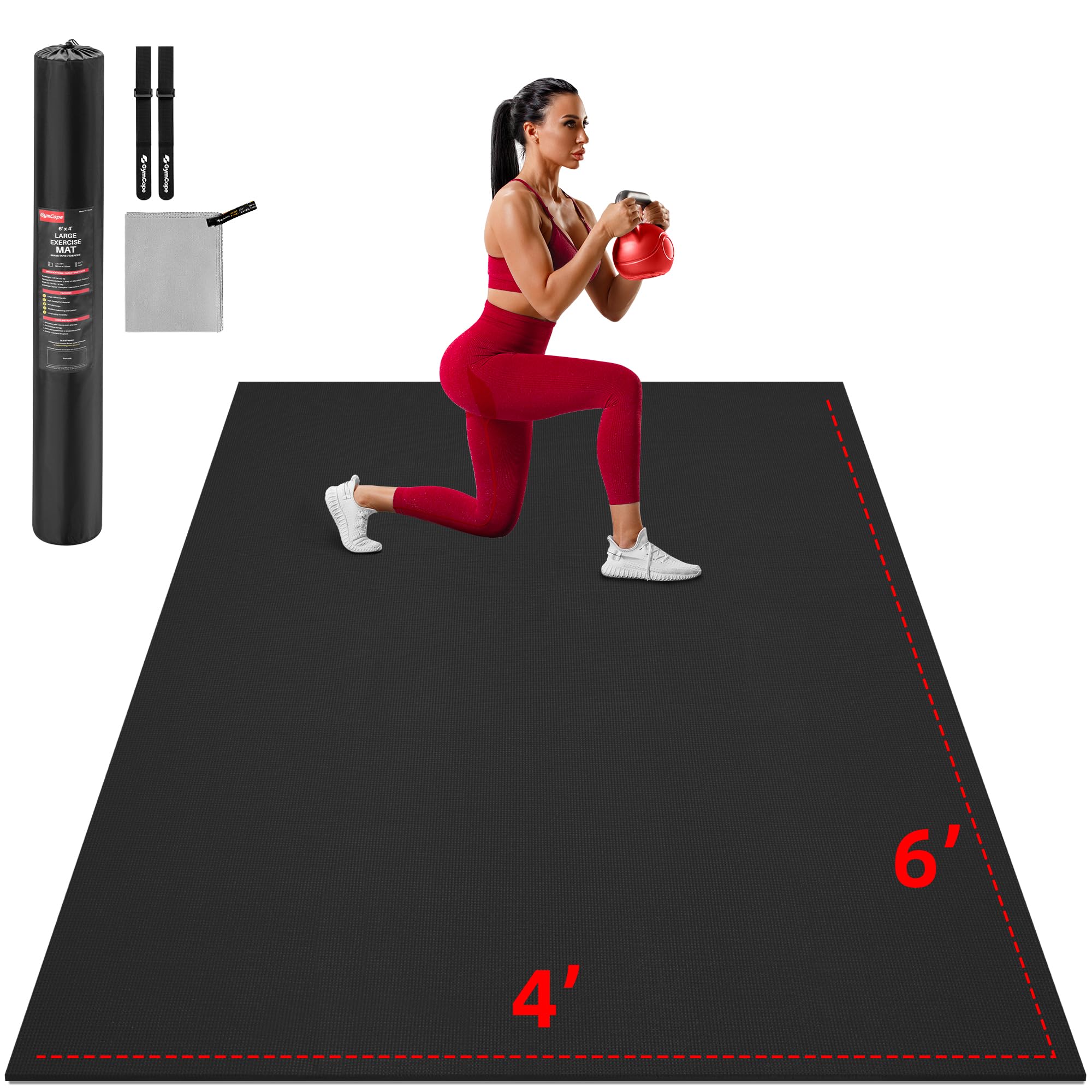
1. GymCope Large Exercise Mat
Our pick — over 4.5★ from 750+ verified ratings; the strongest balance of quality and price.
The all-rounder that handles cardio, weights, and family movie night without flinching.
This mat is the one to beat because it solves the classic home-gym dilemma: you want something that works with shoes for burpees but feels okay for stretching. The heavy-duty PVC surface is built to resist tears from high-intensity training and frequent use, making it a true “low-maintenance” floor for a dedicated room.
It comes in 6 sizes, so you can fit a small apartment corner or a large basement. Owners rave about the double-sided anti-slip surfaces, which keep it firmly in place on tile, carpet, concrete, and hardwood. The 7mm (0.27″) thickness cushions joints while staying firm enough to support a squat rack or dumbbells without sinking.
What wins people over is the durability and sheer size. The only recurring note is the initial odor, but buyers report it dissipates in about 24 hours. The included carrying bag and straps make it portable, so you can even take it outside or use it in a pickup truck bed—one owner did exactly that to prevent their dog from sliding.
The Highlights
- Double-sided anti-slip grip works on hardwood, carpet, and concrete
- Moisture and sweat stay on the surface for a quick wipe-down
- Available in six sizes up to a room-filling 96″L x 72″W
Worth Noting
- Some owners find it firmer than a plush yoga mat
- New-mat odor takes about a day to clear
Reach for this if: you want one versatile surface for everything from jump rope to dumbbells to floor stretches.
Look elsewhere if: you need heavy-duty rubber to park a full power rack with hundreds of pounds of plates.
2. GymCope Extra Large Exercise Mat
A 33% thicker build than the top pick, tuned for garage gyms and heavy landings.
If you want more cushion underfoot without jumping to premium pricing, this GymCope version bumps the thickness to 0.31″ versus the top pick’s 0.27″—a meaningful 15% jump for joint protection. That extra cushion comes from a triple-layer system: a wear-resistant top, a shock-absorbing core, and an anti-slip bottom.
It’s explicitly built for shoe-friendly training like jump rope, boxing, MMA drills, and kettlebell swings. The double-sided anti-slip texture grips hardwood, tile, concrete, and low-pile carpet, so it won’t bunch up mid-set. Owners note it lays flat right away with no need to break it in, and the creases from folding eventually settle out.
The main trade-off is coverage—the largest option is 10’x6′, which is generous for most home spaces but a bit shorter than the 12-foot length the top pick offers. Durability gets mixed feedback from some who put it through extreme tearing abuse, but for standard home training it holds up well, and a 6’2″ owner confirms there’s plenty of room to stretch out completely.
Built For
- 8mm triple-layer cushioning softens high-impact landings
- Anti-slip texture grips concrete, tile, and hardwood
- Comes with two carrying straps, a storage bag, and a towel
The Caveat
- Folding it up leaves temporary creases
- Not intended for extreme commercial gym or hard-sole footwear abuse
Best for: anyone training in shoes on a hard garage floor who wants extra shock absorption without paying top dollar.
Think twice if: you plan to drop loaded barbells from overhead—this is a training mat, not a crash pad.
3. HAPBEAR Large Exercise Mat
The trainer’s choice for HIIT, with corrugated grip that refuses to let you slide.
For high-intensity interval training, the surface you land on makes or breaks your joints. This mat uses a high-density foam core that is 8mm thick (greater than 1/3 inch), and owners say it’s thick enough to absorb workout impact—a key detail if you’re doing burpees or jumping lunges repeatedly.
Its defining feature is the double anti-slip layers: a corrugated structure on top and a suction cup structure on the bottom. This combo grips sweaty feet and floors to prevent ankle slips during intense workouts. Unlike the thinner MRO mat below, this one comes in a wider range of sizes including a 12’x6′ option for large spaces.
Quality is the thing everyone raves about here, and it’s the most-discussed positive aspect by a wide margin. It ships with a set of resistance bands and a storage bag, adding value. The catch? The included bag’s stitching feels a bit questionable to some, and it’s not immune to a determined cat’s claws—so protect it from pets if you want it pristine.
Why It Shines
- Corrugated top and suction-cup bottom deliver serious no-slip grip
- 8mm thickness cushions knees and wrists during high-impact aerobics.
- Available up to 12’x6′ for oversized workout spaces
Keep In Mind
- Storage bag stitching has a cheap feel for some
- Easy to scuff if pets get their claws into it
Choose this for: bootcamp-style training where non-slip stability is non-negotiable.
skip it if: you need ultra-portable flooring you’ll move between rooms constantly—this is best kept down.
4. HAPBEAR Interlocking Mats
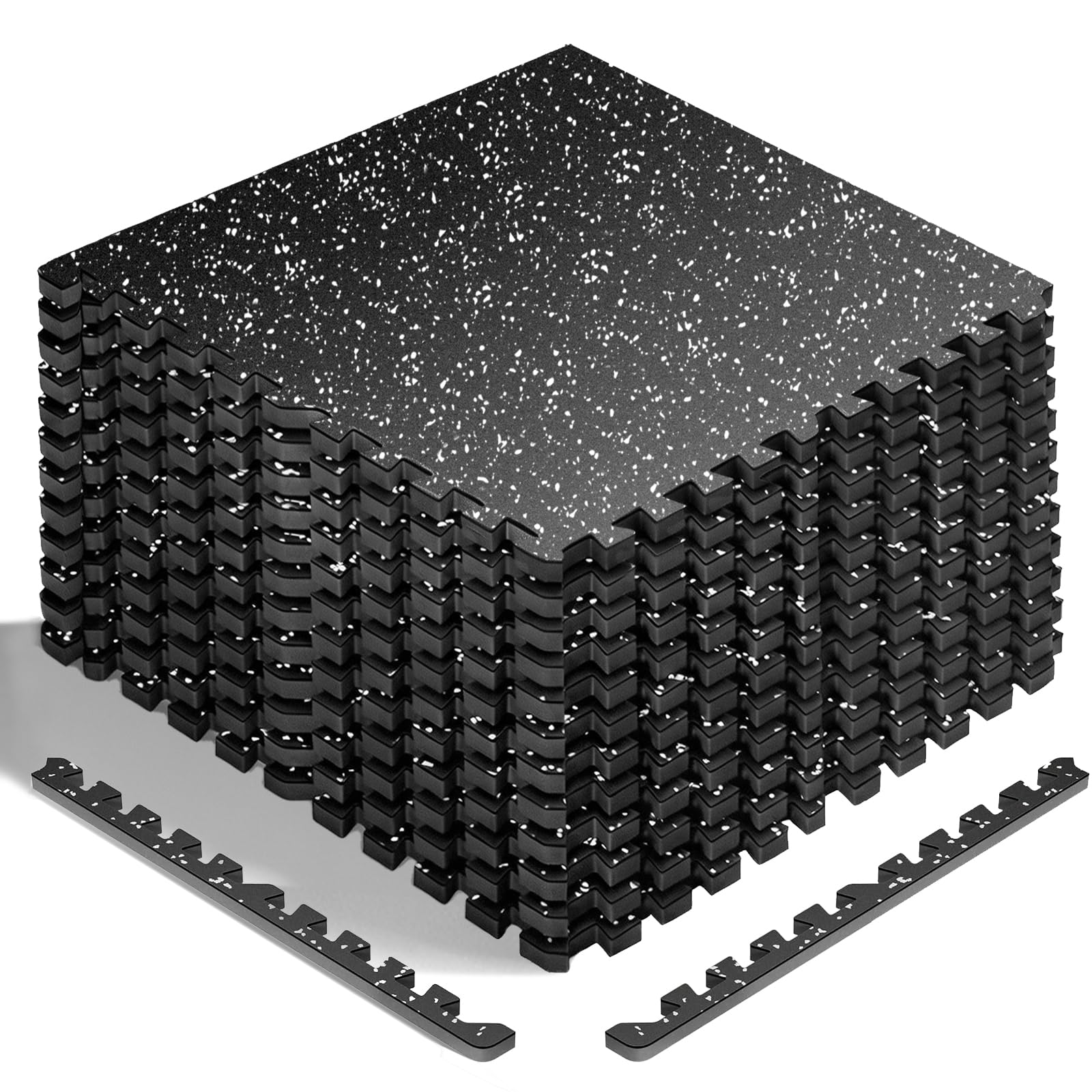
A puzzle-piece floor that holds heavy iron without a hint of rubber odor.
This is the pick when you want a permanent floor that can be rearranged later. It comes as 12 tiles, each 24″ x 24″ and a hefty 0.56″ thick, covering 48 square feet. The interlocking design lets you fit around gym gear or fill a garage, home fitness room, or basement corner.
The dual-layer construction is the star: a dense, textured rubber top for a non-slip surface on heavy equipment, and a high-density EVA foam bottom that absorbs shocks and reduces joint strain. Owners say it handles a Force USA C20 trainer without leaving indentations, and it absorbs vibrations and noise effectively—so you can lift without the whole house hearing it.
Assembly is genuinely easy—one owner calls it “like a jigsaw puzzle.” At 0.56″ thick, it’s more than double the roll mats’ thickness, feeling sturdier under benches and spin bikes. The trade-off is that it’s not truly portable; once laid, you’re not rolling this up for storage. But that’s fine if you’re building a dedicated space.
What Works
- Textured rubber top grips equipment and prevents sliding
- Edge strips peel off for clean side, corner, or center placement
- Trims easily with a box cutter for a perfect fit
Before You Buy
- Initial rubber-and-tire smell needs 1-2 days to fade
- Coverage is fixed at 48 sq ft per pack—larger rooms need multiple packs
Best for: building a permanent, customizable workout zone around heavy equipment like treadmills and power racks.
Not ideal for: renters who need to pack up and move their floor frequently.
5. MRO Extra Large Exercise Mat

A firm, grippy surface that proved itself with zero wear after a full year.
If you want a mat that sits between a weight bench pad and a yoga mat, this is it. The MRO is built with high-density foam tech that’s firm, not spongy, and double-sided textured non-slip surfaces that keep it in place on most floors. It’s a great choice for dumbbells and plyo work on hardwood.
One owner’s review after a year of use is telling: no tears, no wear, no loss of cushion. Scuffs wipe clean, and it remains safe with shoes and heavy weights. At 0.28″ thick and 84″L x 54″W, it’s slightly narrower than the HAPBEAR but still offers plenty of room for most workouts.
The standout here is the extra value: it ships with a microfiber towel and a high-quality jump rope. The main durability concern isn’t the mat itself, but the included straps—some owners mention the buckles broke on first use. The mat itself, however, gets top marks for lasting a year with no cushion loss.
What You Get
- Survives a full year with no wear or cushion loss.
- Free microfiber towel and jump rope included
- Firm, grippy feel that’s less sticky than a yoga mat
The Catch
- Too thin for heavy barbell work—it’s a bodyweight and dumbbell mat
- Included straps can break on first use; handle them gently
Grab this if: you want a dependable, long-lasting mat for dumbbells and bodyweight work without the premium price tag.
Pass on this if: you expect to drop barbells on it—you’ll want interlocking rubber tiles instead.
6. Rubber King Interlocking Tiles
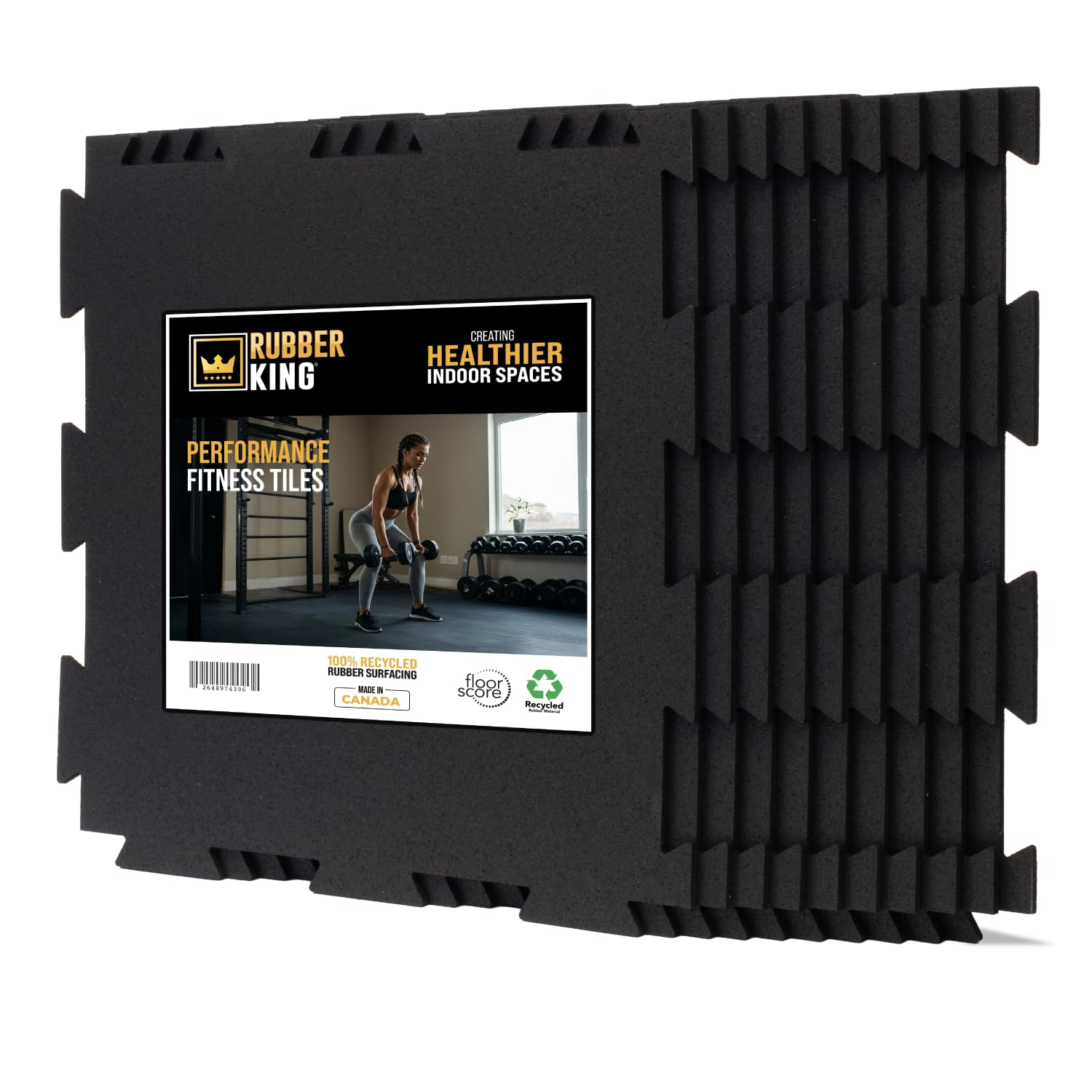
100% recycled rubber with a 5-year warranty, for lifters who demand real durability.
This is the serious lifter’s tile. Made from 100% recycled rubber tires, these 19″ x 19″ tiles snap together like a fitness puzzle and create a professional gym feel that foam simply can’t match. Owners say it transforms a basement into a legit training space, and it’s firm enough to handle a dropped 25lb dumbbell without damage.
Durability is the most-discussed positive here, with owners praising how it holds up under heavy weights. It’s also certified by 3rd Party FloorScore, meaning it meets high indoor air quality standards with fewer volatile organic compounds (VOCs), so you won’t be breathing in harsh fumes during your workout.
For a full room, you’ll need multiple packs, and the price has crept up over time. The recycled construction means color variations can occur between batches, so order enough at once if you want a uniform look.
The Strengths
- Thick rubber density handles dropped weights and heavy machines
- Low-odor, FloorScore-certified for cleaner indoor air
- Cuts easily with a utility knife for custom layouts
The Trade-offs
- Only 23.5 sq ft per pack—you’ll buy several for a full room
- Sticky adhesive residue from the label can mar the top tile
Choose these for: a permanent powerlifting or CrossFit garage set up where equipment durability outranks cushioning.
Skip them if: you want a soft surface for yoga—this rubber is firm by design.
7. Flooring Inc Tough Rubber Roll
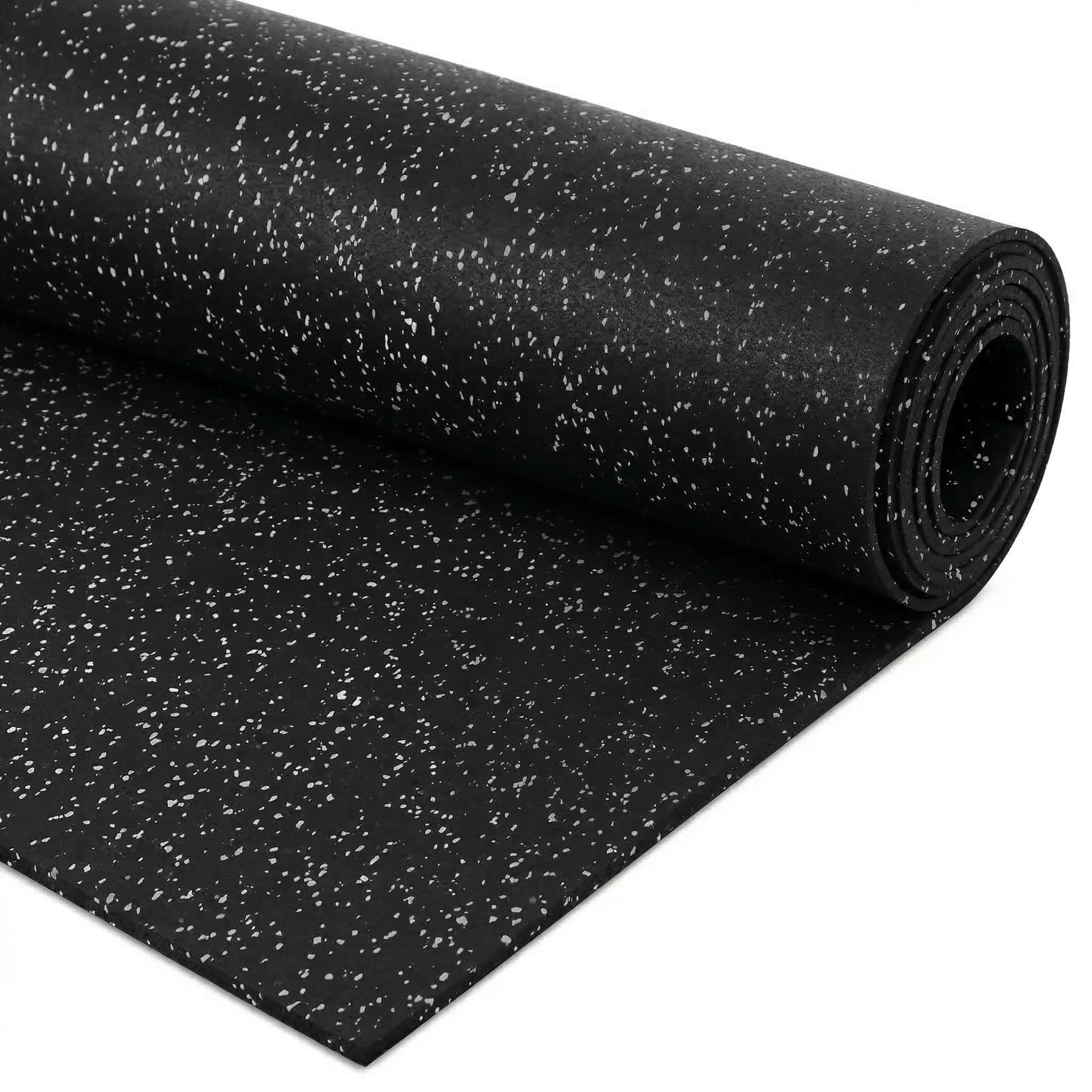
smooth recycled rubber that turns a garage or shed into a commercial-grade gym floor.
This is the choice for a no-seam finish. At 120″L x 48″W, this roll offers a continuous surface that’s ideal for large, open areas like garages, sheds, or home gyms under weight benches and machines. It’s manufactured in the USA from recycled rubber, promising long-lasting resilience for indoor and outdoor settings.
What stands out is its versatility. While designed for gyms, owners have used it as a workbench topper, a basketball dribbling surface, and even horse stall matting or trailer flooring. It’s stiff enough to write on but comfortable to lay on, and it provides excellent grip and moisture resistance under heavy equipment.
The recurring theme in reviews is the initial smell—some call it awful, though most say it fades in days. The cut quality is the main concern, with some reporting uneven cuts at the ends and inconsistent thickness (one section measured 0.29″ vs. the advertised 0.25″). It’s heavy, so unrolling it solo takes effort, but owners agree it’s a better value than foam puzzle mats for a professional finish.
The Upside
- Continuous roll means no seams to catch or separate
- Extremely durable for deadlifts, spin classes, and equipment
- Free of any materials other than rubber
The Downside
- Strong initial rubber smell that takes days to clear
- Uneven cuts reported at roll ends; may need trimming
Reach for this if: you need to cover a large, permanent workout area with a smooth, professional rubber surface.
Think twice if: you want portability or a softer, more cushioned feel underfoot for bodyweight work.
8. AIRHOP Interlocking Tiles

The plush-est tile here, with nearly an inch of cushion to save your joints.
If joint comfort is your highest priority, this tile delivers the most padding of any pick here. At 0.79″ thick per tile, it’s the thickest option in our lineup—significantly more cushioning than the 0.4″ SUPERJARE or the 0.56″ HAPBEAR tiles. This makes it a standout for high-impact cardio, yoga, or anyone with sensitive knees, hips, or a bad back.
It uses a dual-layer design: a textured rubber top for non-slip grip and a high-density EVA foam bottom for shock absorption. The 24″ x 24″ tiles snap together securely with upgraded larger interlocking locks, which owners say prevents separation during intense workouts—a key frustration with cheaper tile sets.
Owners find it comfortable and durable, with one noting it handles weight lifting without an additional mat underneath. The included edge pieces give it a clean, finished look against walls. The biggest negative is the odor, which takes a few days to dissipate, and some note the EVA foam may sink slightly under very heavy dumbbells or squat racks—but for bodyweight and moderate weights, it’s superb.
The Pluses
- 0.79″ thickness delivers the most joint cushioning of any pick here.
- Secure interlocking locks prevent tiles from separating mid-set
- Edge pieces provide a clean, professional finish
The Minuses
- Strong initial odor lasts a few days
- EVA foam may compress under extreme equipment loads
Opt for this if: you want the most comfortable surface for high-impact cardio, yoga, and light-to-moderate weight training.
Look past it if: your floor will be home to a heavy power rack—you’ll want denser rubber for that.
9. SUPERJARE Interlocking Mats

The biggest bang for your buck on square footage—a full room covered with 24 interlocking tiles.
Coverage is the name of the game here. This set includes 24 tiles covering 96 square feet, which is double the coverage of the AIRHOP and HAPBEAR tile sets at 48 sq ft each. If you’re flooring an entire room or garage bay, this drastically reduces the number of boxes you’ll need to buy.
Durability is the standout aspect, with more than double the mentions of the next most-discussed attribute. The dual-layer design pairs an EPDM rubber top with a high-density EVA foam base to handle heavy equipment without tearing. Owners successfully place very heavy universal gym machines on it without issue, and any dents from equipment recover within two days.
Assembly is a breeze with the interlocking edges, and each tile comes with two detachable borders for a neat square or rectangular shape. The mat is quiet and cushioned, reducing noise to avoid disturbing family or neighbors. One owner found no smell after 24 hours, though others note a light rubber odor that fades in days—so results vary.
The Perks
- 96 sq ft of coverage in one box—big value for large spaces
- Durable enough for very heavy universal gym machines
- Equipment dents bounce back within 2 days.
The Limitations
- Some customers note stronger off-gassing smell than others
- Thinner at 0.4″ than the AIRHOP’s 0.79″ for joint comfort
Best for: covering a large dedicated workout space on a budget without sacrificing durability.
Not the best for: high-impact plyometrics where maximum cushioning matters more than coverage.
Understanding the Specs
Material: PVC vs. EVA vs. Rubber
The material dictates your joint comfort, odor level, and how long the floor lasts. PVC (used in roll mats) is shoe-friendly and durable but can have an initial smell. EVA foam is soft and lightweight but can tear under sharp heavy equipment. Rubber is the heaviest and most durable, great for weights, but often firmer underfoot.
Thickness and Coverage Area
Thicker mats (0.79″) provide more impact absorption for knee-sensitive workouts but are usually pricier per square foot. Thinner mats (0.25″) are firm and stable for heavy weights but offer less cushioning. Always check the total coverage area (like 48 sq ft or 96 sq ft) to ensure you can fill your space, and remember that interlocking tiles give you layout flexibility that a one-piece roll can’t.
FAQ
What’s the best thickness for a home gym floor?
How long does the rubber smell last on new mats?
Can I use these mats on carpet?
Are interlocking tiles better than a one-piece roll mat?
Will a 0.27-inch thick mat protect my floor from a treadmill?
What is the difference between EVA foam and rubber mats?
How do I clean and maintain my workout flooring?
Can I cut interlocking tiles to fit my room?
Final Thoughts: The Verdict
If you want one dependable pick, the workout room flooring winner is the GymCope Large Exercise Mat because it’s the most versatile — it’s durable, shoe-friendly, and fits a range of spaces. If you want maximum joint cushioning for HIIT and yoga, grab the AIRHOP tiles. And for those setting up a permanent garage gym with heavy weights, the SUPERJARE mats offer the best mix of durability and coverage for the money.
How We Picked
We do not accept paid placement. Every pick is matched to a real buyer and a real use-case; we do not hands-on test units.
Sources & Methodology
Specifications: manufacturer listings and product documentation. Review insights: verified customer reviews, as of August 2026. Pricing: not shown on this page (it changes often); check the current price via the retailer link.
As an Amazon Associate, Calories Fit earns from qualifying purchases. This does not affect which products we feature.