
Our readers keep the lights on and the coffee maker working hard! As an Amazon Associate, I earn from qualifying purchases.
Specs are compiled from manufacturer listings and verified buyer reviews and can change over time — please confirm the key details on the product page before buying.
A wooden slant board sounds simple — a wedge of wood you stand on. But The right slant board open up deeper squats, reduces knee pressure, and stretches calves and Achilles better than a flat floor.. The wrong board wobbles, slides, or uses an angle that doesn’t fit your body.. This guide identifies the wooden slant board that fits your training, rehab, or daily mobility routine..
I’m Mohammad — the founder and writer behind Calories Fit. This guide is built by comparing the manufacturers’ published specifications and the patterns across verified customer reviews, so you get each pick’s real strengths and trade-offs instead of marketing spin.
These six models cover every real-world need, from a fixed 25-degree wedge for heavy squatting to a 16-level adjustable board that lets you dial in the exact angle. Here is how to pick the best wooden slant board for your home gym or rehab setup.
Our Picks at a Glance
How To Choose The Best Wooden Slant Board
Finding the right wooden slant board means matching your primary activity — squatting, stretching, or rehab — to the board’s width, angle options, and construction. Key details separate a daily-use tool from one that collects dust..
Width matters more than you think
A narrow board forces your feet together, which changes your squat stance and can feel unstable. For squats and lunges, look for a board 17 inches wide or wider so you can stand at shoulder width. For calf stretching and ankle mobility, a narrower 12-to-13-inch board is perfectly fine and easier to store.
Adjustable vs. fixed angle
An adjustable slant board with multiple incline levels (five, sixteen, or even more) lets you start shallow and progress as your flexibility improves. A fixed-angle board, usually set at 25 degrees, is simpler, cheaper, and sturdier under heavy weight — good if you know exactly what angle works for you and plan to load it with barbells.
Weight capacity is not just a number
If you are using the board for bodyweight calf stretches, a 350-pound capacity is plenty. If you plan to squat with a loaded barbell, look for a board rated for 450 pounds or more. The construction — hardwood plywood versus softer pine — directly affects how the board handles that load without flexing or cracking.
Quick Comparison
| Model | Best For | Width | Weight Capacity | Incline Levels | Amazon |
|---|---|---|---|---|---|
| StrongTek (13″ Wide)★ Best Overall | All-around portable use | 13.3 in | 350 lbs | 5 | Amazon |
| KZEBRA ProfessionalRehab Favorite | Rehab & lightweight use | 12.5 in | 450 lbs | 5 | Amazon |
| KIJO Studio 16-Level | Precise angle tuning | 11.8 in | 550 lbs | 16 | Amazon |
| EVERYMATE Slant Board | Wide platform & heavy loads | 19.7 in | 1000 lbs | 1 | Amazon |
| 17″ Premium Portable Wooden Slant Board | Gift-ready with accessories | 17 in | 400 lbs | 4 | Amazon |
| StrongTek Fixed 25° | Heavy-duty squats & ATG work | 19.6 in | 1000 lbs | 1 (fixed) | Amazon |
In-Depth Reviews
1. StrongTek 13” Wide Portable Wooden Slant Board
Our pick — over 4.5★ from 800+ verified ratings; the strongest balance of quality and price.
The crowd favorite that balances portability, sturdiness, and five useful angles
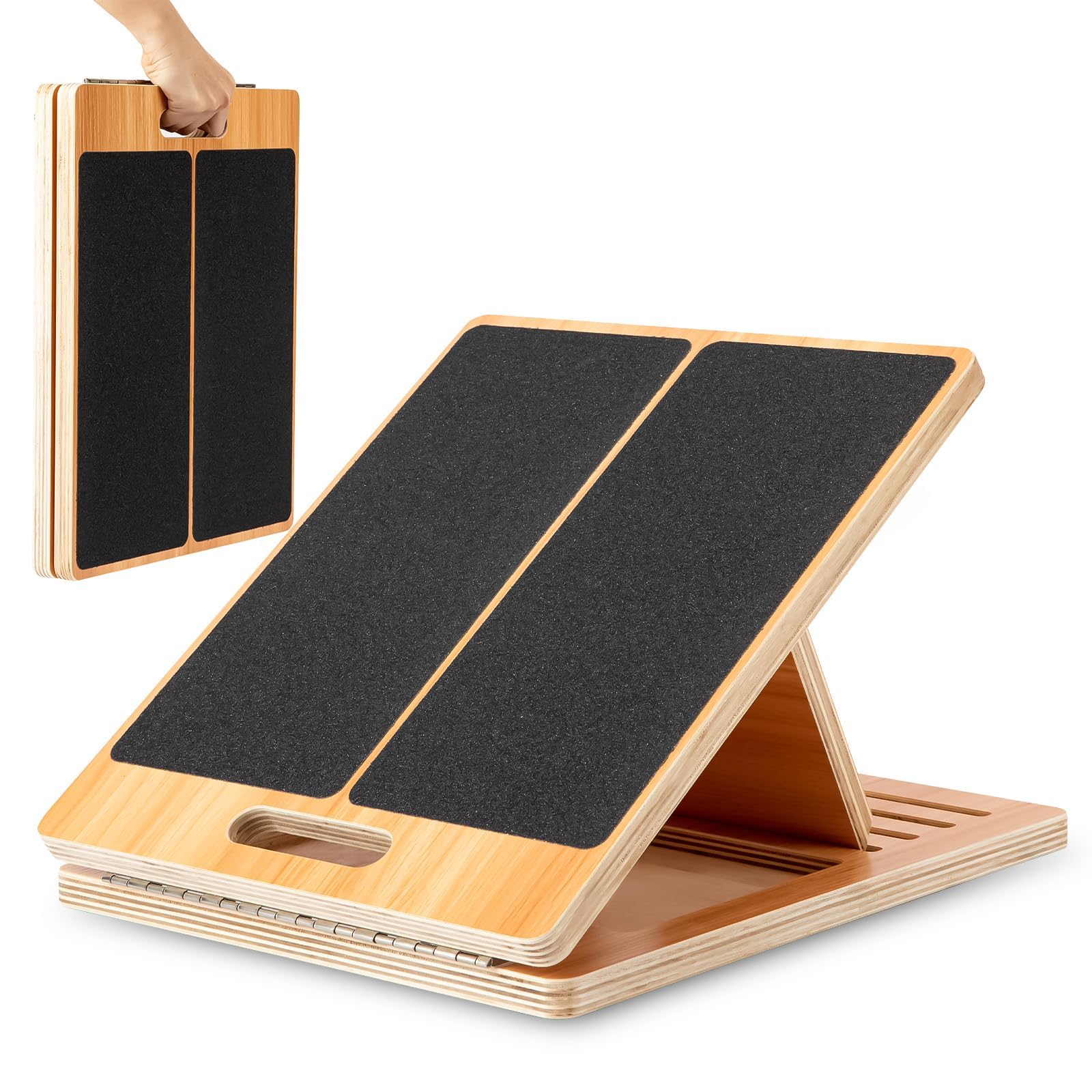
You get five scientifically set incline levels — 15°, 20°, 25°, 30°, and 35° — so you can start gentle and progress as your flexibility improves. At 5.3 pounds, it is lighter than the KZEBRA model at 9.11 pounds and folds flat, meaning it tucks under a couch or into a gym bag without drama. Buyers report that “the lowest slant is 15 degrees which works for me,” especially for daily foot and ankle loosening.
The 13.3-inch-wide platform is noticeably roomier than most portable boards, which gives you stable footing for both calf stretches and lighter squat work. Owners consistently praise the grip — the non-slip surface stops your feet from sliding even during intense stretching sessions. The lower grip handle is a smart detail: it sits below the board so it does not interfere with your feet, yet makes carrying and angle changes easy.
What wins people over is the combination of quality and sturdiness — those two aspects dominate the chatter. The board feels solid underfoot, does not slide on the floor, and has held up well for rehab users (including post-total-knee-replacement recovery). An occasional owner wishes for a steeper top angle, but the 15-to-35-degree range covers nearly every home user and most rehab needs.
wide stable base
- Five adjustable angles from gentle 15° to steep 35°
- Folds flat for storage under furniture or in a bag
- Non-slip surface grips well even barefoot
- Beneath-sole handle keeps the deck clear
limited adjustability
- 350-pound max capacity limits heavy barbell squatting
- Not as wide as premium fixed-angle boards for wide-stance squats
reach for this if: you want one board for daily calf stretching, knee rehab, and bodyweight squats — the portability and five angles make it the most versatile single purchase.
think twice if: you plan to squat with a loaded bar over 350 pounds; a heavy-duty fixed-angle board is safer.
2. KZEBRA Professional Wooden Slant Board
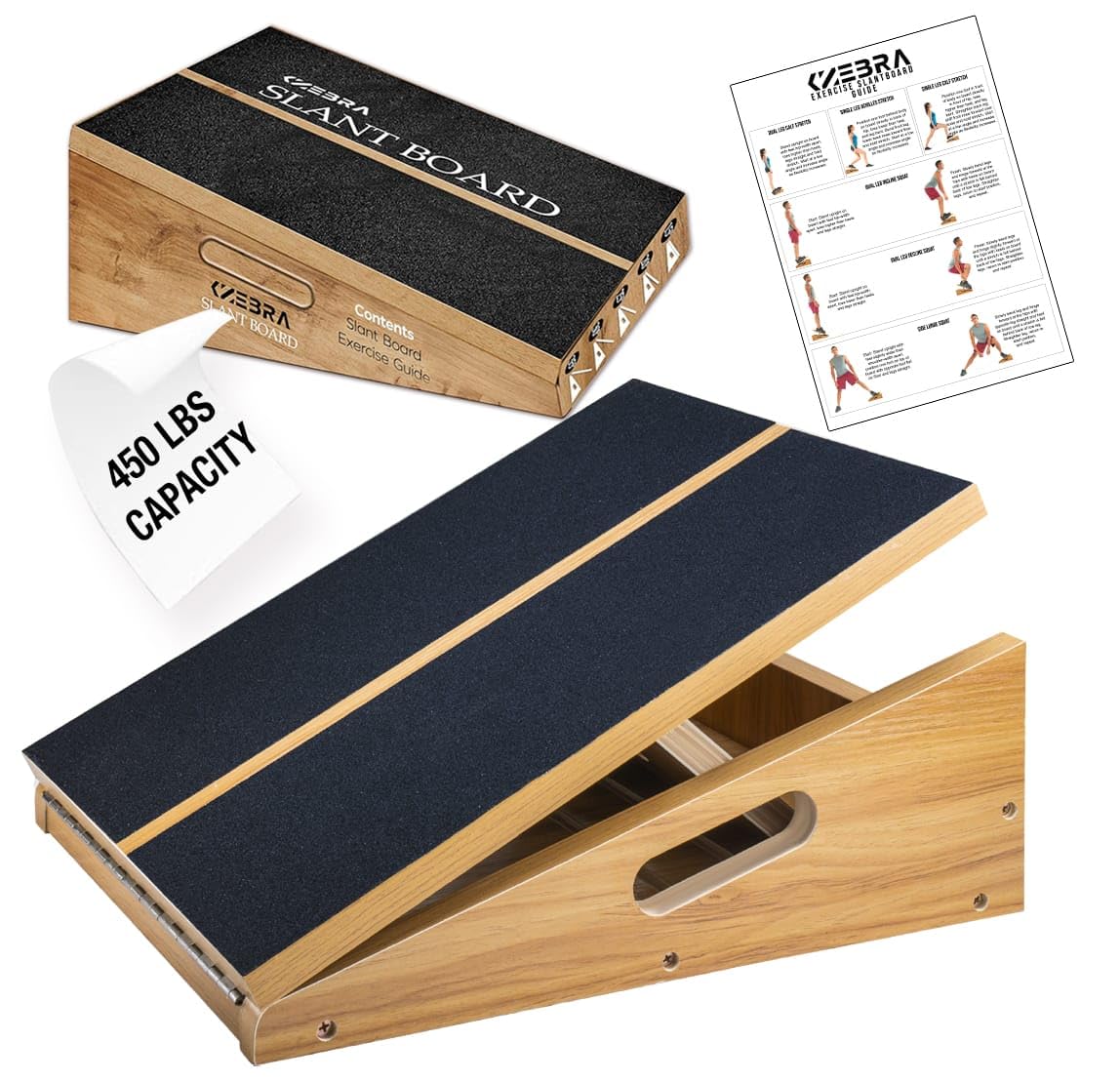
Built from lauan hardwood plywood, this board supports up to 450 pounds for rehab and daily use.
This slant board is built from lauan hardwood plywood, which the maker says is stronger than birch or pine alternatives. Owners mention it is “excellent for ACL recovery; 5 adjustable angles, stable, solid wood, folds flat,” and that it is “superior to plastic options” for daily rehab work.
The 16-inch depth gives you more room front-to-back compared to the KIJO Studio board at 11.8 x 11.8 inches, so your heels and toes both sit comfortably on the deck. The five angles match the StrongTek (15° to 35°), and the anti-slip safety treads on top and bottom keep everything planted. At 9.11 pounds, it is noticeably heavier than the portable StrongTek — less convenient to carry room-to-room but more reassuring underfoot for rehab where stability is everything.
What the data calls out most is effectiveness — owners use it for hamstring stretches, calf work, and post-surgery recovery. The few who mention a downside note it is bulkier than expected, but the trade-off is a board that the whole family can use without creaking.
grab this for: ACL recovery, plantar fasciitis relief, or any rehab where you need a stable, higher-capacity board that folds flat between sessions.
skip it if: portability is your priority — the StrongTek above at 5.3 pounds versus the KZEBRA at 9.11 pounds and travels easier.
3. KIJO Studio 16-Level Adjustable Solid Wooden Slant Board
Sixteen angles let you micro-adjust your stretch or squat depth
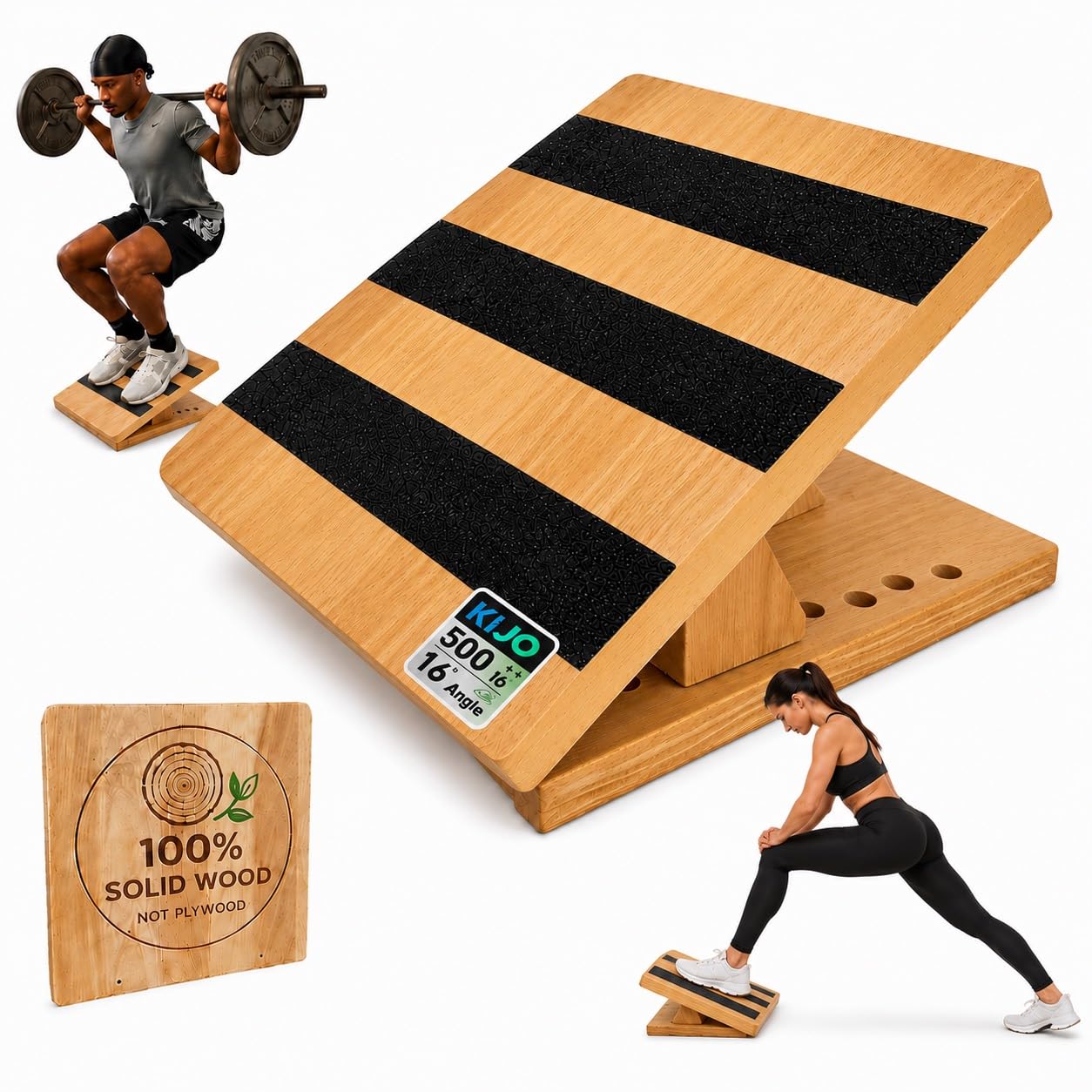
Most adjustable slant boards give you five or six positions. This one gives you 16 adjustable incline levels, which means you can increase the angle in much smaller steps — useful if you are working through a tight ankle or building squat depth millimeter by millimeter. The solid wood construction and reinforced triangular base support up to 550 pounds, beating both the StrongTek and KZEBRA on raw capacity. Buyers describe it as a “solid wood board with 16 adjustable angles and anti-slip patches” that delivers “deep calf and ankle stretching.”
The compact footprint (11.8 x 11.8 inches) is smaller than the other boards here, so your feet sit closer together. That is fine for calf stretches and ankle mobility work, but for squats you will feel the narrower platform compared to the 17-inch Swara or 19.6-inch StrongTek fixed board. The sturdiness wins the most praise — owners say it is “very sturdy” under heavy use and Helps relieve plantar fasciitis..
One heavier user (around 250 pounds) felt the board seemed flimsy, though most owners call it rock-solid. The 7.65-pound weight sits between the portable and heavy-duty options, and the anti-slip rubber feet keep it planted on smooth gym floors.
best for: anyone who wants to progress flexibility in very small increments — physical therapy patients and mobility-focused athletes will appreciate the fine-tuned adjustability.
a note of caution: the narrower platform and compact size may not suit wide-stance squats or users with larger feet who want every inch of deck space.
4. EVERYMATE Slant Board Calf Stretcher (19.7 inches)

A single-angle wedge built wide enough for serious squat work
At 19.7 inches across, this board is wider than most people’s shoulders — you can stand in a true squat stance without your heels hanging off the edge. The 0.71-inch thick hardwood plywood and full sandpaper top give you grip that owners say works well even barefoot. The single-angle design (no adjustable levels) keeps the structure simple and incredibly strong: the board supports up to 1000 pounds, matching the StrongTek fixed board for the highest capacity in this roundup.
Unlike the adjustable boards, this one has one fixed incline angle, so you cannot dial it up or down. That is the trade-off for the bomber build. The 2 ribbed panels on the bottom stop it from sliding on smooth floors, and the handshake holes on both sides and the back make it easy to carry. Buyers use it for ATG squats, VMO work, and heavy lifting routines, calling it “sturdy” and “very sturdy” — the sturdiness and quality aspects dominate owner feedback.
The main recurring observation is that the edges are sharp — a few owners noted they could be more comfortable on bare skin. The width is the standout feature here, giving you a stable base that the narrower adjustable boards simply cannot match when you are loading heavy.
ideal for: lifters who know their preferred angle (no experimentation needed) and want the widest, most bombproof platform for barbell squats and ATG training.
not for: anyone who needs multiple incline levels to progress flexibility or accommodate different family members with different needs.
5. 17″ Premium Portable Wooden Slant Board
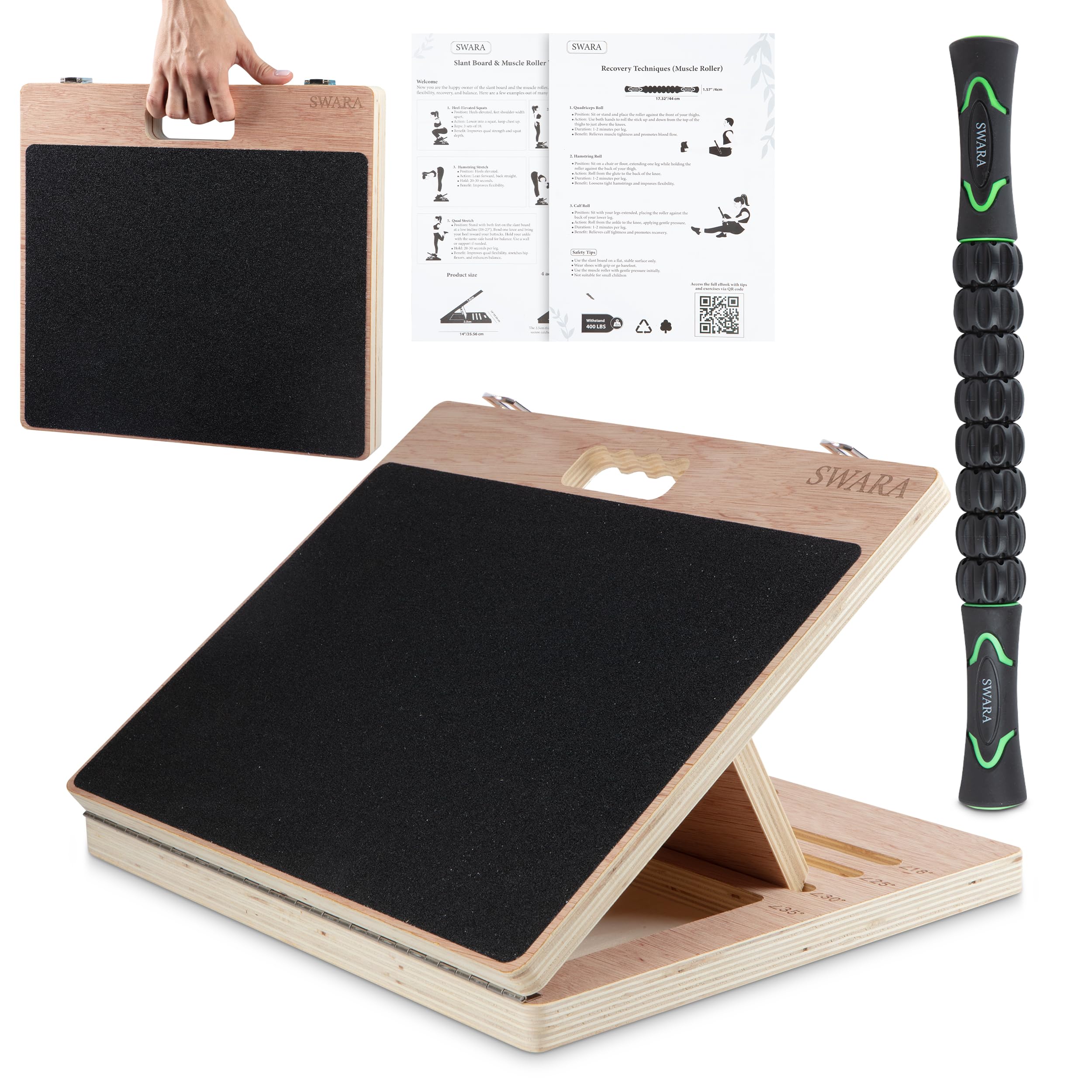
Extra-wide board that arrives with a muscle roller and training guide
This board measures 17 inches wide — wider than the StrongTek portable (13.3 inches) and the KIJO Studio (11.8 inches) — giving you a confident squat stance without going all the way up to the 19.6-inch fixed boards. The 0.98-inch (2.5 cm) thick exterior-grade wood base supports up to 400 pounds, which covers most home gym work. Owners consistently call it “sturdy, well-crafted” and note the grip is excellent even barefoot, with “no slipping” during use.
The foldable design means it stores flat, and the bonus roller is a legitimate add-on for post-stretch massage, not a cheap throw-in. Customers note it provides “instant relief for squats and ankle stretches” and that the 17-inch width is “ideal for stance” when adding bands or weight.
An occasional owner notes the four-angle range is slightly less versatile than five-position rivals, but the wider platform and included accessories offset that for most people. The eucalyptus wood construction is a nice touch — it looks more like furniture than gym equipment.
reach for this if: you want a mid-width board that feels premium, folds flat, and comes with everything you need to start stretching immediately — especially if you are buying for someone else.
consider alternatives if: you need more than four angle options or plan to load beyond 400 pounds with heavy barbell work.
6. StrongTek Slant Board for Squats & Knee Training (Fixed 25°)

The non-adjustable workhorse built for ATG squats and heavy loads
This is not a board for experimenting with angles — it is a fixed 25-degree wedge designed for one job: supporting your heels during deep squats and knee-over-toes training. The 19.6-inch wide deck is the second-widest in this lineup (only the EVERYMATE board matches it), and the three-point support structure plus hardwood plywood construction lets it handle a massive 1000 pounds. Owners have tested it with a 135-pound bar plus 160 pounds of bodyweight and report it felt “100% stable.”
Your feet stay planted and the board won’t slide on any floor, thanks to the non-slip top surface and anti-slip strips on the base. Since it is non-adjustable, there are no moving parts to wear out or loosen — reviewers point out this board will likely outlast every adjustable model in this guide. The hardwood is FSC-certified (sustainably sourced from responsibly managed forests), and it wipes clean with a damp cloth. The trade-off is that it does not fold, so you need permanent floor space for it.
Buyers who have used it for two years praise its durability and say it fits size 12 feet comfortably. The fixed 25-degree incline is steeper than the 15-degree starting point on adjustable boards, so absolute beginners may find it aggressive for calf stretching. But for its intended purpose — weighted squats, split squats, and ATG work — this board is as solid as it gets.
best for: serious lifters who know 25 degrees works for them and want a bombproof, permanent platform for barbell squats that will never wobble or break.
not ideal for: flexibility beginners or anyone who needs a range of angles — the adjustable boards above serve that need much better.
Understanding the Specs
Width (Deck Width)
The width of the board determines how comfortably you can stand in a squat or lunge stance. A board 13 inches wide is fine for single-foot calf stretches, but for two-foot squats you want at least 17 inches to let your feet sit at shoulder width. The EVERYMATE and StrongTek fixed boards at roughly 19.6 inches are effectively as wide as most people need.
Incline Levels (Adjustability)
The number of angles a board can lock into. Five levels (typically 15° to 35°) is standard and covers most users from beginner to advanced. Sixteen levels, as on the KIJO Studio board, lets you progress in tiny increments — useful for rehab where millimeter changes matter. A fixed-angle board (25°) removes adjustability entirely in exchange for maximum strength and simplicity under heavy loads.
Weight Capacity
The maximum load the board can support safely. For bodyweight stretching, 350 to 400 pounds is plenty. For weighted squats with a barbell (your bodyweight plus the bar plus plates), a board rated for 550 pounds or higher gives real confidence. The EVERYMATE and StrongTek fixed boards both hit 1000 pounds, meaning they can handle almost any home gym setup without flexing.
Material and Build
Hardwood plywood (lauan, eucalyptus, or birch) is the standard for durability and stability. A board with a reinforced triangular base or 0.71-inch-plus thick wood resists flexing under load better than thinner or softer wood. The non-slip surface and rubber feet are critical safety features — without them, the board can slide on a smooth floor, especially during dynamic movements like ATG squats.
FAQ
What angle should I start with on a wooden slant board?
Is a wooden slant board better than a plastic one?
Can I use a slant board for squatting with a barbell?
How wide should a slant board be for squats?
Does a slant board help with plantar fasciitis?
Will a slant board fit under my bed or sofa?
How many incline levels do I really need?
Can a heavy person (over 250 pounds) use a slant board safely?
Do I need shoes, or can I use a slant board barefoot?
Final Thoughts: The Verdict
For the majority of shoppers, the best wooden slant board winner is the StrongTek 13″ Wide Portable because it nails the balance of five useful angles, foldable storage, and a price that makes it easy to own. If you want a wide platform for heavy squatting, grab the EVERYMATE Slant Board — its 19.7-inch deck and 1000-pound capacity leave nothing on the table. And for rehab or precise flexibility work, the KIJO Studio 16-Level board lets you dial in your stretch one click at a time.
How We Picked
We do not accept paid placement. Every pick is matched to a real buyer and a real use-case; we do not hands-on test units.
Sources & Methodology
Specifications: manufacturer listings and product documentation. Review insights: verified customer reviews, as of July 2026. Pricing: not shown on this page (it changes often); check the current price via the retailer link.
As an Amazon Associate, Calories Fit earns from qualifying purchases. This does not affect which products we feature.