
Our readers keep the lights on and the coffee maker working hard! As an Amazon Associate, I earn from qualifying purchases.
Specs are compiled from manufacturer listings and verified buyer reviews and can change over time — please confirm the key details on the product page before buying.
Buying a wooden grain mill means you are looking for a quieter, cooler, and more traditional way to turn whole berries into fresh flour or flaked oats. You get to keep the nutrients intact and skip the noisy, overheating electric grinders. The challenge is that “wooden” can mean anything from a decade-worthy heirloom to a wobbly base that tests your patience. This guide cuts through that, focusing on the mills that earn their spot on your counter — not just the ones that look nice in a photo.
I’m Mohammad — the founder and writer behind Calories Fit. This guide is built by comparing the manufacturers’ published specifications and the patterns across verified customer reviews, so you get each pick’s real strengths and trade-offs instead of marketing spin.
Whether you are milling masa for arepas, crushing malt for a weekend brew, or grinding your morning coffee beans fresh, the right wooden grain mill transforms your kitchen routine. This is your no-fluff comparison of the best wooden grain mill options available right now.
Our Picks at a Glance

How To Choose The Best Wooden Grain Mill
First, decide what you are grinding. A mill for dry wheat flour is built differently than one for wet masa or oily seeds. Steel roller mills are ideal for cracking malted barley for beer, while stone burr mills preserve the natural oils and aroma for fine baking flour. Your choice of burr material directly affects the texture, temperature, and taste of your final product.
Burr Type: Stone vs. Steel
Stone burrs crush grain between two abrasive stones, running cool to keep the germ oils from turning rancid. They produce a very fine, airy flour perfect for bread. Steel burrs use sharp ridges to shear the grain, which is better for oily, wet, or high-moisture ingredients like soaked soybeans or fresh masa. Steel also handles spices and coffee without absorbing odors.
Power Source: Manual vs. Drill-Aided
Pure manual mills give you total control and require no electricity, making them great for off-grid use or small batches. However, turning a crank for a full loaf of bread is a real arm workout. Many modern wooden-base mills accept a standard electric drill on the drive shaft — this lets you crush 7 pounds of grain in under a minute while still having the option to go manual when you want.
Build Quality and Stability
The wooden base or frame must be solid, with suction cups or a clamp to keep it from walking across the counter during use. A mill that wobbles on the table is frustrating and dangerous. Look for thick, well-finished wood with a secure mounting system. The metal grinding components should be rust-resistant (food-safe stainless steel or tin-coated cast iron) and adjustable so you can fine-tune the coarseness.
Quick Comparison
| Model | Best For | Burr Material | Capacity | Adjustable | Amazon |
|---|---|---|---|---|---|
| Schnitzer Campo★ Best Overall | Porridge & muesli flakes | Stone / Stainless | 3.89 oz (110 g/min) | Continuous | Amazon |
| FERRODAY Malt MillBrewer’s Champion | Homebrew beer malt | Stainless Steel | 7.7 lb hopper | 0.025–0.1 inch | Amazon |
| MRbrew CrusherTop Performer | Electric-drill milling | Stainless Steel | 7 lb hopper | 0.025–0.1 inch | Amazon |
| Kitchen Crop | Electric + manual backup | Stainless Steel | 2 cups | Dial adjustment | Amazon |
| waitwit Granite Mill | Wet & dry flour grinding | Natural Granite | Small-batch | Manual crank | Amazon |
| Nizodo Granite Mill | Artisanal flour & wet grind | Natural Granite | 14.5 kg unit | Manual only | Amazon |
| WANLIAN Stone Mill | Soy milk & spice grinding | Natural Bluestone | 40 lb unit | Manual only | Amazon |
| Corona Manual Mill | Budget corn & chickpeas | Cast Iron (tin-coated) | 0.8 quart | Plate adjustment | Amazon |
| Estrella Grain Mill | Small-batch masa | Cast Iron | 0.8 quart (0.75 L) | Plate adjustment | Amazon |
In‑Depth Reviews
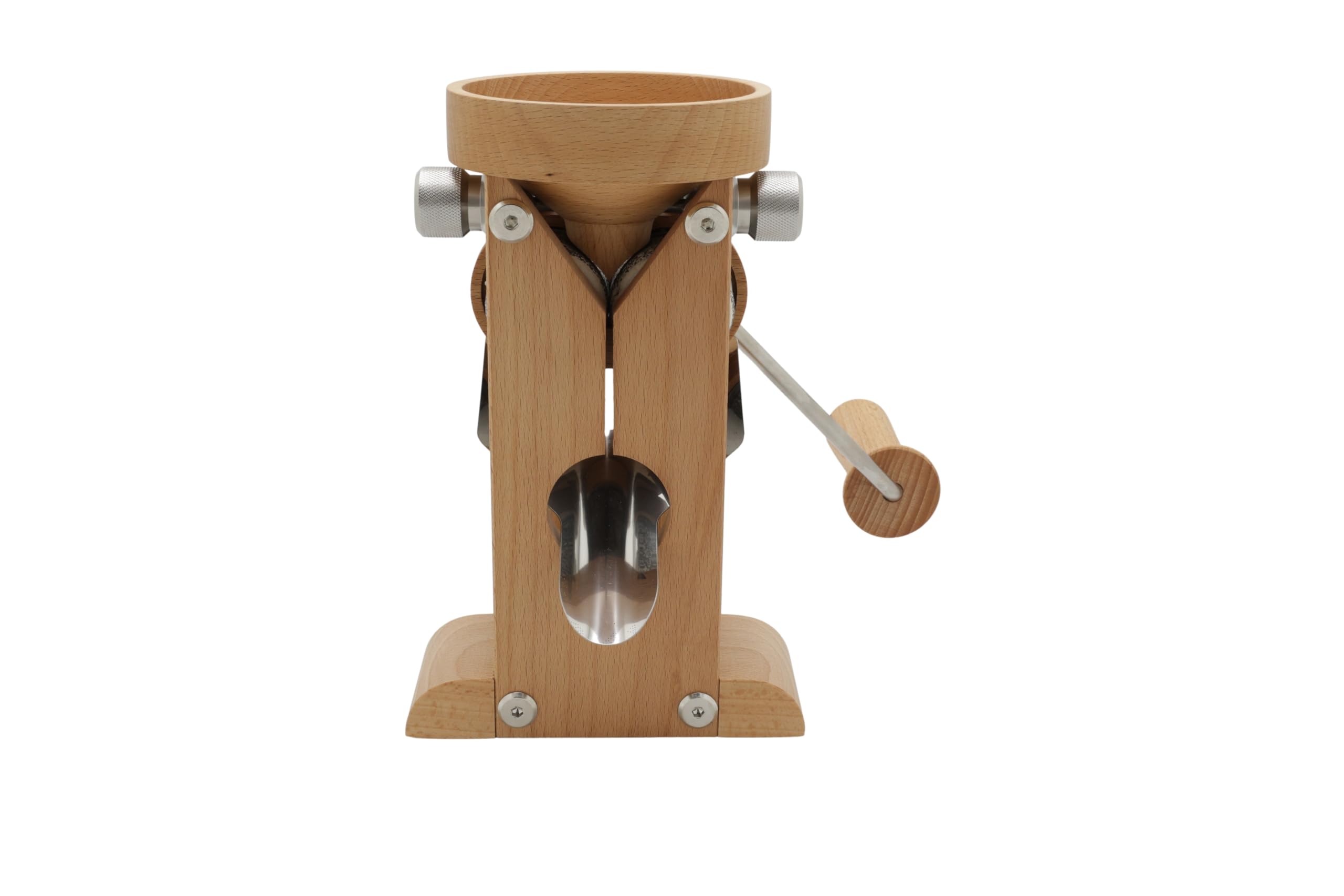
1. Schnitzer ME1154 Campo Grain Crusher and Stone Flaker
Our pick — over 4.5★ from 50+ verified ratings; the strongest balance of quality and price.
The beechwood mill that flanks your morning porridge at 110 grams per minute.
This is the pick for anyone who lives on fresh muesli, oat flakes, and stone-ground goodness. The wood body, hopper, and crank handle all come in beechwood, and the flaking mechanism uses precision ball-bearing rollers made of stainless steel — so the drive stays smooth batch after batch. You dial in the flake thickness continuously, from a coarse crack to a paper-thin sliver, without ever needing to swap parts.
The real win here is the 110 g/minute flaking speed. That means a full bowl of fresh oatmeal from whole oat groats takes about 90 seconds. Buyers report that it “does a good job” and note a slight wiggle in the mechanism, which seems to be by design — it does not affect the grind quality. The table clamp attaches securely to your countertop, and the whole unit measures 9.84 x 4.72 x 9.84 inches, so it fits under most cabinets. It is also fully disassemblable for cleaning, unlike many sealed flakers.
What wins people over is the sheer freshness. One owner described it as “handsome” and mentioned friends would buy it just for looks, but the real payoff is flaking oat groats, millet, and quinoa for a muesli that tastes “tastier and healthier than granola.” The only trade-off: the adjustment mechanism sits inside the hopper where small seeds like flax can catch, and the gap is not perfectly reproducible. For a dedicated flaker that doubles as a kitchen ornament, this is a tough act to beat — and it sits at a much shorter profile than the larger Estrella or Corona mills.
Flakes on demand: Smooth, adjustable, and genuinely fast enough for a daily habit. The stone and steel combo keeps heat out of your grains so the oils stay fresh.
Consider before buying: Small seeds like sesame can get caught in the adjustment area, and the wiggle some buyers see may bother you if you expect total rigidity.
Reach for this if: You eat rolled oats or muesli multiple times a week and want the freshest possible flake without an electric machine.
Look elsewhere if: You need to grind dry flour from hard wheat in volume — a dedicated stone grinder is better for that job.
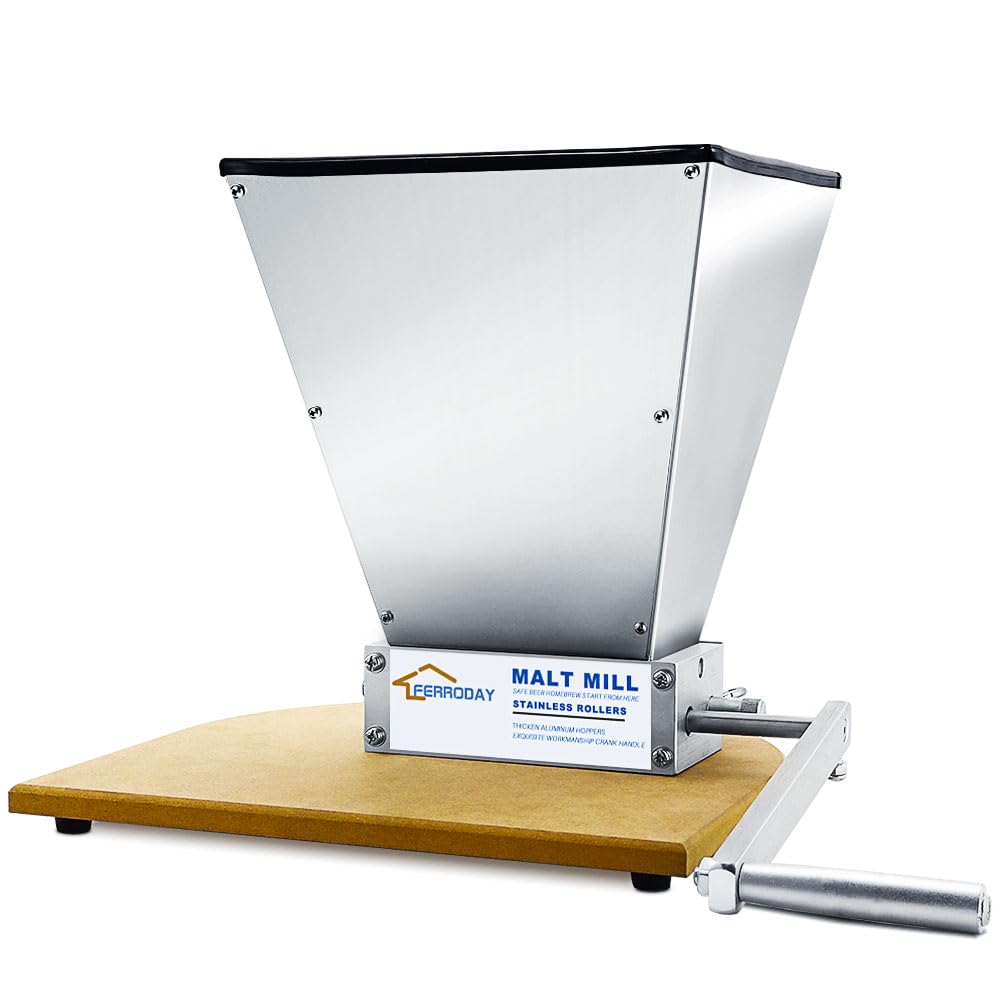
2. FERRODAY Malted Grain Mill with Wooden Base
The homebrewer’s workhorse that crushes 10 lbs of malt in under a minute.
FERRODAY built this 2-roller mill for serious homebrewers who need a repeatable crush without wrecking the hull. The 5-inch stainless steel rollers with 12 TPI knurl grab the grain and pull it through cleanly, leaving the husk intact for a good sparge bed. You set the gap from 0.025 to 0.1 inches, and owners mention that using a feeler gauge (or even a credit card at 0.030 inches) gives you the precision you need for BIAB (brew-in-a-bag) setups.
A cordless drill at low speed turns this into a monster — owners say it chews through a full 7.7 lb hopper in about 60 seconds on drill mode. The wooden base sits snugly on a 5-gallon fermenting bucket, and the gap stays put once you dial it in. The crowd favorite here is performance: owners who milled over 100 lbs of grain in a month report the rollers hold up well. The recurring tip is to avoid flaked grains, which gum up the works, and to keep a feeler gauge handy because the adjustment knobs lack tic marks.
Quality and value are the top two aspects owners praise, beating even raw performance counts. That said, assembly can be fiddly — a few owners found the drive roller installed backwards (a 10-minute fix) and noted the instruction sheet is sparse. The mill is explicitly not for corn or soybeans, so stick to malted barley and wheat for best results. For the price range, as one buyer wrote, “this grain mill work well” once you dial in the gap and run a low-speed drill.
Drill mode monster: Hook up a 3/8-inch drill at low speed and crush a full 7.7 lbs of grain in about a minute. The stainless steel rollers leave the hull intact for better lautering.
Setup needs patience: The adjustment gap is unmarked, so using a feeler gauge is almost mandatory. Assembly can involve fixing a backwards drive roller from the start.
Best for: Homebrewers who do 5–10 gallon batches regularly and want a mill that keeps pace with a drill.
Not for: Anyone needing to grind corn, soybeans, or very wet ingredients — this is strictly a malt mill.
3. MRbrew Grain Crusher Homebrew Malt Mill
An adjustable roller mill that handles both manual grinding and drill power.
MRbrew’s 2-roller crusher gives you an integrated wooden base that is flat and weighted at the edges, so it stays put on any flat surface without suction cups. The rollers use heavy-duty ball bearings and a precision gap that adjusts from 0.025 to 0.1 inch — exactly the range you need to dial in a perfect crush for everything from a fine mash to a coarse grist. The 7 lb hopper means fewer refills than the FERRODAY’s 7.7 lb capacity, but still enough for a full 5-gallon batch in one go.
What sets this mill apart is the grinding performance — owners call that out as the number one positive aspect. “Grinds my beer malt beautifully” is a common sentiment, and while it requires patience to find the exact gap setting, owners note that once set, it stays. The mill also accepts a 3/8-inch hex socket electric drill on the drive shaft, turning it into a near-automated system that saves your arm. Durability gets mixed feedback: some find it surprisingly sturdy after many brews, while others report the drive shaft can unthread over time. One owner who used it on three brews called it “great” and praised the three-level adjustment.
The bottom line: this is a direct competitor to the FERRODAY, trading a slightly smaller hopper for a more compact footprint that fits easier on a narrow counter. Assembly is straightforward, but the adjustment knobs lack tic marks — the same frustration as the FERRODAY. If you prefer a lower-profile wooden base and do not mind the smaller capacity, the MRbrew is the more stable-feeling mill of the two.
What wins
- Performance is the top praised aspect — crushes malt beautifully for brewing
- Drill mode works with standard 3/8-inch hex socket for fast milling
- Flat wooden base stays stable without needing a clamp
Where it stumbles
- Durability is mixed — some owners see the shaft unthread after use
- Adjustment gap settings lack any reference marks for repeatability
Best for: Homebrewers who want a compact, stable mill that works with a drill and outperforms its price.
Skip if: You want a mill for anything besides malted grain — it is purpose-built for beer brewing.
4. Kitchen Crop Grain Mill Wheat Flour Grinder

A dual-power mill that works by hand or by motor with stainless steel burrs.
Kitchen Crop’s mill kit includes both the manual grain mill and a separate motor, so you can switch between hand-cranking and electric power depending on your mood or energy. The stainless steel burrs grind wheat, rice, oats, barley, rye, and even non-oily spices into flour ranging from a coarse crack to a fine bread-quality powder. An external dial lets you adjust the coarseness on the fly without opening the mill.
The motor runs on standard household current, and a sturdy mounting clamp secures the mill to your countertop. The downside is the hopper is tiny — it holds just 2 cups of grain, which means you will refill several times for a single loaf of bread. Owners who grind 15 lbs per month report it is “simple and dependable” with a caveat: the small hopper requires about 1.5 bins for a 2-lb loaf. One owner noted that “manual cranking is nearly impossible” without the motor, so treat this as an electric mill first with a backup hand option. A 5-year warranty backs the build, which is generous for the price tier.
What makes this interesting is the two-in-one value. If you want the security of a manual backup but mostly use electricity, this kit gives you both. The trade-off is speed — the motor is slow compared to a dedicated electric mill, and the 2-cup capacity means you cannot walk away. For the occasional baker who wants the freshest possible flour and appreciates having a grid-down option, the Kitchen Crop is a smart compromise.
Electric with a safety net: The motor does the heavy lifting, but the manual crank is there if the power goes out. Stainless steel burrs handle a wide range of dry grains.
Small hopper slows you down: 2 cups fills fast, so making enough flour for a loaf of bread involves multiple refill cycles. Manual cranking is tough without the motor.
Reach for this if: You bake occasionally and want one machine that works both with and without electricity.
Skip if: You mill large batches of flour weekly — the hopper size will frustrate you.
5. waitwit Natural Granite Stone Grain Mill with Wooden Base
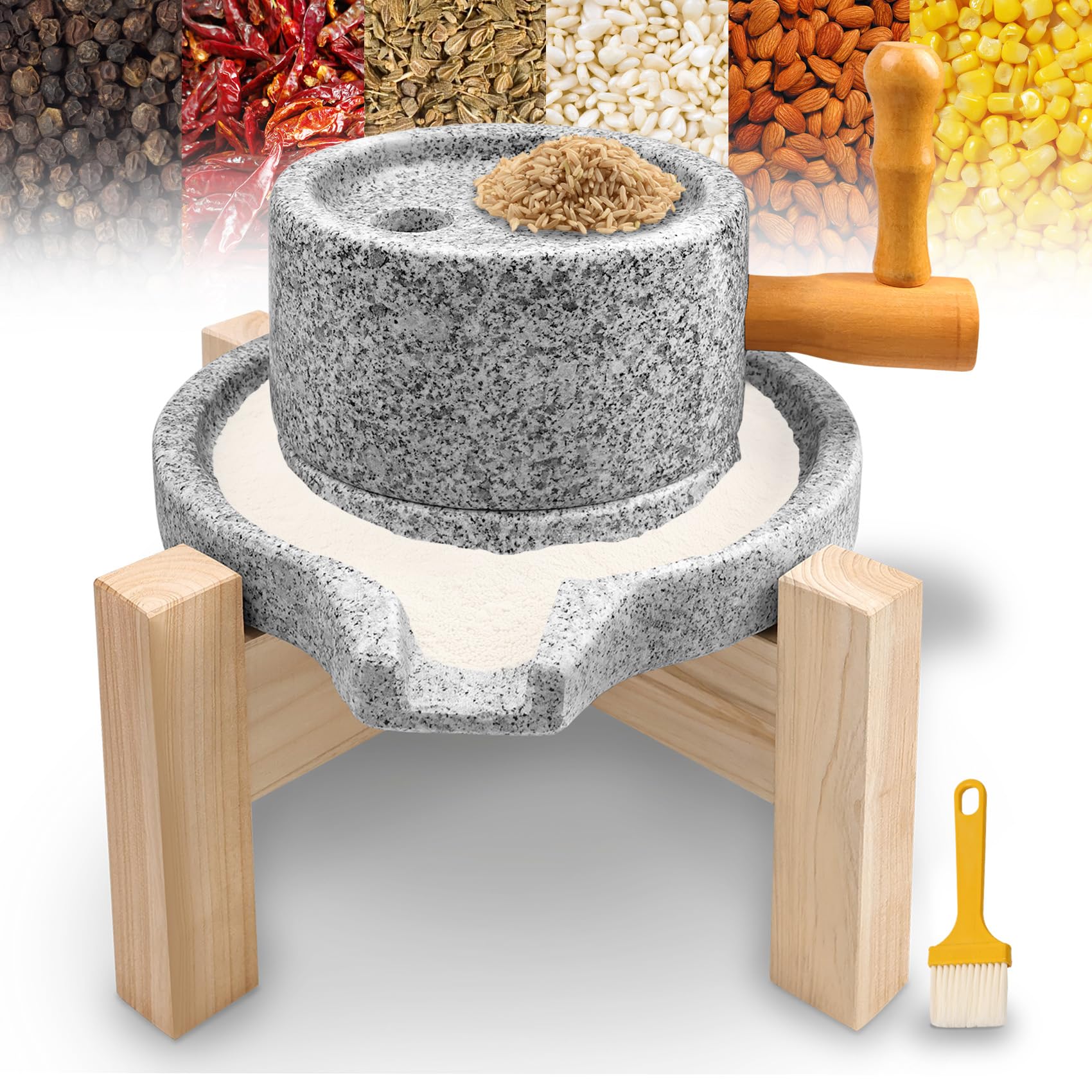
A hand-cranked granite stone mill on a solid wood base that grinds grains and spices into flour with old-world simplicity.
The waitwit mill pairs a solid natural granite grinding stone with a stable wooden base and a heavy-duty steel handle. Turning the crank draws grain between two granite surfaces cut with deep internal grooves, which shear the kernels into flour while the slow, low-heat action helps preserve the grain’s original taste and nutrition. Because the burr is stone rather than steel, it handles both dry grain and wet grinding — think soaked soybeans for soy milk, nut pastes, or a coarse cornmeal.
This is a deliberately slow, manual tool. There is no motor and no drill-attachment point, so output depends on how fast you are willing to crank, and the granite stones add real heft to the countertop. The grind runs from coarse meal to a fairly fine flour depending on how the stones are set, and the wooden base keeps the unit steady while you work. Cleaning is simple with a brush. The main tradeoff is throughput: stone hand-milling is slow, and fine flour usually takes more than one pass through the stones. As with most stone mills shipped with a heavy granite core, it is worth checking the finish on arrival, since the weight can lead to packaging scuffs.
What you are paying for here is genuine stone grinding without a five-hundred-dollar mill. The granite burr turns grain into real stone-ground flour and does wet grinds the steel roller mills cannot, but it rewards patience over speed. For small artisanal batches and hands-on grinding, the waitwit fills a gap the roller mills and electric options leave open. For anyone needing fast, hands-off volume, look at the electric picks instead.
True stone grinding: Natural granite burrs with deep grooves produce real stone-ground flour with low heat, and the mill handles both dry grain and wet grinds that steel mills cannot. The solid wood base keeps it stable.
Slow and manual: Hand-crank only, with no motor or drill option, so it is built for small batches rather than volume, and the granite makes it heavy.
Best for: Cooks who want genuine stone-ground flour and wet grinding in a compact, wood-based manual mill.
Not for: High-volume weekly baking or anyone hoping to attach a drill for speed — this mill demands patience.
6. Nizodo Natural Granite Stone Grain Mill with Wooden Stand
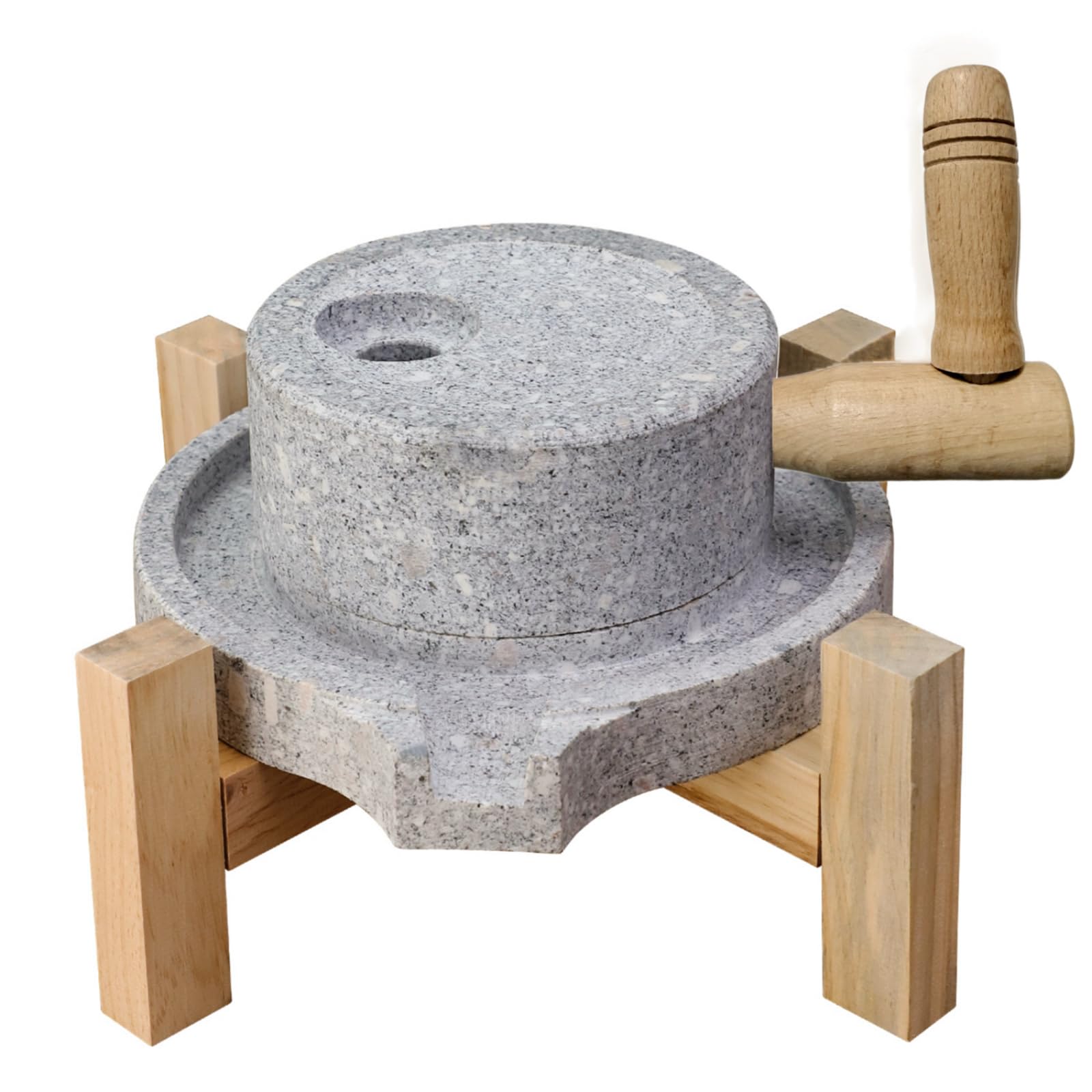
A dense granite stone grinder that produces real flour through repeated passes.
The Nizodo mill skips metal burrs entirely and uses two 100% natural granite stone disks. This design runs cool enough to never heat your ingredients, so the natural nutrients and aroma stay intact. It grinds dry wheat into flour and will process soaked beans into a silky liquid for soy milk or rice paste. The wooden stand is handmade and rustic, with a compact footprint of 7.8 x 11.8 inches.
Understanding how this mill works is key: it requires multiple passes to achieve fine flour. The manufacturer is upfront about this — it is a “manual tool for craftsmen who prioritize quality over speed.” Owners confirm you will need to run wheat through 5 to 10 times for bread-consistency flour. That said, the result is real, quiet, cool-ground flour. One owner who switched from a metal hand mill said this one is “much quieter” and works better. The mill weighs 14.47 kg (about 32 lbs), so it does not wander on the counter.
The catch is consistency from the start. Some units arrive with the grinding stone too loose to actually grind — one owner called it a “display item not a tool.” A missing stainless steel pin was reported by another buyer who had to fabricate a replacement. The wooden stand may also need eventual reinforcement. For meditative bakers and those committed to the slow food lifestyle, this mill delivers a unique, traditional flour. For anyone expecting a grab-and-grind solution, the multiple passes and setup issues will test your patience.
Authentic stone grinding
- Natural granite disks preserve nutrients and oils with no heat buildup
- Works for both dry flour and wet soy milk / rice paste
- Heavy and stable — does not move during operation
Be ready for slow work
- Requires 5–10 passes to get fine flour — labor-intensive
- Quality control is uneven; some units have loose stones or missing parts
Reach for this if: You are committed to a traditional, meditative grinding process and value cool-ground, nutrient-dense flour above speed.
Skip if: You want a consistent, fast, low-effort milling experience.
7. WANLIAN Stone Milled Grinder with Wooden Frame
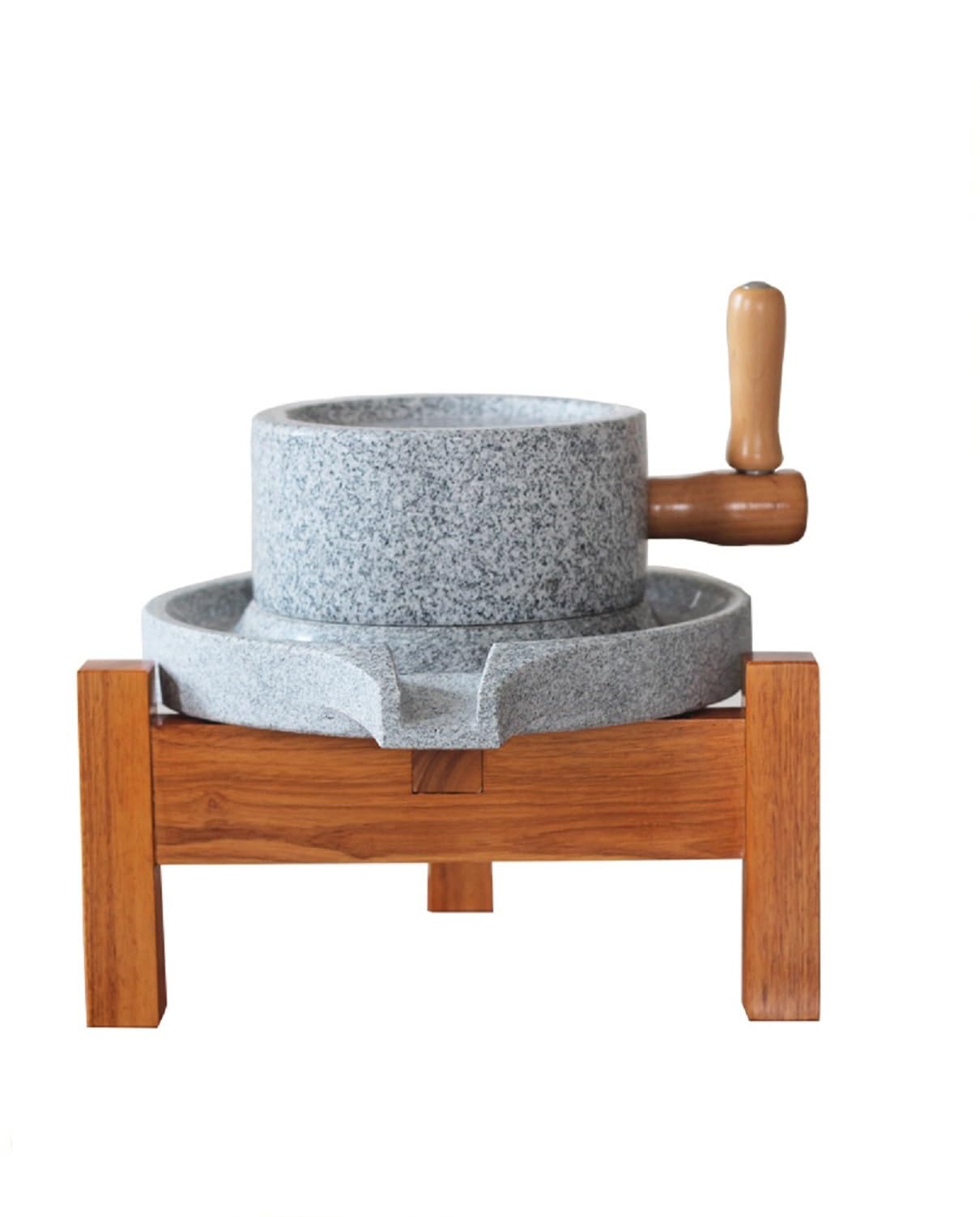
A 40-pound bluestone mill that turns countertop grinding into a full-body workout.
WANLIAN’s stone mill is massive — 40 pounds of natural bluestone mounted on a wooden frame. It is designed for grinding wet soybean milk, wheat flour, corn juice, sesame seeds, spices, and mung beans. The stone grinding teeth are hand-carved with a scientific depth and direction that the maker claims makes turning lighter and more efficient. The mill uses an anti-backflow design in the grinding nozzle to fast-divert the output without clogging.
The trade-off is effort. Customers note that turning wheat berries into bread flour takes 5 to 10 passes, and the physical demand is real — one reviewer noted being “sore after use.” At counter height, the mill is manageable, but some owners plan to build a waist-high stand for better leverage. The mill also handles wet ingredients: one owner used it for mustard seeds and said that after an initial break-in scrubbing, it “grinds perfectly on the first pass.”
The wooden stand is a weak point. Multiple owners reported the dowels arrived broken or loose, though a handy woodworker can fix it. The product page says to contact the seller if the handle is damaged, but one buyer found Amazon’s system blocked the seller contact. For the buyer who values authenticity over convenience, this mill produces a unique texture you cannot get from steel burrs. For anyone with a bad back or limited patience, the physical demand and assembly issues make it a hard sell.
class-leading texture: The hand-carved bluestone disks grind cool and retain the natural oils and flavor of your ingredients. The anti-backflow nozzle clears quickly.
Heavy and demanding: 40 lbs of stone takes a lot of muscle to turn through multiple passes. The wooden stand can arrive with broken dowels.
Best for: Traditional food makers who want an authentic stone-ground result and do not mind a physical workout.
Not for: Anyone with physical limitations or a low tolerance for assembly and setup issues.
8. Corona Manual Grain Mill with Wooden Base

A no-nonsense cast iron mill at a price that makes homemade masa easy.
The Corona is the classic entry-level wooden grain mill. The build is straightforward: a cast iron body with food-safe tin-coated grinding plates, a wooden base with suction cups, and a hand crank. It handles corn, rice, wheat, chickpeas, soybeans, and lentils, and the grinding plates adjust to give you anything from a coarse cracked texture to a fine flour. At 5.04 kg (11 lbs), it is heavy enough to stay put during cranking.
What owners love is that it works. “Excellent, I ground corn for my arepas, happy with the purchase” is the sentiment that sums up the positive reviews. The value proposition is simple: it is inexpensive and does the job for basic grain grinding. The easy adjustment is also a plus — you turn the drive screw to move the plates closer or further apart. The included suction cups on the wooden base help keep it steady on the counter.
The catch is durability. A number of reviewers point out the mill simply does not hold up — “don’t waste your money” is a recurring sentiment from those who received a unit with poor casting or stripped threads. The tin coating can also flake over time with heavy use. This is a budget pick that works brilliantly for occasional milling of smaller batches, but it is not built for daily, high-volume service. For someone making masa for family dinners or grinding chickpeas for falafel a few times a month, it is a fine deal. For a daily baker, the step up to the FERRODAY or Kitchen Crop is worth the money.
What you get for the low price
- Works well for corn, chickpeas, and basic grains with adjustable coarseness
- Wooden base with suction cups provides decent counter stability
- Simple, low-maintenance design anyone can operate
The budget trade-offs
- Quality control varies — some units have poor casting or stripped threads
- Tin coating can flake over time with heavy use
Reach for this if: Your budget is tight and you only mill grains occasionally for specific recipes like arepas or falafel.
Skip if: You plan to mill several pounds of grain every week — the build quality will not hold up to that kind of load.
9. Estrella Grain Mill with Wooden Table

A traditional Mexican corn grinder with an attached wooden table and red cast iron body.
The Estrella is the sibling of the Corona mill, sharing the same basic cast iron design but with an attached wooden table that includes suction cups. The 0.75-liter low hopper handles small batches of corn, rice, lentils, and chickpeas, and the ergonomic wooden handle is comfortable for extended cranking. At 9 x 5 x 11 inches, it is among the most compact wooden grain mills, making it easy to store.
The core complaint is stability — or the lack of it. The phrase “No está muy firme para su propósito de moler granos” (“not very firm for its purpose of grinding grains”) appears in multiple reviews. The wooden table and its anchoring system are the weak link; the mill can wobble when you crank hard. Several buyers also reported receiving units that were missing major parts or arrived clearly used and broken. The compact size and low price attract first-time buyers, but the inconsistency in build quality and packaging makes it a gamble.
For the buyer who wants the most compact budget option and is comfortable with a bit of DIY stabilization (a shim under the table or a sturdier clamp), the Estrella can grind corn into masa effectively. The cast iron grinding plates work fine when the mill is properly assembled. However, given that the Corona is similarly priced and shares the same footprint without the table-wobble issue, the Estrella is the weaker choice between the two budget mills.
Compact and traditional: The attached wooden table and ergonomic handle make this a neat package for small-batch corn grinding. The cast iron body is standard and functional.
Table is too flimsy: The wooden table does not provide a firm anchor during cranking, and some units arrive incomplete or damaged.
Best for: Someone who wants the smallest possible wooden grain mill for occasional masa or small grain batches and does not mind a wobbly table.
Look elsewhere if: You need a stable, reliable mill from the start — the Corona or FERRODAY are better bets at similar or slightly higher prices.
Understanding the Specs
Burr Material: Stone vs. Steel
Stone burrs (natural granite or bluestone) crush grain between abrasive surfaces. They run cool, so the oils and nutrients in your grain stay fresh. Perfect for fine bread flour, nut flours, and wet grinding soaked beans. Steel burrs (stainless or carbon steel) use sharp ridges to shear grain. They are better for oily ingredients, coffee beans, and spices, and they produce a more consistent particle size for brewing beer. Steel burrs do not absorb odors like stone can over time.
Roller vs. Plate vs. Conical
Roller mills (like the FERRODAY and MRbrew) use two parallel steel rollers to crack grain. They are the standard for homebrewing because they leave the husk intact for sparging. Plate mills use two flat grinding plates that rotate against each other, common in the Corona and Estrella budget mills. Conical burrs use a cone-shaped inner burr and an outer ring — they are the standard for coffee grinders because they produce a very uniform particle size with minimal fines, but they are not built to turn grain into flour. Stone burrs, like those on the waitwit, Nizodo, and WANLIAN mills, crush grain between two textured surfaces and excel at fine flour.
Manual vs. Drill-Powered
Pure manual operation gives you complete control and works anywhere without electricity. The trade-off is arm fatigue, especially with stone mills that require multiple passes. Drill-powered mills accept a standard 3/8-inch hex socket on the drive shaft. A low-speed electric drill turns 7 to 8 lbs of grain in about a minute. You still need to hold the drill, but it eliminates the cranking motion. Most drill-compatible mills also work as pure manual units when you want.
Hopper Capacity and Feed Rate
Hopper capacity determines how much grain you can load before needing to refill. A 2-cup hopper is fine for a single loaf of flour but requires multiple refills for a large batch. A 7+ lb hopper lets you load enough malted barley for a full 5-gallon brew in one go. Feed rate is also important — finer gaps slow the throughput, while coarser cracks move faster. For flour, multiple passes are expected; for beer malt, you want one clean pass that cracks the kernel without shredding the hull.
FAQ
Can I grind wet ingredients like soaked soybeans in a wooden grain mill?
Will a wooden grain mill fit on my standard kitchen counter?
How do I clean and maintain a wooden grain mill?
What is the difference between a grain mill and a flaker?
Will these mills also grind coffee and spices?
How fine can a manual wooden grain mill grind flour?
Can I use an electric drill with any manual grain mill?
Why do some grain mills have a wooden base while others are all metal?
How long does a wooden grain mill typically last?
What is the best wooden grain mill for corn masa?
Final Thoughts: The Verdict
For most people, the best wooden grain mill winner is the Schnitzer Campo because it nails the balance of speed, precision, and beautiful beechwood craftsmanship for fresh flakes every morning. If you brew your own beer and need a drill-powered workhorse, grab the FERRODAY Malted Grain Mill — it crushes 7.7 lbs of malt in about a minute with superior value. And for the traditional baker who wants cool-ground, nutrient-dense flour from natural stone, the Nizodo Granite Mill delivers an authentic slow-food experience built to last.
How We Picked
We do not accept paid placement. Every pick is matched to a real buyer and a real use-case; we do not hands-on test units.
Sources & Methodology
Specifications: manufacturer listings and product documentation. Review insights: verified customer reviews, as of July 2026. Pricing: not shown on this page (it changes often); check the current price via the retailer link.
As an Amazon Associate, Calories Fit earns from qualifying purchases. This does not affect which products we feature.