
Our readers keep the lights on and the coffee maker working hard! As an Amazon Associate, I earn from qualifying purchases.
Specs are compiled from manufacturer listings and verified buyer reviews and can change over time — please confirm the key details on the product page before buying.
Your knives meet a wooden cutting board hundreds of times a day. Pick the wrong board, and you will dull your blades fast, deal with warping after a few washes, or fight bacteria hiding in deep scratches. Pick the right one, and it protects your knife edges, stays flat for years, and looks better as it ages. This guide finds the boards that actually deliver on that promise.
I’m Mohammad — the founder and writer behind Calories Fit. This guide is built by comparing the manufacturers’ published specifications and the patterns across verified customer reviews, so you get each pick’s real strengths and trade-offs instead of marketing spin.
You need a daily workhorse for meal prep or a showpiece for holiday roasts. The best wooden cutting board lives in the balance between grain type, thickness, and real-world reviews that prove it holds up.
Our Picks at a Glance


How To Choose The Best Wooden Cutting Board
A wooden cutting board is a long-term kitchen partner, not a disposable gadget. The right choice depends on three things: the wood grain, the thickness, and the size that fits your counter and your cooking style. Get these right, and the board outlasts your knives.
End-Grain vs Edge-Grain: What is the Real Difference?
End-grain boards are built with the wood fibers pointing up — picture a bundle of drinking straws standing on end. The knife blade slips between these fibers rather than cutting across them. This “self-healing” property means end-grain boards are far gentler on your knife edge, and cut marks tend to close up over time. Edge-grain boards have fibers running parallel to the surface. They are easier to make and cost less, but they show scratches more readily and dull blades faster. For a daily-use board, end-grain is worth the upgrade.
Why Thickness Matters More Than You Think
A thin board (under 1.25 inches) can warp under heavy chopping or slide around on the counter. A 1.5-inch board gives you the heft to stay put and the mass to absorb impact without bouncing. Go for 1.75 inches or thicker if you do a lot of meat work — the weight keeps the board anchored and the extra depth prevents cracking over years of use.
Wood Type and Maintenance Commitment
Maple is the classic North American choice — hard, dense, and non-porous, it resists bacteria and knife scarring well. Teak has natural oils that repel moisture, but those same oils can be slightly harsher on blade edges. Acacia sits in the middle — affordable and water-resistant, but it varies in hardness from board to board. Walnut is a premium option — softer than maple, which is actually easier on your knives, and it develops a rich patina over time. All wooden boards need regular mineral oiling (every three to four weeks) to stay hydrated and prevent cracking. Never put them in the dishwasher — the heat and detergent destroy the wood fibers.
Quick Comparison
| Model | Best For | Grain Type | Thickness | Weight | Amazon |
|---|---|---|---|---|---|
| SHUMARU Mahogany★ Best Overall | Overall Daily Use | End Grain | 1.6″ | 8.5 lb | Amazon |
| FANICHI AcaciaBest Value | Value & Versatility | Edge Grain | 1.5″ | 7.1 lb | Amazon |
| Yes4All TeakLargest Surface | Large Turkey-Sized Board | End Grain | 1.5″ | 11.24 lb | Amazon |
| WoodForChef Maple | Knife-Friendly Maple | Edge Grain | 1.5″ | 8 lb | Amazon |
| John Boos Prestige Maple | USA-Made Classic | Edge Grain | 1.25″ | 8 lb | Amazon |
| BABILONIA Black Walnut | Premium End Grain w/ Accessories | End Grain | 1.7″ | 8.81 lb | Amazon |
| Caraway Birch Set | Multi-Board Organization | Edge Grain | 0.5″ | Light | Amazon |
| John Boos CCB Maple | Pro Butcher Block | End Grain | 2.25″ | 21 lb | Amazon |
In‑Depth Reviews
1. SHUMARU Mahogany End Grain Cutting Board
Our pick — over 4.5★ from 750+ verified ratings; the strongest balance of quality and price.
A heavy, end-grain workhorse that loves your knives as much as you do.
You get the end-grain advantage here — the wood fibers stand upright so your blade slips between them instead of cutting across. That “self-healing” surface keeps your knife edges sharp and resists deep cut marks even after months of daily use. At 1.6 inches thick and 8.5 pounds, it sits planted on the counter with zero wobble under heavy chopping. The built-in juice groove wraps around the perimeter to catch runaway liquids from meat or fruit, and the improve rubber feet underneath promote airflow to prevent moisture buildup after washing.
The mahogany grain is a standout — reviewers consistently call the appearance “beautiful” (it is the second most-praised aspect by a wide margin), and the pre-seasoned surface arrives ready to use with food-safe oils. Unlike the thinner edge-grain boards that show every scratch, the end-grain pattern here hides wear gracefully. At 17 by 13 inches, it offers 221 square inches of workspace — roomy enough for a full meal prep, yet compact enough to store without dominating the counter.
The 1.6-inch thickness is notably thicker than the 1.25-inch John Boos Prestige board below, giving it a more solid feel without the 21-pound heft of a commercial butcher block. It is also heavier than the SHUMARU’s own 7-pound spec suggests — buyers report the weight feels reassuring, not cumbersome. Owners mention that over three months of daily use, the board showed “no deep cuts, cracking, or warping.”
Why It Wins
- End-grain construction protects knife edges better than edge-grain boards
- Pre-seasoned with food-safe oils, ready immediately from the start
- Rubber feet keep it stable and allow airflow underneath to prevent moisture damage
- Deep juice groove effectively contains mess from meat and juicy produce
The Trade-Off
- Juice groove could be deeper for heavy carving tasks
- Requires hand washing and mineral oil every 3-4 weeks to maintain the wood
- Side handles are narrow, causing an awkward grip when carrying
Reach for this if: you want a genuine end-grain board that protects your knife investment and stays beautiful through daily abuse — it is the consensus crowd-pleaser.
Think twice if: you need a board larger than 17×13 inches for big holiday roasts, or you prefer a lighter board that is easier to move around.
2. FANICHI Acacia Wood Cutting Board
Two boards in one, with a smart reversible design that handles both veggies and cheese.
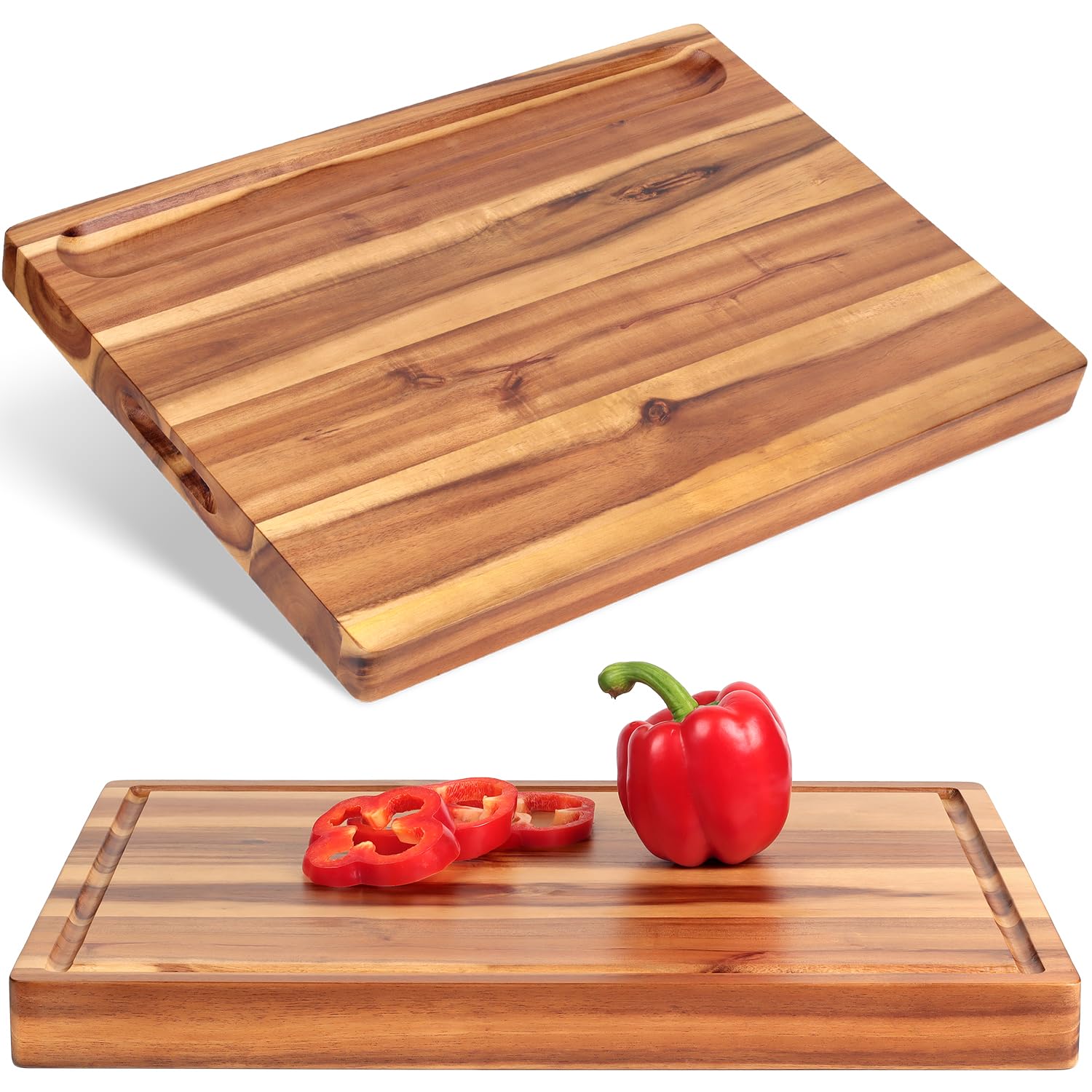
The defining feature here is the reversible surface. One side has a carved juice groove around the edge for catching meat and fruit liquids. Flip it over, and you get a flat surface with a long holder designed for slicing bread and cheeses. This dual-purpose approach means a single board replaces two in your kitchen, and the inner side handles make it easy to carry even when your hands are messy. At 17 by 13 by 1.5 inches, it matches the SHUMARU in footprint but weighs about the same — buyers describe it as “heavy duty” and appreciate the thick construction that does not slide around.
The acacia wood is 100% natural with no paint or chemical finish, so there is no risk of anything leaching into your food. Each board carries unique grain patterns — no two look identical. Customers note the pre-oiled surface works well for daily use, though re-oiling improves water resistance and makes cleanup noticeably easier. The board does show shallow cut marks over time, but the consensus is that this is cosmetic and does not affect performance.
Where the SHUMARU board excels in end-grain knife friendliness, this acacia board uses an edge-grain construction that is more affordable and still easy on blades — just not as forgiving as end-grain for high-end Japanese knives. The crowd favorite aspect here is the sheer build quality, with owners calling it “beautifully crafted” and praising the thick, sturdy feel. A minor complaint: some find the board slightly unbalanced on one corner, so a towel underneath can help stabilize it during heavy cutting.
Smart dual design: The reversible feature with a bread-and-cheese side gives you real versatility for the price — perfect for kitchens where counter space is at a premium.
Snag this for: budget-minded buyers who still want a thick, heavy board with thoughtful features like the groove and reversible sides — it punches well above its tier.
Pass if: end-grain construction is a must for you, or if you need a board that stays perfectly flat without needing a towel underneath.
3. Yes4All Large Teak Cutting Board
The turkey-sized end-grain board that gives you workspace and knife protection in one go.
At 20 by 15 inches and 1.5 inches thick, this is the board you reach for when a whole turkey, a massive batch of vegetables, or a full charcuterie spread is on the menu. The end-grain teak construction is gentle on knives — the fibers close up around the blade, reducing visible cut marks and keeping edges sharp. That heft also means it absorbs impact without bouncing, making heavy chopping feel solid and controlled.
Teak is naturally moisture-resistant thanks to its dense grain and natural oils, which helps the board resist warping better than some other woods. The deep juice groove and built-in side handles add everyday practicality. Owners consistently call the board “beautiful and well-constructed,” noting it lays perfectly flat right from the start. The most-discussed aspects are appearance and quality, both praised by over a hundred owners each. However, a minority report warping or bowing in the middle, so keeping it oiled and stored upright in a cool, dry place is important for longevity.
The Yes4All is 20×15 inches and weighs 11.24 pounds, while the SHUMARU is 17×13 inches and weighs 8.5 pounds — a meaningful jump for anyone who regularly preps large meals. The trade-off is that its size and weight make it less portable and harder to store in a standard cabinet. It also requires the same mineral oil care as any wood board, but teak’s natural oils mean it needs slightly less frequent conditioning than maple or walnut.
True turkey territory: The 20×15-inch surface handles a full holiday bird with room to spare — a serious upgrade if your current board overflows during big meals.
Choose this when: you regularly cook for a crowd or prep large cuts of meat and need a board that stays anchored without sliding.
skip it if: you have limited counter space or need a board you can easily lift and store — this one is a permanent resident on the counter.
4. WoodForChef Maple Cutting Board

Sustainably sourced North American maple that feels premium without the premium price.
This board brings FSC-certified North American maple to the table — meaning the wood comes from responsibly managed forests, which matters for eco-conscious buyers. The 16 by 12 by 1.5-inch dimensions make it slightly more compact than the 17×13-inch boards above, but the 8-pound weight still gives it a planted, no-nonsense feel on the counter. The deep juice groove is a practical upgrade, catching liquids so your counter stays clean. The edge-grain construction strikes a balance between ease of maintenance and knife friendliness — it requires less upkeep than end-grain boards and does not dull blades as quickly as glass or plastic surfaces.
The board arrives pre-seasoned with mineral oil and beeswax, so it is ready to use immediately. Owners note that the hard maple resists scratches well and feels pleasant under the knife — one described the cutting sensation as “nice feel on the knife,” which is a common praise. Quality is the top-cited aspect by far, mentioned by over a hundred owners, and the appearance is widely complimented. The pre-seasoning is a head start, but many owners recommend adding an extra coat of oil and wax before first use if you want the richest color and best water resistance.
Where the SHUMARU and Yes4All boards offer end-grain self-healing, this maple board is edge-grain — it will show cut marks more readily, and it is less forgiving on ultra-hard Japanese knife steels. Durability gets mixed feedback from owners: while many find it holds up, a few report splitting or cracking over time. The short side handles are a minor ergonomic gripe — they are small and can be awkward to grip when carrying the 8-pound board to the sink.
Eco-conscious build: The FSC-certified maple and sustainable sourcing give this board a genuine green credential that most competitors do not match.
Go for it if: you want a sustainably made maple board that is ready to use on day one and offers a smooth, scratch-resistant surface at a reasonable price.
Look elsewhere if: end-grain self-healing is a priority, or you prefer a larger surface for bulk meal prep.
5. John Boos Prestige Series Maple Cutting Board
A legendary brand name, but this particular board shows its limits with daily abuse.
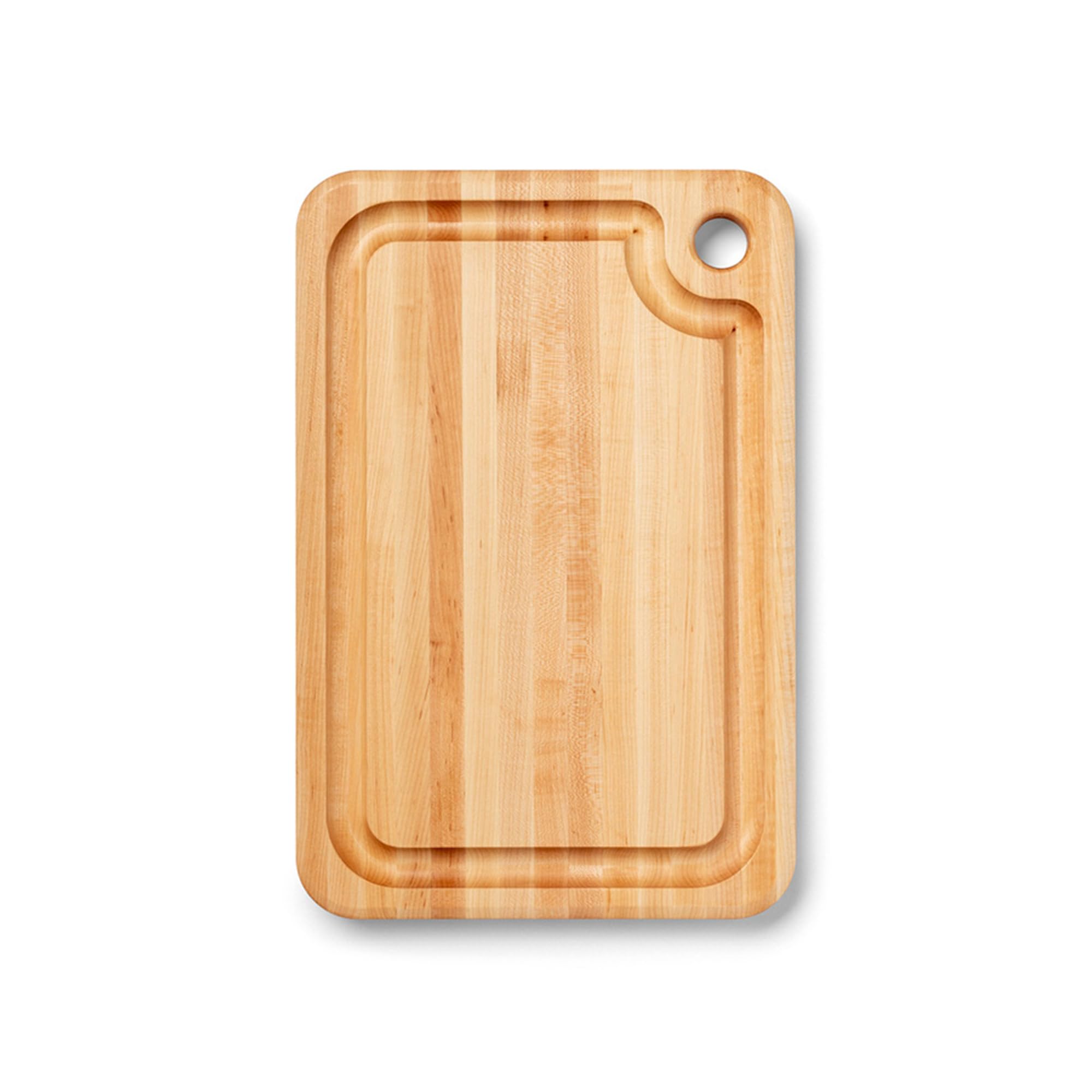
John Boos has been making cutting boards in the USA since 1887, and the Prestige Series carries that heritage with a solid edge-grain rock maple build measuring 18 by 12 by 1.25 inches. The reversible design offers two flat sides, and the finger-grip hole makes it easy to lift and carry. The juice groove is well-positioned for carving cooked meats, and the oil finish gives it a classic, warm look from the start. At 8 pounds, it feels dense and stable during use, with owners noting it does not wobble on the counter.
The story gets complicated when you look at durability. Quality is the top praised aspect with over 80 positive mentions, but durability — mentioned by over a hundred owners — carries a negative verdict from Amazon’s own analysis. Several reviewers point out the board splitting at the glue joints after a few months of use, even with proper oiling. One long-term user noted their board “cracked in 2 spots” after seven months, while another described the sides “splitting, leaking liquid” after a year. The brand’s reputation is strong, and owners who got a good unit rave about it lasting for years, but the failure rate is higher than other boards in this list.
The 1.25-inch thickness is notably thinner than the 1.5-inch standard of the FANICHI and WoodForChef boards above. This makes it lighter and easier to handle, but also means it is more prone to warping and movement over time if not perfectly cared for. The edge-grain construction is less forgiving than end-grain on knife edges, though it is still significantly better than plastic or glass. The consensus: when this board works, it is excellent — but the risk of receiving a splitting unit is real enough to make it a cautious recommendation.
Best for: someone who wants the John Boos name and is prepared to handle rigorous maintenance — oil it regularly, never soak it, and plan for the possibility of glue joint issues.
pass on it if: you want a low-maintenance board that will survive daily use without splitting, or if you prefer a thicker, more substantial cutting surface.
6. BABILONIA American Black Walnut Cutting Board
An end-grain walnut board that comes with everything you need, including free oil and a plate.
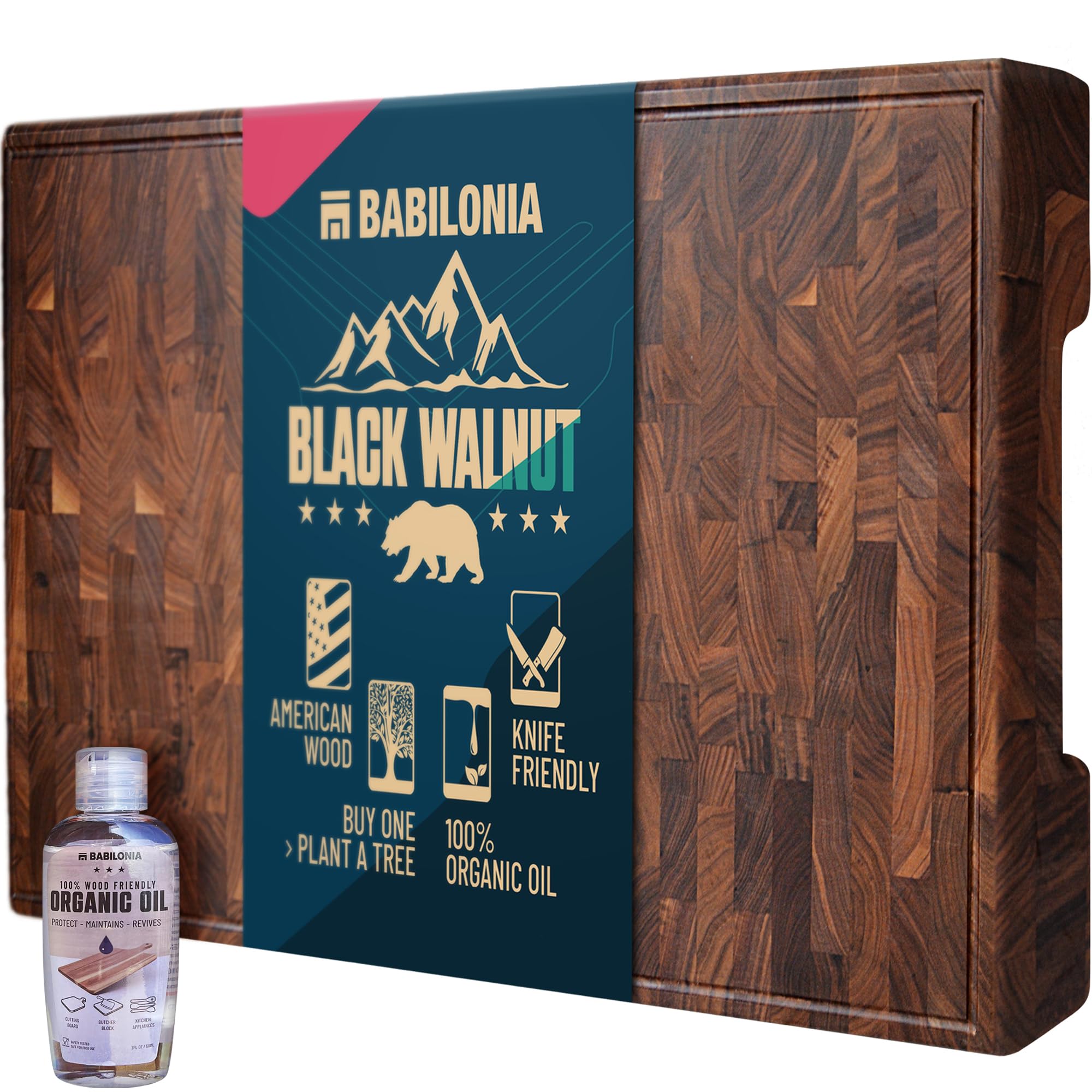
This board goes all-in on the premium experience. It measures 19.7 by 12.2 inches with a full 1.7 inches of thickness — significantly thicker than the 1.5-inch standard, giving it a rock-solid feel that resists warping and absorbs knife impact beautifully. The end-grain black walnut construction is naturally antimicrobial and knife-friendly, with the wood fibers closing around the blade rather than being cut. The most-discussed aspects are quality and appearance, both earning overwhelmingly positive feedback from owners. The board is pre-seasoned and includes a free bottle of organic oil plus a small stainless steel plate that slides into a built-in “plate garage” notch. This notch is genuinely clever — you can push chopped vegetables directly onto the plate without lifting the board.
Compared to the SHUMARU mahogany board, this walnut board is nearly 3 inches longer and has a deeper thickness (1.7 vs 1.6 inches). The darker wood color hides stains and cut marks better than lighter woods like maple. The included accessories — oil and plate — add real value, and the packaging is designed to be gift-ready. Owners are effusive, with several calling it the best board they have ever owned and comparing it favorably to boards costing two to three times more. The reversible design also allows the flat side to serve as a serving tray for charcuterie or appetizers.
The honest caveat: durability gets mixed feedback, with some owners reporting splitting after a couple of months despite proper care. The manufacturer’s customer service appears to be responsive — the company offers a 2-year warranty and shoppers say quick replacements when issues arise. But the split reports are common enough that this board is not a zero-worry buy. Additionally, the 8.81-pound weight makes it a substantial counter resident that is not easy to tuck away in a cabinet.
Clever features: The plate garage notch and included oil set this board apart from any other in this list — it genuinely changes how you prep, saving an extra step.
Buy this for: the gift-ready packaging, included oil and plate, and the deep 1.7-inch end-grain walnut that feels like a luxury item on your counter.
Hesitate if: the durability split reports worry you, or if you prefer a board with a simpler, more traditional design without extra accessories.
7. Caraway 4-Piece Double Sided Wood Cutting Board Set

A three-board system with a stand that keeps your kitchen tidy and your food separate.
Caraway takes a different approach: instead of one large board, you get three double-sided boards in Small (10×7 inches), Medium (14×10 inches), and Large (17×12 inches), plus a storage organizer. The idea is to use different boards for different tasks — raw meat on one, vegetables on another, bread on the third — without cross-contaminating your prep. The double-sided design means each board gives you two surfaces, effectively giving you six cutting sides. The boards are made from FSC-certified birch wood with a food-safe mineral oil and wax finish, so there are no plastics or BPA involved.
The boards are noticeably thinner than any other pick in this list — only 0.5 inches thick, compared to the 1.5-inch standard of most boards here. This makes them lightweight and easy to handle, but they are not designed for heavy-duty chopping or meat carving. The recessed indentations on the surface are a design choice that some owners love for catching mess, but others find annoying because they reduce the usable cutting area and make scraping ingredients into a bowl difficult. Quality is the top-praised aspect, and the set looks terrific on the counter — the stand keeps everything organized and accessible.
The durability picture is mixed. Warping is the most-discussed negative aspect, with owners noting that the thin boards can bow if not dried upright immediately after washing. The boards require monthly oiling to prevent drying and cracking, and they must always be hand-washed and air-dried upright (which the storage stand handles naturally). This set is not a direct competitor to heavy end-grain boards — it serves a different purpose. If you want a single board that anchors your prep and protects your knives, look at the SHUMARU or Yes4All picks. If you want organization and color-coded prep separation, this Caraway set delivers.
Organization system: The included stand and three-size approach solve the “which board for what” problem better than any single board can — it is a system, not just a slab.
Ideal for: kitchens with counter space to spare, or anyone who wants separate boards for meat, veggies, and bread without cluttering the drawer.
Not for: heavy chopping, meat carving, or anyone who wants a single thick end-grain board that will last a decade — these are thinner and more maintenance-intensive.
8. John Boos CCB Series Maple End Grain Chopping Block

A 21-pound, 2.25-inch-thick end-grain block built for serious butcher work.
This is the heavyweight champion of the list. At 20 by 15 inches with a staggering 2.25 inches of thickness, the CCB series is a full-fledged butcher block designed for professional-level chopping, carving, and meat work. The end-grain maple construction is the gold standard for knife preservation — the fibers absorb the blade rather than resisting it, keeping your edge sharp and minimizing visible cut marks. The recessed finger grips on both sides are essential for handling the 21-pound weight, and the reversible design gives you two usable surfaces. This is a board that sits on a countertop mostly permanently because moving it is a two-hand operation.
The reality check: durability is the most-discussed aspect by a large margin, and the verdict is negative. Over a hundred buyers report issues — glue joint separation, cracks appearing after months, and splitting at the seams. One owner reported a crack after seven months of use, while another received a board with “glue joint separation and a small crack” straight from the start. The brand’s reputation as a professional staple since 1887 is well known, but the failure rate in the reviews is higher than any other board here. The board requires extensive initial oiling — one owner noted it needed six-plus rounds of oil before the end grain stopped absorbing like a sponge.
Comparing it to the Yes4All teak board above: both are 20×15 inches, the Boos CCB is 2.25 inches thick at 21 pounds, and the Yes4All is 1.5 inches thick at 11.24 pounds. The Boos is end-grain, which is kinder on knives than the teak board’s end-grain, but the teak is naturally more moisture-resistant and has a lower reported failure rate. The Boos CCB’s value proposition is heavily dependent on getting a good unit — when it works, owners describe it as “beautiful” and “worth the cost for lifetime use.” When it fails, the investment feels wasted.
Absolute anchor: The 2.25-inch thickness and 21-pound weight make this the most substantial board here — it is a countertop monument, not a portable tool.
Meant for: committed home cooks who want a true butcher block and are willing to oil it obsessively (six initial coats) and accept a potential durability gamble.
Avoid if: consistent durability matters more than brand prestige — the review data shows a meaningful split risk that the other mid-range boards here do not have.
Understanding the Specs
End Grain vs Edge Grain
End-grain boards have the wood fibers standing upright, like a bundle of straws. When your knife blade hits the surface, it slips between the fibers rather than cutting across them. This gives you a “self-healing” effect where cut marks close up over time, and it is far gentler on your knife edge. Edge-grain boards have fibers running parallel to the surface. They cost less and are easier to make, but they show scratches more clearly and dull knives faster. For a primary cutting board, end-grain is the clear winner if your budget allows.
Thickness and Stability
A board under 1.25 inches can warp, slide, or bounce during heavy chopping. A 1.5-inch board provides enough mass to stay planted and absorb impact without transferring the force to your knife or countertop. Boards 1.75 inches and thicker — like the John Boos CCB at 2.25 inches — are near-permanent installations that weigh enough to stay put no matter what you throw at them. Thicker boards also resist warping better over time because the extra mass prevents the wood from twisting as it dries and rehydrates.
Wood Species Characteristics
Maple is the most common North American choice — hard, dense, and non-porous, it resists bacteria and knife scarring. Walnut is softer, which is actually easier on knife edges, and develops a rich dark patina over time. Teak contains natural oils that repel moisture, making it slightly more resistant to warping, but those oils can be tougher on blade edges. Acacia is dense and water-resistant but varies in hardness board to board. Birch, used by Caraway, is lightweight but softer and more prone to warping in thin boards.
Juice Grooves and Reversible Design
A juice groove is a channel carved near the edge of the board that catches liquids from meat, fruit, or tomatoes so they do not run off onto your counter. It is a big help for messy prep work. Reversible boards offer two usable surfaces — typically one side with a juice groove and one flat side for tasks like slicing bread or rolling dough. This doubles the life of the board and gives you flexibility. The trade-off is that reversible boards are usually edge-grain rather than end-grain, which is less protective of your knife edge.
FAQ
How often should I oil my wooden cutting board?
Can I put a wooden cutting board in the dishwasher?
How long does a wooden cutting board typically last?
Is end-grain really worth the higher price over edge-grain?
What is the best wood for a cutting board?
How do I fix a cutting board that has warped or bowed?
Do wooden cutting boards hold more bacteria than plastic?
What size cutting board do I need for everyday use?
Is it normal for a new board to feel dry or rough?
Can I use a wooden cutting board for raw meat and vegetables?
Final Thoughts: The Verdict
For the majority of shoppers, the best wooden cutting board winner is the SHUMARU Mahogany End Grain Cutting Board because it delivers genuine end-grain knife protection, a solid 1.6-inch thickness, and consistent owner satisfaction at a price that undercuts dedicated premium brands. If you want a large surface for holiday cooking, grab the Yes4All Teak Board. And for the