
Our readers keep the lights on and the coffee maker working hard! As an Amazon Associate, I earn from qualifying purchases.
Specs are compiled from manufacturer listings and verified buyer reviews and can change over time — please confirm the key details on the product page before buying.
Picking a wood stove for a mobile home is a safety-first decision, not just a warmth decision. The stove you choose must be officially approved for manufactured-home installation, and it has to fit your floor plan without turning your living room into a furnace. This guide compares three freestanding, mobile-home-approved models, from a 750 sq ft compact unit to a 2,500 sq ft powerhouse, so you can match the heat output to your actual space.
I’m Mohammad — the founder and writer behind Calories Fit. This guide is built by comparing the manufacturers’ published specifications and the patterns across verified customer reviews, so you get each pick’s real strengths and trade-offs instead of marketing spin.
You need a stove that is safe, the right size, and simple to run. Here is how to choose the best wood burning stove for mobile home and what the owners of these three models say after a full season of burning.
Our Picks at a Glance

How To Choose The Best Wood Burning Stove for Mobile Home
Mobile homes have tighter clearances and different airflow than stick-built houses, so not every wood stove is safe to install in one. The single most important box to tick is the mobile home approval rating, which tells you the unit has been tested for the specific conditions of a manufactured home. After that, you are balancing heat output against the physical size of the stove and the length of logs you can comfortably feed it.
Check the Mobile Home Approval First
A stove that is approved for mobile home or transportable building use has been vetted for the tighter clearances and ventilation needs of a manufactured home. On these three models, that approval comes with a condition: you must install a fresh air intake kit (model 4FAK on the Ashley units, sold separately) to feed the fire outside air. Without that outside air pipe, the stove can pull warmed room air up the chimney and create backdraft problems.
Match the BTU Output to Your Square Footage
BTU (British thermal units) tells you how much heat the stove can produce per hour. A 26,000 BTU stove suits a small 750 sq ft space, while a 112,800 BTU unit can push warmth through up to 2,500 sq ft. The catch: a stove too big for a small room will overheat it on the lowest setting, and one too small will run constantly without ever catching up on a freezing night.
Look at Firebox Size and Log Length
The firebox is the chamber where the wood burns. A larger firebox means you can load more wood and get longer burn times, but it also makes the stove physically bigger and heavier. Check the maximum log length each stove accepts — the Ashley units take 21-inch logs, while the compact US Stove takes 11-inch logs — because that changes how you will split and stock your woodpile.
Quick Comparison
| Model | Best For | Heat Output | Coverage | Weight | Amazon |
|---|---|---|---|---|---|
| Ashley Hearth AW2520E-P★ Best Overall | Large open spaces up to 2,500 sq ft | 112,800 BTU | 2,500 sq ft | 291 lb | Amazon |
| US STOVE TH-100 | Tiny cabins and zone heating | 26,000 BTU | 750 sq ft | 139 lb | Amazon |
| Ashley Hearth AW2020-P | Mid-size rooms up to 2,000 sq ft | 89,000 BTU | 2,000 sq ft | 280 lb | Amazon |
In-Depth Reviews
1. Ashley Hearth AW2520E-P
Our pick — over 4★ from 60+ verified ratings; the strongest balance of quality and price.
The big-room workhorse that turns a 2,500 sq ft space into a warm zone.
This is the stove you pick when square footage is the whole game. It pushes up to 112,800 BTUs of heat across 2,500 square feet — more than four times the output of the compact US STOVE below, a gap that matters on a bitter night. The 2.7 cubic feet firebox swallows logs up to 21 inches, so you are not constantly reloading. Buyers in northern Wisconsin report running it daily for 4-5 months each winter and holding a 900 sq ft space at 72-74°F even when it drops to 15-20°F outside.
The secondary combustion system is the quiet hero here. It reburns the smoke and gases for more heat and less wood consumption without a catalyst, which keeps the EPA happy while stretching your woodpile. No electricity is needed to run the fire, so it keeps throwing heat through a power outage. The heavy cast iron door with air-washed ceramic glass gives you a clear view of the flames while helping the glass stay cleaner between cleanings.
It is a serious piece of iron at 291 pounds — more than double the 139-pound US STOVE — and it ships by freight to your curb, not your living room, so plan for moving it. That weight is a feature if you want a stove that feels anchored and permanent. The removable ash pan with a built-in ash port speeds up cleanup, though owners note the ash removal plug can be awkward and the flat top needs a slow, narrow door opening to avoid smoke spill. The firebrick-lined interior is built for the long haul, and the included legs and pedestal base let you choose your setup. It is approved for mobile homes in the US and Canada once you add the fresh air intake kit (model 4FAK, sold separately) and connect a standard 6-inch chimney system.
Why owners pick it
- Heat output that handles a 2,500 sq ft layout with room to spare
- Runs with no electricity, so outages do not stop the warmth
- Versatile setup with both legs and a pedestal in the box
What to plan for
- 291 pounds needs a strong floor and a plan to move it inside
- Freight delivery is curbside only, no placement or assembly
- Ash removal through the plug takes some patience
Reach for it if: you have a large open living space and want one stove to heat the whole thing, even in a hard northern winter.
Think twice if: your space is under 1,000 sq ft — this much heat on the lowest setting can overshoot a small room.
2. US STOVE 750 SQ FT STOVE

A small-footprint stove sized for sheds and single rooms, not whole houses.
This is the right tool when your job is small. It heats up to 750 square feet and accepts logs up to 11 inches, with a burn time up to 8 hours on a load. The proportions tell the story — at 18.75″D x 16.38″W x 26.88″H and 139 pounds, it takes up a fraction of the floor space of the 291-pound Ashley above and is far easier to move into place. Owners burn it in a 300 sq ft shed and report that 4 cedar logs cut to size last about 3 hours, with oak burning even longer. It is EPA certified with a 75% efficiency rating and approved for mobile homes in the USA.
The efficiency rating is the number that matters for your wood bill. A 75% rating means most of the wood’s energy becomes heat in your room rather than vanishing up the flue, and the design stretches each load. The small footprint makes it a natural fit for zone heating — warming one room without firing up a whole-house system.
The honest trade-off is that the compact size gets mixed reviews. Owners agree it works well once a good fire is going, but a few find the firebox tight to load and note the top firebrick baffle can be fragile. Durability is the recurring concern in the review pages, with more than one unit arriving with broken firebrick or glass from shipping. That said, the brand’s customer service gets credit for shipping replacement glass and gaskets quickly. The stove pipe and blower are not included, so budget for those separately.
Where it wins: the smallest footprint here — 18.75″D x 16.38″W — slips into corners and tiny rooms the big stoves cannot touch.
Where it loses: at 26,000 BTU it produces less than a quarter of the Ashley AW2520E-P’s 112,800 BTU, so it is a room heater, not a house heater.
Best for: a shed, tiny cabin, or single room where you want steady heat without a massive appliance dominating the floor.
Not for: open-plan mobile homes or anyone who needs to heat more than 750 sq ft from one stove.
3. Ashley Hearth AW2020-P
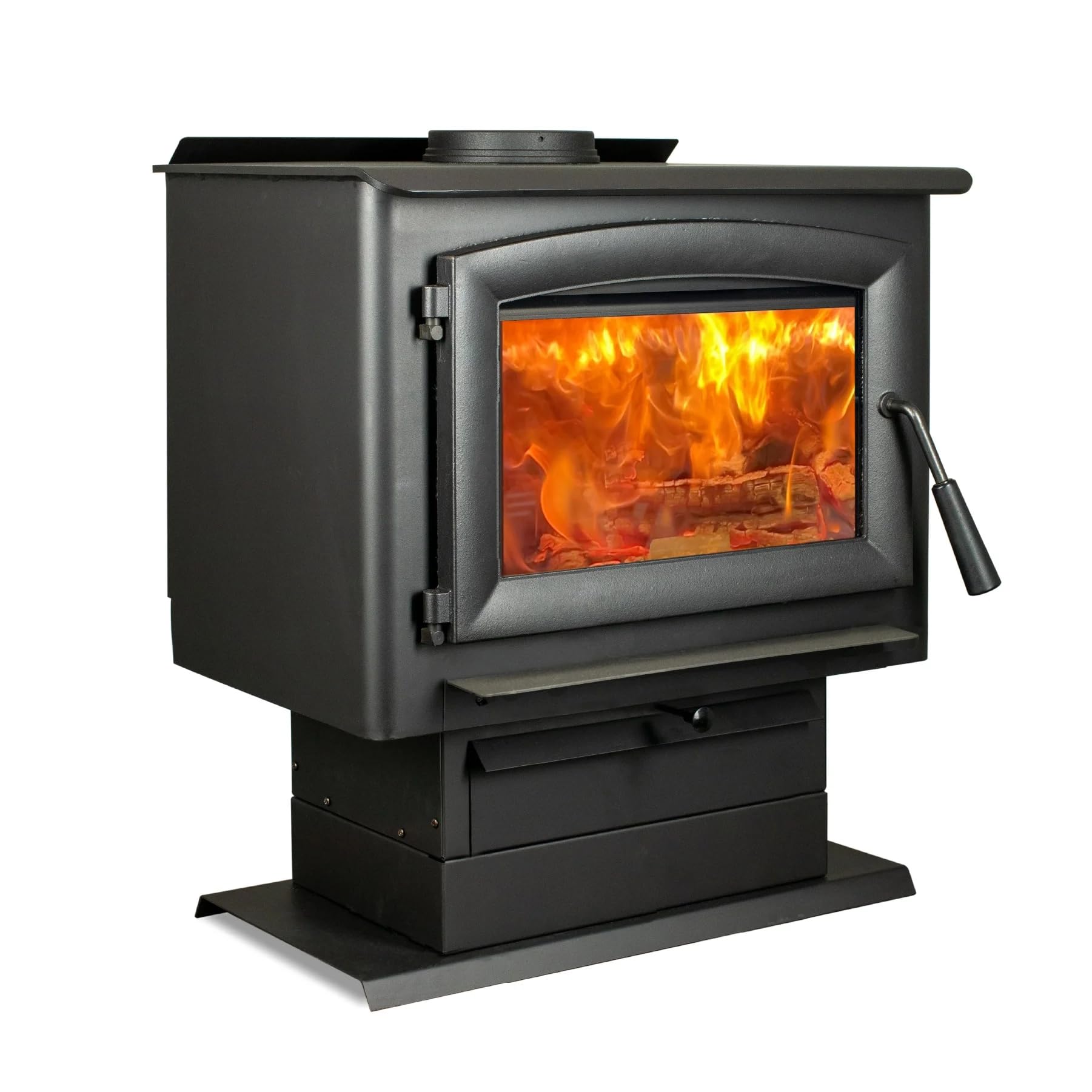
A balanced middleweight that delivers real heat without the top model’s bulk.
If the AW2520E-P is the flagship, this is the smart middle step. It produces up to 89,000 BTUs across 2,000 square feet — a 2,000 sq ft versus 2,500 sq ft gap versus the bigger Ashley above — and takes the same 21-inch logs. The 1.6 cubic feet firebox is noticeably more compact, and at 280 pounds it is 11 pounds lighter than its big sibling while holding the same 27″W footprint. Owners confirm it holds up to two seasons of daily use and call it durable, with one running it in a 700 sq ft yurt and another in a 1000 sq ft cabin. The heat efficiency is the aspect owners praise most, and the build quality runs a close second.
What the specs do not tell you is the room-size reality. Several buyers report it comfortably heats 700 to 1,000 sq ft but will not reach the full 2,000 sq ft the box claims, and one found it overkill for a 400 sq ft space. The 23-inch firebox is spacious for loading, and the outside air intake genuinely helps the draft. The secondary combustion system burns the smoke for extra heat without a catalyst, and no electricity is needed to run the fire, so it keeps working through outages.
The creosote note is worth heeding. When the air is cut back too far, creosote builds up in the chimney — one owner had to burn with the door open more to keep the glass and flue clean, which raises the fire risk. The mobile home approval in the US and Canada requires the fresh air intake kit (model 4FAK, sold separately) and a standard 6-inch chimney, and like the other Ashley it arrives by freight at your curb only. The door’s air-washed ceramic glass keeps the view clear, and the legs and pedestal base are both included.
The standout: heat efficiency is what wins owners over — this stove turns cordwood into warmth without gobbling your woodpile.
The honest limit: plan for it as a 1,000-1,400 sq ft heater in practice, not the full 2,000 sq ft on the box.
Choose this if: you want Ashley build quality and an 89,000 BTU output without stepping up to the 291-pound flagship.
Pass on it if: you need the full 2,500 sq ft of coverage — the AW2520E-P is the one for that job.
Understanding the Specs
BTU Output vs. Square Footage
BTU (British thermal unit) is the amount of heat a stove produces per hour. The rule of thumb is to match the stove’s rated coverage to your actual space — a 26,000 BTU unit covers 750 sq ft, while a 112,800 BTU unit covers 2,500 sq ft. Oversizing a stove for a small room means it will overheat the space on its lowest setting, and undersizing means it will run flat out on the coldest nights.
Secondary Combustion and Efficiency
Secondary combustion is a system that reburns the smoke and gases from the first burn, extracting extra heat while reducing wood consumption and emissions. It removes the need for a catalytic converter. Efficiency ratings (like the US STOVE’s 75%) tell you how much of the wood’s energy becomes heat in your room instead of going up the chimney — a higher percentage means more warmth per log.
FAQ
Is a wood burning stove safe in a mobile home?
What is a fresh air intake kit and do I need one?
How do I know what size stove my mobile home needs?
What length logs can these stoves take?
Do I need electricity to run these wood stoves?
What does the freight delivery mean for these stoves?
How long does a load of wood burn in these stoves?
Will a wood stove overheat a small mobile home?
Do these stoves need a chimney or stove pipe?
What is secondary combustion and why does it matter?
Final Thoughts: The Verdict
For most mobile home owners, the wood burning stove for mobile home winner is the Ashley Hearth AW2520E-P because its 112,800 BTU output and 2.7 cubic feet firebox give you the headroom to heat a real open floor plan through a hard northern winter. If your space is a single room or a shed under 750 sq ft, the US STOVE is the compact, easy-to-move pick that won’t overpower the space. And for mid-size rooms where you want Ashley build quality without the flagship’s 291-pound weight, the AW2020-P delivers 89,000 BTUs at 280 pounds — just plan for it as a 1,000-1,400 sq ft heater in practice. Whichever you choose, remember the mobile home approval and fresh air intake requirement are non-negotiable safety steps.
How We Picked
We do not accept paid placement. Every pick is matched to a real buyer and a real use-case; we do not hands-on test units.
Sources & Methodology
Specifications: manufacturer listings and product documentation. Review insights: verified customer reviews, as of August 2026. Pricing: not shown on this page (it changes often); check the current price via the retailer link.
As an Amazon Associate, Calories Fit earns from qualifying purchases. This does not affect which products we feature.