
Our readers keep the lights on and the coffee maker working hard! As an Amazon Associate, I earn from qualifying purchases.
Specs are compiled from manufacturer listings and verified buyer reviews and can change over time — please confirm the key details on the product page before buying.
If you squat or deadlift heavy and still reach for a belt that gaps at your ribs or pinches your hips, you already know the problem: most belts are cut for a man’s torso, not yours. A women’s lifting belt needs a narrower profile, a curve that follows your waist, and a thickness that supports without jamming into your sternum. A well-fitted belt transforms your brace into a rock-solid platform for heavy lifts.
I’m Mohammad — the founder and writer behind Calories Fit. This guide is built by comparing the manufacturers’ published specifications and the patterns across verified customer reviews, so you get each pick’s real strengths and trade-offs instead of marketing spin.
Below are nine belts that actually fit a woman’s frame, covering everything from budget-friendly leather to competition-ready levers. This is the best women’s lifting belt guide you can trust because it strips out the hype and keeps only what real buyers report from their own heavy sessions.
Our Picks at a Glance


How To Choose The Best Women’s Lifting Belt
Picking the right lifting belt means focusing on three things that matter most to a woman’s frame: width, thickness, and how the belt fastens. A belt that is too wide jabs your ribs during deadlifts. A belt that is too thin fails to generate the intra-abdominal pressure needed for a squat PR. The wrong buckle type wastes time between sets.
Width and Taper
Most men’s belts sit at a uniform 4 inches. Many women prefer a tapered belt that is wider at the lower back (where you brace) and narrower at the front (where your ribs sit). A 4-inch uniform width still works for a shorter torso, but a tapered design — like the 4-inch to 2-inch taper — keeps you from being jabbed on front squats.
Thickness
Thickness is measured in millimeters. A 5mm belt offers flexibility and is best for beginners or lighter training. A 7mm belt hits the balance for most women: stiff enough for heavy squats and deadlifts but not so rigid that it restricts breathing. A 10mm belt is for serious powerlifting — more support, less flex, but also less forgiving during a break-in period.
Closure System
Double-prong buckles give you a traditional, secure fit with multiple holes for precise adjustment. Lever belts fasten with a cam-action lever — extremely fast to take on and off, great for heavy singles, but less granular in adjustment. A self-locking hybrid (leather body with a velcro strap and a locking bar) offers infinite adjustment and security against popping open.
Quick Comparison
| Model | Best For | Thickness | Width | Closure | Amazon |
|---|---|---|---|---|---|
| Dark Iron Fitness Genuine Leather★ Best Overall | Overall Top Pick | 5 mm | 4 inches | Double Prong | Amazon |
| Mytra Fusion Women Lifting BeltBest Value | Budget Value | 7 mm | 4 inches | Double Prong | Amazon |
| Jaffick Weight Lifting Belt For LadiesPadded Lumbar | Padded Lumbar Support | 6 mm | 4-1/6 inches | Double Prong | Amazon |
| RDX Weight Lifting Belt | 5-Year Durability | 7 mm | 4 or 6 inches | Double Prong | Amazon |
| POZTEV Powerlifting Lever Belt | Quick On/Off | 10 mm | 4 inches | Lever | Amazon |
| DMoose Fitness Weight Lifting Belt | Competition Approved | 5 mm | 4 inches | Double Prong | Amazon |
| Iron Bull Strength 7mm Leather Belt | IPF Approved / Tapered | 7 mm | 4 inches (tapered to 2) | Double Prong | Amazon |
| Element 26 Hybrid Leather Belt | Self-Locking Convenience | 7 mm | 4 inches | Hook & Loop + Lock | Amazon |
| MANUEKLEAR Lever Lifting Belt | Heavy-Duty Lever | 10 mm | 4 inches | Lever | Amazon |
In‑Depth Reviews
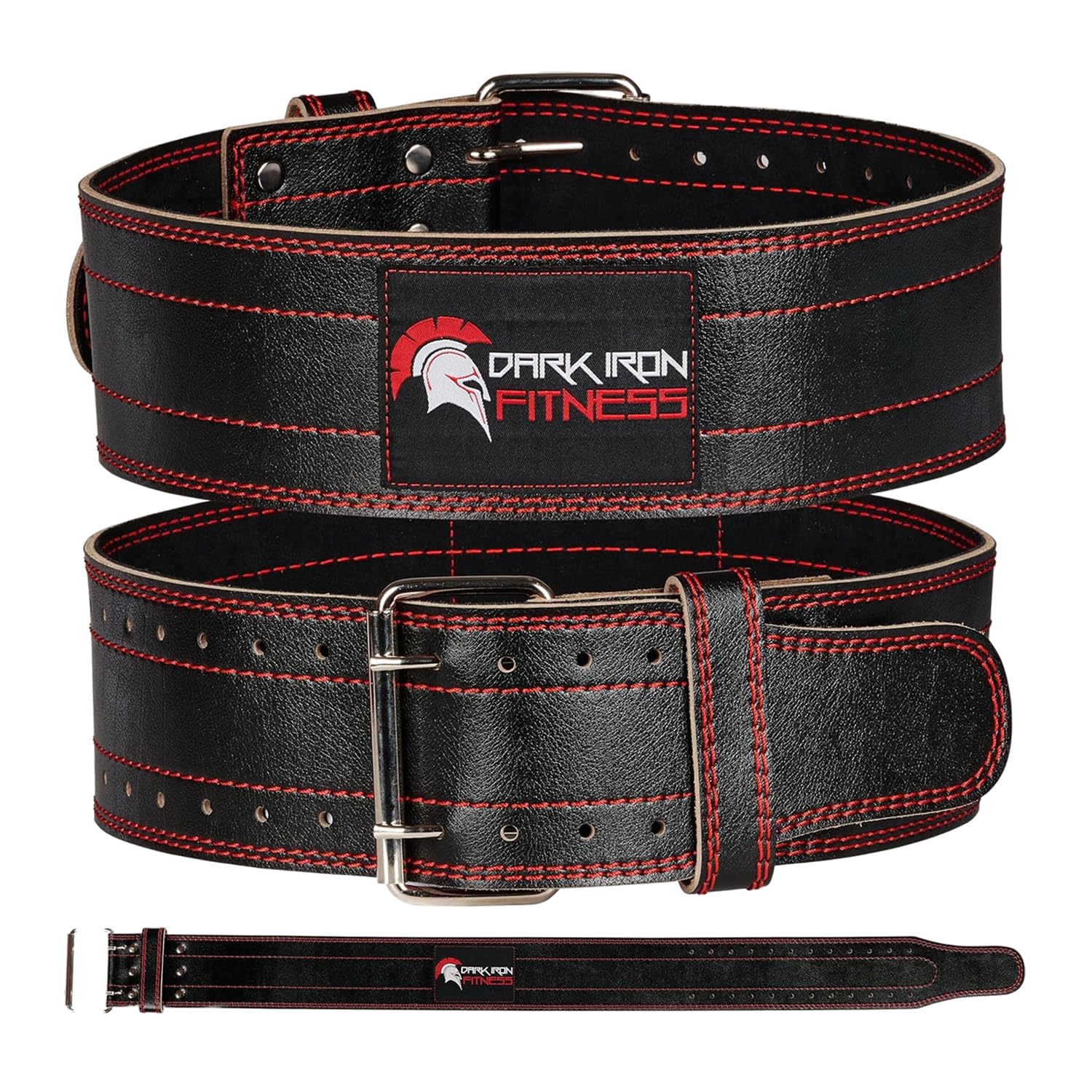
1. Dark Iron Fitness Genuine Leather Weightlifting Belt
Our pick — over 4.5★ from 24,500+ verified ratings; the strongest balance of quality and price.
Over 24,000 buyers trust this belt for heavy squats and deadlifts at a fraction of the cost of big-name alternatives.
You get 100% genuine leather with double-row stitching and reinforced construction that handles daily gym abuse without fraying. At 5 millimeters thick and 4 inches wide, it hits a balanced feel: stiff enough to brace against for a 600-pound deadlift (a number that comes straight from owner experience), but not so thick that you fight to breathe on lighter sets. The suede interior helps it grip your shirt without sliding around mid-rep.
The sizing runs from XS to XL covering a 22-inch to 49-inch waist, with twelve adjustment holes spaced 1 inch apart — so you can dial in exactly one hole tighter for your last working set. The thing owners praise most is the sheer craftsmanship (over 3,200 call out the quality), and the 1,100+ who mention support confirm it locks your core in place. The single recurring note is that the unpadded edges can dig into bare skin, so wear it over a shirt or a thin layer.
Why it rules: A premium leather belt that is built like a model but sold at a mid-range price, backed by a lifetime warranty and an owner community that has stress-tested it on everything from powerlifting meets to moving furniture.
The honest trade-off: The 5mm thickness is perfect for most gym work, but if you pull or squat north of 400 pounds routinely, you may eventually want a 10mm lever belt for the extra rigidity under maximal loads.
Reach for this if: you want a do-everything leather belt that is comfortable for long sessions, built to outlast cheaper options, and backed by tens of thousands of happy owners.
Look elsewhere if: you must have a super-fast on/off lever system, or you are a competitive powerlifter who needs the stiffest possible 10mm support.
2. Mytra Fusion Weight Lifting Belt Women
A 7mm real-leather belt at a price that lets you buy it without guilt — and it comes in a pink that gym owners actually rave about.
This belt is 7 millimeters thick and 4 inches wide, making it noticeably stiffer than the 5mm Dark Iron option — a difference you feel when you brace for a heavy squat. The genuine leather construction means it will break in over time and mold to your waist rather than staying stiff forever. The color is the thing owners bring up most (16 people single it out), and the consensus is that the pink is “spot on” and looks exactly like the listing photos.
The reviews from smaller lifters are particularly telling: a 5-foot-2, 100-pound owner says it “fits perfectly” on her frame, and the XS size accommodates narrow waists that many larger belts skip. The downside that comes up across multiple owners is rust on the metal hardware — a few belts arrived with the buckle or rivets already showing corrosion. That is an occasional QC miss, not a pattern, but it is worth inspecting your buckle when it arrives.
The real draw: You get a full 7mm of leather support at a price that undercuts most 5mm belts. For a woman lifting three or four times a week, that thickness-to-cost ratio is tough to top.
Smart to know: If you are a 27-inch waist, the size small may run tight; several owners advise sizing up to medium for a comfortable brace.
Best fit for: women who want real leather thickness without the premium price tag, and who like a pop of color in their gym kit.
skip it if: you are sensitive about hardware condition on arrival — inspect and return right away if the metal looks off.
3. Jaffick Weight Lifting Belt For Ladies
The sparkly pink belt that 5-foot-1 lifters call “perfect” — because it was actually designed for a shorter torso.
Jaffick built this belt with a 4-1/6-inch wide back section that houses 20 millimeters of sponge padding — essentially an integrated lumbar cushion that other belts lack entirely. The 6-millimeter-thick buffalo hide leather underneath keeps it sturdy without the extra weight of a 10mm belt. There is also an extra leather flap that sits between the double-prong buckle and your stomach, so the cold steel never presses directly into your abs.
The tapered front waistband prevents the pinching that uniform-width belts cause on a woman’s hip bones. A 5-foot-1, 138-pound owner who says her weight fluctuates calls the belt “easy on/off” and reports it helped her push extra weight on squats. The appearance is what owners love most — 29 mention the look, calling it “girly” and “pearlescent baby pink.” On the durability front, the double stitching and industrial-grade steel roller buckle are built to take years of daily slamming on the gym floor.
The Things Owners Praise
- 20mm of padded lumbar support — a feature most leather belts skip entirely
- Tapered waist won’t pinch your hip bones during a deadlift
- Extra leather flap protects your stomach from the buckle
- Low-waist design sits comfortably on a shorter torso
The One Caveat
- The 6mm thickness is a middle ground — supportive for most gym work, but not stiff enough for a 400+ pound powerlifter
Who it fits: women who want lumbar cushioning built into the belt, lifters with short torsos, and anyone tired of metal buckles digging into their belly.
Who should pass: competitive powerlifters chasing maximal rigidity at the platform — you will want a 10mm lever belt instead.
4. RDX Weight Lifting Belt

Owners mention this belt surviving five-plus years of heavy use.
The RDX belt is built from 7mm genuine cowhide leather and has a suede inner lining that prevents the belt from sliding on your shirt during sweaty sessions. It comes in both a 4-inch and a 6-inch width variation, so you can choose the taller back panel for extra lumbar coverage during heavy squats. The dual-prong roller buckle uses industrial-grade steel, and the ten precision-drilled holes give you plenty of room to adjust as your waist changes between bulking and cutting cycles.
The quality is the most-mentioned aspect by a wide margin — 59 owners call it out — and the support ranks second with 27, meaning people feel it locking them in on compound lifts. The most frequent sizing complaint is that the belt runs small: a 38-inch waist owner found the XL too tight, and the seller advice is to measure your waist with a tape at the belly button, not rely on your pant size. The extra leather flap over the buckle is a nice touch that stops the metal from pressing into your stomach during bent-over rows.
What stands out: The 5-year-plus lifespan that keeps coming up in reviews. A belt that costs this little and lasts that long is the definition of value.
The sizing warning: Do not order your pant size. Measure your bare waist at the belly button and cross-reference the size chart — most owners say order one size down from what you think.
Grab this if: you want a tough cowhide belt that handles daily training and lasts long enough to be your only belt for the next half-decade.
Think twice if: you are between sizes and prefer to size up — this belt runs small, so the fit may be off if you guess.
5. POZTEV Powerlifting Lever Belt

This lever belt tightens and releases in milliseconds, ideal for supersets or busy gym sessions.
This is a 10-millimeter-thick, 4-inch-wide single-piece leather belt with a lever cam buckle instead of a traditional prong. You set the lever once for your squat depth, then it clicks on and off with one motion — no threading a buckle between sets. The lever mechanism is a huge time-saver if you take the belt off for warm-ups, accessories, or conditioning work. The belt is also IPF thickness standard, meaning it is competition-legal for raw powerlifting.
The 10mm thickness provides serious rigidity. One owner reports adding 50 pounds to his deadlift (up to 495 pounds) and says his “back feels great” after switching to this belt. The steel lever and double stitching have held up through a year of use according to multiple reviews. The quality is the top-cited aspect at 41 mentions, and value for money comes second at 27 — the belt costs a fraction of a premium lever brand like Inzer. The downside is comfort related: several owners say the top edge digs into the ribs during deadlifts, and the lever pins can occasionally misalign when adjusting.
What Makes It Special
- 10mm of leather provides max rigidity for heavy squats and deadlifts
- Quick-release lever saves time between sets — click in, click out
- IPF-legal thickness for competition lifters
The Reality Check
- The 10mm stiffness can dig into your ribs during deadlifts — wear over a shirt
- Lever adjustment is less granular than a prong buckle; it takes a few sessions to find your exact setting
Best suited for: powerlifters who want competition-grade rigidity without spending +, and anyone who hates fumbling with a prong buckle between heavy sets.
Not ideal if: you do deadlift-heavy programs and want the belt to be soft and comfortable against your lower ribs from day one.
6. DMoose Fitness Weight Lifting Belt
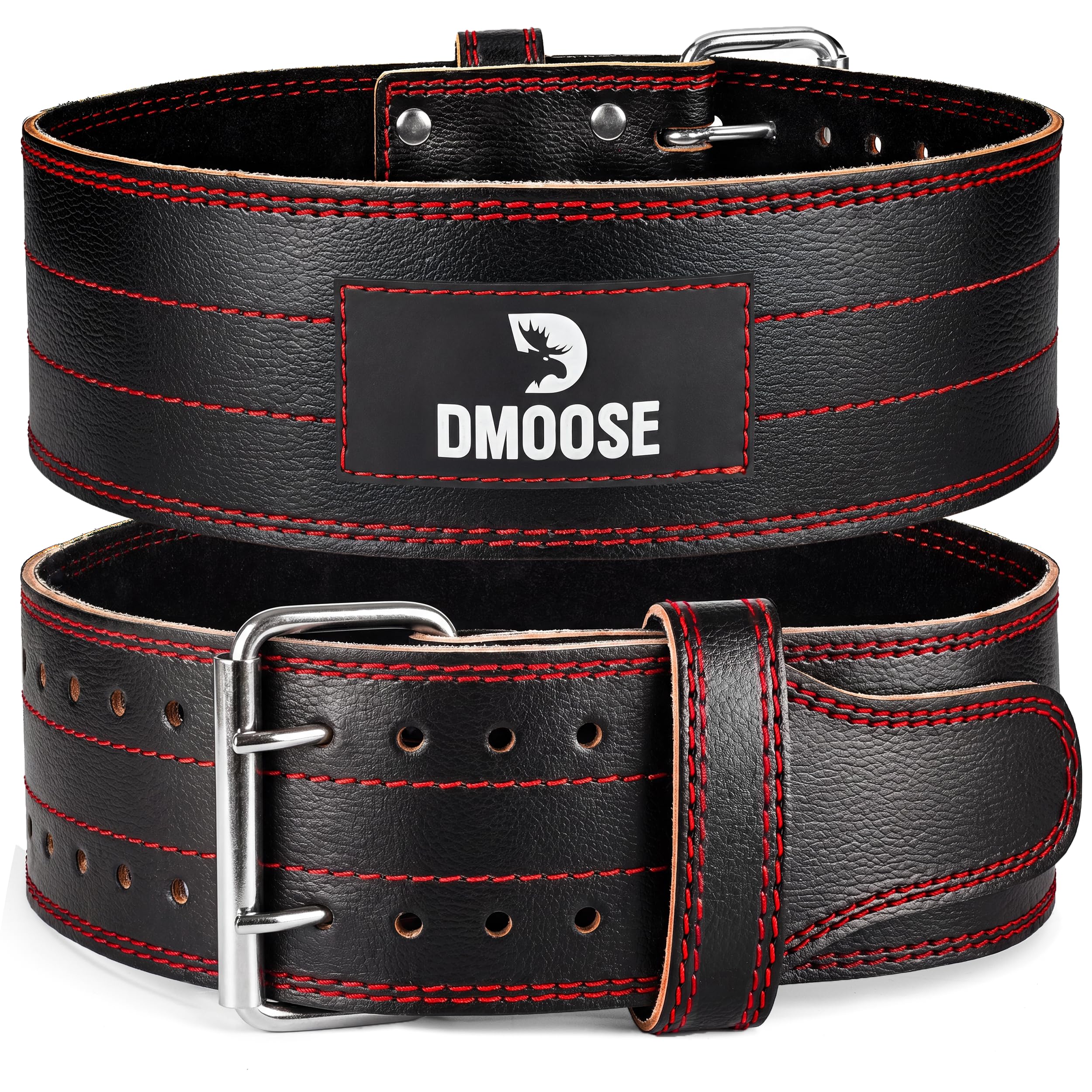
The only belt on this list with USPA and IPL approval, backed by a lifetime satisfaction guarantee.
DMoose built this belt from sweat-free suede leather at a 5mm thickness with a 4-inch lumbar pad. The suede material is the standout feature here: it resists moisture and never gets slippery, even during an hour-long squat session in a crowded gym. The double-prong buckle has a coated finish that won’t scratch your barbell knurling if the belt touches the bar on a clean pull. The USPA and IPL approval means you can wear this in a powerlifting meet without a federation gear check rejecting it.
Quality is the top-cited aspect with 26 mentions, and the fit comes second with 14 — owners consistently say the sizing chart is accurate. One owner with a 41-inch belly measurement confirms the XL fits with two holes to spare. The only real design issue reported involves the single belt loop: after the belt is buckled, the loose flap of leather can protrude about 2 inches, and during a military press, one owner had the barbell hit that flap and drop the weight. That is a specific scenario — for squats and bench, it is a non-issue.
The standout spec: Meet-legal approval without the premium price. At this price point, finding a belt that USPA and IPL allow on the platform is rare.
A note on the design: The single belt loop creates a protruding leather flap. If you do overhead pressing as a core lift, tuck the flap carefully or consider a two-loop belt.
Pick this if: you compete or plan to compete in USPA or IPL meets and want a belt that passes gear check without costing two hundred dollars.
pass on it if: you do heavy overhead pressing and are concerned about the leather flap catching the bar.
7. Iron Bull Strength 7mm Leather Weight Lifting Belt
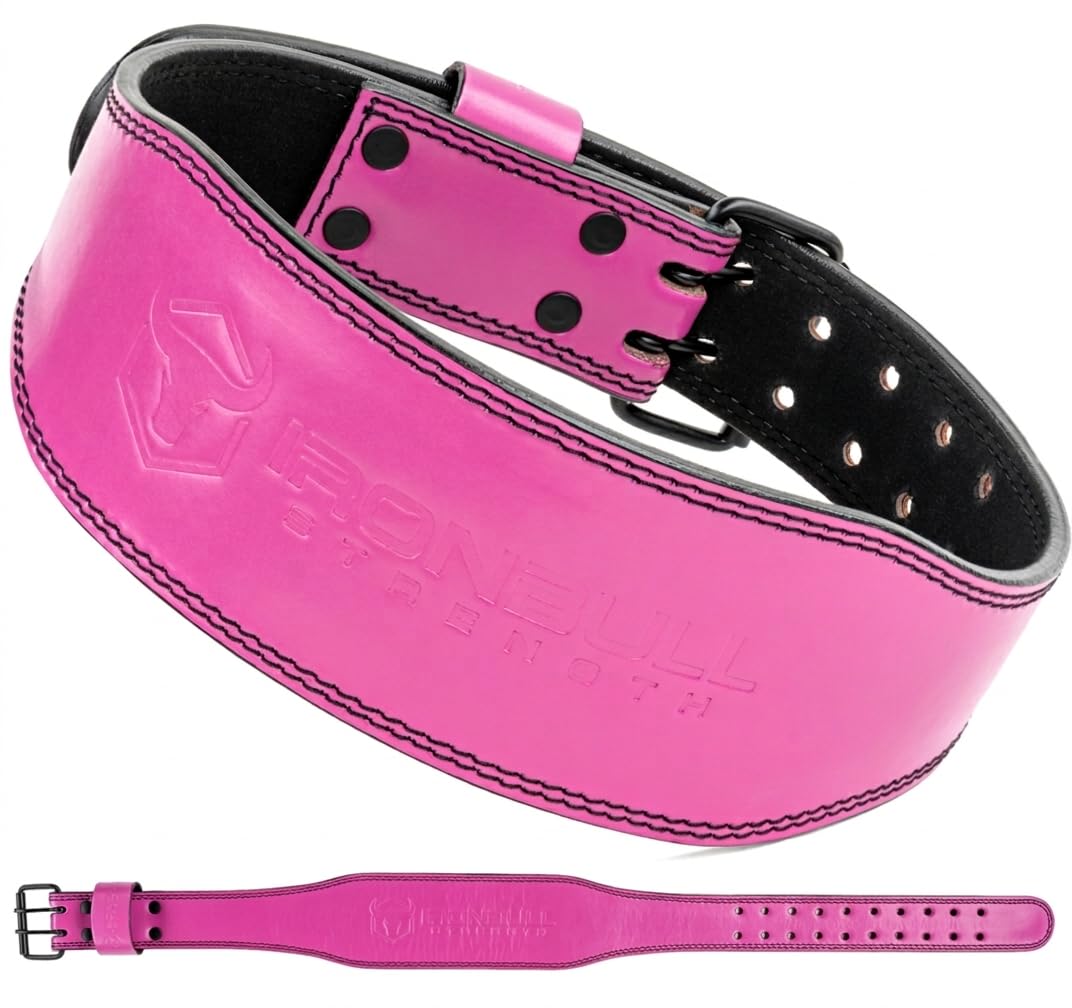
The IPF-approved belt that tapers from 4 inches down to 2 inches — purpose-built for lifters who hate belt pressure on their front ribs.
Iron Bull Strength uses A-Grade leather cut from a single piece (not glued scraps) to deliver a steady 7-millimeter thickness across the entire belt. The 4-inch to 2-inch tapered design means you get full 4-inch support across your lower back where you brace, but only 2 inches across your stomach so it never jams into your rib cage on front squats or cleans. The double roller steel buckle prongs have a black coating that resists corrosion, and the whole belt carries approval for IPF, USAP, USPA, IPL, USAW, and IWF — every major federation.
Owners rave about the feel right from the start: the leather is described as “pre-broken in” and comfortable without needing weeks of conditioning. The top-cited aspect is quality at 39 mentions, with support running second at 19. A 5-foot-tall owner says the medium hugs her body very well and that she highly recommends it for small-framed lifters. The belt even comes with a carrying case. The only sizing caution is that some owners find the belt runs slightly small, so measure at the belly button with a flexible tape rather than guessing.
The Design Wins
- 4-to-2-inch taper prevents rib pressure during front squats and cleans
- IPF, USAP, USPA, IPL, USAW, and IWF approved — good for any federation
- Single-piece A-Grade leather construction, not glued strips
- Comes with a carrying case for gym bag protection
The Sizing Note
- A few customers note the sizing runs tight — always measure your actual waist circumference, not your pants size
Perfect for: competitive lifters who need federation approval, and anyone who does Olympic lifts or front squats where a 4-inch uniform belt digs in.
Not for: lifters who prefer a thick 10mm rigid belt for max powerlifting — the 7mm is flexible enough for dynamic lifting but less stiff under 500+ pound loads.
8. Element 26 Hybrid Leather Weight Lifting Belt
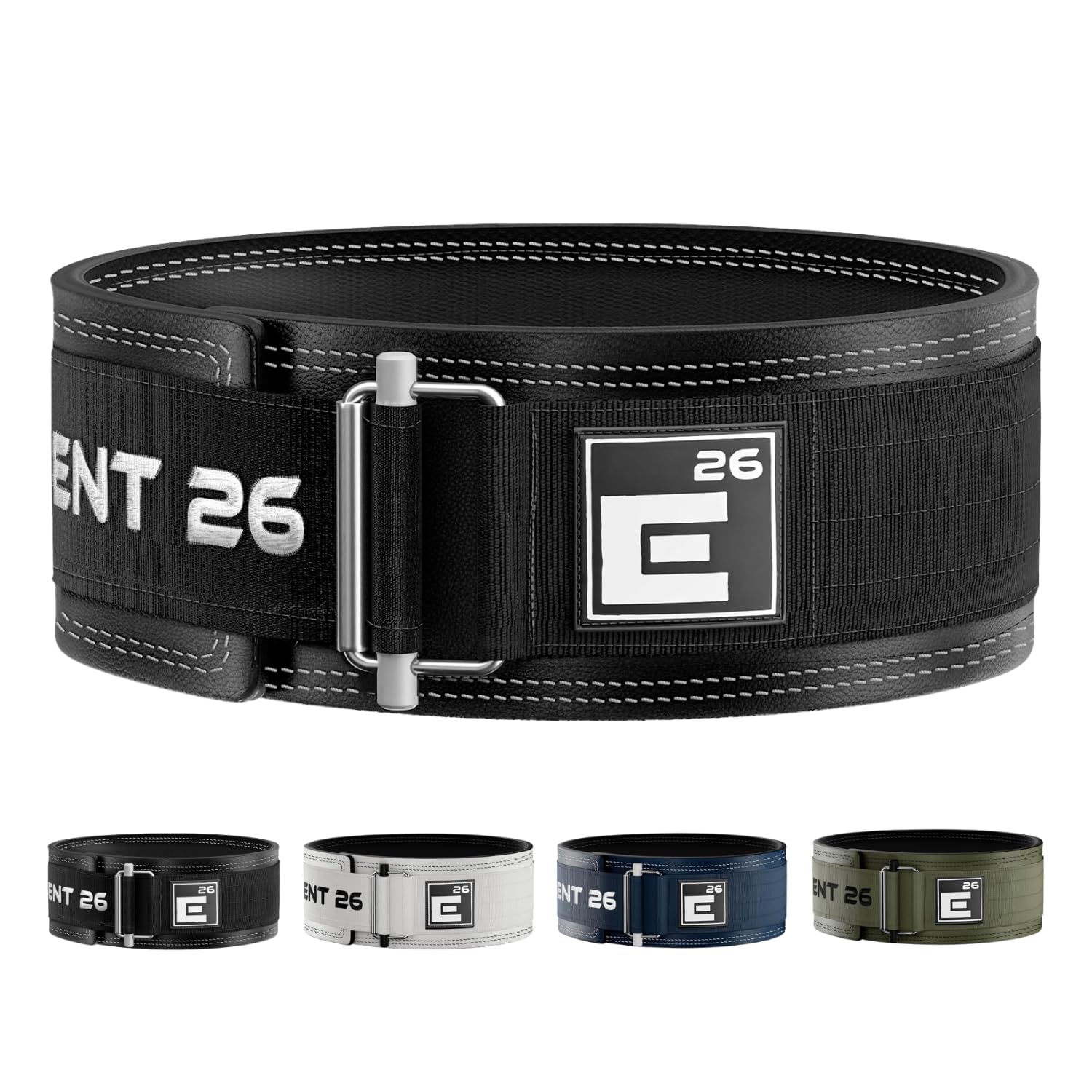
A patented hybrid that marries the stability of 7mm leather with the infinite adjustability of a self-locking velcro system — designed by a Doctor of Physical Therapy.
Element 26’s design solves a problem that every prong and lever owner knows: you are limited by pre-set holes or fixed lever settings. This belt uses 7mm genuine leather for the main body but adds a heavy-duty velcro strap and a self-locking steel mechanism that clamps the belt closed. You can tighten it infinitely — not just in one-inch increments — so you can micro-adjust from your warm-up set to your heavy single. The steel locking bar prevents the belt from popping open mid-lift, which is a known failure point on pure velcro belts.
Quality leads the owner feedback at 54 mentions, and the support and locking mechanism each pull over 20 mentions. The hybrid feel is a genuine improvement: the leather gives you the feedback you need to brace, while the velcro system makes taking the belt off between sets as fast as a lever. The recurring warning is about the velcro: several reviewers point out it wearing out after about a year of twice-weekly use, causing the belt to loosen during reps. The company does offer a lifetime warranty against manufacturing defects, which helps if you hit that issue.
Who designed it: A Doctor of Physical Therapy tune the intra-abdominal pressure and adjustability. That medical input is rare in this market.
The durability question: Many owners love the convenience, but the velcro lifespan is about a year under heavy use. The lifetime warranty softens that blow, but it is worth considering if you train six days a week.
Reach for this if: you want infinite adjustability without committing to a lever setting, or you do a lot of different movements that require different belt tightness.
Think twice if: you train heavy six days a week and want a belt that you will never have to replace the velcro on — a traditional leather with double prong may outlast it.
9. MANUEKLEAR Lever Lifting Belt
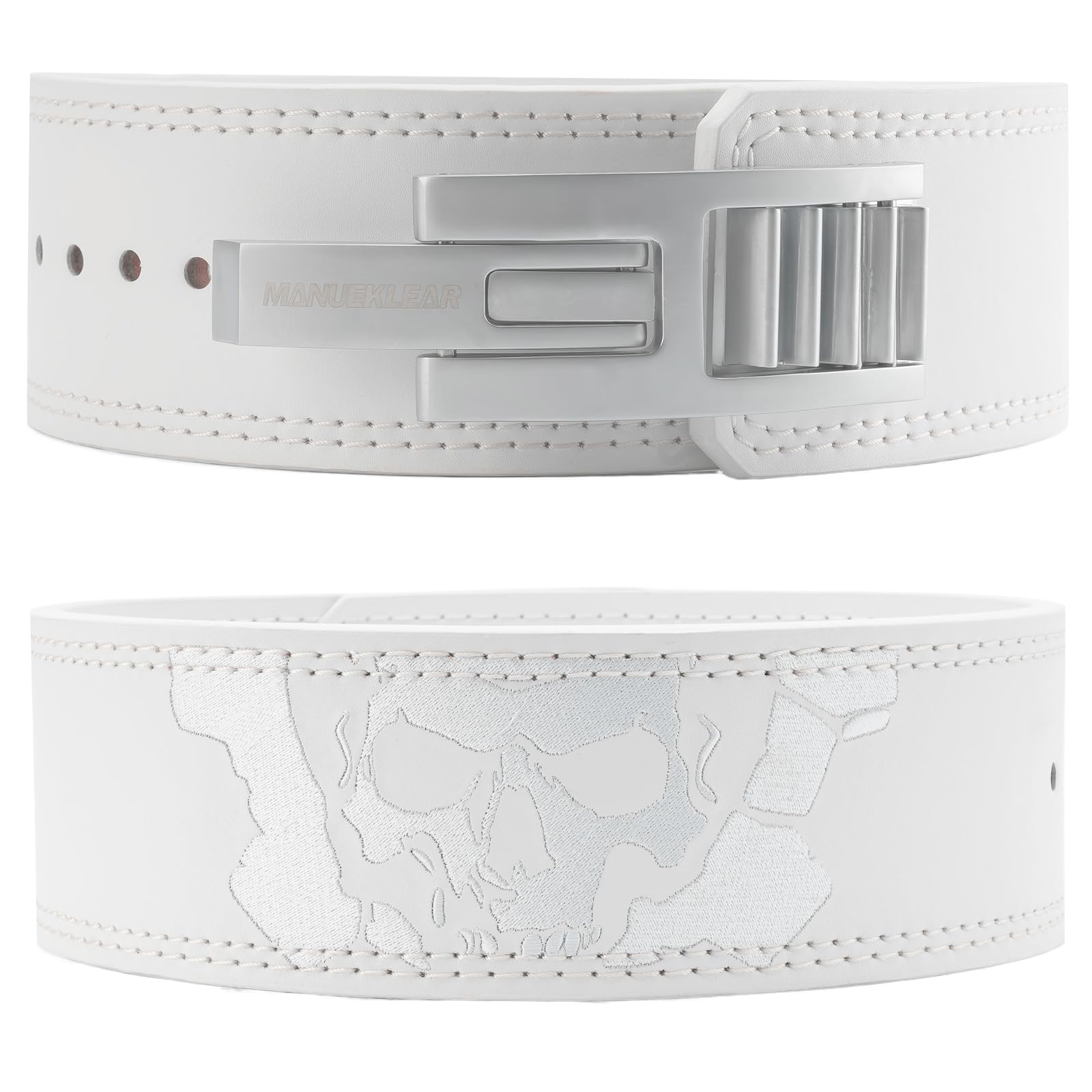
After a year of steady use, owners say their back pain “got way better” and the belt “still works perfectly.” That is the kind of durability report you want from a 10mm lever belt.
The MANUEKLEAR belt is 10 millimeters thick with a heavy-duty lever buckle that MANUEKLEAR says they have upgraded and patented for safety and stability. The belt body is full leather with reinforced stitching, and the lever mechanism uses steel components that lock into place with a firm click. You adjust the fit by moving the lever latch position — it takes a couple of sessions to dial in the perfect spot, but once it is set, you just snap it on and off in seconds for every training session after that.
Quality is the top aspect with 102 mentions — the highest raw count for any single aspect across all nine belts. The support category follows with 41 mentions, and durability with 39. Owners consistently describe the belt as “heavy duty” and “super well-built,” with one noting it has helped resolve back pain over the course of a year. The most common negative is the closure mechanism: 58 owners flagged the lever not staying latched under load. That is a significant enough number to pay attention to — if you get a unit with a loose latch mechanism, the 7-day free return policy is your safety net.
Why Owners Love It
- 102 owners praise the quality — the highest single-aspect count in the guide
- 10mm thickness offers competition-level rigidity for maximal loads
- Quick on/off lever system saves time between sets
- One year of daily use with no degradation reported
The Red Flag to Know
- 58 shoppers say the lever latch coming loose during use — inspect the mechanism on arrival and use the return window if it slips
- The belt weighs about 3.5 pounds, so it is noticeably heavier than a 7mm belt
Best for: serious powerlifters who want 10mm rigidity with lever convenience, and who are willing to QC-check the latch on delivery.
Not for: beginners who just need a basic belt for general gym work — the 10mm stiffness and extra weight are overkill for most training.
Understanding the Specs
Thickness (Millimeters)
Thickness determines how much support the belt gives you. A 5mm belt is flexible and comfortable for all-day wear or lighter training — it is the go-to for general gym work and beginners. A 7mm belt offers a middle ground: strong enough for heavy squats and deadlifts but flexible enough for Olympic lifts. A 10mm belt is the stiffest option, best for powerlifters pushing near-maximal loads where every pound of intra-abdominal pressure matters. The trade-off is that thicker belts take longer to break in and can feel less comfortable on your ribs during deadlifts.
Width and Taper
The width of a belt affects how it sits on your torso. A uniform 4-inch belt gives consistent support across your entire midsection but can dig into your ribs during front squats. A tapered belt (for example, 4 inches at the back tapering to 2 inches at the front) provides full lumbar coverage while leaving more room for your rib cage to expand. For women with shorter torsos, a tapered belt is often the more comfortable choice because it reduces the risk of the belt pressing into your sternum or hip bones.
Closure Types
Double-prong buckles are the traditional style: you thread the belt through the buckle, line up a hole, and push the prongs through. They offer precise, one-inch incremental adjustments but take a few seconds to take on and off. Lever buckles use a cam-action lever that clicks into place — you set the tightness once and then snap it open and closed between sets in one motion. The downside is that lever adjustments are less granular. Self-locking hybrid belts use velcro for infinite adjustment plus a steel locking bar to prevent the velcro from pulling apart under load — the best of both worlds, though the velcro can wear out over time.
Material and Lining
Genuine leather is the standard for serious lifting belts because it is stiff, durable, and molds to your body over time. Buffalo and cowhide leathers are the most common. Suede lining (a soft, brushed leather on the inside) adds grip so the belt stays put on your shirt instead of sliding around during a sweaty set. Some belts include a padded back section for extra lumbar cushioning — useful if you have lower-back sensitivity, though the padding does add a tiny bit of bulk that reduces the clean bracing surface.
FAQ
How should a women’s lifting belt fit?
What thickness lifting belt is best for women?
Do women need a tapered lifting belt?
Is a lever belt or a prong belt better for women?
How do I measure my waist for a lifting belt?
Can I use a men’s lifting belt as a woman?
How long does a leather lifting belt last?
What is the difference between 5mm and 7mm lifting belts?
Do I need a lifting belt for deadlifts?
How tight should a weightlifting belt be?
Final Thoughts: The Verdict
For most women looking for the best women’s lifting belt, the Dark Iron Fitness Genuine Leather Weightlifting Belt is the clear winner because it combines premium 100% genuine leather construction with double-row stitching, a 4-inch uniform width, and over 24,000 overwhelmingly positive owners who confirm it supports heavy training while staying affordable. If you want a 10mm lever belt for quick on-and-off during heavy powerlifting sessions, the POZTEV Powerlifting Lever Belt is the budget-friendly lever option that buyers report added pounds to their deadlift. And for lifters who prioritize infinite adjustability and a hybrid design, the Element 26 Hybrid Leather Belt offers a self-locking system that no other leather belt in this lineup can match.
How We Picked
We do not accept paid placement. Every pick is matched to a real buyer and a real use-case; we do not hands-on test units.
Sources & Methodology
Specifications: manufacturer listings and product documentation. Review insights: verified customer reviews, as of July 2026. Pricing: not shown on this page (it changes often); check the current price via the retailer link.
As an Amazon Associate, Calories Fit earns from qualifying purchases. This does not affect which products we feature.