
Our readers keep the lights on and the coffee maker working hard! As an Amazon Associate, I earn from qualifying purchases.
Specs are compiled from manufacturer listings and verified buyer reviews and can change over time — please confirm the key details on the product page before buying.
You need a watch that survives the backcountry, not just your lunch break. You already know you want GPS (a satellite-based navigation system), a compass, and something that won’t die before the summit — the real question is which rugged navigation tool actually fits a woman’s wrist comfortably and delivers accurate trail data without constant charging.
I’m Mohammad — the founder and writer behind Calories Fit. This guide is built by comparing the manufacturers’ published specifications and the patterns across verified customer reviews, so you get each pick’s real strengths and trade-offs instead of marketing spin.
Above all else, battery life separates a decent watch from a true outdoor partner. Whether you are crossing a ridge or navigating a forest at dusk, you need a reliable companion. These are the details you need before choosing the best women’s hiking watch for your next adventure.
Our Picks at a Glance


How To Choose The Best Women’s Hiking Watch
A hiking watch is a tool you depend on when you are far from a power outlet and far from help. The wrong choice means getting lost or running out of battery mid-trail. Focus on these three things to pick a true outdoor companion.
Battery Life is Your Safety Net
On a multi-day hike, you cannot charge a watch every night. Look for a model that offers days or even weeks of battery in smartwatch mode and enough hours in GPS mode to cover your longest day out. A watch that needs a charge after a single 8-hour trek is a liability.
GPS Accuracy Keeps You on Track
A watch with multi-band or dual-frequency GPS (using two radio frequencies to lock onto satellites faster) maintains a trail signal under heavy tree cover or in steep canyons. Single-band GPS (using one frequency) works fine on open trails, but a dual-band system keeps you from drifting off course when the path is unclear.
Durability for the Elements
A hiking watch should handle bumps, drops, rain, and submersion. A water resistance rating of at least 10 ATM (100 meters) means you can wear it across streams and through downpours without worry. Scratch-resistant glass and a reinforced case keep the watch readable after years of rough use.
Quick Comparison
| Model | Best For | Battery Life (Smartwatch) | GPS Accuracy | Water Resistance | Amazon |
|---|---|---|---|---|---|
| Garmin Instinct 2 Solar★ Best Overall | Solar-powered endurance | Unlimited (with solar) | Multi-GNSS (GPS, GLONASS, Galileo) | 100 meters | Amazon |
| COROS PACE 3Best Value | Lightweight training | 17 days | Dual-Frequency GPS | Not listed | Amazon |
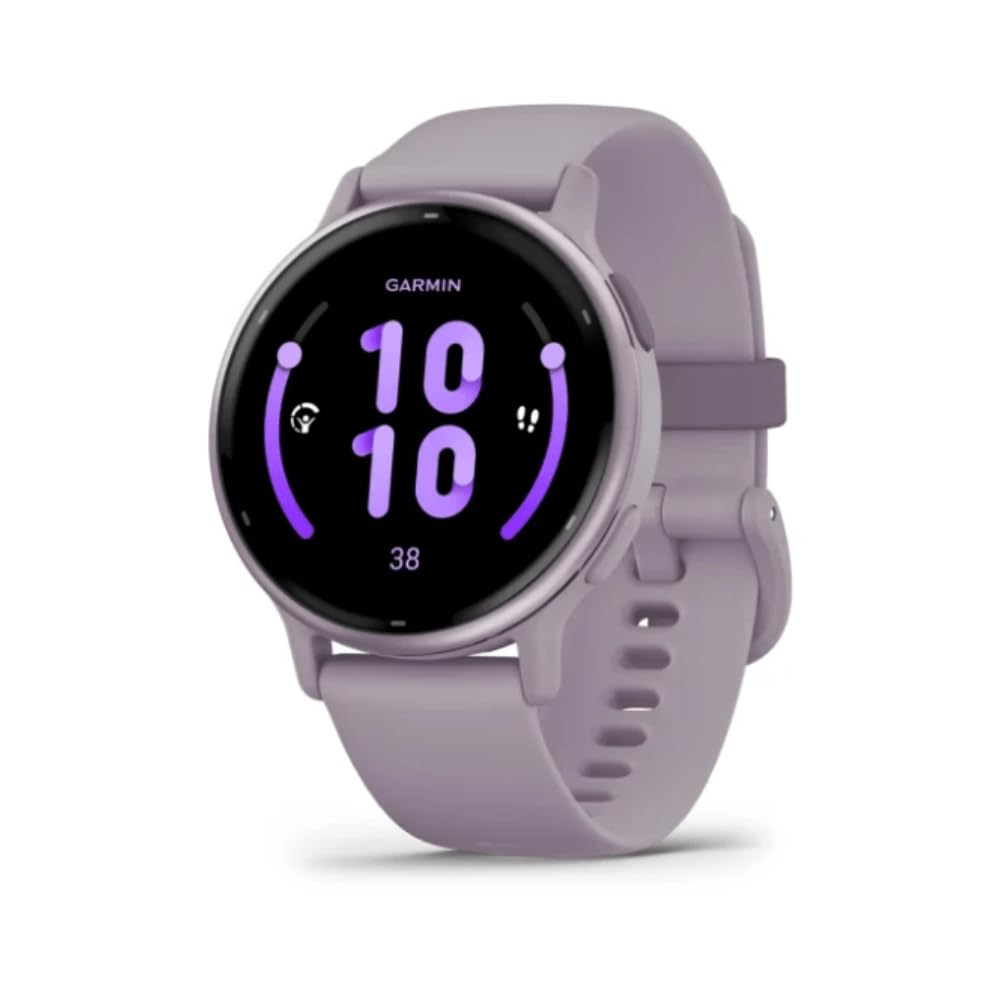
| Garmin vívoactive 5Health-First Pick | Daily health & fitness | 11 days | GPS | 5 ATM | Amazon |
| Amazfit T-Rex 3 | Rugged all-terrain | 27 days | Dual-band GPS (6 systems) | 328 feet (100m +) | Amazon |
| Garmin Epix Gen 2 (Renewed) | Premium mapping | 16 days | Multi-Band GNSS | Not listed | Amazon |
| Amazfit T-Rex 3 Pro | Premium rugged with flashlight | 17 days | Dual-band GPS (6 systems) | 10 ATM | Amazon |
| COROS Nomad | Fishing & adventure | 22 days | GPS | Not listed | Amazon |
| SUUNTO Vertical | Extended expeditions | 60 hours (GPS mode) | Dual-Band GNSS | Not listed | Amazon |
| Garmin Instinct Crossover Solar | Analog-digital hybrid | Up to 70 days (with solar) | Multi-GNSS | 10 ATM | Amazon |
| POLAR Sport Watch | Intensive training metrics | 8 days | Dual-Frequency GPS | Not listed | Amazon |
| SUUNTO Ocean | Diving & hiking | 12 days | Dual-Frequency GPS | 100 meters | Amazon |
In‑Depth Reviews
1. Garmin Instinct 2 Solar
Our pick — over 4.5★ from 750+ verified ratings; the strongest balance of quality and price.
The solar-powered companion that turns sunlight into trail time.
The biggest fear on a long hike is a dead watch. This Garmin Instinct 2 Solar solves that with solar charging that gives you unlimited battery life in smartwatch mode when you get 3 hours of direct sunlight a day. In GPS mode, you get up to 48 hours with continuous solar charging — enough to track a weekend trek without reaching for a cable. The 100 Amp Hour battery capacity is massive compared to the 0.91 Amp Hours in the COROS PACE 3, a 109.9x gap that makes this the obvious choice for anyone who spends multiple days off-grid.
The built-in 3-axis compass and barometric altimeter give you real navigation tools, not just fitness tracking. It communicates with GPS, GLONASS, and Galileo satellites so you stay locked on course even in deep canyons. The fiber-reinforced polymer case and Corning Gorilla glass handle drops and scrapes, and the water rating to 100 meters means you can cross streams without a second thought. The monochrome display is excellent in direct sunlight, though the backlight is dim and the all-button interface has a steep learning curve.
Buyers report an “excellent Apple Watch alternative” with “~19-day battery life with HR & Bluetooth.” The thing everyone raves about is the construction — quality earns the most praise by a wide margin. The silicone band measures 220 millimeters, a purposeful fit for smaller wrists that does not slide around. The solar panel subsidizes the charge rather than fully recharging, so treat it as a range extender, not a bottomless tank.
Why it owns the trail
- Unlimited battery life in smartwatch mode with regular sun exposure
- Multi-GNSS support (GPS, GLONASS, Galileo) for reliable tracking
- Water-rated to 100 meters with military-grade thermal and shock resistance
The honest trade-offs
- Monochrome display has a dim backlight
- Solar adds minor charge, not a full recharge
- Button-heavy interface requires a learning period
The backcountry bet: This is the pick for hikers who plan multi-day trips and want to minimize charging stops. The battery longevity alone justifies the upgrade.
Think twice if: You want a bright, colorful touchscreen or you rarely see direct sunlight on your hikes — the solar benefit diminishes in shaded, forest-heavy terrain.
2. COROS PACE 3 GPS Sport Watch
A featherweight GPS watch that feels invisible on your wrist.
Weighing just 30 grams with the nylon band, this COROS PACE 3 is built for runners and hikers who notice every extra gram on their wrist. The 11.7mm ultra-slim profile makes it comfortable enough for 24/7 wear, and the always-on 1.2-inch transflective touchscreen is readable in bright sunlight. The battery averages 17 days of daily use or 38 hours of continuous GPS tracking, which beats the 11-day average of the Garmin vívoactive 5 by 55%.
The Dual-Frequency satellite chipset locks onto signals fast and maintains accuracy in high-rise cities and under tree cover. Route planning is straightforward — build a custom route on the COROS App and sync it directly to the watch. The breadcrumb navigation feature shows your path without hiding your other activity data. The screen is dimmer than most competitors, notifications remain basic, and there is no streaming music; you must download MP3 files to the watch.
Owners mention the “battery lasts 10 days with 4 workouts/week” and call it a “great first time fitness watch.” The step count is very accurate, and the watch is swim-proof. Activity modes cover trail running, biking, swimming, strength, snowboarding, skiing, and cross-country skiing. The 215-millimeter band length is 2% shorter than the Garmin Instinct 2 Solar’s 220-millimeter band, so it fits snugly on smaller frames.
Why it punches above its weight
- 30g featherweight design with nylon band for all-day comfort
- 17 days of battery life with 38 hours of continuous GPS tracking
- Dual-Frequency GPS for accurate tracking in challenging conditions
The honest trade-offs
- Screen is dim and non-adjustable
- No streaming music — requires MP3 downloads
- Sleep tracking can miss pre-midnight sleep
Who it fits: Runners and day-hikers who prioritize a barely-there feel and accurate GPS over flashy features. The battery life is a genuine edge for weekly training.
Who should look further: Hikers who need offline topo maps or music streaming during long treks — the PACE 3 is a pure training tool, not a full outdoor navigation system.
3. Garmin vívoactive 5
A bright AMOLED screen that makes health data pop.
This watch is for someone who wants a sharp, colorful display alongside hiking capability. The Garmin vívoactive 5 features a bright AMOLED touchscreen and up to 11 days of battery life in smartwatch mode. The Body Battery energy monitoring learns your patterns — it tracks sleep, naps, stress, and workouts to tell you when you are charged up or need rest. The sleep score and personalized sleep coaching give tips to improve your rest, and automatic nap detection logs daytime naps without any manual input.
It has more than 30 built-in GPS and indoor sports apps covering walking, running, cycling, HIIT, swimming, and golf. Wheelchair mode tracks pushes instead of steps, adding push and handcycle activities. The morning report shows your sleep score, HRV status, and weather in one glance. The 42mm case and 20mm silicone band are designed for smaller wrists, and the Orchid color option adds a feminine touch that many hikers appreciate.
Customers note the watch is “perfect for swimmers because it tracks yardage” and that the “ivory design, bright AMOLED display, comfortable all-day wear” encouraged more walks. The screen is readable in sunlight, and the battery lasts 7 to 10 days with typical use. It charges quickly and the touch response is smooth. The 5 ATM water rating means it handles rain and splashes but is not suited for extended submersion beyond surface swimming.
Your daily health hub: The vívoactive 5 is the right choice if you hike regularly but also want a smartwatch that tracks your sleep, stress, and recovery with the best display in this class. The trade-off is shorter GPS battery life compared to the dedicated outdoor models above.
4. Amazfit T-Rex 3

A military-grade build that survives -22°F to 158°F.
The Amazfit T-Rex 3 is built for extreme conditions. The 316L stainless steel bezel and 328-foot water resistance make it ready for freediving down to 147 feet. The ultra-bright AMOLED display hits 2,000 nits peak brightness, meaning maps and workout data stay readable even in direct sunlight. Night mode and Glove Mode ensure you can read the screen at night or while wearing gloves on a cold summit.
The extended battery life delivers over 27 days with typical use or up to 180 hours in GPS mode — more than enough for multi-day backpacking trips. Precision navigation uses dual-band positioning across six satellite systems for fast, accurate GPS connections and turn-by-turn navigation. The 170-plus workout modes cover everything from hiking to surfing, and AI-generated training plans provide real-time updates. The 220-millimeter band length fits comfortably on a woman’s wrist while still looking rugged.
Buyers appreciate the “Best of both worlds: Apple smart features + Garmin durability” and note the battery lasts “several days, far superior to Apple Watch.” The design is the most-discussed feature, followed closely by battery life. It lacks call and text reply functions, and the software is less polished than a Garmin or Apple Watch, but at its price point the value is tough to top.
The high-adrenaline pick: This is for hikers who push into freezing temperatures, deep water, and technical terrain. The battery life and build quality are outstanding, with the only notable omission being voice reply capability.
5. Garmin Epix Gen 2 (Renewed)

A manufacturer-refurbished titanium flagship at a fraction of the new price.
The Garmin Epix Gen 2 brings premium outdoor mapping and performance metrics in a white titanium case that looks more like traditional jewelry than a GPS tool. The manufacturer-refurbished unit shows limited wear and is fully tested to deliver like-new performance, backed by a 90-day warranty. It includes multi-continent Topo maps, multi-band GNSS support, ABC sensors (altimeter, barometer, compass), and ClimbPro feature for real-time ascent information on trail runs and hikes.
The battery averages 16 days in smartwatch mode, and reviewers point out real-world results from 2 weeks to 3 weeks depending on GPS use. The titanium build is military-grade, and the sapphire lens resists scratches. Performance metrics include Real-Time Stamina, daily workout suggestions, Recovery Time, and PacePro technology for pacing strategy on a known route. The watch supports animated workouts and Garmin Coach adaptive training plans. The 47mm case is the largest on this list and may feel bulky on very small wrists.
Shoppers say arriving in “blemish-free, like-new condition” and call it a “great entry price for fitness/adventure watches.” The watch is comfortable but the sharp bezel edges can prevent sleep wear for some. GPS struggles in dense urban areas, but the maps are adequate for trail navigation. The overall quality earns the most praise, with functionality coming second.
The premium shortcut: If you want Epix mapping and titanium build without the flagship price tag, the renewed model delivers. The trade-offs are sharp bezel edges that may irritate during sleep and a 90-day warranty instead of the standard one-year.
6. Amazfit T-Rex 3 Pro
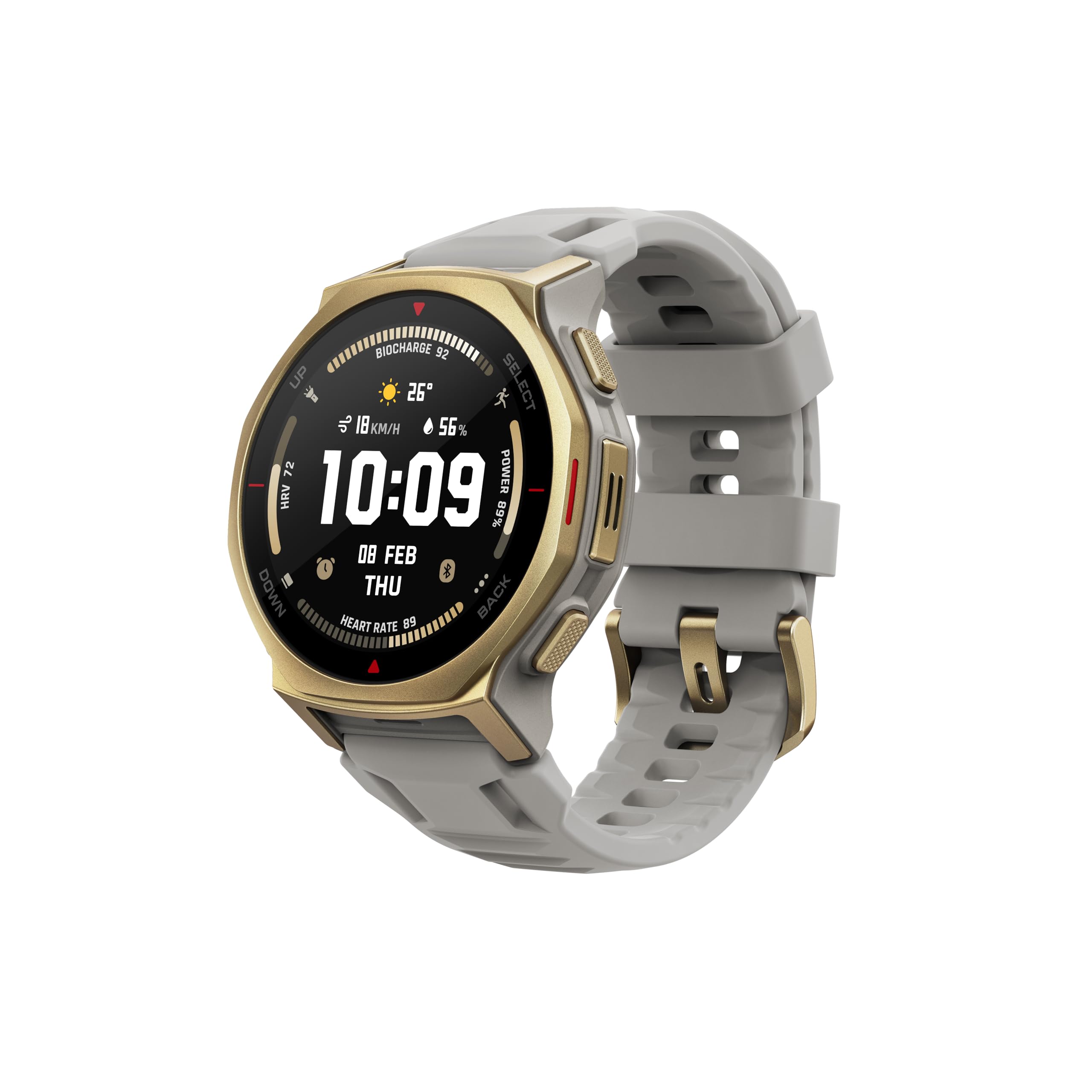
A titanium-alloy explorer with a built-in two-color flashlight.
The Amazfit T-Rex 3 Pro is a step above the standard T-Rex 3, swapping in sapphire glass (scratch-resistant crystal) and a titanium alloy bezel and buttons. The AMOLED display (a bright, vivid screen type) reaches 3,000 nits peak brightness, so offline maps and workout data stay readable in full sun. The dual-band GPS uses six satellite systems to maintain a lock under tall buildings or dense tree cover, and the 10 ATM water resistance (100 meters) with diving certification to 45 meters covers everything from stream crossings to ocean freediving.
It packs a built-in two-color flashlight with a soft red mode for low interference and a bright white mode for clarity, plus Turbo Mode for maximum visibility and an SOS signal. The BioTracker sensor delivers precise heart-rate tracking that can pair with the optional Helio Strap for 24/7 recovery data. The 44mm case is slightly smaller and more wrist-friendly than the 48mm standard T-Rex 3, and the Arctic Gold color adds a metallic accent that stands out on the trail. Battery life reaches 17 days with typical use, and the battery capacity is 500 Milliamp Hours.
Buyers report the “flashlight feature heavily used on farm” and say the watch is “more features than Garmin at similar price.” The design earns the most praise, followed closely by battery life. The software is less advanced than Garmin or Apple, and downloading music to the watch is described as “extremely difficult and unreliable.” The build quality and materials are consistently called comparable to premium Garmins at roughly a third of the price.
The fully-loaded alternative: This is the pick for hikers who want sapphire glass, a titanium bezel, and a built-in flashlight without crossing into Garmin Fenix pricing. Music storage is frustrating, but everything else about the hardware punches well above its cost.
7. COROS Nomad GPS Outdoor Watch
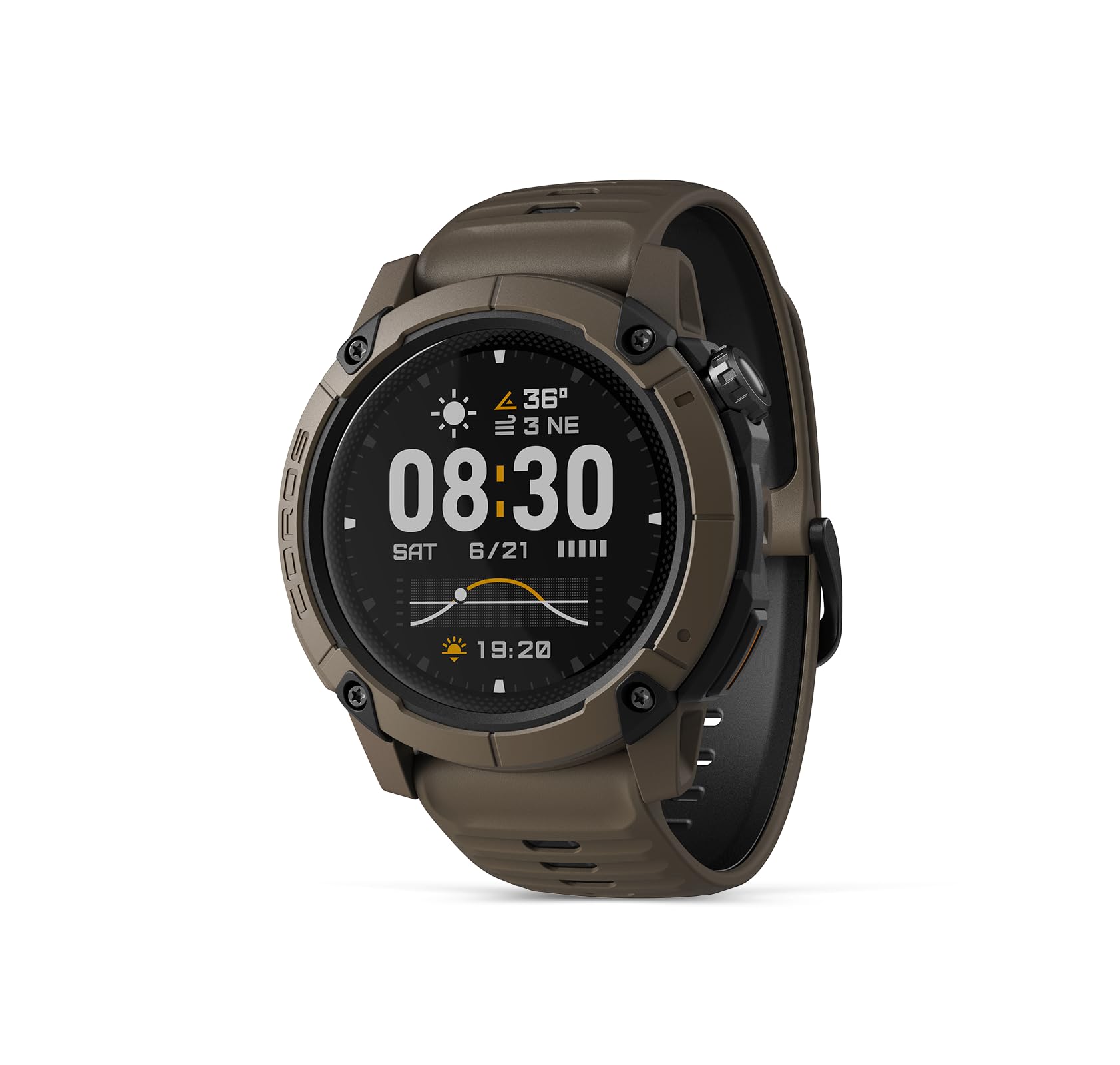
An outdoor watch that logs your catch as accurately as your trail.
The COROS Nomad is a niche pick that deserves attention because it builds outdoor navigation around fishing. The dual-layer polymer and aluminum alloy bezel houses a 1.3-inch Memory in Pixel (MIP) screen that delivers high contrast in direct sun and deep color saturation in low light. The pre-loaded global maps include street names, and the Back-to-Start navigation feature helps you return to your entry point — invaluable when exploring new shoreline or backcountry trails.
Fishing-specific modes provide real-time and forecasted tide data, sunrise, and moon phase information, plus catch logging to mark key spots. The Adventure Journal lets you record voice notes, tag locations, and add photos during activities, then transcribes voice-to-text memos. Battery life reaches 22 days of daily use and 50 hours of continuous GPS tracking. The battery capacity is 10 Milliamp Hours. The 1.3-inch display is easy to read at a glance, and the resin band is comfortable for extended wear.
Owners mention the “battery charge lasts two weeks even with daily workouts” and the “navigation is top-notch.” The watch provides barometric and temperature tracking useful off-grid, and the flashlight mode is a handy addition. The display brightness is a mixed point — it is just right for most but not adjustable for reading in pitch darkness. An occasional Bluetooth connectivity issue appears in the complaints, and the weather data requires a phone sync to update.
Perfect for the angler-hiker: If fishing is your primary outdoor passion and hiking is the way you get to the water, the Nomad is uniquely suited. The 22-day battery and Adventure Journal recording make it a travel companion as much as a fishing tool. MIP display visibility is excellent in sunlight but dim indoors.
8. SUUNTO Vertical

A Finnish-built expedition watch with free global offline maps.
The SUUNTO Vertical is a 49mm outdoor watch with a large color display and free offline global maps showing paths, contour lines, water sources, and landmarks. The dual-band GPS delivers reliable accuracy in the toughest conditions — among cliffs, valleys, and skyscrapers. Battery life reaches up to 500 hours in tour mode and up to 60 hours in the most accurate tracking mode. On sunny days, the solar charging option on the Titanium model boosts battery life by a further 30%.
The watch is made in Finland in Suunto’s own factory using 100% renewable energy and is fully carbon compensated. It includes navigation features like bread crumb trails, points of interest, and bearings. The barometer provides precise altitude measurements. The 49mm case is large and the accompanying 1-foot charger cable is frustratingly short. The touchscreen and menu navigation require a period of adjustment — the interface is not as intuitive as Garmin’s.
Customers note the “best route guidance implementation (non-routable maps)” and a “clean display, lighter than Garmin Tactix.” The build quality earns the highest praise, followed by battery life. The accuracy and map quality receive mixed feedback — some find it accurate while others disagree. The silicone band may need yearly replacement with heavy use. Storm alerts did not trigger for one reviewer, and sleep tracking can fail. The value is mixed compared to Garmin’s ecosystem.
The long-haul specialist: This is the watch for extended backcountry expeditions where you need free global maps that work offline and days of navigable battery. The interface is less polished than the Garmin option, and the map quality varies by region, but the GPS longevity is genuinely expedition-grade.
9. Garmin Instinct Crossover Solar

Luminescent analog hands meet a rugged digital GPS tool.
This Garmin Instinct Crossover Solar combines traditional analog watch hands with a high-resolution digital display and solar charging. The RevoDrive technology ensures accurate analog timekeeping even in demanding environments. The MIL-STD-810 certification guarantees thermal and shock resistance, and the 10 ATM water resistance means this watch handles depths of 100 meters without complaint. The solar charging delivers infinite battery life in battery saver mode, up to 70 days in smartwatch mode, and up to 31 hours in GPS mode with sun exposure.
The watch pairs with your Android or Apple smartphone for smart notifications, Garmin Pay contactless payments, and all-day health monitoring that tracks heart rate, sleep score, Pulse Ox, and respiration. Built-in sports apps cover strength training, running, and mountain biking. The navigation uses GPS, GLONASS, and Galileo satellites with built-in ABC sensors. The silicone and rubber band measures 22 millimeters wide. The display is dark and hard to see at certain angles, and the analog hands are not luminous enough in the dark.
Buyers call it a “great all-around smart watch” and note the “2-3 week battery” with solar. The overall quality is the most praised aspect, followed by battery life. The solar feature adds only a minor boost for most users, and visibility is mixed — some find it hard to see, others appreciate the always-on analog display. The sleep mode gives “poor ratings (e.g., 46)” to one reviewer. An occasional condensation issue in cold weather appears in the feedback.
The classic-modern blend: If you want the look of a traditional watch with GPS smarts and solar backup, this is your option. The trade-off is a dimmer display and analog hands that lack nighttime glow — you trade crisp screen clarity for the classic aesthetic.
10. POLAR Sport Watch with GPS

A top-tier training computer for the runner who also hikes.
This POLAR watch is built for athletes who want the sharpest AMOLED touchscreen and the most comprehensive training data. The dual-frequency GPS locks onto trails, and the downloadable maps with detailed contouring provide a topographic experience for off-path hiking. The customizable dashboards and widgets let you prioritize the data that matters most.
The battery lasts up to 140 hours in training mode and up to 8 days of regular use on a single charge. The silicone band is comfortable for all-day wear. The training and recovery tools are the most comprehensive suite POLAR offers — they give you everything you need to boost performance. The black color is understated and works with any outfit. The battery capacity is 488 Milliamp Hours. The case and band are both silicone, keeping the weight manageable for a 50mm-class watch.
Buyers praise the “high-res screen, run tracking, move reminders, customizable UI” and call it “fantastic” and “easy to use.” The battery life is “wonderful” for those who run 4 to 5 times per week for 90 minutes. Quality earns the top attribute praise. The battery life and reliability are both mixed in the data — recharge inconsistency (5 to more than 10 hours) appears, and a few units arrived with display failures after a few months. iPhone notifications are read-only with no app interaction.
Data-driven hiker: This is for the person who trains seriously and uses hiking as cross-training. The mapping is solid, the screen is excellent, but the battery inconsistency reports mean you should test your unit thoroughly during the return window.
11. SUUNTO Ocean

A full dive computer that also navigates the trail.
The SUUNTO Ocean is a rare watch that serves as both a hiking GPS and a dive computer. The stainless steel case and sapphire glass house a 1.43-inch high-resolution AMOLED display that is clear and bright, tested for readability in various diving conditions. It is water-resistant to 100 meters and measures depth up to 60 meters. The battery delivers 40 hours in dive mode and 40 hours in GPS tracking mode with optimal accuracy. In daily mode, it records heart rate and sleep for up to 12 days.
Five diving modes cover Air & Nitrox, Freedive, Snorkelling, Mermaid, and additional multi-gas support for technical diving. Wireless bottle pressure tracking shows tank pressure and gas consumption directly on your wrist. The dual-frequency GPS provides location precision, and offline maps work underwater to find dive spots and track entry and exit points in the app. The 95+ sports modes cover diving, cycling, yoga, skiing, and hiking. The SUUNTO AI Coach gives personal feedback on training load and recovery based on heart rate variability.
Buyers call it a “great dive computer with great GPS” and note the “amazing battery life” after 11 dives. The display is comfortable and intuitive. The battery lasts multiple weeks between charges. The watch is made in Finland with 100% renewable energy and is fully carbon compensated. The software can be unstable — sync with the watch is buggy and the UI has rough edges. The SpO2 readings are slightly low, and the gym mode is limited. At 50mm diameter and 99 grams, it is the largest and heaviest option on this list.
Land-and-sea specialist: If your outdoor life includes both long hikes and regular dives, the SUUNTO Ocean eliminates the need for two different devices. It excels at diving features and GPS tracking. The trade-off is bulk — it is a large, heavy watch that not everyone will want to wear daily — and software issues that can frustrate a polished-user experience.
Understanding the Specs
GPS (Global Positioning System)
This is the system that tracks your exact location using satellites. A dual-band or multi-band GPS locks onto signals from multiple satellite networks at once. This gives you a more accurate position, especially under tree cover, in deep canyons, or near tall buildings. A single-band GPS is fine for open trails, but a dual-band system is safer for off-path navigation where signal interference is common.
Battery Life (Smartwatch vs GPS Mode)
Battery life in smartwatch mode refers to how long the watch lasts when you are not actively tracking an activity — just telling time and checking notifications. Battery life in GPS mode is how many hours it can continuously track your trail using satellites. A watch that claims 7 days in smartwatch mode may only last 10 to 15 hours of continuous GPS tracking. For a day hike, 15 to 20 hours of GPS battery is enough. For multi-day trips with no charging, look for 40 hours or more of GPS mode.
Barometric Altimeter
This sensor measures air pressure to calculate your elevation above sea level. A GPS-only elevation can be inaccurate by hundreds of feet in thick forest or steep terrain. A barometric altimeter is more precise because it reads the actual air pressure around you, which changes as you climb or descend. This is critical for navigation in mountainous areas where knowing your exact elevation helps you identify your position on a topographic map.
Water Resistance Rating (ATM)
An ATM rating tells you how much water pressure the watch can handle. 5 ATM means it is safe for surface swimming and rain but not for diving. 10 ATM (100 meters) means it can handle snorkeling, shallow diving, and submersion while crossing rivers. If you hike in wet conditions or plan to take the watch kayaking, choose at least 10 ATM. A watch with only 3 ATM is splash-proof and may fail if submerged.
FAQ
Can I use a Garmin hiking watch for everyday fitness tracking?
Does a women’s hiking watch come in a smaller case size?
How often do I need to charge a hiking watch during a long trek?
What is the difference between GPS and GLONASS?
Can I listen to music on a hiking watch without my phone?
How does a barometric altimeter help with navigation on a hike?
Is solar charging worth the extra cost on a hiking watch?
How durable is a military-grade hiking watch compared to a standard smartwatch?
Will a hiking watch work with my iPhone or Android phone?
What is a TracBack routing feature on a Garmin watch?
Final Thoughts: The Verdict
For the majority of shoppers, the women’s hiking watch winner is the Garmin Instinct 2 Solar because it delivers unlimited battery life through solar charging, rugged MIL-STD-810 durability (a military standard for shock, temperature, and water resistance), and multi-GNSS navigation (using multiple satellite networks like GPS and GLONASS) all in a smaller case that fits a woman’s wrist. If you want a lightweight training watch with excellent GPS accuracy, grab the COROS PACE 3. And for a premium sapphire-glass build with a built-in flashlight at a competitive price, the Amazfit T-Rex 3 Pro is the one to reach for.
How We Picked
We do not accept paid placement. Every pick is matched to a real buyer and a real use-case; we do not hands-on test units.
Sources & Methodology
Specifications: manufacturer listings and product documentation. Review insights: verified customer reviews, as of July 2026. Pricing: not shown on this page (it changes often); check the current price via the retailer link.
As an Amazon Associate, Calories Fit earns from qualifying purchases. This does not affect which products we feature.