
Our readers keep the lights on and the coffee maker working hard! As an Amazon Associate, I earn from qualifying purchases.
Specs are compiled from manufacturer listings and verified buyer reviews and can change over time — please confirm the key details on the product page before buying.
Before you buy a wobble balance board, the real question isn’t which one looks coolest in the photos. It’s whether the board will match your skill level, your weight, and the floor you’re standing on — a board too wobbly for a beginner frustrates, and one too stiff for an athlete gets boring in a week. This guide breaks down the 9 best wobble balance boards by who they’re genuinely built for, from physical therapy recovery to standing-desk energy to kids’ play, using only published specs and honest patterns from verified owner experiences.
I’m Mohammad — the founder and writer behind Calories Fit. This guide is built by comparing the manufacturers’ published specifications and the patterns across verified customer reviews, so you get each pick’s real strengths and trade-offs instead of marketing spin.
You’ll see exactly which board holds up under daily use, which ones let you adjust the tilt as you improve, and which ones are built for a 350-pound capacity you can actually trust. This is your clear-eyed look at the best wobble balance board options that genuinely deliver results.
Our Picks at a Glance

How To Choose The Best Wobble Balance Board
Every wobble balance board is a simple platform on a pivot, but the way that pivot works decides everything about your experience. Some boards tilt on a single axis like a seesaw (rocker boards), while others let you tilt in every direction on a rounded base (wobble boards). Knowing which style fits your goal — rehab, desk movement, or sport training — is the first real decision.
Match the Board’s Weight Capacity to Your Body
Check your weight first, because it’s non-negotiable. Boards here range from a 300-pound maximum up to a 480-pound capacity, so there’s a sturdy option for nearly everyone. If you’re near the top of a board’s limit, the wobble motion feels sluggish and the board may not respond as it should.
Adjustable Tilt Means a Board That Grows With You
The best boards let you change the difficulty as your balance improves. Some use adjustable spheres or domes underneath to change the tilt angle, while others use magnetic stoppers or rings to limit the range of motion. A board with zero adjustability is fine for basic use, but an adjustable one keeps challenging you for months instead of weeks.
The Surface Grip Is About Safety, Not Comfort
Your feet need to stay planted, especially when you start to wobble. Look for textured surfaces like EVA foam, cork rubber, or sandpaper coatings that grip well in socks, barefoot, or shoes. A slick surface turns a fun workout into a slip risk, and the data shows this is one of the first things owners notice.
Quick Comparison
| Model | Best For | Weight Capacity | Board Weight | Surface Material | Amazon |
|---|---|---|---|---|---|
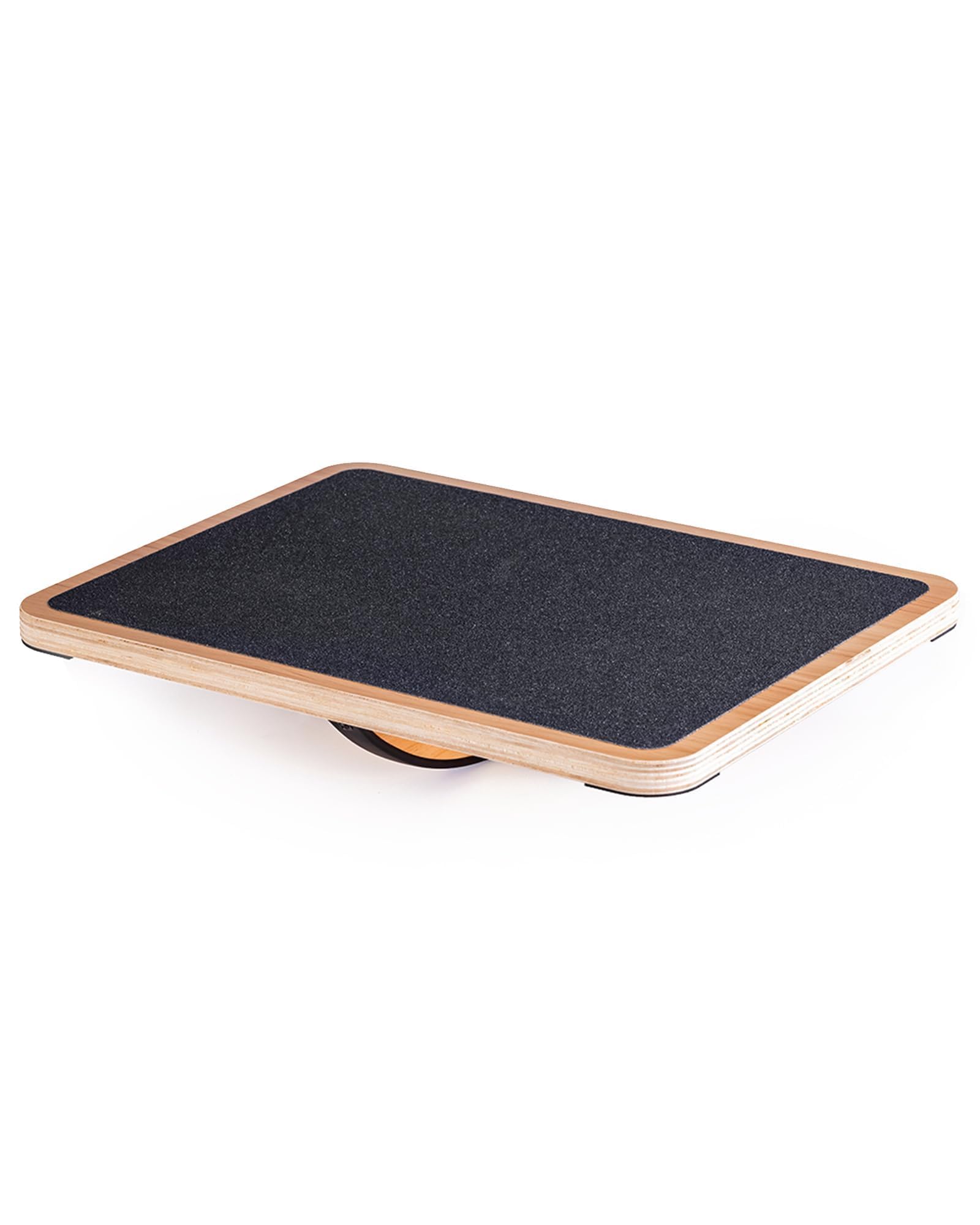
| Fitterfirst Professional Rocker Board★ Best Overall | PT-grade rehab & adjustable challenge | 350 pounds | 7.5 pounds | Baltic birch plywood | Amazon |
| StrongTek Wooden Balance BoardBest Value | Standing desk & value | 350 pounds | 4.9 pounds (2.23 kg) | Lauan hardwood plywood | Amazon |
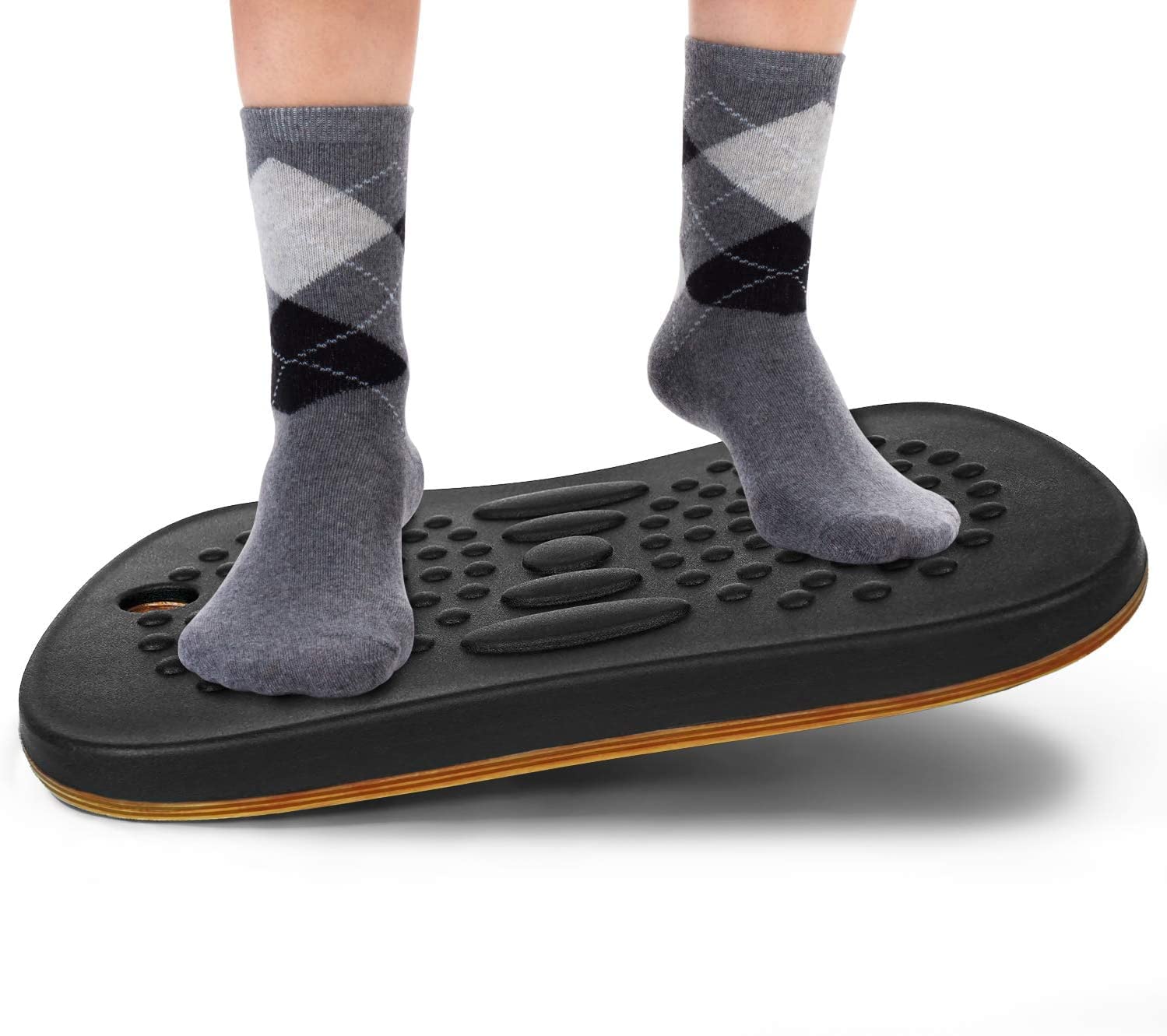
| Yes4All Wobble Balance BoardMost Comfortable | Gentle anti-fatigue desk relief | 396 pounds (180 kg) | 6 pounds | EVA foam | Amazon |
| PROIRON Upgraded Wobble Board | Portable 360° training with handles | 330 pounds | 2.6 pounds (1.2 kg) | PP with TPE bottom | Amazon |
| WOOD CITY Wobble Board | Kids’ play & family creativity | 480 pounds | 4.6 pounds | Natural wood | Amazon |
| Sportneer Balance Board | Versatile 7-mode progressive training | 450 pounds | 13 pounds (5.9 kg) | Birch wood with EVA top | Amazon |
| Flycoop Balance Board | Sport-specific 360° training | 440 pounds (200 kg) | 11.5 pounds (5.2 kg) | 15-layer pressed wood | Amazon |
| Fitterfirst Professional Balance Board | Smaller-footprint adjustable rehab | 300 pounds | 4.1 pounds (1.88 kg) | Wood | Amazon |
| Whirly Board Wide 360˚ | Premium standing desk & sport spinning | 400 pounds | 6 pounds | 8-ply Canadian maple with cork grip | Amazon |
In-Depth Reviews
1. Fitterfirst Professional Rocker Board – 20”
Our pick — over 4.5★ from 800+ verified ratings; the strongest balance of quality and price.
The clinic-grade rocker that earns its spot in physical therapy offices, setting the standard for others to follow
If there’s one board that serious rehab users keep coming back to, this is it. The defining feature here is the single-plane tilt that you can set to 10, 12, or 15 degrees — meaning you choose how steep the seesaw motion feels, so the challenge grows as your ankle or knee heals. It’s built from durable Baltic birch plywood that supports a 350-pound maximum weight, yet the board itself weighs only 7.5 pounds, so it’s heavy enough to stay planted but still easy to move.
Owners consistently praise its balance-training effectiveness and versatility, noting it feels identical to the board at their physical therapist’s gym. As owners put it: “Excellent board not only for improving balance, but for any joint rehab as well.”
It’s the most expensive pick here, and the “value for money” category is the one mixed note — some owners feel the premium price is justified, others expect more for the cost. The trade-off is clear: you’re paying for a board that progresses with you through three levels of difficulty, plus a lifetime-worthy build.
The rehab workhorse
- Three adjustable tilt angles (10°, 12°, 15°) let you gradually increase difficulty
- 350-pound capacity handles most body types with confidence
- Sturdy Baltic birch plywood holds up to daily PT use
What to weigh first
- Single-plane rocker motion only — no 360° side-to-side wobble
- Premium price tag that some owners feel is steep
- Heavier than most portable options at 7.5 pounds
The pick for: anyone doing physical therapy or joint rehab who wants a board that grows with their recovery through adjustable tilt angles.
Think twice if: you want a 360-degree wobble for standing-desk fidgeting — this one rocks back and forth on one plane, it doesn’t spin.
2. StrongTek Wooden Balance Board, Basic Rocker or Advanced 360° Wobble
A cross-shaped base that teaches 360° wobble without the scary round-base learning curve
This board’s smart design gives you the challenge of a full 360° wobble, but tames it with a cross-shaped base that creates a larger floor contact area. That means you can tilt in every direction like a round-base board — training stability, coordination, ankle control, and core engagement — but with a more controlled, approachable feel that beginners actually enjoy. It holds up to 350 pounds, and at 17.5 inches long, it beats the Yes4All board above on compact footprint while still giving size-14 shoes a home.
The standing-desk crowd has made this a favorite, and the phrase that keeps showing up is “perfect height.” Buyers report it stores neatly on its side when not in use, and the textured top keeps your feet from slipping as you shift your weight.
The recurring gripe is honest and specific: the corner pad adhesive isn’t sticky enough, so the edge protectors can fall off. It’s a minor annoyance on an otherwise well-built board — several owners still give it five stars while noting the fix — but it’s worth knowing before you buy.
Why it wins
- Cross-base design adds 360° movement safely for beginners
- Makes balance training noticeably more accessible than round-base boards
- Great budget-friendly price for a wooden board
The honest catch
- Corner pad adhesive is weak and pads can peel off over time
- Learning all-direction tilt takes real practice
- Not as heavy as premium boards, so it can slide on slick floors
Reach for this if: you want a 360° challenge as a beginner or standing-desk user without paying premium prices.
Look elsewhere if: you’re a heavy user who plans to train aggressively every day — the adhesive issue may bother you.
3. Yes4All Wobble Balance Board for Standing Desk/Anti-Fatigue Office Foam Pad
The cushioned foam companion that turns a hard desk job into a gentle, active standing session
This isn’t a hard wooden board — it’s a closed-cell EVA foam pad that feels almost like a cushioned anti-fatigue mat with a wobble built in. The soft, textured surface has a pebbled design that’s comfortable for hours of standing, and the gentle wobble is safe enough to let you turn, step on, and step off without fear. It supports a maximum weight of 180 kg (about 396 pounds), and the board itself weighs 6 pounds.
Owners most often praise its stability and build quality, calling it comfortable and easy to balance on. It’s less wobbly than the office boards at the gym, which makes it perfect for people who want subtle movement, not a workout. Buyers describe it as “comfortable and sturdy, very stable and easy to balance on.”
The honest trade-off is that some experienced users find it too easy — they’ve called it a “wobbly anti-fatigue mat” rather than a training tool. Your feet can hang off the edges if you have large shoes, and the durability of the foam gets mixed reviews over the long haul.
The comfort pick: the softest, most forgiving board here — ideal for programmers, writers, and desk workers who stand for hours and want gentle movement without a steep learning curve.
But not a trainer: if you’re an athlete looking for a real balance challenge, this will feel too easy within days.
4. PROIRON Upgraded Wobble Balance Board

The ultra-light 360° disc with built-in handles that makes balance training a grab-and-go habit
At just 1.2 kg (about 2.6 pounds), this is the lightest board in the lineup — and it’s the one you’ll actually pick up and carry to the office, the park, or the living room. Despite the featherweight feel, it’s reinforced with 12 screws connecting the top and base, and it supports up to 330 pounds. The spherical bottom gives you a full 360-degree rotation with a tilt angle that ranges from 0 to 22 degrees, which is a wider range than most disc boards.
The dual handles aren’t just for carrying — they open up push-ups and Russian twists as a new dimension to your workout. Build quality is the top praise in the reviews, with balance improvement a close second. A 71-year-old owner reports using it every day to work muscles and improve balance, which tells you the learning curve is friendly.
The catch is the surface: the top is textured, but some owners mention it’s a bit slippery in socks and demands a good grip with shoes. Older adults and seniors might want to start with shoes on a carpeted surface just to be safe.
Light and locked together
- 12-screw construction keeps the top and base firmly connected
- Only 2.6 pounds — the easiest board here to transport anywhere
- Dual handles enable push-ups and Russian twists
Watch out for
- Top surface can feel slippery in socks for some users
- All-direction wobble is a steep challenge for complete beginners
- Smaller 16.34-inch platform gives less room for wide feet
Grab this if: you want a portable balance trainer that travels with you and offers grip-based exercises beyond just standing.
Pass if: you prefer a roomier platform and plan to train barefoot in socks — the grip may not be enough for you.
5. WOOD CITY Wobble Board

A 35-inch curved plank that doubles as a balance trainer, a bridge, a tunnel, and a lounge chair
This is the only board here that’s genuinely a toy first and a fitness tool second. At 35 inches long and 11.8 inches wide, it’s an open-ended play piece that kids turn into a swing, a bridge, a shop, a cabin, or a stepping stone. But it’s also a serious balance trainer that safely holds up to 480 pounds — the highest capacity in this entire lineup — so adults and even grandma can practice balance on it alongside the kids.
Owners overwhelmingly praise its playability and fun factor for kids and families. It’s an eco-friendly, natural wood board with unique grain patterns on each one, and it’s made for kids age 18 months and up. The 0.66-inch thickness means it’s a curvy rocker that tilts front-to-back and side-to-side, not a 360° spinning disc.
Stability gets mixed feedback, with some owners reporting the board can slip out from under them if you hit it at the wrong angle. And there’s a minor pinch hazard for tiny toes and fingers when the board tips — worth watching with toddlers. It’s a whole-family pick that’s more about creative play than progressive athletic training.
The family centerpiece: built for toddlers and grown-ups together, with the sturdiest weight capacity in this guide at 480 pounds — but it’s a flat rocker, not a 360° trainer.
The honest note: watch for pinching and occasional slipping; this is playful, not precision training equipment.
6. Sportneer Balance Board, 7-Mode Balance Trainer with Roller & Ball

Seven challenge modes and four magnetic stoppers that turn one wooden plank into a full stability gym
This board is built for people who want a system, not just a plank. The 7-mode design comes with a roller and a 2.8-inch ball, and four magnetic removable stoppers let you reconfigure the challenge in seconds with no tools. You can go from a beginner-friendly rocker to an expert-level free-rolling balance trainer to the brutal ball mode — the one owners say is genuinely difficult. The birch wood platform supports a sturdy 450-pound capacity and the board weighs 5.9 kg (about 13 pounds).
Owners most often mention fun and balance training as top benefits. The textured non-slip EVA surface gives you grip whether you’re in shoes or barefoot, and the foam top keeps things quiet. The magnetic snap-in fences are easy to rearrange, making this a hit for kids burning off indoor energy and surfers training for the season.
The one frustration from owners: the half-circle rails lack indentions, making them hard to remove once snapped in — the straight ones are easy. It’s a small design flaw on an otherwise well-engineered board that costs a fraction of a surf training session.
The progression system
- 7 distinct difficulty modes from beginner rocker to advanced ball
- Magnetic stoppers adjust without any tools
- 450-pound capacity and quiet EVA foam top
Minor friction points
- Half-circle rails are stubborn to remove once attached
- Heavier than portable disc boards at 13 pounds
- Narrower than some competitors for wide-stance practice
Pick this for: athletes (surf, snowboard, hockey) who want progressive difficulty and a system that scales from beginner to expert.
skip it if: you just want a simple, lightweight board to fidget on under a standing desk — this is a full training setup.
7. Flycoop Balance Board with Adjustable Stoppers: 3 Modes
A 15-layer pressed wood board with magnetic stages and a long rolling surface built for serious sport training
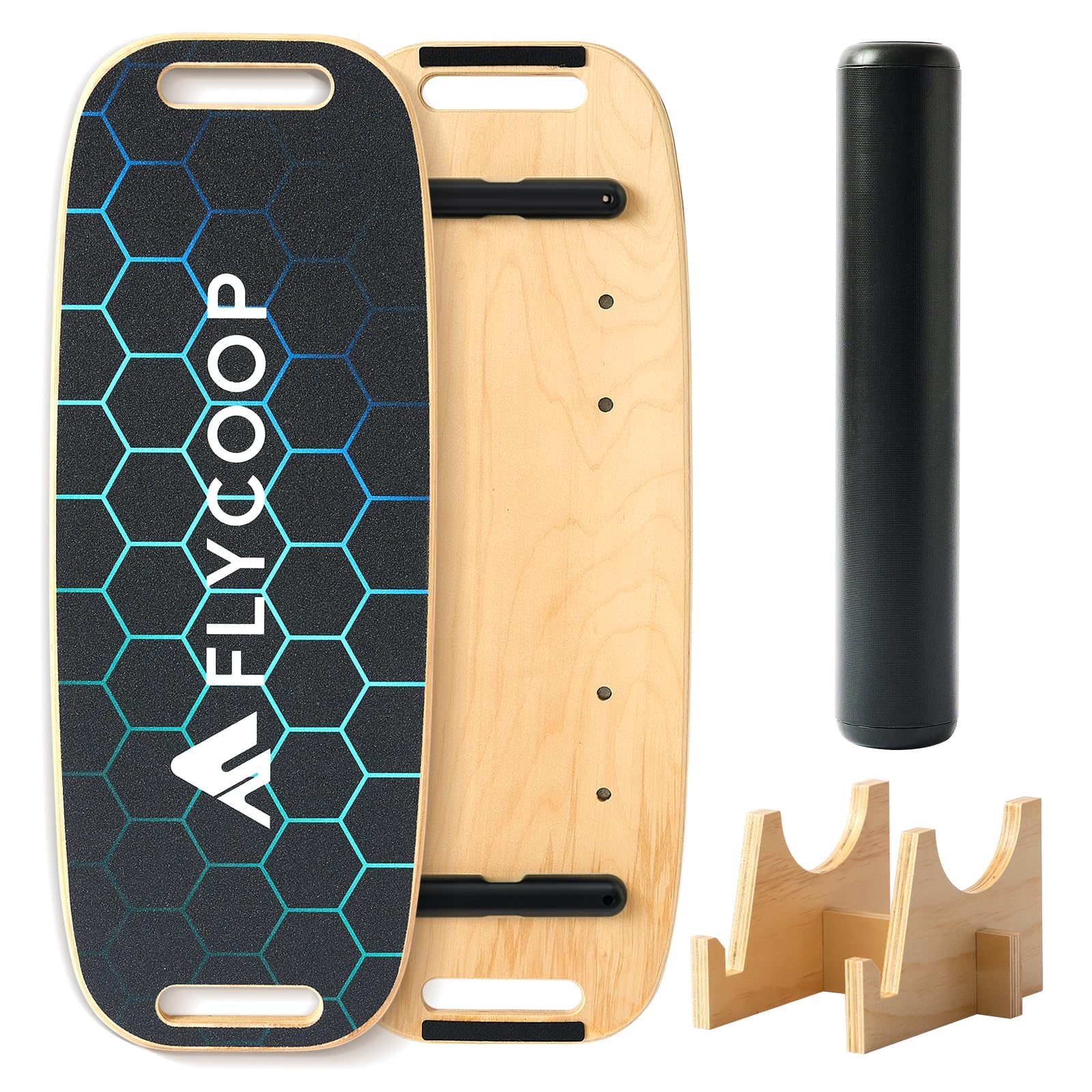
Where most boards rely on smooth strips for traction, this one uses a unique back design with holes and magnetic brackets that support a variety of balance exercises. The 3 modes come from magnetic stages on the bottom that adjust the stoppers — so you can feel safe and in control at first, then ramp up the difficulty as your balance improves. Built from 15 layers of pressed wood, it supports up to 200 kg (about 440 pounds), far more than most comparable products.
Owners most often praise its build quality, balance training, and fun factor. It’s made for sports like surfing, snowboarding, skiing, skateboarding, and even golf — the long rolling surface mimics the dynamic balance you need on a board. Customers note a steep learning curve but call it “highly challenging but a lot of fun,” with the adjustable stoppers making it a safe way to gain control.
The two holes on either side double as handles for push-ups or attachment points for resistance bands (sold separately), making this a genuinely versatile tool. The one annoyance: the board picks up dust and dog hair, so owners brush it off before storing it vertically.
The athlete’s board
- 15-layer pressed wood gives a sturdy, heavy-duty feel
- 3 magnetic difficulty modes progress with your skill
- Side holes enable push-ups and resistance band work
Heads-up
- Steep learning curve for true beginners
- Heavier at 5.2 kg (about 11.5 pounds)
- Surface attracts dust and pet hair, needs brushing
Best for: athletes across surf, snow, skate, and hockey who want a sturdy 360° trainer with safety adjustability built in.
Not for: anyone who wants a lightweight desk accessory — this is a proper training board that commits to the workout.
8. Fitterfirst Professional Balance Board

The smaller 16-inch sibling of the top pick, with a taller tilt range for serious rehab progression
The platform here is 16 inches square — noticeably more compact than the 20-inch top pick — but it brings a bigger challenge: the adjustable tilt goes from 15 to 17 to 20 degrees, steeper than the 20-inch board’s 10/12/15 range. That makes this the right choice when you’ve maxed out the larger board and need more difficulty to keep rebuilding the stabilizing muscles around an injured ankle or knee. It supports 300 pounds and uses the same brilliant adjustment mechanism that owners describe as feeling exactly like the board at their physical therapist’s gym.
Owners most often praise its balance training and the adjustable tilt mechanism. One owner followed a specific recovery path: buying the 20-inch board first for safety, then cutting it down to 16 inches for progression — evidence that the smaller frame genuinely is the harder setting. The build quality is heavyweight and the adjustment engineering is what owners consistently call “brilliant.”
Here’s the honest catch: the top is too smooth for barefoot work, so you’ll want grip socks or shoes. And at this smaller size, athletic individuals may find even the 20-degree setting too easy after a couple of weeks. The surface-grip and difficulty categories are the two most mixed in the review data.
Built for progression
- Steeper 15°/17°/20° adjustable tilt for advanced rehab
- Same clinic-grade quality as the 20-inch version
- Compact footprint stores easily
Know before you buy
- Smooth top needs grip socks or shoes — barefoot slips
- 300-pound limit is the lowest in this guide
- Serious athletes may outgrow even the hardest setting
Choose this if: you’re rehabbing an ankle or knee and want a compact board with a steeper challenge than the standard 20-inch model provides.
Think twice if: you’re over 300 pounds or you want to train barefoot — this board demands grip socks and has a lower weight ceiling.
9. Whirly Board Wide 360˚ | Standing Desk Balance Board
A handcrafted 8-ply Canadian maple deck that spins, rocks, and tilts — and doubles as wall art
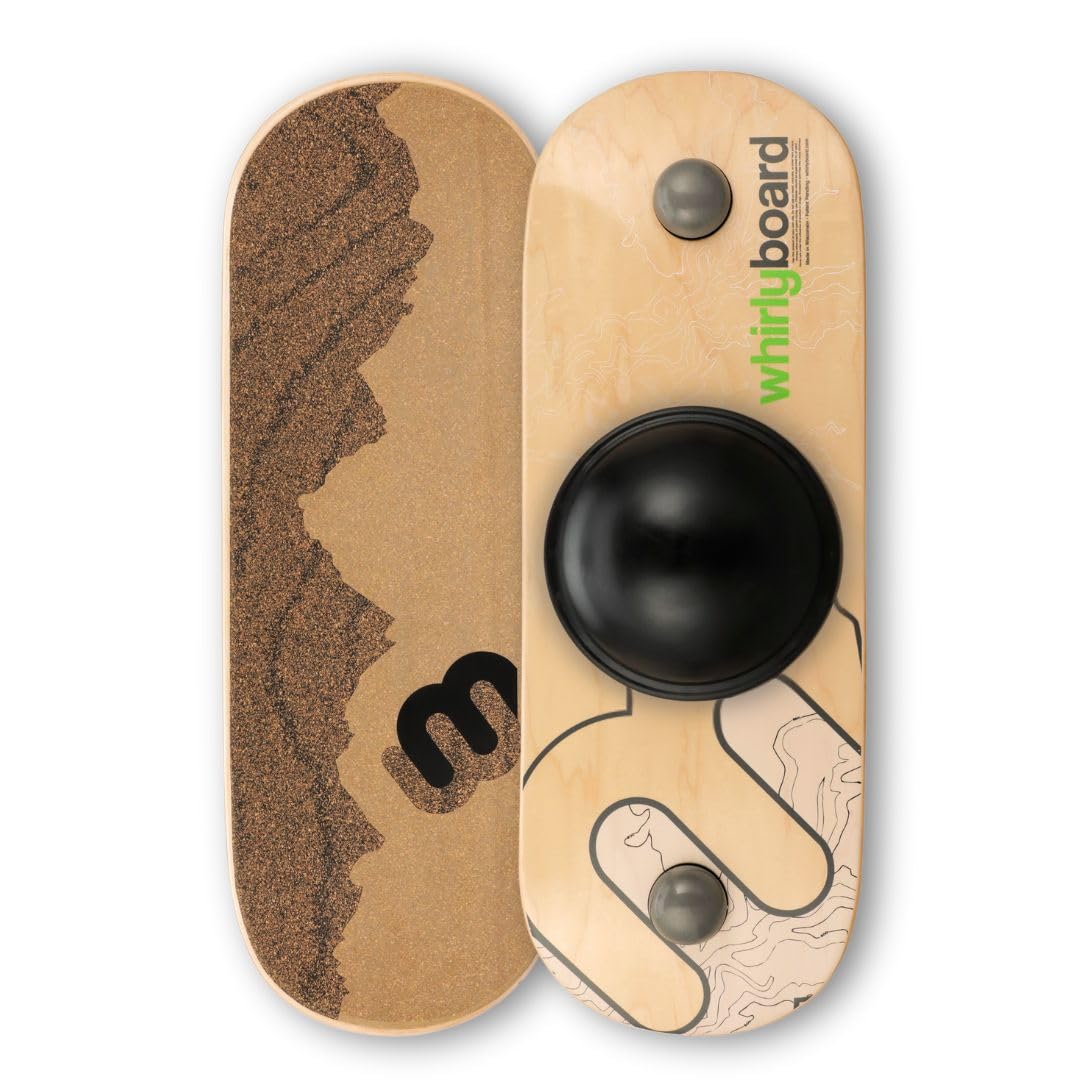
This is the most distinctive board in the guide, and it earns its premium price through materials and craftsmanship alone. It’s built from 8-ply Canadian maple — the same wood quality used in professional skateboards — and topped with eco-friendly cork grip tape and recycled rubber featuring a Teton Mountain design. Instead of a single pivot point, it uses three semi-spherical balance points that create a dynamic 360° spinning motion in any direction. You can spin, rock, tilt, and bounce for a complete workout, and it supports 400 pounds.
The 10-inch wide deck is designed to fit comfortably under a standing desk, and the standing-desk crowd has embraced it hard. Reviewers point out it reduces fatigue enough to enable 2+ hours of comfortable standing with no typing issues. Owners most often praise its balance training and quality, calling it worth the price and helpful for long conference calls.
This is advanced equipment, and the maker is upfront about it: beginners should use the optional stabilizing ring (sold separately) or hold a desk for support, and never use it on slippery floors like wood, tile, or cement without a mat. The cork grip works for barefoot use, socks, or shoes, and it’s handcrafted by a family-owned business in Northern Wisconsin with a lifetime replacement guarantee.
The premium experience
- Handcrafted 8-ply Canadian maple with cork rubber grip
- Unique 360° spinning motion engages more muscles
- Lifetime replacement guarantee from a family-owned maker
Be honest about
- Steep learning curve requires support or the ring to start
- Must be used on a mat — not safe on bare wood or tile
- Highest price in this guide by a clear margin
Splurge on this if: you want a premium, handcrafted board that looks gorgeous, trains your core through full 360° motion, and comes with a lifetime replacement promise.
Pass if: you’re a complete beginner without a mat or support — start with a gentler board like the Yes4All or StrongTek before stepping onto this one.
Understanding the Specs
Weight Capacity vs. Board Weight
The maximum weight recommendation tells you the heaviest user the board is built to support — this guide spans 300 to 480 pounds. The board’s own weight matters for portability: a 2.6-pound disc is easy to carry but can slide, while a 13-pound trainer stays planted under your feet. Heavy boards feel more stable; light boards travel better.
Tilt Angle and Movement Type
A single-plane rocker tilts forward and back on one axis, like a seesaw — best for rehab and beginners. A 360° wobble board tilts and spins in every direction on a rounded base, engaging more muscles but demanding more skill. Some boards offer adjustable tilt angles (like 10°, 12°, and 15°), letting you increase the challenge as you improve.
Surface Material and Grip
The top surface is your only contact point, so the material decides your safety. EVA foam is soft and cushioned for long desk sessions, cork rubber offers natural traction for barefoot use, and textured wood or sandpaper coatings grip well in shoes but can be slippery in socks. Match the surface to how you plan to use the board.
Adjustability Features
Progressive training depends on being able to change the difficulty. Some boards use interchangeable domes or spheres underneath, others use magnetic stoppers or snap-in rails, and a few add handles for push-ups or resistance band attachment points. A board with zero adjustability has a fixed challenge that you’ll likely outgrow.
FAQ
How much weight can a wobble balance board hold?
What is the difference between a rocker board and a wobble board?
Can a wobble board help with ankle or knee rehabilitation?
Are wobble balance boards safe for seniors to use?
Can I use a wobble board at a standing desk?
What does a 360-degree wobble board actually do differently?
What is an adjustable tilt angle and why does it matter?
Is it safe to use a wobble board barefoot or in socks?
Final Thoughts: The Verdict
Across the board, the best wobble balance board winner is the Fitterfirst Professional Rocker Board because it delivers clinic-grade durability, three adjustable tilt angles for real progression, and a 350-pound capacity that handles most body types with confidence. If you want a gentle, cushioned desk companion that feels like an active anti-fatigue mat, grab the Yes4All foam board. And for athletes training for surf, snow, or skateboarding, the Sportneer with its seven adjustable modes is the one to reach for.
How We Picked
We do not accept paid placement. Every pick is matched to a real buyer and a real use-case; we do not hands-on test units.
Sources & Methodology
Specifications: manufacturer listings and product documentation. Review insights: verified customer reviews, as of August 2026. Pricing: not shown on this page (it changes often); check the current price via the retailer link.
As an Amazon Associate, Calories Fit earns from qualifying purchases. This does not affect which products we feature.