
Our readers keep the lights on and the coffee maker working hard! As an Amazon Associate, I earn from qualifying purchases.
Specs are compiled from manufacturer listings and verified buyer reviews and can change over time — please confirm the key details on the product page before buying.
A room that feels fine to you might be silently ruining your wine collection, drying out your guitar, or stressing your greenhouse plants. The fix is simple: put a sensor in that space and get a live readout on your phone, anytime, from anywhere. The trick is picking the one that actually works through walls, stays connected, and doesn’t eat batteries every month — which is harder than it sounds. That is exactly what this guide cuts through.
I’m Mohammad — the founder and writer behind Calories Fit. This guide is built by comparing the manufacturers’ published specifications and the patterns across verified customer reviews, so you get each pick’s real strengths and trade-offs instead of marketing spin.
if you need to monitor a freezer, a nursery, or a basement, the right wireless temperature and humidity sensor saves you worry and wasted time — here are the nine that earn a spot in your home.
Our Picks at a Glance


How To Choose The Best Wireless Temperature and Humidity Sensor
The single most common mistake people make is grabbing the cheapest WiFi sensor they see. What they discover a month later is a dead battery, a dropped connection, or an app that only works when the sensor is five feet from the router. A few minutes spent understanding the wireless protocol, the battery math, and the accuracy rating saves you from ripping the sticky mount off the wall in frustration.
Wireless Protocol: WiFi, LoRa, or Zigbee
Regular WiFi sensors are the easiest to set up — just connect to your home network and you’re done. The trade-off is power draw. A WiFi sensor that talks to your router constantly will drain batteries in weeks, not years. LoRa (Long Range) and Zigbee are low-power protocols that send tiny data packets. They need a hub plugged into your router, but that hub gives the sensor a battery life measured in years and a signal that punches through metal, concrete, and multiple floors.
Accuracy and Sensor Chip Quality
The temperature accuracy spec (often ±0.5°F or ±0.3°C) and humidity accuracy (±2% RH or ±3% RH) tell you how trustworthy the reading is. Sensors that use a Swiss-made chip from Sensirion tend to hold tighter tolerances and drift less over time. A cheap sensor might start accurate but wander by several degrees after a few months.
Battery Life and Maintenance
A sensor you have to climb a ladder to replace batteries on every four weeks is a chore, not a convenience. Look for units that promise a year or more on a set of AAs or AAAs — that usually means the radio is sleeping most of the time and only waking up to send a reading. Some premium sensors manage two to five years on a single battery set, which makes them essentially fit-and-forget.
Alerts and Smart Home Integration
Most sensors let you set high and low thresholds, so you get a push notification when the temperature in your wine cellar climbs past 70°F. A few go further: they can sound an audible alarm on the sensor itself, flash a smart light, or trigger a plug to turn on a space heater. If you use Apple HomeKit, Amazon Alexa, or Google Home, check the compatibility notes carefully — not every sensor talks to every ecosystem.
Quick Comparison
| Model | Best For | Wireless Type | Accuracy (Temp) | Battery Life | Amazon |
|---|---|---|---|---|---|
| YoLink 3-Pack with Hub★ Best Overall | Extreme Range & Pro-Level Reliability | LoRa | ±0.36°F | 5 years | Amazon |
| Ambient Weather WH31EEcosystem Pick | Existing Ambient Weather Station Owners | 915 MHz RF | Standard | Several years | Amazon |
| Tapo T315Display Champion | Smart Home Automators | Sub-1G (Hub Required) | ±0.54°F | 2 years | Amazon |
| SENCKIT 4-Pack | Budget Multi-Room Coverage | WiFi | ±1.8°F | ~1 month | Amazon |
| X-Sense STH54 (3 Sensors & Base) | Accurate Multi-Sensor Systems | WiFi via Base | ±0.36°F | Long (sensors) | Amazon |
| X-Sense STH0A31 (with LCD) | Visible On-Device Display | WiFi via Base | ±0.36°F | Long (sensors) | Amazon |
| GoveeLife H5151+H5110 | Govee Ecosystem & 2-Year Data | WiFi via Gateway | ±0.54°F | 2 years | Amazon |
| Aqara Zigbee TZ-007 | Apple HomeKit Die-Hards | Zigbee (Hub Required) | Standard (Sensirion) | ~2 years | Amazon |
| SensorPush HTP.xw | Lab-Grade Accuracy & Data Logging | Bluetooth | ±0.1°F | 1-2 years | Amazon |
In‑Depth Reviews
1. YoLink Smart Wireless Thermometer Hygrometer, 3-Pack with Hub
Our pick — over 4.5★ from 750+ verified ratings; the strongest balance of quality and price.
The sensor that reaches a quarter mile, so your data finds you even where WiFi cannot.
Instead of using your WiFi band, YoLink runs on LoRa — a long-range, low-power radio that can punch through steel siding, a freezer door, and concrete floors without slowing your home network down. The hub talks to the internet so the sensors barely use any power themselves. The result is a claimed 5-year battery life on two AAs and a range of up to 1,300 feet in open air. Owners confirm it works flawlessly in greenhouses, patios, living rooms, and even beehives, with the signal staying strong through steel siding that would kill a regular WiFi sensor.
Accuracy is another strong point: temperature readings land within ±0.36°F between 32°F and 129°F, and humidity is within ±3% RH. You get push, email, and limited SMS alerts, plus IFTTT and Alexa integration for triggering routines. The three-sensor pack with one hub covers a whole house or a workshop and a greenhouse at the same time. The recurring feedback is that reliability is off the charts — it is the most-praised feature by a wide margin.
What Wins People Over
- LoRa radio reaches 1/4 mile — far beyond any WiFi sensor
- 5-year battery life on a single set of AA batteries
- Commercial-grade temperature accuracy of ±0.36°F
- Works reliably inside freezers and through metal siding
The Trade-Offs
- Requires the included YoLink hub — one more plug on your shelf
- SMS alerts are limited to 15 free messages per month
- Alexa voice queries support temperature only, not humidity
Reach for this if: you need a sensor that stays connected from a detached garage, a freezer, or a greenhouse far from the router.
Look elsewhere if: you want a system with zero extra hardware — this one needs its hub plugged into your router to work.
2. Ambient Weather WH31E Thermo-Hygrometer Sensor
A drop-in upgrade for anyone who already owns an Ambient Weather station.
This sensor is a spare channel that links directly to your existing Ambient Weather console (models WS-2902, WS-2000, WS-5000, and others). It operates on the 915 MHz RF band, which gives you a claimed range of 300 feet, though buyers report 100 feet is more realistic through walls. A key stat: the sensor refreshes every 71 seconds, which is slower than the top picks but entirely adequate for monitoring a basement, a garage, or a wine room where conditions change gradually.
What stands out in the real-world feedback is the battery endurance. Multiple owners mention the original pair of AA batteries lasting well over two years, with one buyer writing “I have had them for over two years and still working on the first battery.” The sensor measures 4.75 x 1.5 x 0.6 inches — small enough to tuck into tight corners. If you do not already own an Ambient Weather station, skip this one; it needs that console to do anything.
Ideal for station owners: if you have a WS-2000 or WS-5000 on your wall, this is the cheapest way to add another room to your monitoring grid.
Best for: Ambient Weather users who want to track a basement, attic, or garage without buying a whole new system.
Not for: anyone starting from scratch — you need the base station first.
3. Tapo Smart Temperature and Humidity Monitor T315
A crisp e-ink screen on your shelf with Swiss sensor precision behind the glass.
The Tapo T315 uses a 2.7-inch e-ink display that you can read from across the room — no glare, no backlight washout. Inside is a Swiss-made sensor chip that delivers temperature accuracy of ±0.54°F and humidity accuracy of ±3% RH, with data refreshing every 2 seconds. You need the Tapo Hub H100 (sold separately) to connect it to your network. Once paired, the sensor communicates over a Sub-1G low-power radio, which gives it a claimed battery life of up to 2 years on two AAA batteries.
What owners really appreciate is the free data logging: the app stores up to two years of history and lets you export it for free. The sensor also displays comfort-level icons on its screen, so you glance at it and instantly know if a room is too damp or too dry. The main downside is that the display stops showing temperature once it hits 32°F, which limits its use in freezers. For everything else — a nursery, a living room, a wine cabinet — this is among the most polished units you can buy.
Clear, smart, and long-lived: the e-ink screen makes it the most glanceable sensor in this list, and the Swiss chip keeps the data honest.
Grab it for: a room where you want to see the reading on a screen without pulling out a phone.
Think twice if: you need to monitor a freezer — the display cuts off below 32°F.
4. X-Sense Wi-Fi Thermometer Hygrometer STH54 (3 Sensors & Base Station)

Three Swiss sensors and a base station that give every room its own accurate climate log.
The X-Sense STH54 uses a Swiss-made sensor chip that measures temperature within ±0.36°F and humidity within ±2% RH — numbers that rival the YoLink’s top-tier accuracy. The base station connects to your 2.4 GHz WiFi and can support up to 10 sensors, so you can buy more later and expand room by room. The open-air transmission range is listed at 1,700 feet, providing a stable signal across multi-level homes. Unlike some mesh systems, this one uses a dedicated base station to relay data to the cloud, which means the sensors themselves sip power and the WiFi connection stays consistent.
The app stores a full year of data for free and allows CSV export. Customers note that setup takes about three minutes, the sensors link instantly, and the alerts are customizable per probe. The package comes with three sensors and the base station, plus batteries and mounting lanyards. It is a well-rounded, no-nonsense system that earns high marks for both functionality and ease of use — the two most-cited positives by a large margin. The base station itself does not have an LCD screen, so you need the app to see live readings.
A straightforward winner for coverage: the combination of Swiss-sensor accuracy and a base station that handles up to ten sensors makes this a setup you can grow into.
Choose this if: you want multi-room coverage with pro-grade accuracy and zero subscription fees for data history.
skip it if: you want each sensor to show the reading on its own screen — there is no LCD on the sensors or the base station.
5. X-Sense Wi-Fi Thermometer Hygrometer STH0A31 (3 Sensors with LCD & Base Station)
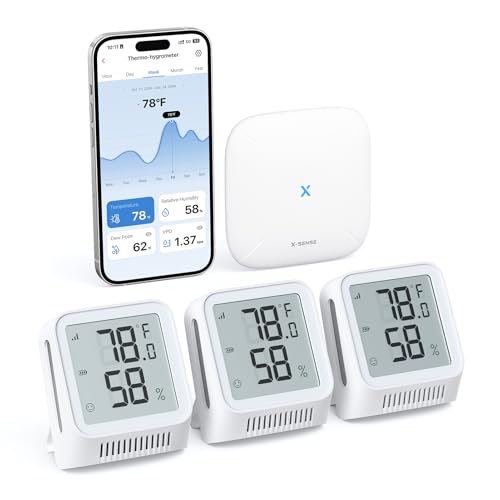
The same Swiss accuracy with a big, clear LCD on every sensor, plus a base station that sounds its own alarm.
This is the X-Sense system with one important upgrade: each of the three sensors includes its own LCD screen that shows the current temperature, humidity, and a comfort-level icon. The Swiss-made sensor chip inside keeps accuracy at ±0.36°F for temperature and ±2% RH for humidity, identical to the STH54 above. The base station is the same SBS50 model, supporting up to 10 sensors over a range that reaches 1,700 feet in open air. What sets this version apart is that the base station itself sounds an audible alarm when a sensor goes out of range, in addition to the push alerts on your phone.
Owners consistently rate the value for money as excellent, praising the build quality and the fast setup. The app shows min, max, and average temperature and humidity over time in graph form, and it lets up to 12 users monitor the same environment simultaneously. Unlike the STH54, the included LCD display on each sensor means you can walk into the room and see the reading instantly — no phone required. One trade-off is that the sensors are freestanding or wall-mountable, so they are slightly larger than the bare-probe versions.
Two alarms, one system: get audible notification from the base station and visual notification on the phone app if your wine cellar or baby’s room goes out of safe range.
Perfect for: a cigar humidor or reptile enclosure where you need both a local screen and a remote alert.
Not ideal if: you only need one sensor — the multi-pack is priced for covering several rooms.
6. GoveeLife 2.0 WiFi Hygrometer Thermometer with Gateway, 3-Pack
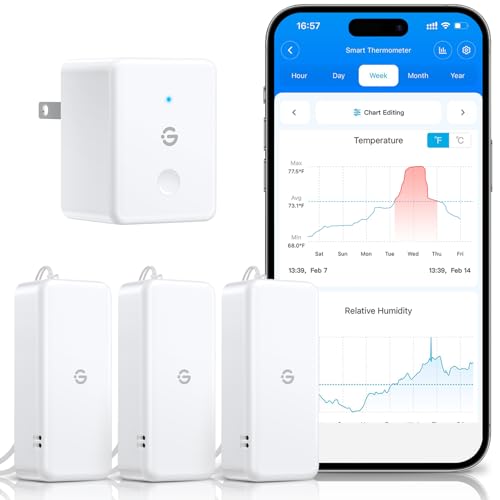
Tiny sensors that talk to a dedicated WiFi gateway, keeping battery drain invisible to you.
The GoveeLife system uses a small plug-in gateway that bridges the sensors to your WiFi. The three sensors are compact, each about the size of a stack of coins, with a lanyard for hanging in tight spaces like a guitar case or a wine cabinet. Inside is a Swiss-made sensor chip that reports temperature to ±0.54°F and humidity to ±3% RH, with data refreshed every 2 seconds. The gateway supports pairing up to 10 sensors, so you can buy more later without adding extra hubs.
Battery life is rated at 2 years, which is strong for a WiFi-relayed sensor. The app stores up to two years of history and allows CSV export. A notable detail: if you already own Govee smart plugs or lights, you can create automations triggered by these sensors (turn on a dehumidifier when humidity climbs, for example). The most common complaint is that initial connection to the gateway can be finicky, but once paired, reliability is strong. The gateway requires a 2.4 GHz WiFi network.
Pint-sized and persistent: the lanyard-ready design and two-year battery make these the easiest sensors to drop into hard-to-reach spots and forget about.
Best for: anyone already inside the Govee smart plug or light ecosystem — the automations work smoothly.
Pass if: you need a sensor that works without a separate gateway plugged in all the time.
7. Aqara Zigbee Temperature and Humidity Sensor 3 Pack

The smallest sensor here that tracks temperature, humidity, AND barometric pressure in one coin-sized disc.
The Aqara sensor measures just 1.42 x 1.42 x 0.35 inches — barely larger than a quarter. Inside is a Sensirion chip, an industry-leading manufacturer, that monitors temperature, relative humidity, and atmospheric pressure. It uses Zigbee wireless protocol, which means it needs an Aqara Hub to function (sold separately). The hub requirement is the biggest barrier to entry, but it is also the reason the sensor can run for about two years on a CR2450 coin cell battery.
If you already use Apple HomeKit, the Aqara sensor integrates natively — you can see the readings in the Home app and trigger automations (like turning on a fan when the temperature hits a threshold). The same goes for Alexa and IFTTT. The max reliable distance from the hub is about 33 feet, so plan placement carefully. Some reviewers point out that sensors occasionally drop off the Zigbee network, requiring a re-pair, and the tiny battery hatch needs a small screwdriver to open. The consensus: when they work, they are excellent; reliability depends heavily on your Zigbee hub and channel setup.
Triple-duty in a tiny disc: no other sensor this small also tracks barometric pressure, and HomeKit integration is smooth for Apple households.
Reach for this if: you run an Apple HomeKit or Home Assistant setup and want a tiny, battery-sipping sensor that also reports air pressure.
pass on it if: you want a simple WiFi-only plug-and-play — the hub and occasional Zigbee tinkering add friction.
8. SensorPush HTP.xw Smart Temperature & Humidity Sensor

The gold-standard precision tool that serious cigar and wine collectors trust for a reason.
SensorPush earns its place at the top of the accuracy chart with a temperature tolerance of ±0.1°F and humidity accuracy of ±2% RH. It measures five variables: air temperature, relative humidity, heat index, barometric pressure, dewpoint, and VPD (vapor pressure deficit). The sensor runs on a CR2477 battery that lasts 1-2 years under typical conditions, and it stores 30 days of data onboard even when your phone is out of Bluetooth range. For remote access, you can add the G1 WiFi Gateway (sold separately), which open up unlimited cloud storage and desktop viewing.
The app is the star of this experience — owners describe the interface as intuitive with day, week, and month graph views, and the ability to export CSV data for spreadsheets. One reviewer who owns four HTP.xw units reports less than 0.02% variation between them when placed side by side. The sensor communicates through steel, stud walls, and plumbing up to about 25 feet from the hub, and its Bluetooth range can reach 330 feet line of sight. It is splash-resistant and built in Brooklyn, NY. The catch: it is a Bluetooth-first device, so without the separate gateway, you need to be within range to see live data.
Uncompromised accuracy: if your cigar humidor, wine cellar, or lab demands the tightest tolerances, this sensor delivers — and the app makes the data easy to understand.
Buy this for: a situation where a few tenths of a degree matter — wine storage, cigar aging, or greenhouse research.
Pass if: you want remote WiFi access from the start without buying an additional gateway.
9. SENCKIT 4-Pack WiFi Temperature Humidity Sensor

Four WiFi sensors for the price of one premium unit — the no-frills choice for wide coverage on a budget.
The SENCKIT sensors connect directly to your 2.4 GHz WiFi without needing a hub. Each unit is small enough to fit in a reptile vivarium, a potted plant corner, or a camper van. The app (Tuya Smart or Smart Life) lets you set alert thresholds and view historical data graphs. The sensors work with Alexa and Google Assistant so you can ask for the temperature in a specific room by voice. The temperature accuracy is rated at ±1.8°F and humidity accuracy is ±5% — noticeably wider than the Swiss-chip units above, but acceptable for general monitoring where you care about trends rather than lab-grade numbers.
The biggest practical issue reported across many reviews is battery life: owners often see only about one month from a set of AAA batteries, especially when the sensor is placed outdoors or in a high-temperature area. Some units also stop connecting after a few months. For the price, you get four sensors, which makes this a good option for covering a rental property or a vacation home where losing a single sensor is not a crisis, but the catch is clear — you trade long-term reliability for low upfront cost and instant WiFi setup.
Quantity over fidelity: four sensors for the money is tough to top if you just want to know whether the attic is hotter than the garage today.
Works best as: a temporary monitoring solution or for low-stakes spots where a dead battery every month is an acceptable chore.
Avoid if: you need a set-and-forget sensor in a hard-to-reach location like a crawlspace or above a drop ceiling.
Understanding the Specs
Wireless Protocol (LoRa, Zigbee, WiFi, Bluetooth)
This decides both how far the signal reaches and how long the battery lasts. LoRa and Zigbee are low-power radios that send tiny data packets a long distance, but they need a hub to bridge to your home internet. WiFi sensors connect directly to your router — no extra hardware — but the constant radio chatter drains batteries fastest. Bluetooth uses even less power than WiFi but requires your phone to be within about 100 feet of the sensor to see the data, unless you add a dedicated gateway.
Accuracy Tolerances (Temperature & Humidity)
The spec that tells you how trustworthy the reading is. A temperature accuracy of ±0.36°F means the actual temperature could be up to 0.36 degrees higher or lower than what the sensor displays. The tighter the tolerance, the more you can rely on the sensor to trigger precise actions (like keeping a wine cellar at exactly 55°F). Humidity accuracy works the same way: ±2% RH is tight; ±5% RH is fine for comfort monitoring but not for a humidor.
FAQ
Can I use a wireless sensor in a freezer without it breaking?
Do I need a hub to use a wireless temperature and humidity sensor?
How long do the batteries actually last in real use?
Will a wireless sensor work through brick walls or metal siding?
Can I get alerts on my phone even when I am not home?
What do temperature accuracy numbers like ±0.36°F actually mean for me?
Which sensors work with Apple HomeKit without extra steps?
Can I use one app to monitor sensors in different rooms?
Is a Bluetooth-only sensor a problem if I travel a lot?
Does a sensor with an LCD screen drain batteries faster than one without?
Final Thoughts: The Verdict
For the majority of shoppers, the wireless temperature and humidity sensor winner is the YoLink 3-Pack with Hub because its LoRa radio covers a quarter mile, the batteries last 5 years, and the accuracy matches commercial-grade thermometers. If you want a visible screen and smooth smart-home automation, grab the Tapo T315. And for lab-level precision that cigar and wine collectors demand, the SensorPush HTP.xw is the one to reach for.
How We Picked
We do not accept paid placement. Every pick is matched to a real buyer and a real use-case; we do not hands-on test units.
Sources & Methodology
Specifications: manufacturer listings and product documentation. Review insights: verified customer reviews, as of July 2026. Pricing: not shown on this page (it changes often); check the current price via the retailer link.
As an Amazon Associate, Calories Fit earns from qualifying purchases. This does not affect which products we feature.