
Our readers keep the lights on and the coffee maker working hard! As an Amazon Associate, I earn from qualifying purchases.
Specs are compiled from manufacturer listings and verified buyer reviews and can change over time — please confirm the key details on the product page before buying.
You need to know when your oxygen drops or your heart rate spikes — and you need to know it immediately, not after you sync a gadget to your phone. A wireless pulse ox streams data to your phone, tracks trends, shares reports with your doctor, and alerts you to dangerous swings before they become emergencies. Some clip-on monitors deliver readings in under ten seconds and run for days on a charge. Others struggle with connection reliability or drift from hospital-grade accuracy. The nine models below are ranked by accuracy, battery stamina, and app usability at this price.
I’m Mohammad — the founder and writer behind Calories Fit. This guide is built by comparing the manufacturers’ published specifications and the patterns across verified customer reviews, so you get each pick’s real strengths and trade-offs instead of marketing spin.
From budget-friendly rechargeable units to premium overnight recorders, here is your clear, honest rundown of the best wireless pulse ox choices you can buy right now.
Our Picks at a Glance

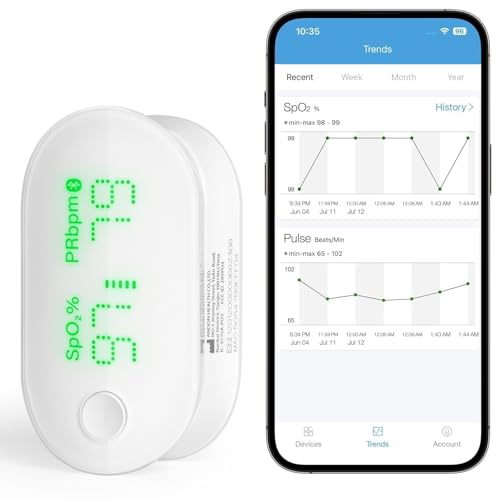
How To Choose The Best Wireless Pulse Ox
Most fingertip pulse oximeters do the same basic job: shine light through your finger to estimate how much oxygen is in your blood. But when you add Bluetooth and an app, a few specifications suddenly separate the useful daily tool from the frustrating gadget.
Battery Life and Power
Some wireless pulse ox models run on standard AAA batteries for 30 hours; others have built-in rechargeable lithium-ion packs that last anywhere from 3 to 72 hours. If you plan to use it overnight, a rechargeable model with at least 10 to 14 hours is essential. For quick daily spot checks, AAA-powered units that last weeks are more convenient — you never have to wait for a charge.
Accuracy and Sensor Features
The measurement accuracy is usually stated as ±2% for SpO2. But the real-world reliability often depends on extras like a plethysmograph — a waveform that shows the pulse signal strength — and a perfusion index (PI), which tells you whether the device is getting a strong enough reading from your finger. A device with both of these visual cues gives you more confidence that the number on the screen is correct.
App Ecosystem and Data Export
A wireless pulse ox is only as useful as its app. Look for an app that stores trends over hours, days, and weeks, allows multiple user profiles, and exports data in PDF or CSV format so you can share it with your healthcare provider. Some apps integrate directly with Apple Health or Google Health Connect, which saves you from manual logging.
Quick Comparison
| Model | Best For | Battery Life | SpO2 Range | Plethysmograph | Amazon |
|---|---|---|---|---|---|
| Innovo iP900BP-B★ Best Overall | Most reliable daily tracking | 30 hours | 70% – 100% | Yes | Amazon |
| iHealth PO3 RechargeablePremium Pick | Rechargeable for travel | 3 hours | 70% – 99% | Yes | Amazon |
| Vibeat S6WSmart Reminder | Long rechargeable ride | 14 hours | 70% – 100% | No | Amazon |
| Vibeat (B0B8SBK8LR) | Extended duration with alerts | 24 hours | — | No | Amazon |
| Anriwell Breeze AW-401 | Family multi-user tracking | 1.5 years | 35% – 100% | No | Amazon |
| Zacurate 500B-B | Budget-friendly with app | AAA (30 hr rating) | — | Yes | Amazon |
| SonoHealth Pulse Oxi V1.0 | Rotating display ease | AAA (est. 30 hr) | 95% – 100% | No | Amazon |
| EMAY SleepO2 | Overnight continuous sleep | 10 hours | — | No | Amazon |
| Wellue Checkme O2 Max | 72-hour all-day monitoring | 72 hours | 70% – 100% | No | Amazon |
In‑Depth Reviews
1. Innovo iP900BP-B Fingertip Pulse Oximeter
Our pick — 4.5★ from 7,000+ verified ratings; the strongest balance of quality and price.
The wireless pulse ox that caught a pulmonary embolism before it was too late, according to buyer reports.
The standout here is battery stamina: 30 hours on two AAA batteries means you can grab it months later for a reliable reading. The Innovo iP900BP-B measures SpO2, pulse rate, and respiratory rate (RR) even at low blood perfusion, which is critical for people with cold fingers or poor circulation. A built-in plethysmograph (a live waveform that shows your pulse signal) and perfusion index (a number that measures blood flow strength) let you verify the signal strength before you trust the number, something the lower-tier models lack.
Buyers report the device “detected dangerous O2 swings (mid-90s to mid-80s) and pulse spikes (50s to 120+), prompting ER visit for acute saddle pulmonary embolism.” That real-world story explains why over 7,100 owners have made this the most reliable pick in the category. The “Beyond Oximeter” app records readings over time, and the patented multi-directional display offers six layout options so you and a caregiver can read the screen from any angle.
The main catch is that the app is designed for a single user — no multi-person profiles. If you are tracking an entire family, look toward the Anriwell below. For personal monitoring of a chronic condition, this is the one to buy.
What Wins People Over
- 30‑hour battery on standard AAA cells — months of daily spot checks
- Plethysmograph waveform confirms reading stability
- Multi‑directional display with 6 layouts for caregiver visibility
- Proven track record of catching serious O2/HR events
The Trade‑Off
- Single‑user app — no multi‑person profiles
- Not designed for continuous overnight monitoring/recording
Reach for this if: you need a rock‑solid daily reader with app tracking and a battery that lasts for months.
Look elsewhere if: your goal is overnight sleep tracking — this one was not built for continuous recording.
2. iHealth Rechargeable Bluetooth Fingertip Pulse Oximeter PO3
A rechargeable pulse ox that integrates with Samsung Health and Google Health Connect, unlike the Innovo’s single-user setup.
The iHealth PO3 swaps disposable batteries for a built-in lithium-ion pack — three hours of charging gives you roughly 300 uses per charge. That is perfect for someone who wants zero ongoing battery cost and the convenience of Micro-USB recharging. The free iHealth MyVitals App records data for multiple users and tracks SpO2 and pulse rate trends by hour, day, week, and year. Crucially, the in-app pulse waveform (plethysmograph) and perfusion index provide real-time signal verification, so you are not guessing whether the reading is stable.
Buyers love the readability and the smooth sync with Samsung Health and Google Health Connect — one owner with worsening asthma called it “perfect” for daily monitoring. But accuracy is the mixed note here: one reviewer noted that the device showed resting O2 levels of 92-93 percent while a hospital test averaged 95 percent. This means the iHealth is best used as a trend-tracking tool rather than a single‑reading diagnostic. The 3-hour battery life is also far shorter than the Innovo’s 30 hours, so you have to remember to charge it.
What Wins People Over
- Rechargeable — no battery replacement cost
- Multi‑user app tracks trends by hour, day, week, year
- Integrates with Samsung Health and Google Health Connect
- Plethysmograph and perfusion index for reading confidence
The Trade‑Off
- Mixed accuracy — some find it off by several points vs. hospital gear
- 3‑hour battery life requires frequent charging
Grab it for: a zero‑hassle rechargeable model that logs your family’s trends in one app.
Think twice if: you need absolute single‑reading precision without cross‑checking.
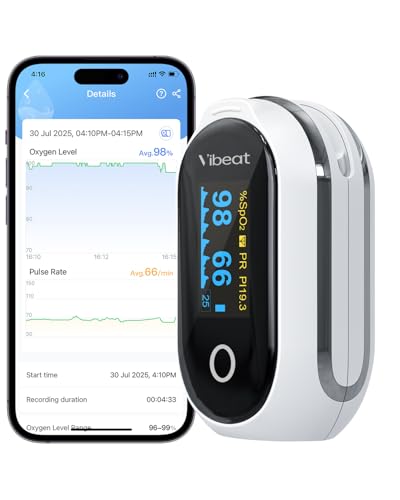
3. Vibeat S6W Rechargeable Pulse Oximeter
A 14‑hour rechargeable that beeps when your oxygen or heart rate breaks your set threshold — something the Innovo does not do.
The Vibeat S6W uses research-grade photoplethysmograph technology — infrared light to sense blood flow — and a USB-C rechargeable battery that lasts 14 hours on a full charge. That is enough for a full night of sleep tracking plus the next day. The real differentiator is the customizable notification threshold: if your O2 level or pulse rate exceeds the range you set, the oximeter beeps and the screen flashes. For anyone monitoring a condition like sleep apnea or COPD, that audible alert can be a lifesaver.
The free “Vihealth” app stores unlimited data and lets you download reports in PDF and CSV formats, which is excellent for sharing with your doctor. The device also has two measurement modes — spot check (30 seconds, then auto-stop) and continuous tracking, which you toggle in the menu. Beauty is in the eye of the beholder: the functionality gets mixed reviews, with some owners reporting Bluetooth connection failures after a day and others saying it stopped working after six months. The fixed screen orientation (no rotation) and a loud, unmutable “disconnected” alarm are genuine frustrations. Weigh the smart alerts against the reliability risk.
Best application: nighttime monitoring where you need an audible warning for dangerous dips.
Honest limitation: build quality is a gamble — some units fail within months, and the alarm cannot be silenced.
Reach for this if: the customizable low-O2 alert is your must‑have safety net.
Look elsewhere if: you cannot tolerate a device with a Bluetooth pairing track record that is “mixed.”
4. Vibeat Rechargeable Oxygen Meter (B0B8SBK8LR)

A 24‑hour rechargeable with a heart rhythm readout after only 30 seconds of measurement, beating the S6W’s 14-hour battery.
This Vibeat model shares the same photoplethysmograph sensor tech as the S6W above but offers a longer 24-hour battery life and a distinct heart rhythm feature — after 30 seconds of stable measurement in spot-check mode, the screen displays your pulse rhythm directly. That is a quick, intuitive way to check for irregular beats without scrolling through an app. The USB-C charging cable is included, and the two-color highlight OLED screen is crisp even in dim light.
The free “Vihealth” app again provides unlimited data storage and PDF/CSV report exports. Battery longevity gets mixed feedback — some owners mention one charge lasting months, while others say the rechargeable pack eventually fails to hold a charge. A few buyers hit a serious wall: the device stopped being recognized by the Vihealth app after a month, and the manufacturer refused to honor the warranty unless the unit was purchased directly from them. That is a significant risk for a long-term investment.
Smartest feature: the 30‑second spot‑check heart rhythm display on the screen itself.
Crucial caution: warranty and app connectivity issues are more than anecdotal — treat the purchase as final sale.
Best for: users who want a long-lasting rechargeable and value the on‑device heart rhythm check more than app reliability.
skip it if: dependable Bluetooth sync and responsive customer support are non‑negotiable.
5. Anriwell Breeze Bluetooth Pulse Oximeter AW-401
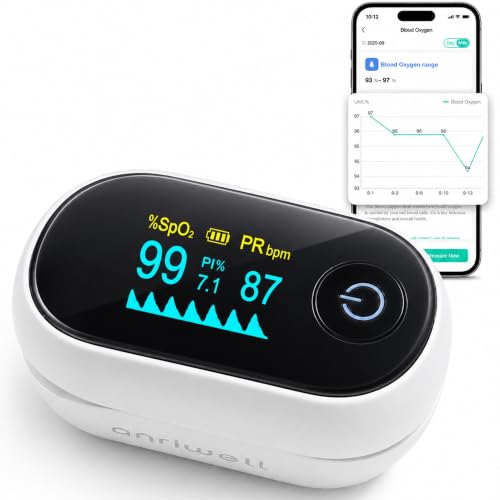
The only unit here with an FDA 510(k) clearance, carrying a 1.5‑year battery life on two AAA batteries — far longer than the Innovo’s 30 hours.
The Anriwell Breeze is built for the family health nut: it uses the Anriwell app to manage blood oxygen, temperature, and blood pressure records for parents, children, and seniors all in one place. The device measures SpO2 from 35 to 100 percent, pulse rate from 25 to 250 bpm, and perfusion index from 0.2 to 20 percent — all in as little as 8 seconds. The battery life is genuinely exceptional: 1.5 years on the included AAA batteries, so you will almost forget it needs power.
The HD LCD display is large, high-contrast, and has a soft backlight for nighttime checks without blinding you. The unit weighs only 38 grams (about 1.3 ounces), making it the lightest finger clip on this list. A minor but real flaw: the display does not rotate orientation, so when used on your left hand the numbers appear upside down. The finger grip also feels less secure than some competitors. And crucially, the pairing process requires a specific path — “My Profile” > “Equipment Center” > “Blood Oxygen” — rather than scanning a QR code. Follow that, and it works.
Why It Stands Out
- FDA 510(k) cleared — a rare regulatory stamp at this price
- 1.5‑year battery life — the longest of any unit on this list
- Multi‑parameter family app (O2, temp, blood pressure)
- Ultra‑light at 38g for travel
The Quirks
- Display cannot rotate — upside down on your left hand
- Pairing requires specific app menu path, not QR scan
Ideal for: a family that wants one app to track everyone’s vitals.
Not for: left‑handed users who need the screen right‑side up.
6. Zacurate 500B-B Wireless Bluetooth Pulse Oximeter
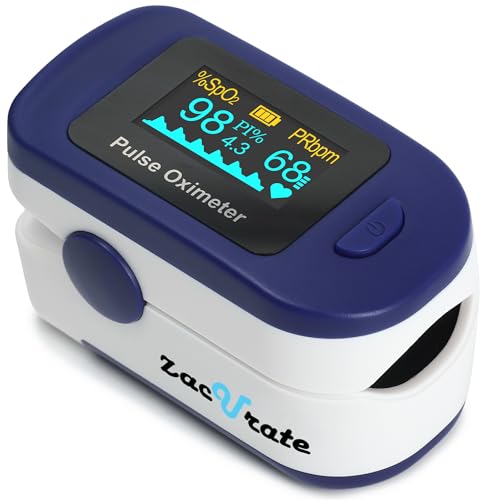
The crowd‑favorite budget Bluetooth ox with a plethysmograph and perfusion index for under forty dollars — missing on the more expensive SonoHealth.
The Zacurate 500B-B is the most wallet‑friendly entry into the wireless tracking world that still gives you both a plethysmograph waveform and a perfusion index to verify reading stability. That is a big deal at this price. It pairs with the free Beyond Oximeter App (the same app used by the Innovo above) to store long-term data for multiple users, and it supports both iOS and Android. The SMART Spring finger chamber accommodates a wide range of finger sizes, so it works for most of the family.
Buyers consistently praise the functionality and build quality — this is one of the rare budget models where the “does it work” feedback is overwhelmingly positive. The accuracy, however, draws mixed reactions, and some customers note that after two months the device started showing erratic readings. The 12‑month warranty and USA‑based technical support are a safety net, but the warranty starts from your purchase date, so test it immediately. It runs on two AAA batteries that are included.
Best angle: entry‑level Bluetooth tracking with pro‑level signal verification at a budget price.
Honest caveat: accuracy is not as consistent as the Innovo, so cross‑check any alarming reading.
Reach for this if: you want the lowest‑cost gateway into the Beyond Oximeter app ecosystem.
Look elsewhere if: you need hospital‑grade single‑reading precision and can pay more for the Innovo.
7. SonoHealth Pulse Oximeter with Bluetooth

A rotating OLED screen with six layout options that flips orientation by simply turning your hand — unlike the Anriwell’s fixed display.
The SonoHealth Pulse Oxi V1.0 is designed around convenience: the multi-directional OLED display automatically rotates to match whichever angle you are viewing from, using six different layout configurations. That means a caregiver can grab it and read the numbers without turning the device around. It connects via Bluetooth to the SonoHealth app for trend tracking and integrates with Apple Health, saving you from manual logging.
Reviewers point out that this is “the only oximeter that works” out of multiple brands they tried, and that it provides continuous readings for monitoring oxygen levels. The rotating screen is a genuine hit — one owner bought a replacement immediately after losing the back cover, calling it an “awesome O2 meter.” The weak spot is the app itself, which some find “hit or miss” for reliably displaying results. The device itself gets the job done, but the app experience can be inconsistent.
Best feature: the rotating OLED is a practical win for both self‑checking and caregiver use.
Honest limitation: the app’s reliability is mixed — do not buy this solely for Apple Health integration.
Best for: older users and caregivers who need no‑fuss screen rotation and large‑font readings.
Think twice if: a rock‑solid, always‑working Bluetooth app is your top priority.
8. EMAY SleepO2 Wrist Pulse Oximeter

A wrist‑worn pulse ox that records overnight SpO2 and heart rate without needing your phone nearby — a completely different design from every clip-on here.
The EMAY SleepO2 is fundamentally different from every other product here — it is a wristband with an ultra‑soft patented finger probe designed for sleep. The device has built‑in storage that records SpO2 and pulse rate continuously throughout the night without a smartphone. After you wake up, you sync to the EMAY app via Bluetooth to download, review, and share detailed data and professional reports. The battery runs for 10 hours of continuous recording, which covers a full night’s sleep.
Owners consistently praise the comfort (the unit weighs only 20 grams) and the quality of the reports. One buyer mentioned that the O2 dips it detected were more detailed than what their Apple Watch and Pillow app captured. The internal memory holds 48 hours of data, so you can skip a sync if you want. Reliability is the top positive by far, with buyers calling it “perfect for recording at night.” The downsides are the micro‑USB charging port — which doubles as both the sensor connector and the charging port, requiring daily detachment — and the first minute of readings is often bogus (heart rate of 30, O2 of 40), so be sure to discard that warm‑up data.
What You Get
- Wrist‑worn continuous overnight tracking without a phone nearby
- 48‑hour internal storage for non‑urgent syncs
- Ultra‑light 20g design with comfortable silicone probe
- Detailed reports rivaling sleep studies
The Compromise
- Micro‑USB port doubles as sensor/charger — daily plug/unplug
- First ~60 seconds of each session are unreliable
Reach for this if: you need dedicated, comfortable overnight O2 recording without a tether to your phone.
pass on it if: you only want quick daytime spot checks — this is built around the sleep‑tracking use case.
9. Wellue O2 Pulse Oximeter Checkme O2 Max

A ring‑style pulse ox that runs for three continuous days on a single charge — the endurance champ, beating the EMAY’s 10 hours by a wide margin.
The Wellue Checkme O2 Max is the endurance champion of wireless oximetry: the rechargeable battery lasts up to 72 hours per charge. That is enough for a weekend camping trip or three nights of sleep tracking without touching a charger. The patented soft silicone ring sensor wraps around your finger, freeing your hand completely — no clip, no cord. It vibrates and makes a “drip” sound when your blood O2 falls below your defined level, and both the vibration intensity and sound can be adjusted.
The “Vihealth” app and “O2 Insight Pro” software let you share all-day data on your phone, tablet, or PC. The internal memory stores four groups of 10-hour data — plenty for multiple recording sessions before syncing. A few buyers with sleep apnea reported it detected severe OSA (O2 drops to the mid‑70s, with over 25 events per hour), which was later confirmed by hospital polysomnography. That is powerful. But some units fail after around five months, and the fragile cord connector is a recurring pain point — the plug and socket interface seems to wear out quickly. Wellue’s warranty service is generally responsive, but the need to use it is disappointing at this premium price.
Why It’s Unique
- 72‑hour battery — longest continuous runtime in this roundup
- Soft silicone ring sensor for hands‑free comfort
- Smart vibration/audio reminder for low O2
- PC software for in‑depth data analysis
The Downside
- Fragile plug/socket connector fails in some units within months
- Less accurate during exercise due to motion and sunlight interference
Best for: multi‑day sleep studies or anyone who wants a truly hands‑free continuous monitor.
Look elsewhere if: you need something sturdy enough for daily sports use — the ring sensor does not handle motion well.
Understanding the Specs
Plethysmograph
A plethysmograph is a live waveform on the screen that shows the pulse signal the device is detecting. When the waveform looks smooth and strong, you can trust the SpO2 and heart rate numbers more. If the waveform is flat or erratic, your reading may be unreliable — move your hand or try a different finger. This is the single most useful tool for knowing whether your device is getting a clean signal.
Perfusion Index (PI)
Perfusion index is a number that tells you how strong the blood flow is in your finger at the moment of measurement. A higher PI (typically above 1.0) means the sensor is reading a good, pulsing signal. A very low PI means the reading may be inaccurate — common when your hands are cold. Many of the wireless pulse ox models here show the PI right on the screen, which helps you self‑correct before trusting the number.
SpO2 Measuring Range vs. Accuracy
The measuring range is simply the span of oxygen levels the device can detect — most cover 70 to 100 percent. The measurement accuracy, often stated as ±2 percent, tells you how close the device is likely to be to a true reading. A pulse ox reading 97 percent could actually be anywhere from 95 to 99 percent. That margin is fine for spotting trends but matters when you are comparing to a hospital device.
Spot Check vs. Continuous Mode
A spot‑check mode takes a reading for a set duration (usually 30 seconds) and then stops — good for a quick measurement before or after exercise. Continuous mode keeps recording until you manually stop it, which is what you want for overnight sleep tracking or prolonged monitoring. Some devices switch modes automatically; others require a menu setting change. Make sure the model you choose has the mode you actually need.
FAQ
Can I use a wireless pulse ox overnight while sleeping?
What does the plethysmograph waveform actually tell me?
How accurate are fingertip pulse oximeters compared to hospital equipment?
Can multiple people use the same wireless pulse ox and app?
Why do my oxygen readings change when I move my hand?
How long does a pair of AAA batteries last in a wireless pulse ox?
What does the Perfusion Index (PI) number mean?
Can I share my pulse ox data with my doctor?
Is the iHealth PO3 compatible with Samsung Health and Apple Health?
What is the difference between a medical‑use and a sports‑use pulse ox?
Final Thoughts: The Verdict
For most buyers, the best wireless pulse ox is the <