
Our readers keep the lights on and the coffee maker working hard! As an Amazon Associate, I earn from qualifying purchases.
Specs are compiled from manufacturer listings and verified buyer reviews and can change over time — please confirm the key details on the product page before buying.
If you are trying to stop a pipe from freezing, keep a wine cellar perfectly stable, or just make sure a baby’s room is not too dry, a wireless monitor is the only way to know what is happening when you are not standing there. The challenge is picking one that actually stays connected and gives you data you can use, not just a fuzzy number on a screen. This guide breaks down nine of the best wireless humidity and temperature sensors, from simple Bluetooth puck-style devices to full multi-sensor hub systems, so you can match the right one to your exact situation.
I’m Mohammad — the founder and writer behind Calories Fit. This guide is built by comparing the manufacturers’ published specifications and the patterns across verified customer reviews, so you get each pick’s real strengths and trade-offs instead of marketing spin.
if you need a single sensor for a greenhouse or a multi-pack to monitor every room in your home, this roundup of the best wireless humidity and temperature sensor options will help you find a reliable match for your needs and your smart home setup.
Our Picks at a Glance

How To Choose The Best Wireless Humidity and Temperature Sensor
The right sensor depends entirely on where you are putting it and how you want to check the data. A sensor in a living room that you glance at might be fine on Bluetooth, but one tucked inside a metal shed or a basement far from the router needs a much longer-range radio.
Range and radio type
Bluetooth is simple and has no hub, but its range is usually around 260 to 400 feet in open air, and walls cut that quickly. Wi-Fi sensors connect to your home network directly, so you can check them from anywhere, but they can crowd your 2.4 GHz band. Zigbee creates a mesh network where each sensor talks to its neighbors, but it demands a hub. LoRa, used by YoLink, is a different beast — it breaks the 1/4 mile mark in open air and punches through thick walls and metal, making it the choice for sheds, freezers, and outbuildings.
Power source and battery life
Most sensors run on AA or AAA batteries, and life spans vary wildly. For example, the YoLink LoRa sensor lasts up to five years. Some Wi-Fi sensors require monthly battery changes. If you pick a USB-powered model, you skip batteries entirely but lose the ability to place it anywhere without a wire.
Smart home compatibility
Before buying, check what hub or platform you already own. If you have an Echo with a built-in Zigbee hub (like the 4th-gen Echo or Echo Plus), a Zigbee sensor might pair with no extra hardware. If you run Home Assistant, almost any protocol works, but some brands (like Aqara or Third Reality) are easier to integrate than others. Wi-Fi sensors that use the Tuya or Smart Life app usually work with Alexa and Google, but you may lose humidity voice readings on Alexa.
Quick Comparison
| Model | Best For | Wireless Type | Battery Life | Multi-Pack | Amazon |
|---|---|---|---|---|---|
| YoLink Hub+3 Pack★ Best Overall | Far-reaching / difficult locations | LoRa | 5 years | 3 sensors + hub | Amazon |
| TempPro TempAirBest Value | Desktop clock with data export | Bluetooth 5.0 | — | Single | Amazon |
| Gaoducash WiFi TH06Compact Pick | Plug-in simplicity + voice control | Wi-Fi | USB powered | Single | Amazon |
| THIRDREALITY Zigbee Lite | Home Assistant / SmartThings users | Zigbee | 2 years | Single | Amazon |
| SwitchBot Meter Plus 2 Pack | Large display + app tracking | Bluetooth | 2 years | 2 Pack | Amazon |
| SENCKIT 4-Pack | Budget multi-room coverage | Wi-Fi | ~1 month (outdoor) | 4 Pack | Amazon |
| GoveeLife H5179 | Accurate single sensor + 2-year data | Wi-Fi / Bluetooth | — | Single | Amazon |
| GoveeLife 2.0 3-Pack | Multi-sensor system with gateway | Wi-Fi + Gateway | 2 years | 3 sensors + gateway | Amazon |
| Aqara Zigbee 3 Pack | HomeKit / Aqara ecosystem | Zigbee | 2+ years | 3 Pack | Amazon |
In‑Depth Reviews
1. YoLink Smart Wireless Thermometer Hygrometer, 3-Pack
Our pick — over 4.5★ from 750+ verified ratings; the strongest balance of quality and price.
The only sensor here that reaches a quarter-mile and works inside a metal freezer.
Instead of using your Wi-Fi, YoLink runs on a unique LoRa-based wireless protocol — a long-range, low-power radio that leaves standard Wi-Fi in the dust. In open air, it monitors up to 1/4 mile, which means you can place sensors in a fridge, a greenhouse several floors away, a gun safe, or an outdoor chicken coop without worrying about the signal dropping. That range is a different league than the Bluetooth and Zigbee picks on this list. The package includes one YoLink Hub and three sensors, totaling four items, and the hub itself handles the connection to your internet so your Wi-Fi network never gets crowded.
The temperature accuracy runs at ±0.36°F in the 0°C to 54°C range and ±0.72°F down to -20°C, with humidity accuracy at ±3% between 10% and 90%. It measures temperatures from -4°F all the way up to 129°F and 0% to 100% humidity, so it handles everything from a deep freezer to a summer greenhouse. Each sensor runs on two AA batteries and delivers up to 5 years of continuous operation. The crowd favorite, with an outstanding rating from hundreds of owners, is praised most for sheer reliability: well over 200 buyers single it out. You get push, text, email, and “Critical Alerts” on Apple devices that bypass silent mode (SMS is limited to 5 alerts per device per month, plus 5 free total). One real-world example: a buyer using a fridge sensor prevented expensive Humira medication from freezing, catching a bottom-drawer temperature near 32°F versus the 37°F target.
IFTTT and Alexa voice queries work (humidity is not supported over voice right now, and Alexa routines are not directly triggered). The trade-off is that these sensors have no display — they feed data purely through the YoLink app. Be aware that the system is a closed loop: the hub only works with YoLink devices, so you are locked into their ecosystem for expandability.
class-leading Range
- 1/4 mile open-air range penetrates walls, steel siding, and freezers
- 5-year battery life means near-zero maintenance
- Does not crowd your 2.4 GHz Wi-Fi network
- Commercial-grade accuracy across a very wide temperature span
The Catch
- No on-device display — you must check the app
- LoRa is proprietary to YoLink, so no third-party hub compatibility
- Alexa humidity queries and routine triggers are not supported
Reach for this if: you need to monitor a place Wi-Fi cannot reach — a walk-in freezer, a far-off shed, or a greenhouse with metal siding.
Think twice if: you want a simple screen on the sensor itself or you prefer to stay inside a single smart-home ecosystem like HomeKit.
2. TempPro TempAir Bluetooth Thermometer with Clock
A desktop clock that doubles as a serious data-logging hygrometer for under.
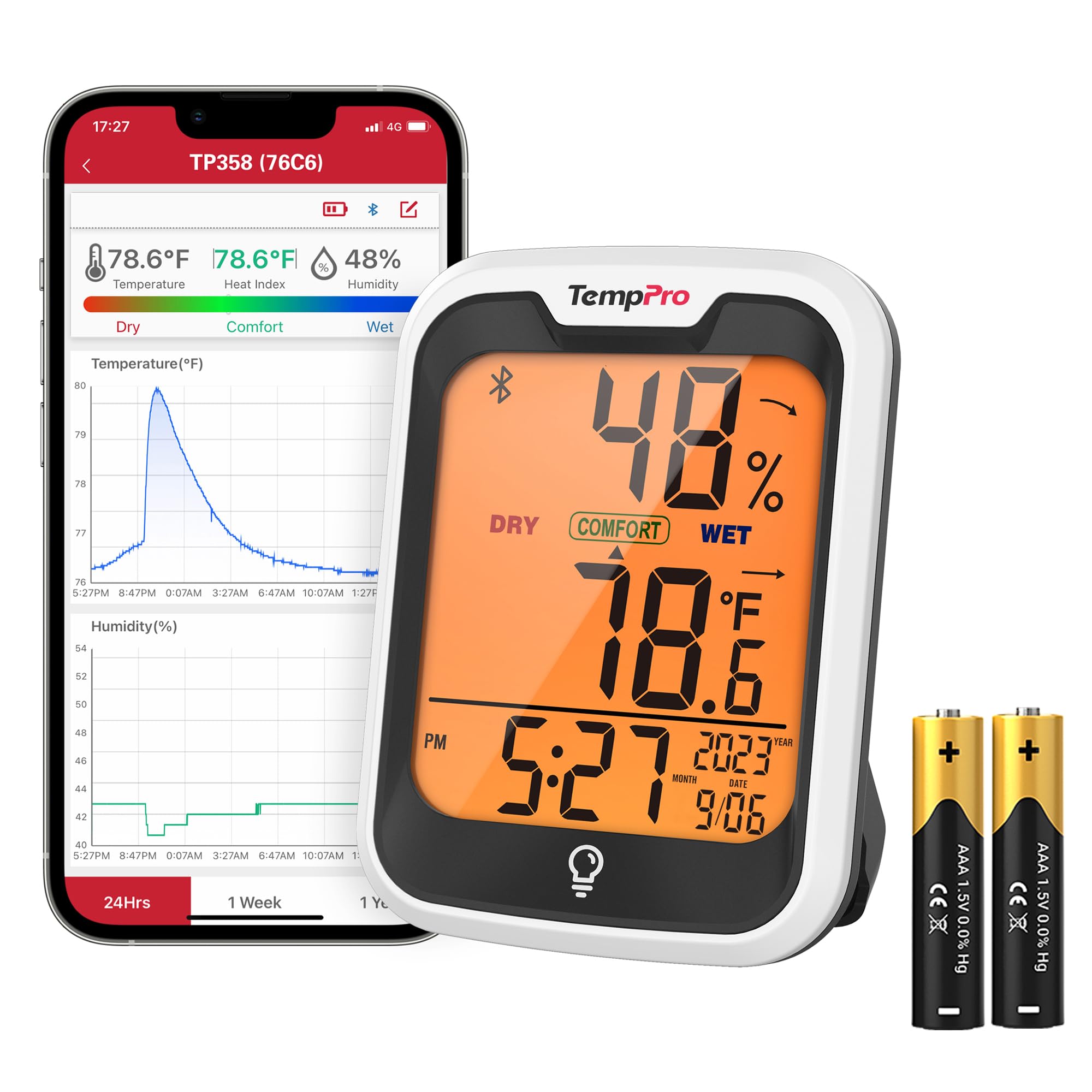
Most budget sensors show you a number and nothing else. The TempPro TempAir goes much further, acting as a full-time clock and a data vault that stores 20 days on-board and lets you export two full years of history. That granularity is rare at this price. It uses a Bluetooth 5.0 SIG-certified connection with a 260-foot range in open air and a 10-second refresh rate, so changes show up fast. The accuracy lands at ±0.9°F and ±2% RH — easily good enough to spot a room trending too humid or too dry. One owner used it to confirm high humidity in a new house, and the Bluetooth app’s daily, weekly, and annual data matched what an AC technician’s professional meter showed, giving the buyer total confidence.
The 3-inch backlit LCD screen is the standout physical feature. It displays the time, day of the week, comfort-level icons, and temperature/humidity trends all at a glance, making it genuinely useful as a bedside or desk item, not just a buried sensor. App alerts push to your phone when conditions exceed your presets, and the app itself is private (it does not register your personal information). The main shortcoming is Bluetooth’s inherent range limitation: at 260 feet, it will not work across a large property or through thick masonry walls. It is also not rated for a refrigerator — the condensation can damage the sensor if you move it between environments.
Desktop + Logger
- Clear 3-inch backlit LCD shows time, date, comfort, and trends
- 2-year data export and 20-day on-board storage
- Reasonable ±0.9°F / ±2% RH accuracy
- Very affordable entry point
The Catch
- Bluetooth range drops with walls — no remote access from outside the home
- Not suitable for fridge or freezer use due to condensation risk
- Battery swap can erase past records if not manually synced first
Grab this for: a home office, nursery, or basement where you want a visible clock and deep trend analysis without spending much.
skip it if: you need remote monitoring from outside your house or plan to put it inside a refrigerator.
3. Gaoducash Smart WiFi Temperature Humidity Monitor
A tiny, USB-powered sensor that skips batteries entirely and talks to Alexa.
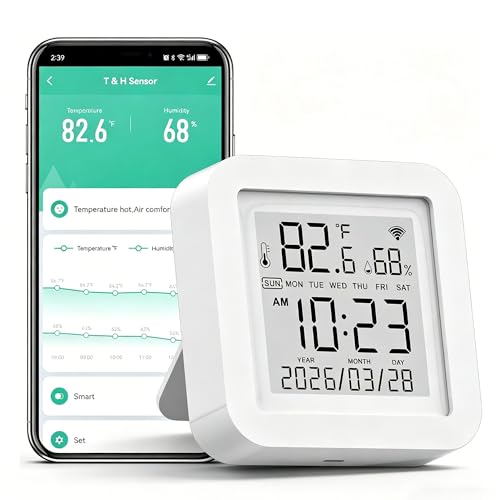
Because it plugs into a standard USB port (USB-C), you never change a battery — it is always on, always connected. That is a real upside for a spot near a router or a desk where a power outlet is handy. It connects over 2.4 GHz Wi-Fi only (no 5G support), so you must have that band enabled. The on-board Swiss-made sensor delivers 24/7 readings displayed on a 2.6-inch square LCD that shows temperature, humidity, and time. Temperature accuracy is rated at ±1°C, which is serviceable for general home monitoring but a step behind the ±0.3°C precision of the Sensirion-based picks in this guide.
The Tuya/Smart Life integration lets you set up smart scenes: you can trigger a fan or dehumidifier when a threshold is hit, and Google Home or Alexa voice queries work — although Alexa only reports temperature, not humidity. The price is right, and the always-on power means no “dead sensor” moment. On the flip side, WiFi sensors crowd your 2.4 GHz band, and some owners mention the plug needs a firm push to engage. A few also note that the screen numbers appear light and can be hard to read at a glance. It works well for a vacation home where you need a continuous connection, but if the power goes out, it reverts to Celsius on reconnect.
Plug-and-Read: No batteries, no pairing hub — just USB power, WiFi, and a small LCD. The catch is that the connection is dependent on your 2.4 GHz WiFi staying solid, and a hard push on the USB-C plug is needed to get it seated.
Ideal for: a vacation property, a server closet, or any spot where you never want to touch the sensor again after installation.
Not for: places without a nearby USB outlet or anyone who needs ±0.3°C precision for delicate environments.
4. THIRDREALITY Zigbee Temperature and Humidity Sensor Lite

High-precision Sensirion internals in a tiny, adhesive-backed package for Zigbee ecosystems.
This sensor is all about accuracy and integration. It uses a sensor from Sensirion, a leading Swiss manufacturer, to deliver a temperature accuracy of ±0.3°C across a 5°F to 122°F range and humidity accuracy of ±2% from 0% to 100%. Two AAA batteries are included and should deliver at least 2 years of normal use. The 3M-rated adhesive backing lets you stick it almost anywhere — a basement wall, inside a greenhouse, under a wine cabinet — without drilling. It is designed exclusively for indoor use, so keep it out of direct rain.
It works with any compatible Zigbee hub, including Echo devices with a built-in Zigbee hub (4th-gen Echo, Echo Plus, Echo Studio, Eero 6, Eero Pro 6), SmartThings, Home Assistant, Homey, Hubitat, and of course, Third Reality’s own hub. The THIRDREALITY app stores a month of history, while SmartThings and Home Assistant give you full access to historical data. Fast refresh and automatic router switching help keep the mesh network stable. The leading praise across owners is reliability, and compatibility comes in second. The honest limitations: the Alexa app displays temperature only (no humidity), and some owners note the Zigbee range drops as the battery weakens. There is no calibration offset setting on the sensor itself, though the firmware may allow it via the app.
Ecosystem Fit: For Home Assistant, SmartThings, or Zigbee-Echo users, this is a drop-in upgrade over generic sensors because of the Sensirion accuracy. The cost is a hub purchase if you don’t already have one.
Best if: you already own a compatible Zigbee hub and want lab-grade accuracy in every room.
Look elsewhere if: you do not have a Zigbee hub or want a self-contained Wi-Fi sensor with its own app.
5. SwitchBot Thermometer Hygrometer, 2 Pack

A 3-inch screen you can actually read from across the room, with a fast-responding Swiss sensor inside.
SwitchBot packed a Swiss-made sensor into this device that reports changes 10 times per second, maintaining a temperature accuracy of ±0.4°F across a very wide range of -4°F to 176°F, and humidity accuracy of ±2% from 0% to 99%. The 3-inch bold LCD display is the biggest and clearest in this lineup, using vivid icons to show comfort level at a glance. You can place it on a table in three different angles, stick it to a magnetic surface, or mount it to a wall. The two-pack covers two rooms right from the start.
The Bluetooth range extends to 394 feet in open air (no obstacles), which is noticeably farther than the TempPro’s 260 feet. On-board storage holds up to 68 days of data, and if you add the SwitchBot Hub, you get unlimited cloud storage plus remote notifications and access to two years of in-app history. Data can be exported as a.csv file. The app also supports Dewpoint and VPD (Vapor Pressure Deficit) readings — useful for serious gardeners. Owners call out accuracy and connectivity most often. That said, the Bluetooth range still cannot match a cloud-connected Wi-Fi or LoRa system for remote access without the hub. A few customers note the sensor reads about 1°F off before calibration, and the built-in calibration slider in the app fixes it.
Big Screen, Swiss Core
- 3-inch display is the largest and most readable here
- ±0.4°F accuracy and ±2% RH from a Swiss sensor
- 394-foot Bluetooth range beats most Bluetooth competitors
- Two-pack provides multi-room coverage immediately
The Catch
- Full remote alerts and cloud storage need an additional SwitchBot Hub
- Bluetooth can show sensors as offline at longer ranges without a hub
- Calibration slider may be needed to dial in exact reading
Choose this if: you want a visible, wall-mountable display with excellent accuracy and the option to add a hub later for full remote access.
Skip if: you have no interest in the SwitchBot ecosystem and just want a single app for everything.
6. SENCKIT 4-Pack WiFi Temperature Humidity Sensor

Four Wi-Fi sensors with app alerts for under the cost of one premium unit.
If you need to cover a whole house or a campervan on a tight budget, this four-pack from SENCKIT gives you a sensor for every room at a very low per-unit cost. Each sensor runs on 2x AAA batteries and connects over 2.4 GHz Wi-Fi to the Tuya Smart or Smart Life app, where you can set alert thresholds, view temperature and humidity graphs, and create smart scenes. For example, you can trigger a phone alert when a room goes above a set temperature. The compact design measures under 3 inches tall, so it fits into reptile vivariums, potted plant cabinets, and other tight corners. It supports both adhesive and screw mounting.
The trade-off for the low price is consistency. Some reviewers point out great results — easy pairing, accurate readings within 1°F, and months of service monitoring a campervan’s lithium battery bank. Others saw sensors stop connecting to the app after three months, and battery life is a known weak spot: outdoors, some units need a battery swap every month. NiMH rechargeable batteries help, but this is not the set-and-forget solution of a Govee or YoLink system. Documentation is minimal, and switching from Celsius to Fahrenheit requires a reset. Alexa integration reportedly fails for some users. At this price, treat it as a functional but not bulletproof option.
Rooms on a Dime: Four sensors, Wi-Fi, and app alerts at a per-sensor price that is tough to top. The honest cost is battery drain that can be monthly outdoors and a reliability curve that is not guaranteed.
Reach for this if: you are monitoring multiple non-critical spaces on a strict budget and are comfortable swapping batteries now and then.
Pass on it if: you need a rock-solid connection for essential monitoring (freezer, medication storage) or dislike tinkering with setup.
7. GoveeLife WiFi Thermometer Hygrometer H5179

A Swiss sensor packed into a portable body with instant push alerts and two-year data history.
GoveeLife is a strong brand in this space, and the H5179 shows why. It uses the same type of Swiss-made sensor found in higher-end units, delivering a temperature accuracy of 0.54°F and humidity accuracy of ±3% RH. The sensor refreshes every 2 seconds, so you catch small fluctuations fast. The temperature range spans -4°F to 140°F, which covers home, greenhouse, and even reptile tank use. It runs on three AA batteries (included) and includes a lanyard loop so you can hang it anywhere — a closet rod, a greenhouse hook, a wine rack.
The GoveeHome app is among the best in this category: it provides daily, weekly, and monthly filter views of your data, supports online viewing of the last 20 days of graphs, and lets you export CSV data spanning the past 2 years. Notification alerts push instantly when a preset value is breached. It also plays nicely with other GoveeLife smart appliances — for instance, pairing it with a GoveeLife humidifier will automatically adjust the humidity without you tapping the app. The leading praise from owners is functionality, followed by how easy it is to use. The catch is that some buyers find the Bluetooth connection unreliable behind obstacles, and the Wi-Fi setup can occasionally be finicky. The slow temperature reading has also been noted by a few. It works best when kept in a stable location near decent Wi-Fi.
Accurate + Portable: The H5179 is a Swiss-sensor powerhouse with a lanyard for hanging and excellent data tools. The main trade-off is that connectivity can be inconsistent in signal-tough spots.
Great for: greenhouses, incubators, wine cellars — anywhere you need accurate, hangable monitoring with long-term data exports.
Less ideal for: challenging RF environments where Wi-Fi is weak or for those wanting a large on-device display.
8. GoveeLife 2.0 WiFi Hygrometer Thermometer with Gateway, 3-Pack
A dedicated gateway that turns three tiny sensors into a two-year, 24/7 monitoring system.
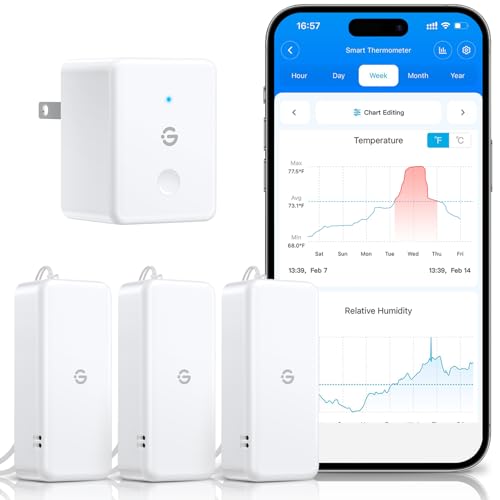
This is the solution if you want multiple sensors without the battery anxiety of Wi-Fi models. The plug-in Wi-Fi gateway pairs with up to 10 of the mini sensors included here (three in the box) and handles all the network heavy lifting. Because the sensors only talk to the gateway over a low-power protocol, they achieve a 2-year battery life on AAA cells — far better than any direct Wi-Fi sensor. The sensors themselves are impressively compact, with no screen, just a simple body and a lanyard, designed to be tucked into a guitar case, wine cabinet, or basement corner.
The Swiss-made temperature sensor delivers ±0.54°F accuracy with a 2-second refresh rate. You can set alerts for each sensor individually in the Govee app and receive notifications via app and email. The system stores the past 20 days of trend charts and lets you export the last 2 years of data. Owners praise reliability first and foremost — it is a consistent, well-built system. The calibration sliders in the app are useful for fine-tuning. The honest critique: some owners experience Wi-Fi connection drops between the gateway and router, and the initial setup (phone-to-gateway Bluetooth, then gateway-to-Wi-Fi, then adding sensors) can confuse people who skip the instructions. The range of the gateway’s radio is also limited compared to the LoRa-based YoLink system, so placing a sensor in a far outbuilding may not work.
System Benefits
- 2-year battery life on each sensor — far better than direct Wi-Fi
- Gateway supports up to 10 sensors for whole-home coverage
- Calibration sliders in the app let you fine-tune readings
- Sturdy build quality and reliable sensor data
System Limits
- Gateway-dependent: no sensors, no data
- Wi-Fi connection can drop; setup process is multi-step
- No on-sensor display — data lives only in the app or gateway
Best for: whole-home monitoring (each room, basement, attic) where you do not want to change batteries every month.
Not for: a single-room quick setup — the gateway requirement makes it more gear than needed for one spot.
9. Aqara Zigbee Temperature and Humidity Sensor 3 Pack

The compact 3-in-1 monitor that measures pressure too, built for the Apple HomeKit crowd.
Aqara’s sensor is a 3-in-1 device that tracks temperature, humidity, and atmospheric pressure — a feature none of the other picks here offer. That makes it genuinely different for weather enthusiasts or anyone dialing in a precise indoor climate. Inside is a high-quality sensor from Sensirion, the same Swiss maker found in the Third Reality model, so you get proven accuracy. It connects via Zigbee and requires an Aqara Hub (sold separately), which then allows integration with Apple HomeKit, Amazon Alexa, and IFTTT. With a fresh battery (a CR2032 coin cell), owners regularly see 2+ years of operation.
The biggest edge is HomeKit integration: it works natively through the Aqara app into Apple’s ecosystem, letting you create automations like “turn on the fan if the room hits 80°F.” The response time is a claimed 5 seconds. On the flip side, the proximity requirements are tight — Aqara specifies keeping the sensor within 400 inches (about 33 feet) of the hub for a solid Zigbee connection. The battery hatch on newer units has been redesigned with a tiny screw, which some owners find finicky. There are also reports of sensors arriving with dead batteries (likely shelf-aged) and, occasionally, DOA units from the start — although Amazon replaces them. If you are deep in the Aqara ecosystem and use HomeKit, it is a natural fit; if you just want a simple sensor, the hub requirement and tight range make it a harder sell.
Ecosystem Lock-In: If you already have an Aqara Hub and use HomeKit, this three-pack adds atmospheric pressure tracking that nothing else here matches. The trade-off is a strict 33-foot range from the hub and some fit-and-finish quirks with the battery hatch.
Choose this if: you are invested in the Aqara ecosystem and want HomeKit-native sensors with pressure data.
Pass on this if: you do not have an Aqara Hub or prefer a longer-range, lower-fuss solution like the YoLink system.
Understanding the Specs
Wireless Protocol
This is the radio language the sensor uses to talk to your phone or hub. Bluetooth is fine for a single room or short-range use (typically 200–400 feet) and needs no extra gear. Wi-Fi connects directly to your home network for app access from anywhere, but it can crowd your 2.4 GHz band and drains batteries faster. Zigbee and Z-Wave are mesh networks that require a hub (like an Echo or SmartThings hub); they use very little power and are great for whole-home systems. LoRa is a long-range, low-power protocol that can reach a quarter mile but needs its own proprietary hub — ideal for distant sheds or inside metal structures.
Battery Life
Look at the battery life estimate closely, because it varies hugely. If the sensor is in a hard-to-reach spot (like a crawlspace or ceiling), prioritize a model with a 2-year or longer rating. USB-powered sensors skip this worry but tie you to a power outlet.
FAQ
Do these sensors work with Alexa or Google Home?
Will a sensor work inside a fridge or freezer?
Can I monitor the sensor data from outside my home?
What is the difference between a hub and a gateway?
How often do I need to change the batteries?
Can I set up an alert if the temperature goes too high or too low?
What does VPD or Dewpoint mean in the app?
Will a Zigbee sensor work with my Home Assistant setup?
Can I use these sensors outdoors?
What does 2.4 GHz Wi-Fi only mean for my network?
Final Thoughts: The Verdict
For the majority of shoppers, the best wireless humidity and temperature sensor is the YoLink 3-Pack because its LoRa radio reaches places Wi-Fi and Bluetooth cannot, its 5-year battery life eliminates maintenance, and its commercial-grade accuracy handles everything from a deep freezer to a chicken coop. If you want a visible desktop clock with deep data logging and do not need remote access, the TempPro TempAir delivers incredible value. And for those building a whole-home monitoring network with the Govee ecosystem, the GoveeLife 2.0 Gateway 3-Pack gives you the best balance of battery life, accuracy, and multi-sensor coverage without cluttering your Wi-Fi.
How We Picked
We do not accept paid placement. Every pick is matched to a real buyer and a real use-case; we do not hands-on test units.
Sources & Methodology
Specifications: manufacturer listings and product documentation. Review insights: verified customer reviews, as of July 2026. Pricing: not shown on this page (it changes often); check the current price via the retailer link.
As an Amazon Associate, Calories Fit earns from qualifying purchases. This does not affect which products we feature.