
Our readers keep the lights on and the coffee maker working hard! As an Amazon Associate, I earn from qualifying purchases.
Specs are compiled from manufacturer listings and verified buyer reviews and can change over time — please confirm the key details on the product page before buying.
A freezer that fails overnight can cost you hundreds in ruined meat, a fridge that drifts a few degrees can turn milk sour days before the date. The real question is which wireless system reaches the garage, handles a power cut, and works for years without a subscription. This guide compares the best wireless fridge thermometers by range, battery life, alert types, and reliability when you’re away.
I’m Mohammad — the founder and writer behind Calories Fit. This guide is built by comparing the manufacturers’ published specifications and the patterns across verified customer reviews, so you get each pick’s real strengths and trade-offs instead of marketing spin.
Whether you are stocking a chest freezer in the basement or just want a second eye on your kitchen fridge during a power outage, finding the right best wireless fridge thermometer depends on matching the wireless tech to your home and knowing exactly how each model sounds the alarm.
Our Picks at a Glance


How To Choose The Best Wireless Fridge Thermometer
The first decision is the wireless protocol. WiFi models connect straight to your home network and don’t need a separate hub, but they only work inside your router’s range — typically about 100-150 feet indoors — and they eat batteries faster because they have to send data to the cloud. LoRa-based thermometers like the YoLink use a long-range radio that punches through walls and metal fridge boxes, reaching up to a quarter-mile in open air, and sip so little power that a set of AA batteries lasts roughly five years.
Alert types and false alarms
App push notifications are standard, but the best models also offer email, SMS text messages, or a loud buzzer on the display unit. A smart anti-false-alarm delay of 1-10 minutes prevents quick door openings from triggering alerts.
Quick Comparison
| Model | Best For | Wireless Type | Battery Life | Accuracy | Amazon |
|---|---|---|---|---|---|
| YoLink Smart Wireless Thermometer (3-Pack)★ Best Overall | Long-range whole-home monitoring | LoRa | 5 years | ±0.36°F | Amazon |
| MOCREO WiFi Freezer Alarm NS1Premium Pick | Power-outage & probe monitoring | WiFi | Continuous (USB) | ±0.9°F | Amazon |
| GoveeLife WiFi Thermometer 2-Pack H5111Top Performer | Multi-sensor with loud buzzer | WiFi / Bluetooth | 2 years | ±0.9°F | Amazon |
| MOCREO WiFi Refrigerator Thermometer H3 Kit | Power-outage alert & 30-sensor expandability | WiFi | 2 years | ±0.9°F | Amazon |
| YoLink Smart Freezer Thermometer (3-Pack) | Freezer-focused app & SMS alerts | LoRa | 5 years | High Accuracy | Amazon |
| GoveeLife WiFi Thermometer 2-Pack H5108 | LCD display & 2-year data export | WiFi / Bluetooth | Battery | ±0.9°F | Amazon |
| PHYSEN WiFi Freezer Thermometer | Budget multi-sensor with humidity | WiFi / Bluetooth | 2 years | ±1.8°F | Amazon |
| U UNNI Digital Wireless Thermometer | Basic dual-sensor with loud alarm | Wireless | Battery / USB | ±1.8°F | Amazon |
| KeeKit Refrigerator Thermometer | Entry-level dual-probe with display | Wireless | Battery | Standard | Amazon |
In-Depth Reviews
1. YoLink Smart Wireless Thermometer Hygrometer, 3-Pack
Our pick — over 4.5★ from 750+ verified ratings; the strongest balance of quality and price.
The only pack that reaches a quarter-mile without touching your home WiFi.
This is the wireless fridge thermometer that redefines what range means. Instead of standard WiFi, the three sensors talk to the included hub via LoRa — a low-power radio protocol that can work from 1/4 mile away in open air. That means you can stash a sensor in a detached garage, a basement far from the router, or even a greenhouse at the back of the yard and still get a live reading on your phone. The sensors deliver temperature accuracy of ±0.36°F (down to 0°C) and ±0.72°F below that, plus humidity readings that cover 0% to 100%.
Over 200 buyers cite reliability as the standout trait. Setup is straightforward too: you plug in the hub, pair each sensor through the YoLink app, and the devices start polling every 10 to 60 minutes. As one buyer explained, a user keeps his system configured so that above 51°F his mini-splits kick on, and below 50°F the boiler fires up — all triggered through the sensor’s alerts. The battery life lives up to the claim: a Yolink owner using the sensor in a Florida beehive reports five-year battery life with no issues so far. The only catch is that the sensors have no screen — you read the data through the app — and the hub is required, so this is not a grab-and-go gadget.
For the price, you are getting a hub plus three sensors that all work off the same network. The crowd favorite holds a 4.7-star average across 700+ owners, making it the most trusted pick by score and volume.
Why It Leads
- LoRa range punches through fridge metal and concrete walls where WiFi fails
- Five-year battery life on two AA cells means years of zero-maintenance monitoring
- Three sensors in one box give you full coverage for fridge, freezer, and a secondary location
The Trade-Offs
- No on-device display — all data is read through the YoLink app
- Hub is mandatory for operation, adding one more plug-in device
Reach for this if: you need to monitor a detached space like a garage or basement where WiFi can’t reach, and you want the longest possible battery life between battery changes.
Think twice if: you prefer seeing the temperature at a glance on a screen rather than through an app.
2. MOCREO WiFi Freezer Alarm & Refrigerator Thermometer NS1
The ultra-flat probe that slides through your freezer door without breaking the seal.
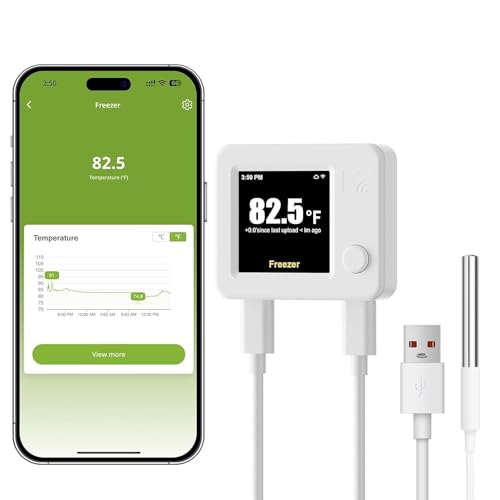
The defining physical feature here is the 4.9 ft ultra-thin flat probe cable — just 0.9mm thick — that slips between the fridge or freezer gasket without letting warm air in. Most thick sensor cables prop the door open by a hair, slowly building frost and wearing out the seal over months. This one solves that. The NS1 runs on continuous USB power, so there is never a dead-battery surprise during a critical alert.
Accuracy sits at ±0.9°F even at deep-freeze temperatures as low as -40°F, with a total sensing range of -40°F to 257°F. Owners highlight two real-world features: power outage alerts that trigger after 25 minutes with the exact time logged, and offline alerts if the WiFi drops. As the review pages sum it up: an owner who used the NS1 for 248 days still calls it reliable, praising the app updates and fast email alerts. The downside is that the display is small and it has no audible buzzer on the unit itself — only the phone and email alerts. Velcro mount instead of magnets also gets a mention from a long-term user.
This is the quiet workhorse for anyone wanting a thin profile and confidence against unnoticed appliance failure. The YoLink has the longer range and bigger pack, but this MOCREO leads on power-loss detection and door-seal safety.
Strengths
- Ultra-thin flat probe preserves door seal and prevents frost buildup
- USB-powered so battery failure during a power outage is never a concern
- Power outage alerts with exact timestamps give you critical data after a blackout
Limitations
- Small display can be hard to read from across the room
- No built-in audible alarm — you rely entirely on app and email alerts
Best suited for: anyone with a deep freezer in a garage or basement where door-seal integrity is the top concern and a nearby USB outlet is available.
skip it if: you want a loud local siren or a large, easy-to-read screen on the device itself.
3. GoveeLife WiFi Refrigerator Thermometer Sensor 2-Pack H5111
Two sensors plus an 80-decibel buzzer that actually makes you stand up.
The headline here is the 80dB audible alarm built into the gateway — loud enough to hear from another floor, which matters when you are not glued to your phone. The H5111 uses an ultra-sensitive 2.7mm NTC probe with ±0.9°F precision and a response time of roughly two seconds. The whole kit includes two waterproof sensors and a single WiFi gateway that supports up to 10 sensors if you want to expand later to cover a wine cooler or a second freezer.
Accuracy and reliability are the two most-mentioned positives from owners — 122 buyers single out reliability, with another 67 praising accuracy. The fact that the same gateway works with up to 10 sensors means you can monitor every cold spot in the house without a separate hub for each. The magnetic and hanging design, plus an included probe holder for cable management, makes setup a five-minute job. The main limitation is it requires 2.4GHz WiFi; it won’t work on a 5GHz-only mesh network, so some garage setups might need a range extender. One buyer also noted initial app bugs that eventually resolved after a few attempts.
This pick fits the buyer who wants a loud local alarm in addition to phone notifications and may want to grow the system over time. The KeeKit below is simpler and cheaper, but this GoveeLife gives you a proper buzzer and a real smart-home ecosystem.
Highlights
- Two sensors with IP65 waterproof rating, flat cable for door seal, and lanyard for flexible placement
- Single gateway supports up to 10 sensors for whole-home expansion
Considerations
- Requires 2.4GHz WiFi — not compatible with some newer mesh-only networks
- App had some reported early bugs that were later resolved through updates
Perfect for: households that want a loud local siren in addition to phone alerts, and plan to add more sensors for multiple fridges or freezers.
Look elsewhere if: your home runs a 5GHz-only WiFi network or you have zero interest in app-based monitoring.
4. MOCREO WiFi Refrigerator Thermometer with Freezer Alarm H3 Kit
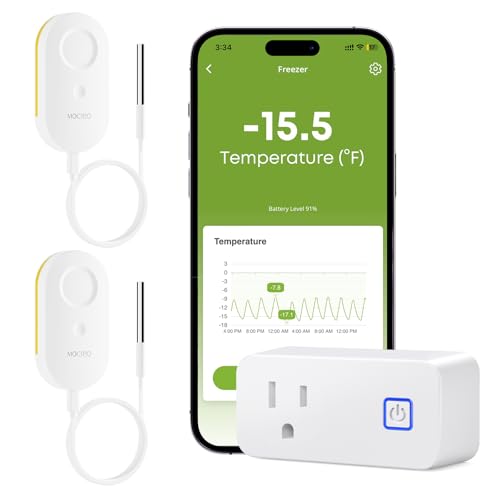
The hub design that doesn’t eat your only kitchen outlet.
Most monitoring hubs plug into a wall outlet and block the second socket completely. The MOCREO H3 Hub instead features a built-in pass-through outlet so you can still plug in the coffee maker or a charger. That small ergonomic decision makes a huge difference in a kitchen where every outlet is precious.
Alerts come three ways: an 80dB buzzer on the hub itself, a push notification, and an email. The system also sends a power outage alert the moment the grid goes down, complete with the exact time, plus a separate notification when power is restored. The probe cable is an ultra-thin 0.9mm flat wire that slides through the door gasket without breaking the seal — the same thoughtful design as the NS1 above. The recurring piece of feedback is the hub buzzer could be louder, and the tape holding some sensors can fail over time.
If the YoLink provides the best range and the GoveeLife provides the best buzzer, this MOCREO provides the best outlet-friendly hub and the highest ceiling for expansion. The value comes from buying a system that scales to 30 sensors without needing a second hub.
What Stands Out
- Pass-through outlet hub leaves the second wall socket free for other appliances
- Up to 30 sensors per hub — highest expandability in this roundup
- Three-alert system (app, email, local buzzer) ensures you never miss a warning
Known Quirks
- Hub buzzer volume could be stronger for noisy garages
- Adhesive tape on sensor mounts may lose grip over time
Ideal for: homes with multiple freezers and fridges where a single hub that doesn’t block outlets is a must-have for space planning.
Not for: anyone who needs a big, bright display on the hub itself — this unit has no integrated screen.
5. YoLink Smart Freezer Thermometer, LoRa Wireless 3-Pack

The same proven LoRa engine in a freezer-focused three-pack without humidity.
This is the sibling of Product 1, stripped down to temperature-only monitoring (no humidity) and sold as a dedicated freezer sensor pack. The wireless technology is identical — LoRa with up to 1/4 mile range, no WiFi crowding, and a battery life of up to five years from two AA cells. The big addition here is SMS text alerts in addition to email and push notifications, with 15 free SMS per month per hub-and-sensor pair. That matters if you are somewhere without a data signal but with texting.
Owners are unanimous about reliability — with 146 positive mentions, it is the most-discussed aspect. As one buyer put it, the system already paid for itself when it detected a fridge door that wasn’t fully closed by noticing the temperature trend before food was ruined. Another uses it for breastmilk storage and relies on the fast, accurate alerts. The hub is required (included in the trio — a hub plus three sensors) and is compatible with other YoLink devices like water leak detectors. The only real limitation versus the first YoLink model is the lack of humidity reporting, which only matters if you are monitoring a greenhouse or reptile enclosure alongside the freezer.
This is the most cost-effective way to cover a single freezer or a few fridges with SMS alerts and the longest possible battery life. The U UNNI below is cheaper but uses standard wireless and a shorter range, while this YoLink runs on LoRa that laughs at freezer walls.
Why It Works
- SMS alerts give you a backup even when app notifications are down
- Five-year battery life on each sensor keeps maintenance near zero
- Proven LoRa reliability through thick freezer walls and long distances
The Catch
- No humidity sensor — temperature monitoring only, not suited for greenhouse or wine storage needs
- Hub is mandatory and adds one more plugged-in device
Best for: anyone who needs SMS text alerts as a failsafe, and who prioritizes long-range coverage and minimal battery changes.
Pass if: you also need to track humidity levels, or you want a system that works without a hub.
6. GoveeLife WiFi Refrigerator Thermometer 2-Pack H5108

The only WiFi model here with a screen on every sensor so you can read temps without the app.
While most sensors are blind unless you open the app, each H5108 sensor has its own LCD display that shows the current temperature at a glance. That small screen makes a practical difference when you walk past the fridge — you see the number immediately without pulling out your phone. The kit includes two sensors with probes, a WiFi gateway (H5151) that supports up to 10 sensors, and offers free 2-year data export in CSV format.
The precision is the same ±0.9°F accuracy as the other GoveeLife models, with a -40°F to 158°F sensing range and a two-second refresh time. A smart anti-false alarm lets you set a delay of up to 10 minutes, so opening the door to grab milk doesn’t trigger a false app alert. The holder design keeps the probe cable organized, and the magnets and lanyard let you mount it almost anywhere. The shortcoming is that the device itself does not sound an alarm — all alerts come through the app. Some owners also report occasional WiFi connectivity drops.
This is the best option if you want an actual temperature readout on the fridge door itself, not just on your phone. Among the WiFi picks, it competes directly with the MOCREO NS1 and GoveeLife H5111, but only this one gives you a full LCD.
Standout Features
- Built-in LCD display on each sensor for quick, app-free temperature checks
- Smart anti-false alert with 1-10 minute delay avoids nuisance notifications
- Free 2-year data export to CSV for tracking trends over seasons
Limitations
- No audible alarm on the sensor itself — all alerts are app-only
- WiFi connectivity can be inconsistent, requiring occasional reconnection
Great if: you want to read the temperature directly on the sensor without pulling out your phone every time, and you appreciate detailed historical data export.
Not ideal if: you need a loud local alarm to hear from across the house, or you dislike unreliable WiFi reconnections.
7. PHYSEN WiFi Freezer Thermometer with 2 Wireless Sensors
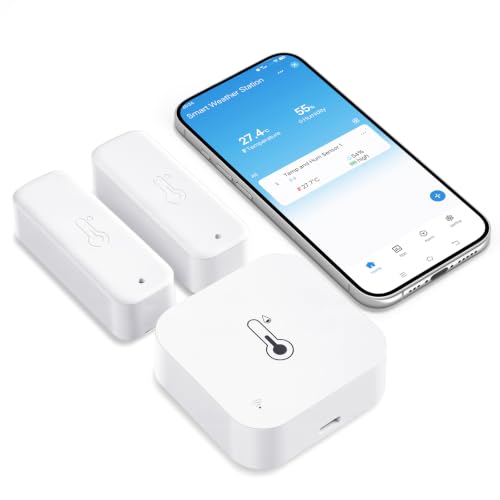
Two IP65-rated sensors that track both temperature and humidity for the lowest price in the WiFi category.
The PHYSEN is the cheapest WiFi option in this list, yet it still packs two sensors that are fully waterproof (IP65) and each measures humidity alongside temperature. That makes it a strong candidate for anyone who wants to keep tabs on a humid basement wine fridge or a reptile tank without paying for a premium system. The temperature sensing range runs from -4°F to 140°F, with ±1.8°F accuracy, and the wireless range goes up to 492 feet in open air.
A single gateway within the kit supports up to nine sensors, so you can expand gradually. The included AAA batteries are freeze-resistant and claimed to last up to two years. The app provides free notifications, plus one year of free data export in CSV. The volume of the app alerts gets mixed feedback — some owners find the chime loud enough, while others wish it were stronger. Also note that the minimum monitoring temperature is -20°C (-4°F), so this won’t work for deep-freeze chests that dip below that.
Compared to the U UNNI below, this PHYSEN offers WiFi connectivity instead of a dedicated wireless display, meaning you can check the temperature from anywhere rather than only within the base unit’s range. The trade-off is slightly lower top-temperature accuracy.
Perks
- Two fully waterproof (IP65) sensors that also track humidity
- 492-foot wireless range reaches into a detached garage or basement
- Supports up to nine sensors on one gateway for later expansion
Downsides
- App alert volume is inconsistent — some owners find it too quiet
- Lowest monitoring temperature is -4°F, not suitable for deep-freeze applications below that point
Reach for this if: you are on a tight budget but still want WiFi-connected monitoring with humidity tracking and waterproof sensors.
Skip if: your freezer runs below -4°F, or you need a very loud, room-filling alarm.
8. U UNNI Digital Wireless Refrigerator Thermometer

The 90dB beeper makes itself heard even from a basement or garage.
This U UNNI model uses a Swiss-made Sensirion sensor inside, which helps it maintain ±1.8°F accuracy across a temperature range from -40°F to 158°F. The display unit itself can run on either USB power (which keeps the backlight always on) or AAA batteries (which show the screen for only 10 seconds after a button press). The 4.5-inch screen is one of the largest here, making it easy to read from across the room. The 90dB alarm is noticeably louder than the 80dB buzzer on the GoveeLife models, so it cuts through the buzz of a garage fan or kitchen noise.
The kit includes two sensors plus the display, with data transmission every 30 seconds across a 328-foot range. The reliability is the most frequently praised aspect — 64 owners mention it, and 34 praise the build quality. The main limitation is the magnet strength — several owners note the display magnet is not very strong, which can cause it to slide or fall off ferro-magnetic fridge doors. The base should not be placed near a microwave to avoid interference.
Compared to the KeeKit below, this U UNNI offers a more accurate sensor (Sensirion) and a louder alarm. It is a solid step up from the entry-level market without hitting the premium price of the YoLink or MOCREO systems.
Highlights
- Swiss-made Sensirion sensor delivers reliable accuracy for the price
- 90dB alarm is the loudest in this budget tier
- 4.5-inch display with adjustable backlight — easy to read from distance
Drawbacks
- Magnet strength on the base unit is weak — it may not stay on all fridge doors
- Base unit should not be placed close to a microwave due to signal interference
Perfect for: buyers who want a clear, large display and a very loud alarm without spending on a full WiFi system.
Not for: anyone who needs a strong magnetic hold on a textured or non-flat fridge door surface.
9. KeeKit Refrigerator Thermometer with 2 Sensors

The simplest way to put two temperature probes on one screen for under.
The KeeKit is the most basic and cheapest option, but it gets the core job done: a base unit with a built-in sensor plus two remote probes, all displayed on one LCD screen. The remote sensors cover -40°F to 140°F with a 328-foot range in open air, and the base supports magnets, a hanging hole, and a kickstand for placement on the fridge door, wall, or counter. The audible alarm can be set to a maximum and minimum threshold, and once triggered, it gives a 20-second response delay before ringing.
Buyers report the accuracy is acceptable for the price — a typical reading is about 2°F high, which is fine for general monitoring but not for precision food safety labs. One owner noted the freezer sensor failed after being iced over but revived after a battery removal, confirming this is not waterproof. The display is also too dim to read outdoors. The main functional strength is spotting a fridge door left ajar before food spoils, since the alarm triggers quickly on high temperature.
This is the fallback pick for someone who just wants a quick, cheap temperature check without WiFi, an app, or a long-term commitment. The U UNNI above has a more accurate sensor and louder alarm, but this KeeKit costs less and still gives you two remote probes.
Strengths
- Lowest entry price of any dual-sensor thermometer in this list
- Flexible mounting options — magnet, hang, or stand
- Good for catching an ajar fridge door before food spoils
Trade-Offs
- Accuracy runs about 2°F high — good enough for general use, not for precision
- Freezer sensor is not waterproof — it may fail if exposed to ice buildup
Best for: the simplest possible two-zone temperature check with no apps, no hubs, and very little investment.
Look elsewhere if: you need highly precise readings, waterproof sensors, or WiFi/remote monitoring.
Understanding the Specs
LoRa vs WiFi Connectivity
LoRa (Long Range) is a radio protocol that uses very little power to send small data packets over huge distances — up to a quarter-mile in open air. It requires a hub but does not use your home WiFi, so it won’t slow down your network and it can pass through steel-sided fridges and multiple walls. Standard WiFi thermometers connect directly to your 2.4GHz router; they can be checked from anywhere via the cloud, but they have shorter indoor range and drain batteries faster because they must maintain a constant network handshake.
False-Alarm Filters
Every time the fridge door opens, warm air rushes in and the internal temperature rises for a few minutes. A thermometer without a delay filter will trigger an alert every time someone grabs milk. The best models let you set a “wait time” — typically 1 to 10 minutes — before sounding the alarm, so only genuinely dangerous temperature excursions (a failed compressor, power outage, or door left wide open) get your attention.
Probe Type and Door Seal
Thermometers with a wired probe (a sensor on the end of a cable) can measure temperatures directly inside the fridge while the display sits on the counter. The thickest round cables can lift the door gasket just a fraction of an inch, causing a slow cold-leak that wastes energy and builds frost. The best probes now use an ultra-thin flat cable (0.9mm) that slides through the rubber seal and lets the door close completely, preserving the fridge’s internal temperature and preventing condensation.
Battery Life and Power Backup
WiFi sensors that talk to the cloud every minute may need new batteries every few months. LoRa sensors, by contrast, send a single data packet every 10-60 minutes and can run for years on a set of AA batteries. USB-powered units never die during use but become useless during a power outage unless they have a battery backup. If you need monitoring during a blackout, look for a model that specifically lists a power-outage alert function with a backup battery or capacitor.
FAQ
Will a wireless fridge thermometer work through metal freezer walls?
Can I use the same thermometer for both the fridge and the freezer?
How do I prevent false alarms from normal door openings?
What happens if the power goes out?
Do I need a separate hub for every brand?
How long do the batteries actually last?
Can I monitor a chest freezer in an unheated garage?
Do any of these thermometers track humidity too?
Is an app required to use the thermometer?
What does the “Critical Alerts” feature on Apple devices do?
Final Thoughts: The Verdict
If you want one dependable pick, the best wireless fridge thermometer winner is the YoLink Smart Wireless Thermometer (3-Pack) because it combines class-leading LoRa range, five-year battery life, and the highest reliability score from hundreds of owners. If you want power-outage alerts and a thin probe that won’t leak cold from the door seal, grab the MOCREO NS1. And for a loud local alarm with two IP65 sensors and humidity tracking at a lower price, the PHYSEN WiFi Thermometer is the one to reach for.
How We Picked
We do not accept paid placement. Every pick is matched to a real buyer and a real use-case; we do not hands-on test units.
Sources & Methodology
Specifications: manufacturer listings and product documentation. Review insights: verified customer reviews, as of July 2026. Pricing: not shown on this page (it changes often); check the current price via the retailer link.
As an Amazon Associate, Calories Fit earns from qualifying purchases. This does not affect which products we feature.