
Our readers keep the lights on and the coffee maker working hard! As an Amazon Associate, I earn from qualifying purchases.
Specs are compiled from manufacturer listings and verified buyer reviews and can change over time — please confirm the key details on the product page before buying.
Cadence — pedal revolutions per minute — is the key metric for efficient, joint-friendly riding. A wireless bike computer with cadence gives you that live pedal-pace readout on your handlebars without a single wire, and the right one also tracks speed, distance, and GPS route. The core trade-off is battery and screen size versus navigation and brand features.
I’m Mohammad — the founder and writer behind Calories Fit. This guide is built by comparing the manufacturers’ published specifications and the patterns across verified customer reviews, so you get each pick’s real strengths and trade-offs instead of marketing spin.
Every unit here pairs wirelessly with a cadence sensor and records your rides with GPS. Find your perfect match from this lineup of the wireless bike computer with cadence options.
Our Picks at a Glance


How To Choose The Best Wireless Bike Computer With Cadence
You want a bike computer that shows your pedal pace, speed, and distance from wireless sensors on a screen you can read without looking down for long. Your choice hinges on battery life, sensor compatibility, and if you need on-device maps.
Battery Budget vs. Screen Size
The two specs that fight each other most are battery life and display size. A big, bright screen like a 2.9-inch panel makes data easy to catch at speed, but a larger display often sips more power. Units advertising 60-plus hours of runtime on a single charge are built for multi-day touring, not for constant backlight use.
Sensor Protocol Compatibility
Your cadence sensor, heart-rate strap, and power meter all talk to the head unit over a wireless protocol. ANT+ is the open standard most sensors use, while Bluetooth is what your phone uses. Units supporting both give you the widest pairing options; a unit that only does ANT+ still handles sensors but bolts the phone to Bluetooth duty for syncing only.
Navigation vs. Pure Data
Not every cadence-capable unit shows you a map. Some models focus purely on data fields and skip turn-by-turn prompts, which keeps the price and complexity down. If you routinely ride new routes, look for on-device map navigation or at least route import from Strava, Komoot, or Ride with GPS.
Quick Comparison
| Model | Best For | Battery | Display | Water Resistance | Amazon |
|---|---|---|---|---|---|
| Wahoo ELEMNT Bolt V2★ Best Overall | Serious navigation & training | 15 hours | 2.2 inches | IPX7 | Amazon |
| CYCPLUS M1Battery King | Multi-day touring battery | 60+ hours | 2.9 inches | IPX6 | Amazon |
| COOSPO BC107Compact Pick | Budget training with ANT+ sensors | — | 2.4 inches | IP67 | Amazon |
| COOSPO CS300 | Custom data pages for road riders | 40 hours | 2.6 inches | IPX7 | Amazon |
| Magene C506SE | Color screen on a budget | 24 hours | 2.4 inches | IP54 | Amazon |
| iGPSPORT BSC200S | Route navigation with a big data set | 25 hours | 2.4 inches | IPX7 | Amazon |
| iGPSPORT BSC100S | Complete sensor bundle value | 40 hours | 2.6 inches | IPX7 | Amazon |
| Magene C506 | Touchscreen navigation & indoor training | 24 hours | 2.4 inches | — | Amazon |
| Garmin Edge Explorer 2 | Glove-friendly navigation for explorers | 16 hours | 3 inches | — | Amazon |
In‑Depth Reviews
1. Wahoo ELEMNT Bolt V2 GPS Cycling/Bike Computer Bundle
Our pick — over 4.5★ from 350+ verified ratings; the strongest balance of quality and price.
The navigation-first powerhouse that pairs with radar, sensors, and a heart-rate strap from the start.
The Bolt V2 is the complete package for riders who treat their computer as a training hub, not just a speedometer. It generates turn-by-turn prompts right on the device for GPX files, TCX files, and routes from Strava, Ride with GPS, and Komoot, so you get directional cues without pulling out your phone. Top LEDs and audible chimes tell you at a glance whether your next turn is coming or you have drifted off-course.
The Wahoo Bolt V2 lasts 15 hours per charge, which is 4.0x shorter than the CYCPLUS M1’s 60+ hours below, but it adds ANT+ radar integration (a wireless protocol that shows approaching cars on the screen). Its 2.2-inch display is 32% smaller than the M1’s 2.9-inch panel, yet buyers report the vivid colors and brighter LED make it easy to read, especially with map zoom. At 2.4 ounces, it is 13% lighter than the M1’s 2.7-ounce body, a difference you notice on long climbs.
Owners mention it is a reliable upgrade from a 9-year-old Bolt with accurate speed, cadence, and heart-rate tracking that matches Garmin watches. The bundle includes RPM speed and cadence sensors plus a TICKR heart-rate monitor, so you get cadence live on day one. The recurring honest caveat concerns the heart-rate monitor reliability, which some owners found mixed, and the 15-hour run time means multi-day tourers will need to charge mid-trip.
Where it leads
- On-device turn-by-turn navigation with audible and LED cues
- Complete bundle: cadence sensor, speed sensor, and heart-rate strap included
- ANT+ radar integration shows approaching cars on screen
Trade-offs owners note
- 15-hour battery needs charging on multi-day trips
- Heart-rate monitor reliability drew mixed feedback
- 2.2-inch screen is smaller than several rivals
Pick this if: you want premium navigation, radar awareness, and a full sensor bundle in one box.
Look elsewhere if: your priority is running multiple long days on one single charge.
2. CYCPLUS GPS Wireless Bike Computer M1
The 60-plus-hour workhorse with the biggest 2.9-inch screen in this lineup.
For multi-day touring, the CYCPLUS M1’s 1200mAh battery is the reason to choose it. It runs more than 60 hours on a charge — 4.0x longer than the Wahoo Bolt V2’s 15 hours — so you can commute for weeks or finish a bike-packing trip without a USB port. The 2.9-inch glare-free FSTN screen (a low-power reflective display) auto-brightens based on sunrise and sunset in your time zone, keeping data readable from dawn to night.
The Swiss-imported GPS chip locks onto routes for four satellite systems, and Bluetooth syncs your journey to the CYCPLUS FIT app where you can push rides to Strava. It supports ANT+ and Bluetooth, recording speed, cadence, heart rate, power, route traveled, and altitude from compatible sensors. Customers note accurate cadence, speed, and GPS distance, with the only real miss being no calorie calculation — a detail calorie-focused riders will notice. The IPX6 rating shrugs off rain, though it stops short of the full-submersion IPX7 you get on the Wahoo.
At 2.7 ounces and 2.17″L x 0.79″W x 3.54″H, it carries a slightly chunkier footprint than the 2.4-ounce Bolt V2, but the bigger display earns that bulk back. The honest gripes are the proprietary 3-inch USB-A charging cable (no USB-C support) and stiff buttons, plus a mount that owners say is not replaceable. For the price, the battery and screen combination is the value story of this list.
Multi-day endurance: 60+ hours of runtime on a 1200mAh battery makes this the longest-lasting unit here by a wide margin.
Daily-driver check: the automatic backlight and four-satellite positioning keep data readable and accurate, but skip it if you need turn-by-turn navigation.
3. COOSPO Bike Computer Wireless GPS BC107
A featherweight GPS head unit that its 2.4-inch screen keeps tidy without wasting handlebar space.
The Coospo BC107 suits riders who want full GPS data without a bulky unit on the stem. Its 2.4-inch display sits in a compact body made of glass-filled ABS and TPU (tough plastics), weighing just 0.14 kg. It uses dual positioning — GPS alone or GPS plus Beidou (China’s satellite system) — and auto-sets the time once it locks signals, with a GPS-off mode for indoor trainer rides.
The BC107 pairs sensors only via ANT+ (a wireless standard for fitness devices), so it works with heart-rate monitors, speed and cadence sensors, and power meters, but not over Bluetooth. Bluetooth is reserved for the CoospoRide app, where you adjust settings, load GPS track maps, and sync rides to Strava. Owners call it a reliable starter unit that locks satellites fast and reads accurately against Garmin units; one reviewer noted battery at roughly 75% after 500 miles over 10 days, suggesting multi-week runtime.
The IP67 rating means it survives dust and full submersion briefly, a step tougher than the IPX6 of the CYCPLUS M1. The setup process drew mixed feedback — some find it easy, others say the documentation is thin on details like adding a combination cadence-speed sensor. Treat first-day configuration as a small learning curve and the value is tough to match.
Compact strengths
- Ant+ pairs with cadence, speed, heart-rate, and power sensors
- IP67 waterproofing beats most rivals for rain confidence
- Fast GPS lock with accurate readouts vs. pricier brands
Know before you buy
- No Bluetooth sensor pairing — ANT+ only
- Setup instructions are thin on detail
- Temperature readout can run high
Reach for it if: you run ANT+ sensors and want a compact, genuinely affordable GPS head unit.
pass on it if: you need Bluetooth sensor pairing or expect a plug-and-play setup.
4. COOSPO CS300 GPS Bike Computer

The 2.6-inch display that lets you build your own data pages and lock out the ones you never use.
The CS300 speaks to riders who like their screens arranged exactly their way. You can customize display pages, alerts, and settings — from metric or imperial units to which data fields fill each screen — and the bike computer adapts to your riding style. The 2.6-inch auto-backlight LCD keeps those custom pages readable in varying light, and the 40-hour battery with a USB-C charge port means rest stops, not chargers, pace your long rides.
Pairing is the strongest flex here: it supports both ANT+ and Bluetooth 5.0, so Garmin speed and cadence sensors connect without fuss, and the CoospoRide app syncs rides to Strava and TrainingPeaks. Reviewers point out fast GPS acquisition across GPS, BDS, and QZSS satellites, with one noting they only charged it every two months. The 40+ riding data fields cover speed, distance, grade, cadence, calories, and more, plus a dedicated heart-rate/speed/pedal/power zone display that surfaces your effort at a glance.
The honest gap is navigation: this is a data computer, not a map computer, and trail riders found it lacks a current lap-time display during the ride (you only see lap time after syncing to the phone). That makes it a miss for segment chasing but a strong pick for structured training on known roads.
Personalized data hub: full page customization plus ANT+ and Bluetooth 5.0 pairing covers nearly every sensor setup.
Training-focused caveat: no live lap-time field means interval timing happens in the app afterward, not on the bar.
5. Magene C506SE Wireless GPS Bike Computer

A 74-gram color-screen unit that locks GPS in about five seconds and supports nine device types.
The iGPSPORT C506SE offers a colorful 2.4-inch display in a weight class where rivals often use monochrome screens. At just 74g, it feels light on the handlebar, and its three-button layout allows one-handed operation. The high-precision Airoha chipset (a GPS processor), with over 300 days of calibration and AGNSS support (assisted GPS that uses network data), is designed to lock position within 5 seconds; that offline AGNSS stays valid for about 14 days, so you get fast lock even before syncing fresh data.
The C506SE’s wireless reach is its surprise: it supports Bluetooth and WiFi, and the maker claims WiFi transfers data 28 times faster than Bluetooth. That speed helps when uploading navigation files and ride records. It connects via ANT+ and Bluetooth to nine device types — speed and cadence sensors, heart-rate monitors, power meters, smart trainers, radar tail lights, smart tail lights, and electronic shifting systems — making it among the most flexible pairing options here.
The color screen shows 108 data items across 14 categories with circular dials, line graphs, and bar charts, and the OnelapFit app pushes rides to Strava and TrainingPeaks. The recurring owner gripe is that GPS navigation can get confused on laps or when doubling back on a route. Shoppers say it is a reliable budget-friendly upgrade with accurate tracking, excellent battery, and easy pairing, though the 24-hour rating trails the 40-hour units above.
Why it wins riders
- Color 2.4″ screen at an entry-level price point
- Fast 5-second GPS lock via Airoha chipset
- Supports 9 device types including smart trainers
The catch
- Navigation can confuse on laps or when retracing a route
- Small screen limits data per view
- IP54 rating is lighter than IPX7 rivals
Best for: riders who want a color screen and broad sensor support without paying flagship prices.
Not for: anyone planning complex route navigation or expecting heavy-rain submersion confidence.
6. iGPSPORT BSC200S GPS Bike Computer

Route navigation plus 100-plus data fields in a 67-gram body that charges fully in about 1.5 hours.
The BSC200S is for riders who want turn-by-turn navigation without the premium-brand price tag. You can build a route in the official iGPSPORT app or import one from Strava, Ride with GPS, or Komoot, then send it to the unit with one touch. It also supports “Back to Start” navigation and riding-record navigation, plus turn reminders, yaw reminders, and yaw-direction guidance so you always know the next move.
The 2.4-inch semi-transparent, semi-reflective color screen stays legible under direct sun — a detail owners highlight after riding with it in bright conditions. Its 600mAh battery delivers up to 25 hours and recharges to full in about 1.5 hours over USB-C, so even a brief café stop tops it up for the ride home. With over 100 riding data fields including speed, distance, grade, cadence, calories, time, temperature, and FTP, it covers everything a training-minded rider tracks, and it stores up to 400 hours of riding data.
The wireless story is strong: it pairs over ANT+, Bluetooth, and USB, and connects to iGPSPORT front lights for control and power-level checks plus radar lights to monitor nearby vehicles. Buyers report excellent battery life — one saw 19 days and 194.1 miles with 16% left — and call its value “a bargain” at roughly a third of the cost of bigger brands. The honest trade-offs are small side buttons and a tiny, low-resolution navigation map that requires squinting on unfamiliar roads.
Route-ready value: full turn-by-turn navigation plus 100+ data fields at a fraction of premium-brand pricing.
Reality check: the navigation map is small and low-res — fine for known roads, less ideal for dense city streets.
7. iGPSPORT BSC100S GPS Bike Computer
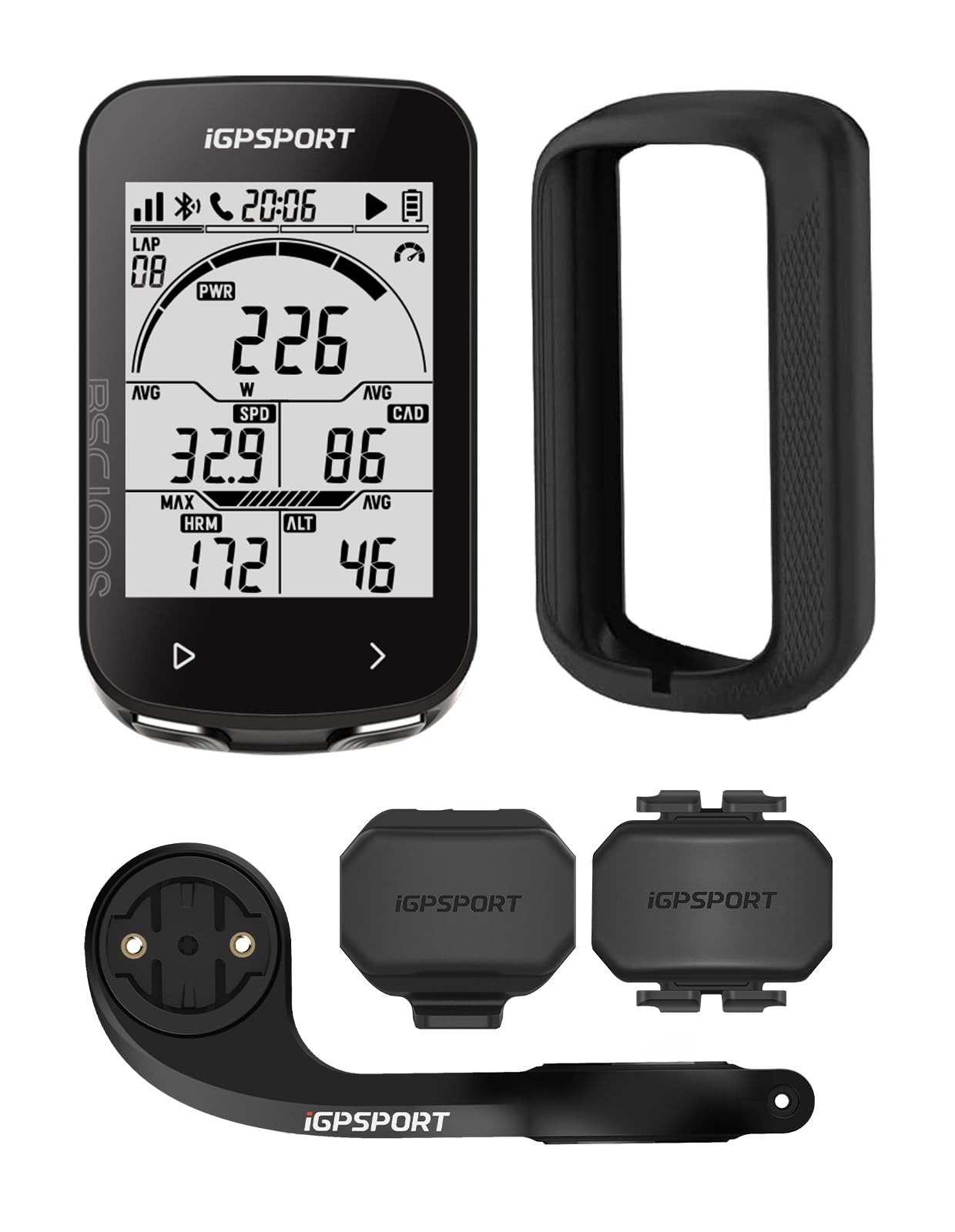
The rare kit that ships with both a cadence sensor and a speed sensor in the box, ready to pair.
Most budget computers make you buy the cadence sensor separately — the BSC100S set skips that hassle. The package includes the BSC100S head unit, a CAD70 cadence sensor, an SPD70 speed sensor, a mount, a case, and a charge cable, so you get live pedal-pace readouts from the very first ride. The 2.6-inch anti-glare screen displays over 40 riding data fields spanning speed, distance, grade, cadence, calories, time, and temperature.
Positioning uses five satellite systems — GPS, Beidou, GLONASS, GALILEO, and QZSS — which owners credit for never dropping satellite signal on long rides. The 600mAh battery carries the unit up to 40 hours on a charge, more than double the 15 hours of the Wahoo Bolt V2, and the USB-C port charges faster than older micro-USB designs. It pairs with speed, cadence, and heart-rate sensors plus smart watches over ANT+ and Bluetooth 5.0, and the iGPSPORT app analyzes rides and shares them to Strava and Komoot.
The IPX7 waterproofing shrugs off heavy rain, which pairs well with the 40-hour runtime for all-day touring. Owners consistently describe it as a great starter unit that sets up easily through the iPhone app, with one noting they switched from a Garmin for cost and reliability reasons. The downsides are the classic budget trade-offs: no routing or map navigation, a manual that reads like broken-English translation, and page layouts that sometimes force you to switch screens to see current and average speed together.
Bundle bonus
- CAD70 cadence and SPD70 speed sensors included in the box
- 5-satellite positioning keeps signal locked on long rides
- 40-hour battery and IPX7 waterproofing for all-weather touring
Honest limits
- No maps or route navigation
- Manual is poorly translated; find the full English manual online
- Can’t show current and average speed on the same page
Grab this if: you are starting out and want cadence and speed sensors without a second purchase.
Pass if: turn-by-turn navigation is a must-have for your riding style.
8. Magene C506 GPS Bike Computer
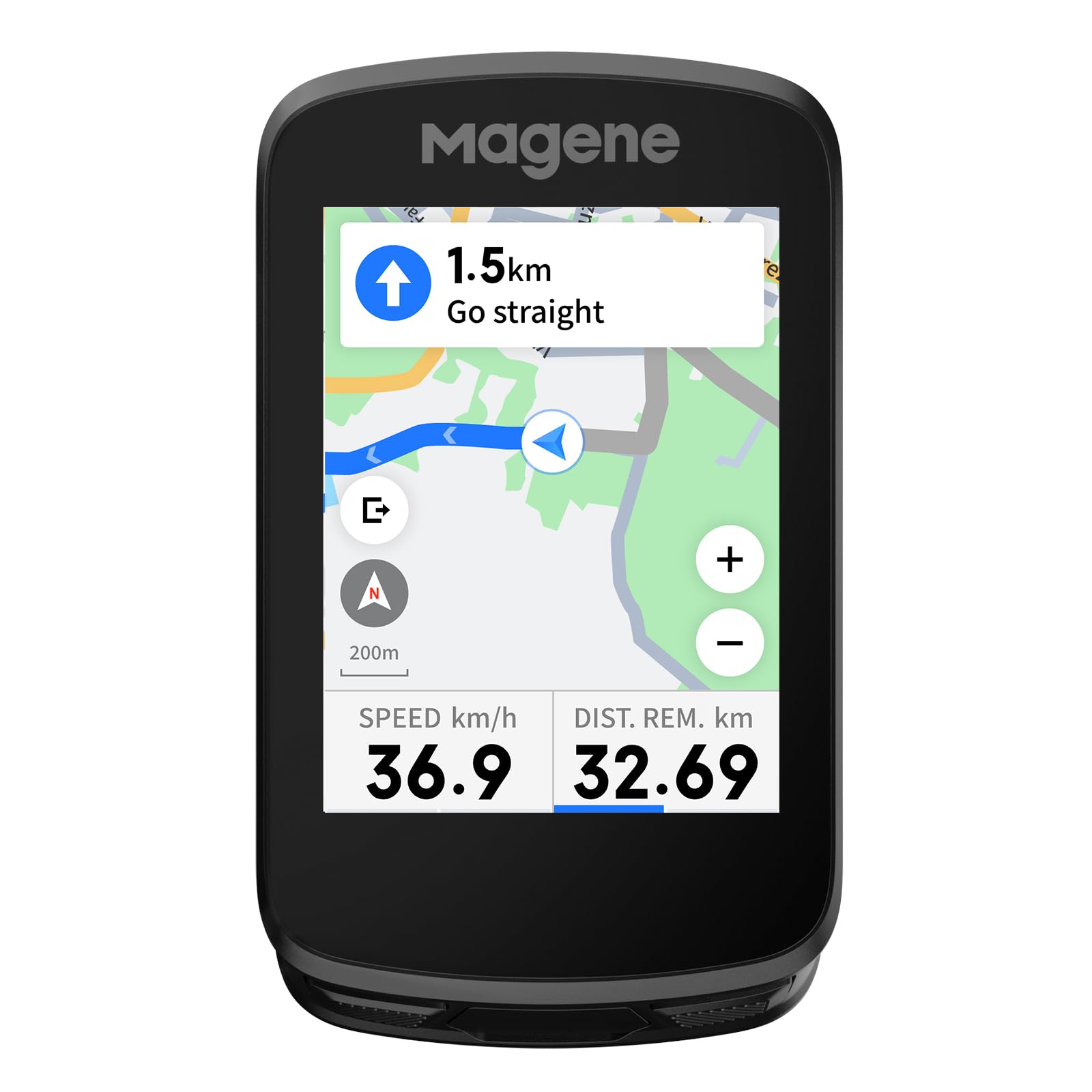
A 76-gram touchscreen unit that downloads free global maps and controls smart tail lights from the bars.
The C506 is the step-up version of the C506SE, swapping three buttons for a 2.4-inch touchscreen that still keeps three physical buttons for gloved riding. At 76g it stays light, and the touch panel responds to swipes for quick data-page changes. Smart navigation is the headline: you download free global maps directly to the computer, get turn-by-turn prompts with street names, and create custom routes in the OnelapFit app or upload GPX files.
Wireless muscle comes from Bluetooth and WiFi dual protocols with automatic AGNSS sync — the maker claims WiFi transfers data 28 times faster than Bluetooth, which owners feel when rides auto-sync to Strava and Google Health without prompting. The Airoha chipset targets positioning in as fast as 5 seconds, backed by more than 300 days of calibration. It connects over ANT+ and Bluetooth to nine device types including SRAM eTap and Shimano Di2 electronic shifting, plus speed and cadence sensors, heart-rate monitors, power meters, smart trainers, and radar tail lights.
The smart riding assistant is the differentiator: control Magene L508 and L308 tail lights without your phone, get auto front-light activation at 10km/h, and receive hydration, energy, and return-time reminders. Indoor riders can upload FIT files to a smart trainer to simulate outdoor routes with custom power targets and resistance. The battery hits 24 hours in endurance mode. Owners praise the value against Garmin and Wahoo, though the touchscreen occasionally needs multiple presses and the app’s map-download process draws complaints for being unintuitive.
Feature-dense value: free map navigation, touchscreen control, and smart light integration at a mid-range price.
Interface friction: the touchscreen sometimes takes a second press and the map download flow inside the app is clunky.
9. Garmin Edge Explore 2

The 3-inch glove- and rain-friendly touchscreen with preloaded activity profiles that work from the start.
The Edge Explore 2 is Garmin’s answer for riders who want navigation as their top priority and a screen that behaves in real conditions. Its 3-inch high-resolution touchscreen works with gloves on and in the rain, and stays visible in direct sunlight — the largest display in this lineup. Setup is genuinely simple, with preloaded road, off-road, and indoor activity profiles ready to ride immediately, plus ride-type-specific maps that highlight popular roads and trails with searchable points of interest.
The Garmin Edge 530’s built-in GPS tracks distance, speed, elevation, and location, and it works with separately sold sensors for heart rate, bike speed, bike cadence, and more. Its battery lasts 16 hours, shorter than the 40-hour units on this list, but it held up across a reported 30-mile hilly ride at 8,500 feet that barely drained the charge. Paired with your smartphone, you get LiveTrack and GroupTrack, smart notifications, rider-to-rider messaging, and built-in incident detection during outdoor rides — a safety net owners say gives family confidence on long solo rides.
For eBike riders, connecting to a compatible bike pulls battery status, assist level, and range into the navigation guidance. It also pairs with Varia radar and smart lights to detect cars and alert drivers. On indoor rides, it controls music directly from the Edge. Owners call it a solid, intuitive unit that does everything most riders need, with the interface feeling phone-like and easy to navigate while riding. The honest caveats: some found the on-screen route logic can favor highways, and battery-life feedback is mixed if you run full brightness and navigation constantly.
Big-screen navigator: the Garmin Edge Explore 2’s 3-inch touchscreen and preloaded maps let you explore new roads smoothly, even with gloves on.
Consider it for: eBike riders and those who want LiveTrack safety features — plan for a mid-day charge on all-day epics.
Understanding the Specs
Battery Life (Hours)
This tells you how many hours of riding you get per charge, and it is the single biggest spec split in this category. Units like the CYCPLUS M1 and iGPSPORT BSC100S push 40 to 60-plus hours — enough for multi-day touring. The Wahoo Bolt V2 at 15 hours and Garmin Edge Explore 2 at 16 hours are built for feature-rich day rides, not week-long epics, and their owners recharge more often.
Display Size (Inches)
Screen size dictates how much data you can read at speed. A 2.2-inch display like the Wahoo Bolt V2 keeps the unit compact but requires zooming for maps, while a 2.9-inch panel like the CYCPLUS M1 or the 3-inch Garmin Edge Explore 2 shows more fields and larger fonts without squinting. Bigger screens usually mean a slightly heavier and bulkier head unit.
Water Resistance (IP Ratings)
An IP rating describes how well the unit survives moisture. IPX7 means the device can be submerged in up to 5 feet of water briefly — the toughest rating here, found on the Wahoo, COOSPO CS300, and both iGPSPORT units. IPX6 handles heavy rain but not submersion, and IP54 (the Magene C506SE) covers splashes and dust. Choose IPX7 if you ride in serious downpours.
Sensor Protocols (ANT+ / Bluetooth)
These are the two wireless languages your cadence, speed, heart-rate, and power sensors speak. ANT+ is the open standard most bike sensors use and pairs with nearly any brand. Bluetooth 5.0 adds smartphone-style pairing and is required for app syncs with Strava and others on most units. Units supporting both, like the COOSPO CS300 and iGPSPORT BSC100S, offer the widest pairing freedom.
FAQ
Do all bike computers with GPS track cadence?
Can I use my existing Garmin cadence sensor with a different brand computer?
What does the IPX7 rating mean for riding in heavy rain?
How long does a 40-hour battery actually last in real-world riding?
Is ANT+ or Bluetooth better for connecting sensors?
What is the difference between cadence and speed tracking?
Can I upload routes from Strava to my bike computer?
Does a larger screen make the computer too heavy for the handlebar?
What is a smart trainer and why would I pair my bike computer to one?
Do these computers track calories burned?
Final Thoughts: The Verdict
For most riders, the best wireless bike computer with cadence is the Wahoo ELEMNT Bolt V2 because it bundles premium navigation, radar awareness, and a complete sensor kit into one polished device. If your priority is multi-day battery endurance on a big screen, the CYCPLUS M1 delivers over 60 hours on a single charge. And for the strongest out-of-box value with cadence and speed sensors included, the iGPSPORT BSC100S is the one to reach for — the review-data crowd favorite pairing reliable tracking with a genuinely complete package.
How We Picked
We do not accept paid placement. Every pick is matched to a real buyer and a real use-case; we do not hands-on test units.
Sources & Methodology
Specifications: manufacturer listings and product documentation. Review insights: verified customer reviews, as of August 2026. Pricing: not shown on this page (it changes often); check the current price via the retailer link.
As an Amazon Associate, Calories Fit earns from qualifying purchases. This does not affect which products we feature.