
Our readers keep the lights on and the coffee maker working hard! As an Amazon Associate, I earn from qualifying purchases.
Specs are compiled from manufacturer listings and verified buyer reviews and can change over time — please confirm the key details on the product page before buying.
Forget the frustration of a GPS unit losing signal under tree cover, or a wireless sensor eating through coin-cell batteries every season. A wired bike computer solves both problems in one go — it gets power and data through a single thin cable, so your speed and distance numbers stay live as long as the wheel turns. The trade-off is you have to route that wire along your fork and frame, which takes a few extra minutes during setup. But once it is on, you get instant-read data with zero pairing, zero charging, and zero signal drops — every time you swing a leg over the saddle.
I’m Mohammad — the founder and writer behind Calories Fit. This guide is built by comparing the manufacturers’ published specifications and the patterns across verified customer reviews, so you get each pick’s real strengths and trade-offs instead of marketing spin.
If you are looking for a dead-simple speedometer that just works without any screens to tap or Bluetooth to fuss with, these are the three wired computers worth your attention. This roundup covers the best wired bike computer options for riders who value reliability over smartphone integration.
Our Picks at a Glance
How To Choose The Best Wired Bike Computer
Wired bike computers are refreshingly simple — a sensor on your fork talks to a handlebar display through a physical wire. That wire means you never change a sender battery or lose pace data in a tunnel. But the small differences between models matter more than you think. Here is what to look at before you buy.
Battery Life — Years vs Hours
This is the single biggest advantage a wired computer has over wireless. While most wireless units sip a coin cell every 12 to 18 months, the best wired models run on a single battery for multiple seasons. Look for a battery span measured in years rather than months. A computer that lasts three years basically runs on autopilot — you install it and forget it until you see a dim display.
Display Readability — Lines and Layout
A single-line screen forces you to push a button every time you want to switch from speed to distance. Multi-line displays show several data fields at once (current speed, ride time, trip distance, clock) so you get a full dashboard without hunting for a mode button mid-ride. If you ride in varying light, a large LCD with high contrast helps you glance down fast without squinting.
Auto Start/Stop
This feature pauses the timer and freezes the average speed calculation whenever you stop rolling — at a red light, a coffee stop, or a trail junction. Without it, your average speed gets dragged down by every pause, which can make a fun group ride look slower than it was. Nearly every modern wired computer has this, but always check the description to be sure.
Quick Comparison
| Model | Best For | Battery Life | Display Layout | Item Weight | Amazon |
|---|---|---|---|---|---|
| CATEYE Wired Bike Computer★ Best Overall | Overall reliability | 3 years | Single-line, 12 functions | 27.22 g | Amazon |
| Planet Bike Protégé 9.0 | Buttonless multi-line display | 30 hours | 4-line, shows temperature | — | Amazon |
| Planet Bike Protege 8.0 | Budget-friendly 8-function | 1 year | 4-line MacroMonitor | — | Amazon |
In‑Depth Reviews
1. CATEYE Wired Bike Computer
Our pick — 4.5★ from 60+ verified ratings; the strongest balance of quality and price.
The wired workhorse that outlasts your favorite cycling shorts — three years on a single battery.
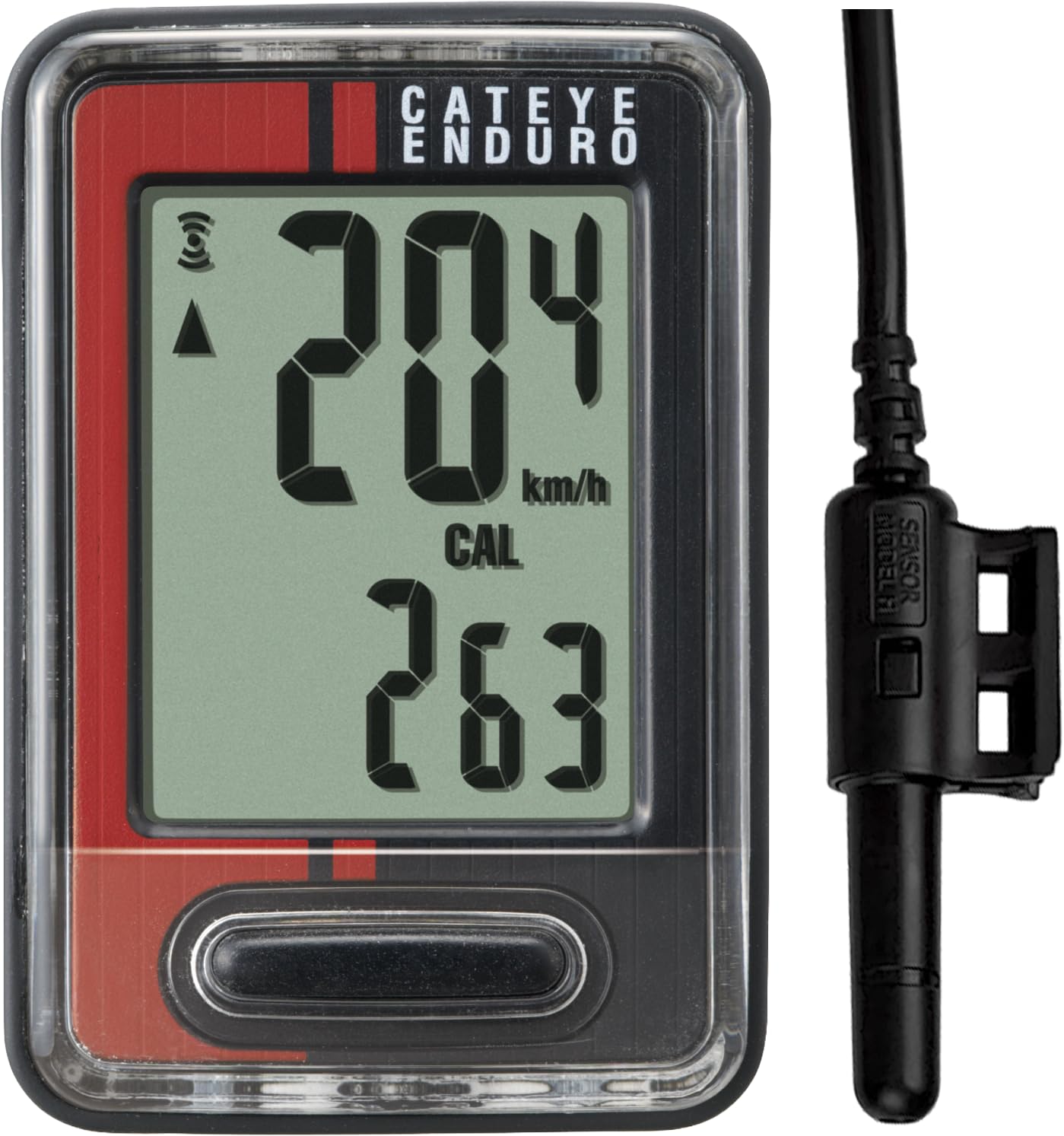
What wins people over here is the sheer endurance of the battery. The CATEYE runs for three years on one cell — a big jump over some competitors that need a fresh battery every 12 months. That means you mount it, set the wheel size once, and stop thinking about power entirely. It tracks current, max, and average speed, plus total distance, trip distance, elapsed time, calories, carbon offset, and the clock — all through a single front-facing button. The auto start/stop function pauses the timer whenever you stop, so your average speed number stays accurate through coffee breaks and red lights.
The wired nature does bring one trade-off. The cable is on the shorter side, which can be a problem if you need to run it to a rear wheel on a stationary or recumbent bike. For a standard front-wheel installation on a road, mountain, or gravel bike, it is straightforward — the included wire sheath and zip-ties keep everything tidy along the fork. Buyers report the computer works perfectly on typical bikes under 50 mph, with one owner noting it is “great and easy to set up and use once you understand the manual.” The crowd favorite across 66 ratings gives it a 4.5 average, with functionality earning the most praise by a wide margin — riders simply want speed and distance that does not lie, and this delivers.
What Riders Love Most
- Three-year battery life — install and forget about power for seasons.
- One-button toggle keeps the interface dead simple, even with gloves on.
- Heavy-duty wire stands up to off-road vibration and trail grit.
The Real Caveat
- Short wire makes rear-wheel or stationary-bike installation tight — measure your frame first.
- Durability has mixed feedback; a small number of units show issues around the four-year mark.
Reach for this if: you want a set-and-forget speedometer that runs for years and does not need smartphone pairing, navigation menus, or battery swaps mid-season.
Think twice if: your bike setup requires the sensor on the rear wheel — the cable length may not reach without extra work.
2. Planet Bike Protégé 9.0 Wired Bike Computer

A buttonless computer that swaps tactile pokes for a gentle nudge — and adds temperature data.
The Protégé 9.0 is the cleverest design of the three. Instead of physical buttons, you push the whole unit forward in its bracket to cycle through the bottom row of data. That means no tiny rubber membrane to fail, no accidental mode-switches when you hit a bump. The four-line LCD shows five data fields at a glance, including outside temperature — a feature you won’t find on the other two picks here. The display is notably large at 2.5 by 2 inches, making it easy to read while you are bouncing over chipseal.
Performance is consistent across the board. Verified owners mention it performed well on a 30-mile ride and found it accurate compared to a phone GPS. A long-time user who replaced a 15-year-old Protégé 5.0 praised the upgrade to temperature and average/max speed readouts. The wired harness is described as durable and weatherproof, so it shrugs off rain without losing signal. The main knock is a lack of color choice — it only ships in white — and durability reports show some units last 2-3 years before needing replacement. At 4.5 stars from 30 ratings, it earns a near-perfect score from a smaller but genuinely satisfied owner pool.
Standout Features
- Buttonless operation — nudge the computer forward to change screens, no switch to break.
- Temperature readout is rare at this price tier and genuinely useful for cold-weather ride planning.
- Large, high-contrast 4-line display shows speed, pace arrow, time, and distance all at once.
One Thing to Know
- Battery life is 30 hours — far shorter than the CATEYE’s multi-year span, so keep a spare lithium cell in your saddle bag.
- Only available in white, which may not match every handlebar setup.
Go for this if: you want temperature data and a large, easy-glance display without fumbling for buttons during a ride.
skip it if: you want a multi-year battery; the 30-hour lithium life means a replacement every season or two.
3. Planet Bike Protege 8.0 8-Function Bike Computer

The budget pick that has quietly logged over 800 miles for thousands of riders without complaint.
This is the wired computer with the deepest history. The Protegé 8.0 has been a staple for years, and the owner community is vocal about one thing — it simply works. Riders report it working reliably for over 800 miles, with odometer readings matching within 0.02 miles over a 15-to-20-mile ride. It uses a 4-line MacroMonitor LCD that shows up to five data fields at once, including current speed, a speed comparator arrow, ride time, trip distance, and a dual odometer that lets you store two wheel sizes (useful if you swap between road and trainer wheels). The heavy-duty wire harness is weatherproof, and the mount fits handlebars from 25 mm to 31.8 mm.
Where this pick really stands out is sheer value density. It earns high marks for reliability, ease of use, and value for money — the three aspects owners praise most. Buyers describe it as “solid performer” and note they have bought multiple units over the years for family bikes. The main downsides are a slide-button mechanism that can accidentally clear trip data, and a battery life of roughly one year (compared to the CATEYE’s three-year span). The display updates every three seconds rather than instantly, which is fine for cruising but feels laggy if you are sprinting. With a 4.2 average from 119 ratings, it has a bigger owner base than either the CATEYE or the Protégé 9.0, making it the most-widely-tested wired computer of the three.
Why Owners Keep Buying It
- Dual odometer stores two wheel sizes — swap between road bike and trainer without re-pairing.
- Multi-line screen shows speed, time, distance, and average pace all at the same time.
- Weatherproof wired harness sheds rain and road spray without signal loss.
The Honest Trade-Offs
- Slide-button design can wipe trip data if you bump it the wrong way during a ride.
- One-year battery life means more frequent replacements than the category-leading CATEYE.
Best for: the budget-conscious rider who wants a proven, widely-tested wired computer and does not mind changing a battery once a year.
Look elsewhere if: you want a multi-year battery span or a buttonless interface — the CATEYE or Protégé 9.0 will serve you longer between swaps.
Understanding the Specs
Battery Span (Years)
This is the number you care about most in a wired computer because there is no charging cable or battery door to fuss with daily. A unit rated for three years (like the CATEYE) basically runs on autopilot through hundreds of rides. A unit rated for one year means you will likely switch it out during a spring tune-up or when the display starts dimming. Always check this number before you buy — it is the real measure of how “set and forget” a wired computer really is.
Display Layout (Lines)
A single-line display cycles through one data field at a time — you push a button to see speed, push again for distance, push again for time. A multi-line screen (4 lines, as found on both Planet Bike models) shows several fields simultaneously, so you can glance down and see your current pace and ride time and clock all in one look. For riders who want a dashboard-style readout, more lines are always better.
FAQ
Will a wired bike computer work on a mountain bike with suspension?
How does the auto start/stop feature work?
Can I use a wired computer on a stationary or exercise bike?
How long do the batteries last in a wired bike computer?
Is a wired computer more accurate than a wireless or GPS computer?
Will the wire get in the way during a ride or crash?
What handlebar sizes do these computers fit?
Can I switch a wired computer between multiple bikes?
What happens to my odometer reading when I change the battery?
Final Thoughts: The Verdict
For most riders, the best wired bike computer is the CATEYE Wired Bike Computer because it delivers the longest battery span in the category — three years of riding without a single power concern — plus a full set of training stats and a simple one-button interface. If you want temperature data and a buttonless, large-screen display, grab the Planet Bike Protégé 9.0. And for a budget-friendly workhorse with a proven track record across more than a hundred owners, the Planet Bike Protege 8.0 is the one to reach for.
How We Picked
We do not accept paid placement. Every pick is matched to a real buyer and a real use-case; we do not hands-on test units.
Sources & Methodology
Specifications: manufacturer listings and product documentation. Review insights: verified customer reviews, as of July 2026. Pricing: not shown on this page (it changes often); check the current price via the retailer link.
As an Amazon Associate, Calories Fit earns from qualifying purchases. This does not affect which products we feature.