
Our readers keep the lights on and the coffee maker working hard! As an Amazon Associate, I earn from qualifying purchases.
Specs are compiled from manufacturer listings and verified buyer reviews and can change over time — please confirm the key details on the product page before buying.
Sleeping warm on frozen ground isn’t about the thickness of your bag—it’s about the pad underneath you. A winter sleeping pad has one job: stop your body heat from sinking into the earth, and the number that tells you how well it does that is the R-value. This guide cuts through the marketing to show you which insulated pads genuinely hold up in the cold, from car-campers’ plush bases to ultralight backcountry heroes.
I’m Mohammad — the founder and writer behind Calories Fit. This guide is built by comparing the manufacturers’ published specifications and the patterns across verified customer reviews, so you get each pick’s real strengths and trade-offs instead of marketing spin.
Because real cold demands real insulation, we’ve ranked the best winter sleeping pad options by their certified R-value, weight, and owner-reported warmth so you can sleep soundly in any freeze.
Our Picks at a Glance

How To Choose The Best Winter Sleeping Pad
Before you buy a winter sleeping pad, ask yourself three things: how cold will it actually get, how far will you carry it, and do you want plush comfort or featherweight packability? Your answers will quickly narrow the field.
R-Value: The Number That Actually Keeps You Warm
R-value measures how well the pad resists heat loss to the ground—the higher the number, the warmer you stay. For true winter camping you want an R-value of 4 or above; serious freeze conditions call for 6 or higher. Don’t trust a pad’s “4-season” label without checking this number.
Weight vs. Comfort: Know Your Camping Style
Car campers can haul a 4-pound plush pad that feels like a real bed. Backpackers need to shave every ounce, so a 1.5-pound pad with less cushioning becomes the better trade. Be honest about how you actually camp before you commit.
Inflation Method: Set Up Speed in the Cold
Self-inflating pads use foam that expands on its own, while air pads need either breath or a pump sack. In freezing temperatures, blowing up a pad by mouth introduces moisture and takes energy—look for a pump sack or easy valve to save your breath for the trail.
Quick Comparison
| Model | Best For | R-Value | Weight | Thickness | Amazon |
|---|---|---|---|---|---|
| Therm-a-Rest Basecamp★ Best Overall | Car Camping Comfort | 6 | 3 lb 6 oz | 2 in | Amazon |
| Elegear 4″ ThickBest Value | Extreme Cold Value | 9 | 2.2 lbs | 4 in | Amazon |
| Therm-a-Rest NeoAir Xlite NXTPremium Pick | Ultralight Backpacking | 4.5 | 11.5 oz | 3 in | Amazon |
| KLYMIT Insulated Static V Lite | Budget Backpacking | 4.4 | 20 oz | 2.5 in | Amazon |
| Hikenture 6.2R | Ultralight Warmth | 6.2 | 1.53 lb | 3.2 in | Amazon |
| Naturehike 27oz | Lightweight Value | 4.6 | 27.2 oz | 3.2 in | Amazon |
| Naturehike 20oz | Side Sleeper Support | 6.5 | 26.5 oz | 3.94 in | Amazon |
| KingCamp Hybrid Foam | Plush Car Camping | 4.9 | 4.1 lbs | 4 in | Amazon |
| Big Agnes Rapide SL | Backcountry Comfort | 4.8 | — | 3.5 in | Amazon |
In‑Depth Reviews
1. Therm-a-Rest Basecamp Self-Inflating Camping Sleeping Pad
Our pick — 4.5★ from 850+ verified ratings; the strongest balance of quality and price.
The car-camping king that trades pack weight for a heavenly night’s sleep
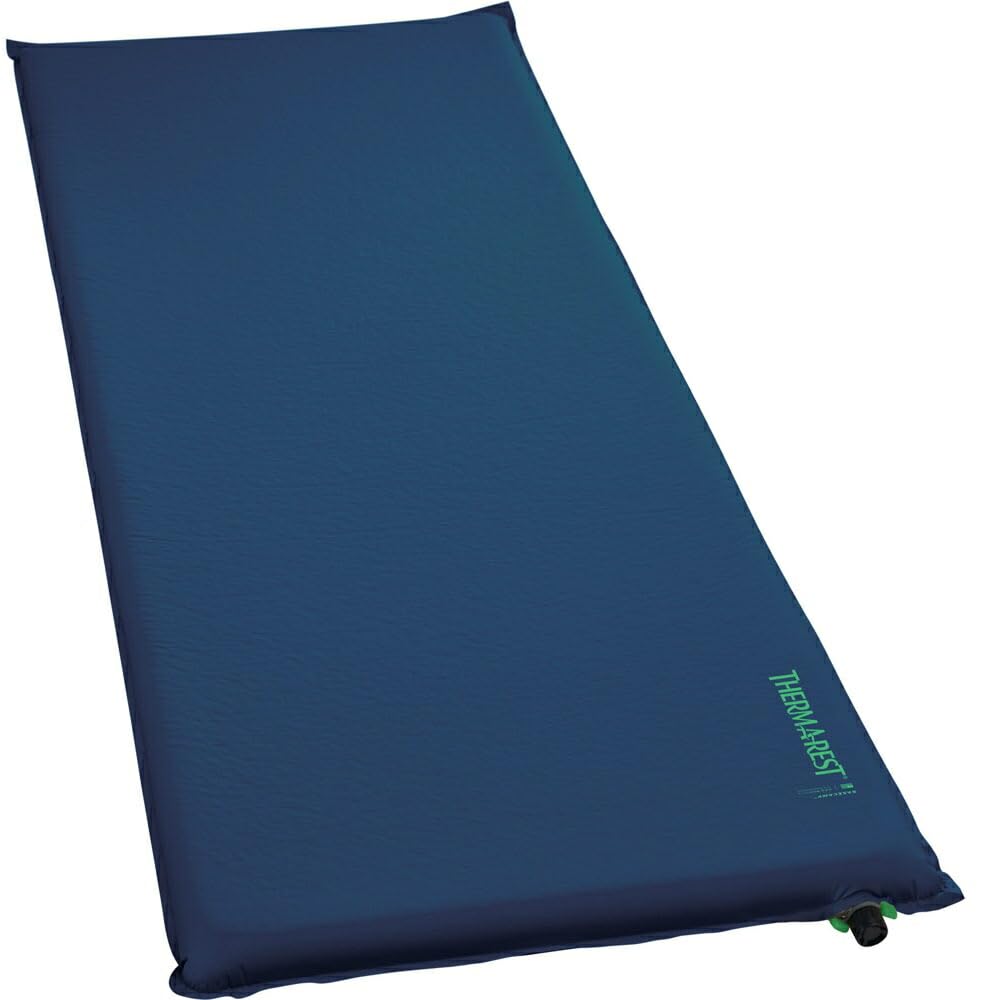
The Basecamp is the pick when you drive to camp and want to actually sleep, not just survive. It earns its “Best Overall” spot with a 6 R-value (meaning serious year-round insulation) and a self-inflating WingLock valve that fills the pad three times faster than a classic valve—so you’re not huffing and puffing in the cold. Owners describe it as “Big, bulky, Hefty weight, heavenly night’s sleep”, and that trade-off is exactly the point.
At 77x25x2 inches and 3 pounds 6 ounces, this is a generous bed for wiggly sleepers, and the thick thermal foam cushions side sleepers beautifully. Buyers report it’s so comfortable it replaces leaky air mattresses, and it’s “durable after 1yr/5 uses”. The honest catch: at that heft it’s not for backpacking—this is a basecamp or car-camping specialist, and the 1440-pound capacity means it handles heavy bodies without bottoming out.
Compared to the ultralight NeoAir Xlite NXT below, the Basecamp is the polar opposite—you trade 3 pounds of pack weight for plush, warm, dependable comfort. If you want the best sleep of your camping life and don’t mind carrying it from the car to the tent, this is it.
What Owners Love
- Comfort is the #1 praise — 33 owners call it out specifically
- Self-inflating WingLock valve sets up three times faster than classic valves
- Insulation gets frequent praise — 7 owners note how warm it stays
- Made in the USA with a stuff sack included
Honest Trade-Offs
- Heavy and bulky — at 3 lb 6 oz it’s strictly car-camping gear
- Inflation gets mixed reviews — 27 owners note it needs extra breaths for firmness
- Not designed for backpacking despite its 4-season capability
- Large size gets mixed feedback — some find it not wide enough
Reach for this if: you car-camp or “glamp” and want a warm, plush, dependable bed with zero pump hassle.
Look elsewhere if: you need to strap your pad to a backpack — at 3 lb 6 oz it will drag you down.
2. Elegear 4″ Thick Sleeping Pad with 9 R-Value
A certified 9 R-value that out-colds pads three times its price
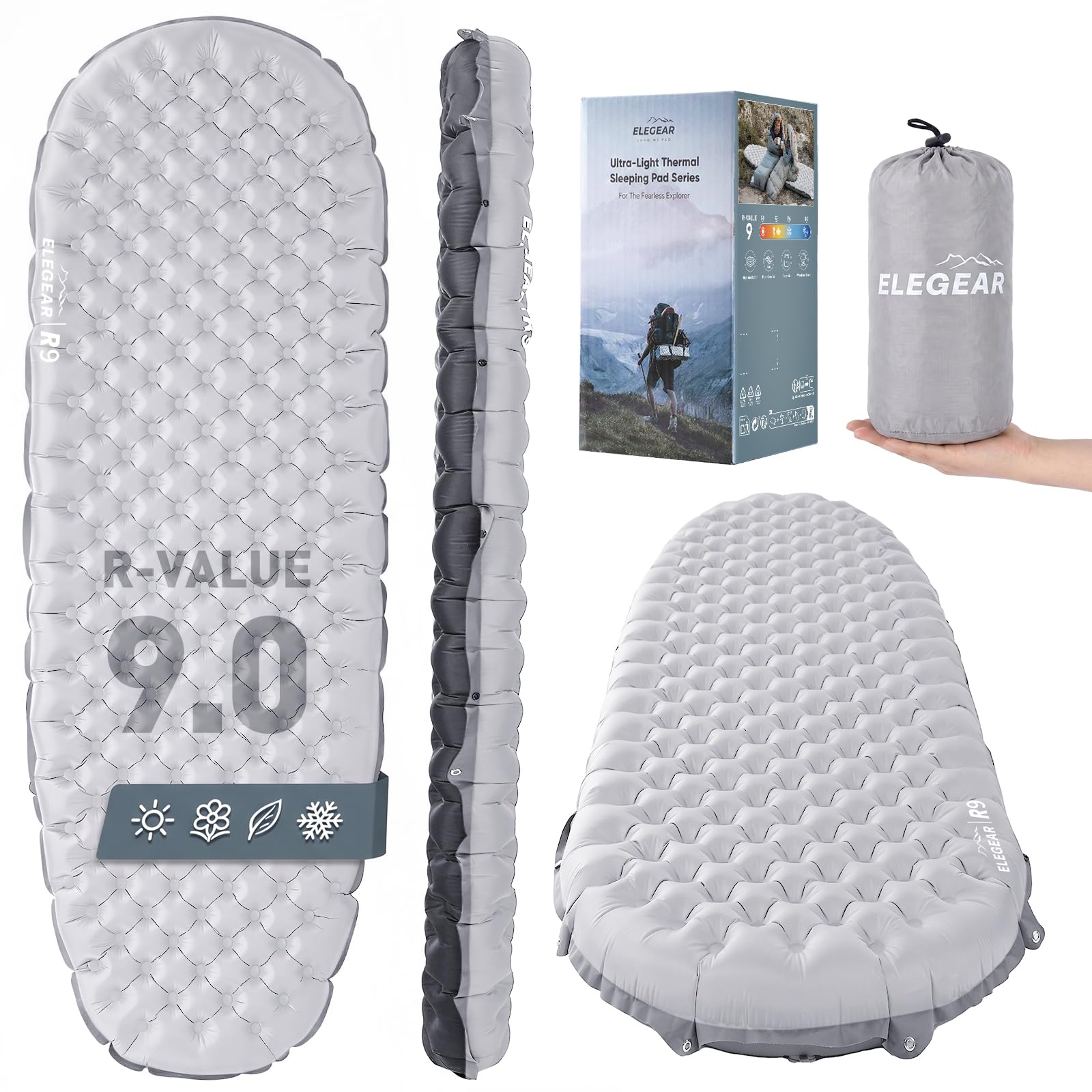
The Elegear delivers the highest certified R-value per dollar of any pad here. Its 9 R-value is independently SGS tested and ASTM F3340-22 certified, and it’s rated down to -40°C—double the insulation of the KLYMIT’s 4.4 R-value below. That’s double the insulation of the KLYMIT below, so it’s the pick for extreme cold.
Despite that extreme warmth, it weighs just 2.2 lbs and packs down compactly, with a pump sack that inflates it in only 4–6 pumps. The full 4-inch thickness uses densely distributed support cells to keep your hips and shoulders off the ground, even on rocky terrain. The 20D nylon and reinforced TPU layer resist abrasion and moisture for durable four-season use.
Owners confirm the warmth: one notes it “kept him so warm in 20 degree weather”, while another stayed warm with a single blanket on 50-degree nights. The gripes are minor—some find it a little heavier than expected, and one buyer noticed the surface feels like plastic rather than fabric. For the price, the certified R-value alone makes this a steal.
Why It Wins
- Comfort is the top praise — 14 owners single it out
- 9 R-value is SGS tested and ASTM certified for extreme cold
- 4-inch thickness beats standard 3.2-inch mats for cushioning
- Inflation is praised — 6 owners note the easy 4-6 pump setup
Know Before You Buy
- Weight gets mixed feedback — 7 owners find it heavier than expected
- Surface material reads as plastic to some buyers, not fabric
- Mummy shape saves space but feels narrower than rectangular pads
Grab it for: extreme cold, high-altitude camps, or anyone who wants certified -40°C protection without a premium price tag.
Think twice if: you want a wide rectangular sleeping surface — the mummy cut runs narrower.
3. Therm-a-Rest NeoAir Xlite NXT Ultralight Sleeping Pad
The 11.5-ounce backcountry legend that packs a 4.5 R-value punch
You get real warmth without the weight with the NeoAir Xlite NXT, the ultralight backpacking standard. At just 11.5 ounces (330 grams) in the regular size, it weighs a fraction of the Basecamp’s 3 lb 6 oz, yet its 4.5 R-value (a measure of insulation against heat loss) keeps you warm enough for year-round trips. The warmth comes from Reflective ThermaCapture technology (a layer that reflects your body heat) and Triangular Core Matrix construction (a pattern of triangular baffles that reduce heat loss).
The 3-inch baffled profile offers stable support, and the WingLock valve inflates and deflates quickly. The NXT version is notably quieter than the crinkly older models, and one owner found it “superior to Big Agnes Zoom UL” which had leaked. It holds air for 48+ hours despite its 11.5-ounce weight.
The honest trade-off is width: at 20 x 66 inches, some owners note their arms hang off the sides—”a little narrow though so my arms hung off the sides” is the recurring theme. It’s a deliberate trade for the pack weight, and the quality earns high marks across the board. This is the pad for thru-hikers and fast-movers who count every gram.
What Shines
- Quality is the #1 praise — 20 owners call it out
- 11.5 oz weight is class-leading for a 4.5 R-value insulated pad
- Quiet NXT version fixes the crinkly noise of older models
- Holds air 48+ hours with durable construction
Consider This
- Size gets mixed feedback — 11 owners find it narrow for side sleepers
- Price is premium territory; value reviews are divided
- Occasional quality control issues reported with valves
Choose it for: ultralight backpacking where every ounce counts and you still want genuine 4-season warmth.
skip it if: you’re a broad-shouldered side sleeper who needs width — the 20-inch cut runs slim.
4. Hikenture Camping Sleeping Pad with 6.2 R-Value
A 6.2 R-value in a 1.53-pound package that punches far above its tier
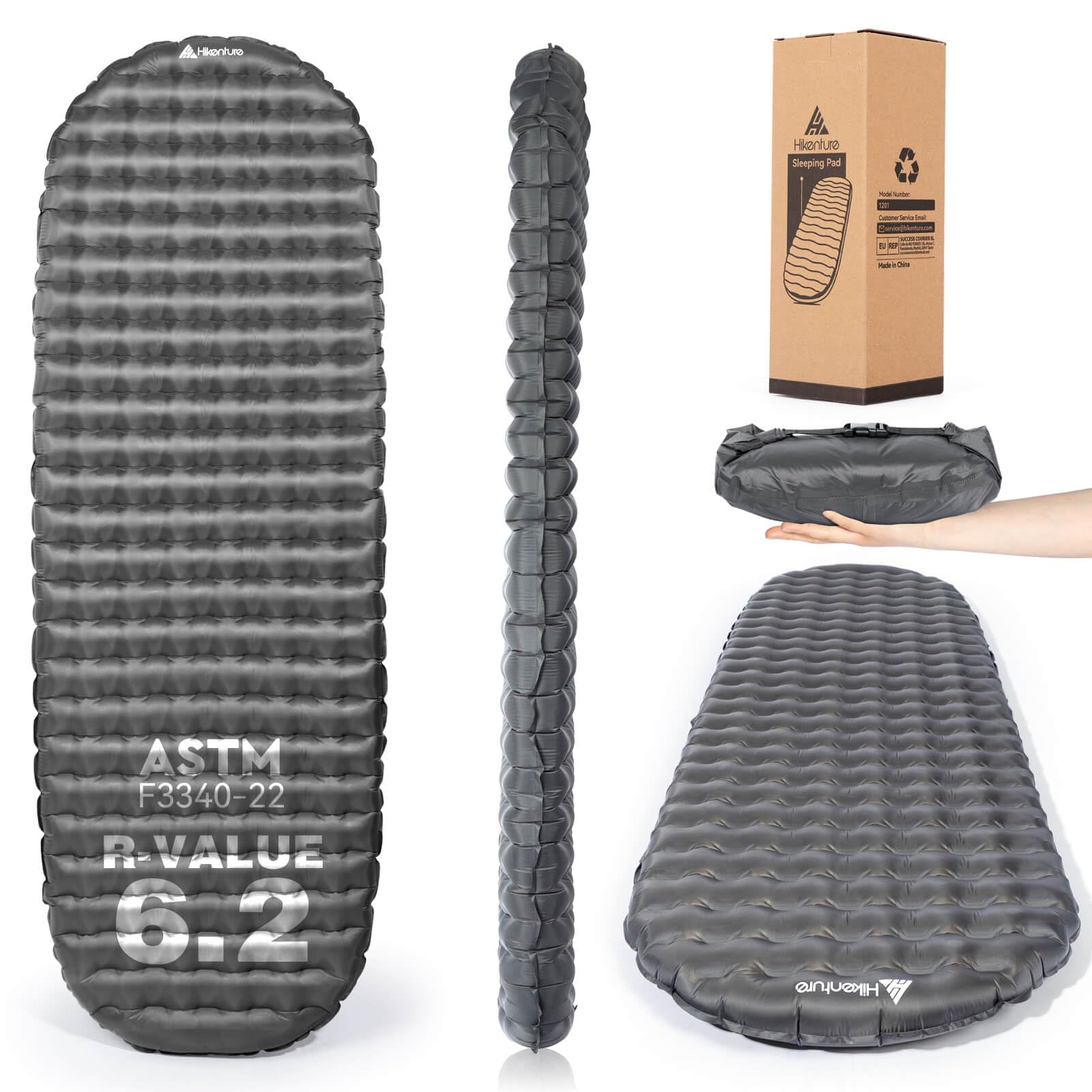
If you refuse to freeze, the Hikenture hits the balance. Its ASTM-tested 6.2 R-value (tested to F3340-22 standards, a standardized method for measuring insulation) uses an aluminum film layer that reflects your body heat back at you, yet the whole pad weighs just 1.53 pounds. Owners mention taking it down to 5°F with a 0° bag and staying warm—exceptional performance for the weight.
The 3.2-inch airbag structure distributes pressure evenly, preventing bottom-out even when sitting up. The 2-in-1 storage bag doubles as a 40L pump sack, inflating the mat in just 3 pumps. It also comes with two repair patches for trail mishaps, and the TPU liner is an eco-friendly choice.
What wins people over is the quality-per-pound ratio: 26 owners single out quality as the top aspect, with inflation close behind at 25. One owner noted it’s “wide enough for two sleeping opposite” and held air for two days. The recurring complaint is the crinkly noise when you move, and there’s a documented valve failure on a first backpacking trip—so treat the valve with care.
Why It Impresses
- Quality is the #1 praised aspect — 26 owners mention it
- Inflation is second — 25 owners love the 3-pump sack setup
- 6.2 R-value at 1.53 lb is exceptional warmth-to-weight
- 12-month warranty and two repair patches included
Know The Catch
- Noise is mixed — 13 owners note crinkly sounds when moving
- A documented valve failure left one owner on cold ground
- Air retention gets mixed feedback — 12 owners weigh in
Best for: backpackers who want 6+ R-value warmth without hauling a brick — the 1.53 lb weight is the draw.
Be careful if: you’re rough on gear — the valve is the weak point, so handle it gently.
5. Naturehike 27oz Ultralight Sleeping Pad, 4.6R

Packs to the size of a Nalgene bottle yet delivers consistent 4.6R warmth
The Naturehike 27oz is the definition of packable warmth. Its NKTR Air heat-reflective system uses a multi-layer composite aluminum mold to reduce heat loss to the ground, delivering a 4.6 R-value rated for temperatures above -4°F/-20°C. Owners describe it as packing “down to about the size of a nalgene”, which is remarkable for a pad with 3.2-inch thickness.
The eight-layer aluminum molded 3D insulation structure separates each air chamber to lock in warmth, and the perforated aluminum layer design cuts down on noise. At 27.2 oz (770g) with a storage volume of just Φ5.1 x 8.66 inches, it’s built for lightweight campers who still want cushioned support. The patented dual-vent valve means one-directional inflation with fast deflation when you open the inner air cover.
Comfort is what owners rave about most—43 of them single it out as the standout feature. One noted a sleep score of 80 versus their average 77, and another said a 6’4″, 240-pound sleeper doesn’t touch the ground. The pad inflates in about 4 big squeezes with the pump sack. The mixed feedback centers on noise (some find it incredibly noisy) and durability, so it’s not the pad for aggressive toss-and-turners.
What Stands Out
- Comfort is the top praise — 43 owners highlight it
- Value for money is second — 14 owners call it a bargain
- Packs to Nalgene-bottle size for easy backpack storage
- Inflates in ~4 squeezes with the included pump sack
The Trade-Offs
- Noise is split — 9 owners find it incredibly noisy, others quiet
- Durability gets mixed reviews — 8 owners question long-term wear
- 3.2-inch thickness is thinner than premium 4-inch rivals
Pick this for: minimalist backpackers who want a tiny, warm, comfortable pad that disappears in the pack.
Look past it if: you’re a restless sleeper — the crinkle factor gets mixed reviews.
6. Naturehike 20oz Ultralight Sleeping Pad with Sidewalls, 6.5R
Extra sidewalls and a 6.5 R-value keep big bodies warm and on the pad
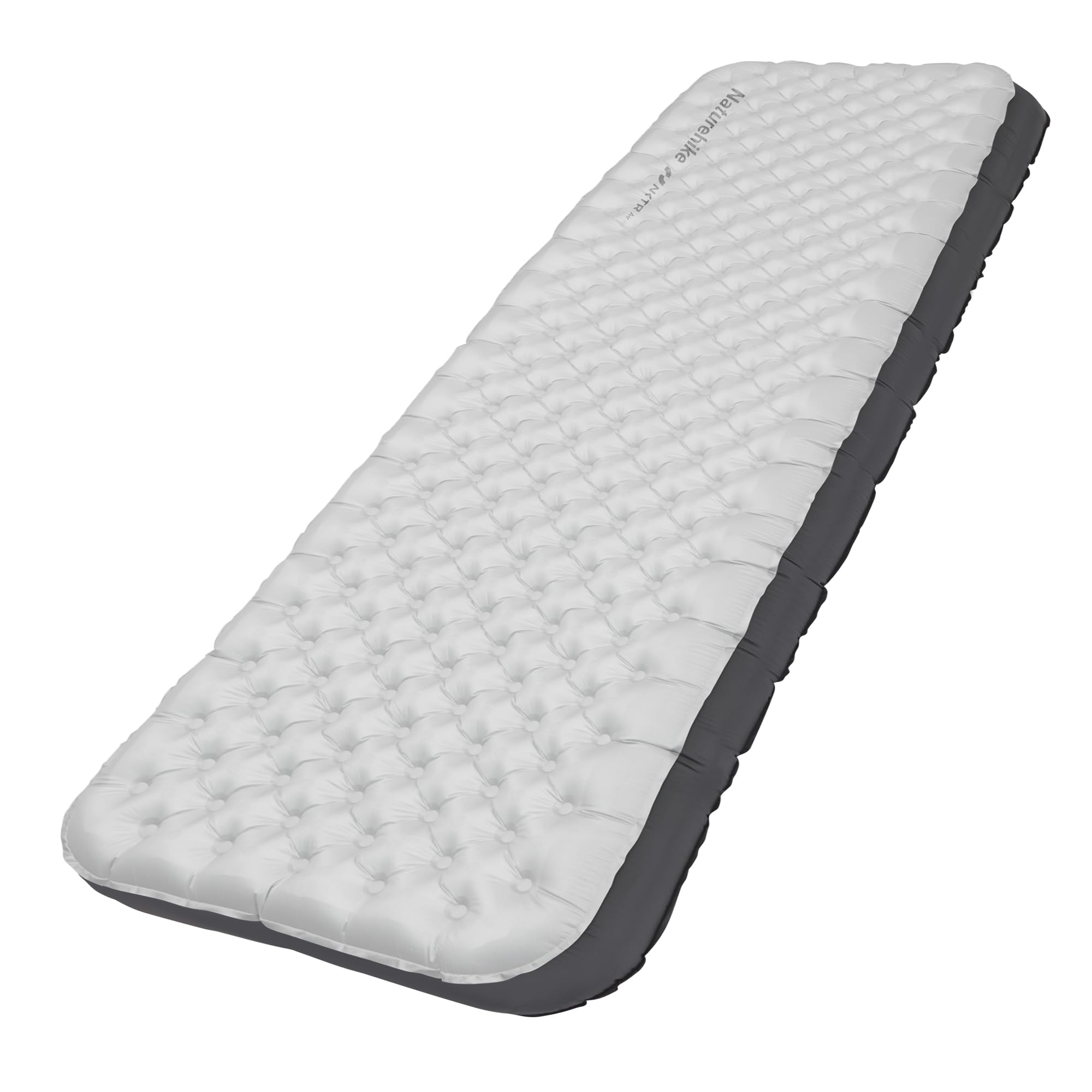
The Naturehike 20oz is the stronger sibling of the 27oz, trading a few ounces for serious cold protection and roll-off prevention. Its 6.5 R-value is rated for temperatures above -13°F/-25°C, and the 10cm (3.94-inch) thickened design delivers high resilience and shock absorption. The extra side walls are the standout feature—they minimize rolling off the pad during the night, which side sleepers will appreciate.
At just 26.5 oz (750g) and a PFAS-Free 20D nylon + TPU build, it packs to Φ5.1 x 8.7 inches. The punching point structure distributes pressure evenly, and the 77.2 x 25.2-inch size allows free turning. Customers note it’s “great for 6′ 350lb side sleeper; no hip/rib contact”, which is a strong endorsement for bigger bodies.
Setup is quick thanks to the dual-vent valve (two openings for faster inflation and deflation) and the included inflatable bag, and buyers praise the material quality for the price. One owner, however, found the middle sinks to the ground while the sides balloon—a stability issue worth noting. For most buyers, the warmth-to-weight ratio at 6.5 R-value is tough to top at this price.
Strong Points
- 6.5 R-value handles -13°F/-25°C conditions
- Extra sidewalls prevent rolling off at night
- 26.5 oz weight with PFAS-Free materials
- Packs tiny at Φ5.1 x 8.7 inches
Watch For
- One owner reported middle sinking with sides ballooning
- Durability unverified in early reviews
- Water-repellent only, not fully waterproof
Reach for it if: you’re a larger or restless sleeper who wants 6.5R warmth and sidewalls that keep you in place.
Test carefully if: you’re sensitive to pad stability — a few report uneven support.
7. KingCamp Hybrid Foam Camping Mattress, 4″ Thick
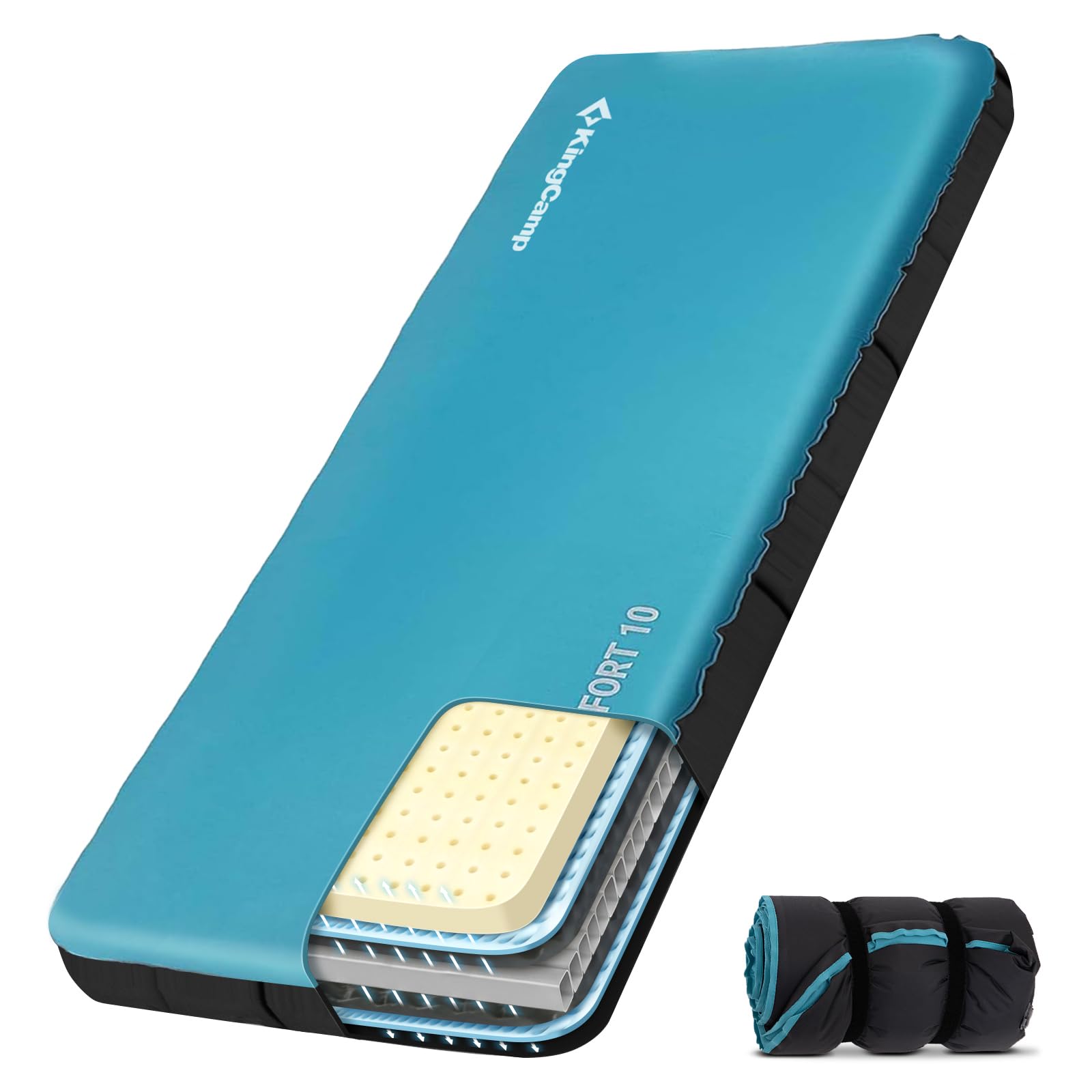
A whisper-quiet foam-and-air hybrid that feels like a real bed on the trail
The KingCamp Hybrid solves the two biggest inflatable-pad annoyances—noise and bottoming out—with a double-layer design. A sturdy air base sits under a 0.8-inch plush foam top, and the full 4-inch thickness conforms to your body so you never feel jagged rocks. The premium 50D polyurethane elastic cloth surface (a durable, stretchy fabric) stays whisper-quiet, so flipping over at 2 a.m. doesn’t sound like a potato chip bag.
At 4.1 lbs and rolling to φ23 x 33 cm, it’s heavier than the ultralight crowd, but owners say it’s ideal for motorcycle camping and car trips where comfort wins. The expected R-value of 4.9 covers four-season use, and the tear-resistant 240T pongee rhombus plaid TPU base handles rough terrain. The 2-in-1 double-layer air valve system prevents air leakage during inflation and deflates fast when opened fully.
Quality is the top praised aspect at 25 mentions, with comfort close behind at 21. Owners specifically call it “very comfortable and useful for anyone with bad backs” and praise the support on uneven ground. The foam absorbs water and dries slowly, and some find it doesn’t truly self-inflate—the “hybrid” name means you’ll still add breaths for firmness. One reviewer noted a pad that stopped holding air after the second use, so inspect it early.
Why It’s Loved
- Quality is the #1 praise — 25 owners single it out
- Comfort is second — 21 owners love the foam + air combo
- Whisper-quiet surface eliminates crinkling noise
- 4-inch thickness with foam top prevents bottoming out
Honest Limits
- Inflation is mixed — 18 owners note it doesn’t truly self-inflate
- Air retention has 8 negative mentions — test it early
- Foam absorbs water and dries slowly
- 4.1 lbs is heavy for backpacking
Buy it for: car camping, motorcycle trips, or anyone with back pain who wants a quiet, plush surface.
Pass if: you need to carry it deep into the backcountry — 4.1 lbs is a lot on your back.
8. Big Agnes Rapide SL Insulated Sleeping Pad

A quilted, cushioned sleeping surface with premium stability for backcountry nights
The Big Agnes Rapide SL brings a pillow-like feel to the backcountry with its quilted top that creates a cushioned, pillowy sleeping surface. Two layers of heat-reflective film deliver an R-value up to 4.8, making it a proper three-season backpacking pad that can stretch into cold shoulder seasons. The proprietary offset I-Beam construction cuts weight while keeping the pad stable.
At 3.5 inches thick with 4.25-inch larger outer chambers, it cradles you without the bouncy air-mattress feel—the outer chambers are engineered to keep you from rolling off. The superlight double ripstop nylon with aviation-grade TPU lamination offers durability and strong welds, and the high-volume valves with micro-adjustment let you fine-tune firmness to your liking. The included Pumphouse inflation sack fills the pad in seconds without introducing mouth moisture.
Buyers who took it to the Grand Canyon for a week-long backpacking trip call it “light, packable, and comfortable,” and a hunter found it “very comfortable and warm compared to my old Klymit static v.” The regular size measures 72 x 20 x 4.25 inches. One long-term user noted the baffle sewing “leaves alot of room for problems after prolonged use,” so durability over many seasons remains an open question. The lifetime quality guarantee against manufacturing defects adds confidence.
What’s Great
- Comfort is the top praise — 8 owners highlight it
- Sleeping quality is second — 7 reviewers point out better rest
- Quilted top and offset I-Beams prevent air-mattress bounce
- Pumphouse sack inflates in seconds without moisture
Consider Before Buying
- Baffle sewing may weaken with prolonged hard use
- 20-inch width runs narrow for broad-shouldered sleepers
- Premium price point for the R-value offered
Choose this for: backpackers who want a cushioned, stable, high-quality pad and plan multi-day trips.
Think twice if: you’re hard on gear over many seasons — the baffle construction is the long-term question.
9. KLYMIT Insulated Static V Lite Inflatable Sleeping Pad

The affordable, packable classic that’s most comfortable in any body position
The KLYMIT Static V Lite is the budget entry point into insulated winter sleeping, and it earns its place with a clever V-Chamber design that conforms to your body while limiting air movement. The Klymalite synthetic insulation fills those chambers, and at 20 oz packed it slips easily into any backpack. It measures 72 x 23 x 2.5 inches, making it a generous 7% larger than the Basecamp’s 77-inch length-to-width comparison in a lighter package.
The “Lite” in the name means real weight savings, but reviews reveal a catch. While the claimed R-value is 4.4, one owner who tested it in real conditions says it “felt cold at 40°F with zero-degree bag and extra layers” and suspects the real number is closer to 1.3, per a YouTube review. That’s a significant warning for true winter camping—this pad may be more of a 3-season pad with winter aspirations.
Owners praise it as “the most comfortable of 3 tested” and note it stays firm for a week, with 10-15 breaths to inflate and easy deflation. It’s also “boat-ready” per one sailor who used it for two weeks in Panama with water rolling right off. The recurring gripes: it runs narrow for some (one owner returned for the Lux version), and the flat valve is hard to inflate and repair if it leaks.
What’s Good
- Most comfortable of 3 pads tested per one owner
- 20 oz weight and 8 x 3-inch packed size are backpack-friendly
- Holds air firm for a week
- Waterproof build withstood a two-week sailboat trip
The Warning
- Real-world R-value questioned — felt cold at 40°F despite 4.4 claim
- Narrow fit for some sleepers
- Flat valve is hard to inflate and tough to repair
- 350-pound capacity is the lowest on this list
Grab it for: mild cold or 3-season camping where light weight and low cost matter more than extreme warmth.
Be skeptical if: you’re heading into genuine freezing conditions — the real-world insulation is questioned.
Understanding the Specs
R-Value
This number measures how well the pad resists heat loss to the ground—think of it as insulation rating. A higher R-value means you stay warmer in colder conditions. For winter camping, look for R-Value of 4 or above; for extreme cold, 6 or higher is the safe zone.
Weight and Packed Size
Weight is the great divide in sleeping pads. Car campers can afford 3-4 pound pads with plush foam, while backpackers need 20 ounces or less to keep their pack manageable. Packed size matters too—the Naturehike 27oz packs to the size of a Nalgene bottle, while the Therm-a-Rest Basecamp rolls to 26 x 7.5 inches. Match the weight to how far you’ll carry it.
Inflation Method
How a pad inflates affects both setup speed and your energy in cold weather. Self-inflating pads use foam that expands on their own but still need a few breaths. Air pads need a pump sack (like the Hikenture’s 3-pump system) or mouth inflation (10-15 breaths for the KLYMIT). In freezing air, mouth inflation introduces moisture—a pump sack is the smarter winter choice.
Insulation Type
Insulation comes in two forms: synthetic fill (like Klymalite or foam) that physically blocks cold, or heat-reflective layers (aluminum film) that bounce your body heat back. The best winter pads combine both—like the Elegear’s 9-layer system or Naturehike’s 8-layer aluminum molding. Foam hybrids like the KingCamp add cushioning but weigh more and absorb water.
FAQ
What R-value do I need for winter camping?
Can I use a 3-season pad in winter?
Is a self-inflating pad better than an air pad for winter?
What’s the difference between the Naturehike 27oz and 20oz pads?
How much weight does a winter sleeping pad add to my pack?
How do I inflate a pad in freezing temperatures?
Will a 4-inch thick pad prevent bottoming out on rocky ground?
How do I store a self-inflating pad for winter?
What’s the difference between the Therm-a-Rest Basecamp and NeoAir Xlite NXT?
How long do inflatable sleeping pads last?
Final Thoughts: The Verdict
For most campers, the winter sleeping pad winner is the Therm-a-Rest Basecamp because its 6 R-value, self-inflating convenience, and plush comfort make every cold night feel like a real bed. If you want certified extreme-cold protection at a value price, grab the Elegear 4″ with its 9 R-value. And for ultralight backpackers who count every ounce, the NeoAir Xlite NXT at 11.5 oz is the one to reach for. Whichever you choose, check the R-value against your coldest expected night—your sleep depends on it.
How We Picked
We do not accept paid placement. Every pick is matched to a real buyer and a real use-case; we do not hands-on test units.
Sources & Methodology
Specifications: manufacturer listings and product documentation. Review insights: verified customer reviews, as of August 2026. Pricing: not shown on this page (it changes often); check the current price via the retailer link.
As an Amazon Associate, Calories Fit earns from qualifying purchases. This does not affect which products we feature.