
Our readers keep the lights on and the coffee maker working hard! As an Amazon Associate, I earn from qualifying purchases.
Specs are compiled from manufacturer listings and verified buyer reviews and can change over time — please confirm the key details on the product page before buying.
You want to wake up warm, not shivering, when the temperature drops below freezing. A winter sleeping bag rated to 0°F or lower is the key to staying warm, and this guide ranks the ones that truly deliver.
I’m Mohammad — the founder and writer behind Calories Fit. This guide is built by comparing the manufacturers’ published specifications and the patterns across verified customer reviews, so you get each pick’s real strengths and trade-offs instead of marketing spin.
From military-grade systems to ultralight down mummies, the best winter sleeping bag for you depends on how you camp—here’s what actually keeps you warm.
Our Picks at a Glance


How To Choose The Best Winter Sleeping Bag
To pick your bag, ask yourself three things: how cold will it get, how are you carrying it, and what’s your body type. Answering these honestly prevents both freezing nights and wasted money on an overbuilt bag.
Temperature ratings: comfort vs. limit vs. extreme
The number on a bag isn’t a promise you’ll be toasty at that temp—it’s usually the limit rating, meaning you’ll survive but likely shiver. For a restful night, look for a bag whose comfort rating (typically 15-20°F higher) matches the coldest temps you expect. If you sleep cold, add a liner or wear layers.
Down vs. synthetic insulation
Down (feathers) packs smaller, weighs less, and offers superior warmth-to-weight—but loses loft when wet. Synthetic (polyester) keeps insulating even damp, dries faster, and costs less, but is bulkier and heavier for the same warmth. For damp climates or budget buyers, synthetic wins; for weight-conscious backpackers, down is king.
Mummy vs. roomy fits
Mummy bags hug your body to minimize dead air space that your body heat must fill—the most efficient shape for cold. Roomy or rectangular bags let you stretch and roll over, but that extra space means more volume to heat. For winter, a mummy or semi-mummy shape with a snug hood and draft collar is the practical choice.
Quick Comparison
| Model | Best For | Temperature Rating | Fill Type | Weight | Amazon |
|---|---|---|---|---|---|
| Military Modular Sleep System★ Best Overall | Extreme-Cold & Budget Versatility | 50°F to -50°F | Down | ~10.8 lbs total | Amazon |
| Coleman North Rim 0°FBudget Champion | Simple Car Camping Warmth | 0°F | Polyester | 6.3 lbs | Amazon |
| TETON Sports ALTOSCompact Pick | Backpackers on a Budget | 0°F to 20°F options | Synthetic | 3.5 lbs | Amazon |
| ZOOOBELIVES AlpliveD1500 | Down Warmth on a Budget | Lower 10°F | Down (550+ fill) | 3.86 lbs | Amazon |
| TETON Sports Deer Hunter | Tall, Big Campers | 0°F | Polyester | 8.5 lbs | Amazon |
| Kelty Cosmic Synthetic | Proper Backpacking Warmth | 0°F | Synthetic | 4 lbs 6 oz | Amazon |
| Browning McKinley -30° | Base Camp & Extreme Cold | -30°F | Polyester (TechLoft) | 12.8 lbs | Amazon |
| QEZER 600 Fill (P7) | Lightweight Down Backpacking | 0°F | Down (600 fill) | 4.74 lbs | Amazon |
| QEZER 650 Fill (P8) | Spacious Ultralight Down | 0°F | Down (650 fill) | 4.54 lbs | Amazon |
In-Depth Reviews
1. Military Modular Sleep System 4 Piece with Goretex Bivy Cover
Our pick — over 4.5★ from 850+ verified ratings; the strongest balance of quality and price.
A four-piece modular system that covers 50°F to -50°F for year-round use.
This is the rare winter setup that covers every season in one purchase. It includes a patrol bag (rated 30-50°F), an intermediate bag (rated -10-30°F), a waterproof Gore-Tex bivy cover, and a stuff sack—so you mix and match layers for everything from a crisp fall night to a -50°F deep freeze. The comfort range spans 50°F down to -50°F, which is broader than any single bag here.
The whole system weighs around 10.8 lbs, so it’s a truck, canoe, or base-camp bag rather than a backpacking one. Buyers report it’s the best value compared to commercial bags, arriving in better-than-described condition straight out of surplus. The quality is what wins people over—over 230 owners single out the build as the top praise, with warmth close behind at over 180 mentions.
The catch: this is heavy and not ultralight, and surplus pieces occasionally show minor cosmetic wear. Wash the bags before first use, and consider a spare compression sack since over-tightening can stress the buckles. For preppers or car campers wanting one system that does it all, this is the crowd favorite.
What wins people over
- Total warmth range from 50°F to -50°F
- Three layers combine via snaps for any condition
- Gore-Tex bivy is waterproof and breathable
- Better-than-described surplus condition reported
The honest trade-offs
- Roughly 10.8 lbs—too heavy for long hikes
- Surplus pieces may show minor wear or loose snaps
- Commercial compression sack recommended as a spare
Reach for this if: you want one budget-friendly system covering all four seasons without buying separate bags.
Look elsewhere if: you’re counting ounces for backcountry miles—this rides in a vehicle, not on your back.
2. Coleman North Rim 0°F Sleeping Bag
A budget mummy that delivers 0°F warmth without the premium price.
If you’re car camping or tent camping on a budget, this is the bag that delivers serious warmth without the serious cost. It’s rated to keep you comfortable down to 0°F, and owners mention sleeping warm in 14°F conditions on real trips—one camper had to unzip it a bit in the low 20s because it got too hot. That’s the Coleman told you it’d be.
You get solid build quality for the price: the Coletherm hollow polyester insulation (a synthetic fill with hollow fibers that trap heat) keeps you warmer with less weight, and the Thermolock draft tube blocks the zipper line where heat escapes. It fits campers up to 6 ft. 2 in., so you get a roomy mummy fit, and the adjustable hood lets you vent when you overheat. It’s machine washable and comes with a 5-year limited warranty.
The honest caveats: it’s heavy and bulky—buyers are unanimous that it’s not a backpacking bag. And the zipper, despite a no-snag label, is where a few owners reported snags or breakage. The warmth-to-price ratio, though, is the reason it stays on this list. If you drive to your campsite, this is the value pick.
The verdict: A 0°F-rated mummy that keeps you warm and doesn’t break the bank—buy it for car or tent camping, skip it for long hikes.
3. TETON Sports ALTOS Mummy Sleeping Bag
A 3.5 lb mummy that compresses small for backpacking trips.
At just 3.5 lbs, this bag is the clear answer for backpackers who want winter warmth without hauling a duffel. It packs to roughly 2/3 the size of comparable bags, and the included compression sack lets you cinch it even tighter—one owner notes it easily fits an internal frame 55L backpack. The 84″ x 32″ cut gives more shoulder and leg room than typical mummies, so it doesn’t feel like a body bag.
Customers note it gets “really hot quick,” staying comfortable down to about 20°F, though it’s too warm above 30°F unless you vent. The durability impresses too—one owner’s bag survived a thorough soaking on Mt. Fuji and dried well, keeping its loft. The beefy zipper and thick cushioning round out a bag that owners describe as excellent value.
The realistic downside: it’s a 0°F bag, not a -20°F bag. Below freezing with movement or cold-sleeping tendencies, you’ll want a hot water bottle or toe warmers to stay cozy. For spring, fall, and mild winter backpacking, this is the one to grab.
Why it’s a backpacking gem
- Just 3.5 lbs with a roomy mummy fit
- Packs to 2/3 size with compression sack
- Water-resistant shell dried well after a soaking
- Comfortable to 20°F for most sleepers
Who should think twice
- Cold sleepers need extra layers below 32°F
- Bulkier buckles than some competitors
Best for: the budget-minded backpacker who needs a 3.5 lb bag that compresses small.
Not for: deep-winter expeditions where -20°F ratings are required—this is a mild-winter bag.
4. ZOOOBELIVES AlpliveD1500 Down Mummy Bag

550+ fill down warmth at a price that typically buys synthetic.
This is the budget-friendly way to get genuine down insulation (feathers, which pack smaller and weigh less than synthetic) without paying premium prices. It’s filled with 35 oz of 550+ fill power down, giving a warmth range from a 32°F comfort temp down to a 10°F lower limit. That makes it a solid 3-season bag with winter potential when you add a good pad and layers.
The roomy mummy shape is a standout—it fits campers up to 6’4″ and 280 lbs, with an anatomic 3D foot box that keeps your feet from feeling cramped. The 20D ripstop nylon shell (a tightly-woven, tear-resistant fabric) and smooth YKK anti-snag zipper hold up to real outdoor use. Reviewers point out staying warm in the 30s°F while tent camping, including a rainy trip in Yellowstone where morning condensation dried quickly. The bag also zips together with a left/right version for couples.
The trade-offs are minor: it’s not an ultralight thru-hiking bag (around 3.86 lbs), it’s bulky to roll, and a few owners note a chemical smell on arrival that fades. But the warmth-to-value ratio is hard to argue with—comfortable down at a budget price is the headline here.
The take: Down insulation buyers on a budget get the best of both worlds—real 550 fill warmth without the premium markup.
5. TETON Sports Deer Hunter Sleeping Bag

A 90-inch canvas bag with roomy space for tall campers.
At 90″ x 39″ with a tough canvas shell, this bag is the answer for big and tall sleepers who find standard mummies too restrictive. A 6’3″, 210 lb owner reports having room to move around freely inside. The double-layer construction with zipper and shoulder draft tubes (insulated flaps that block drafts at the zipper line and your shoulders) keeps warmth in even in extreme cold, and the soft poly-flannel lining earns “Cloud” sleeping comparisons.
It’s rated to 0°F, and the water-resistant canvas shell shrugs off damp conditions better than most. Owners have used it at elk camp and in cold, rainy climates, praising the warmth. The zippers on each side allow easy access and temperature control—you can vent one side without letting all the heat out. The half-circle mummy-style hood with drawstrings seals in warmth around your head.
The downsides are real: at 8.5 lbs, it’s not for backpacking, and a few shoppers say the zipper needs a finger guard to avoid catching the liner. Some also note a chemical smell that requires airing out. But for truck or tent camping where size isn’t an issue, this is a genuinely warm, roomy bag.
Best for: tall or large campers who prioritize sleeping room over pack weight.
Skip if: you’re hiking to your site—8.5 lbs belongs in a vehicle.
6. Kelty Cosmic Synthetic 0° Bag
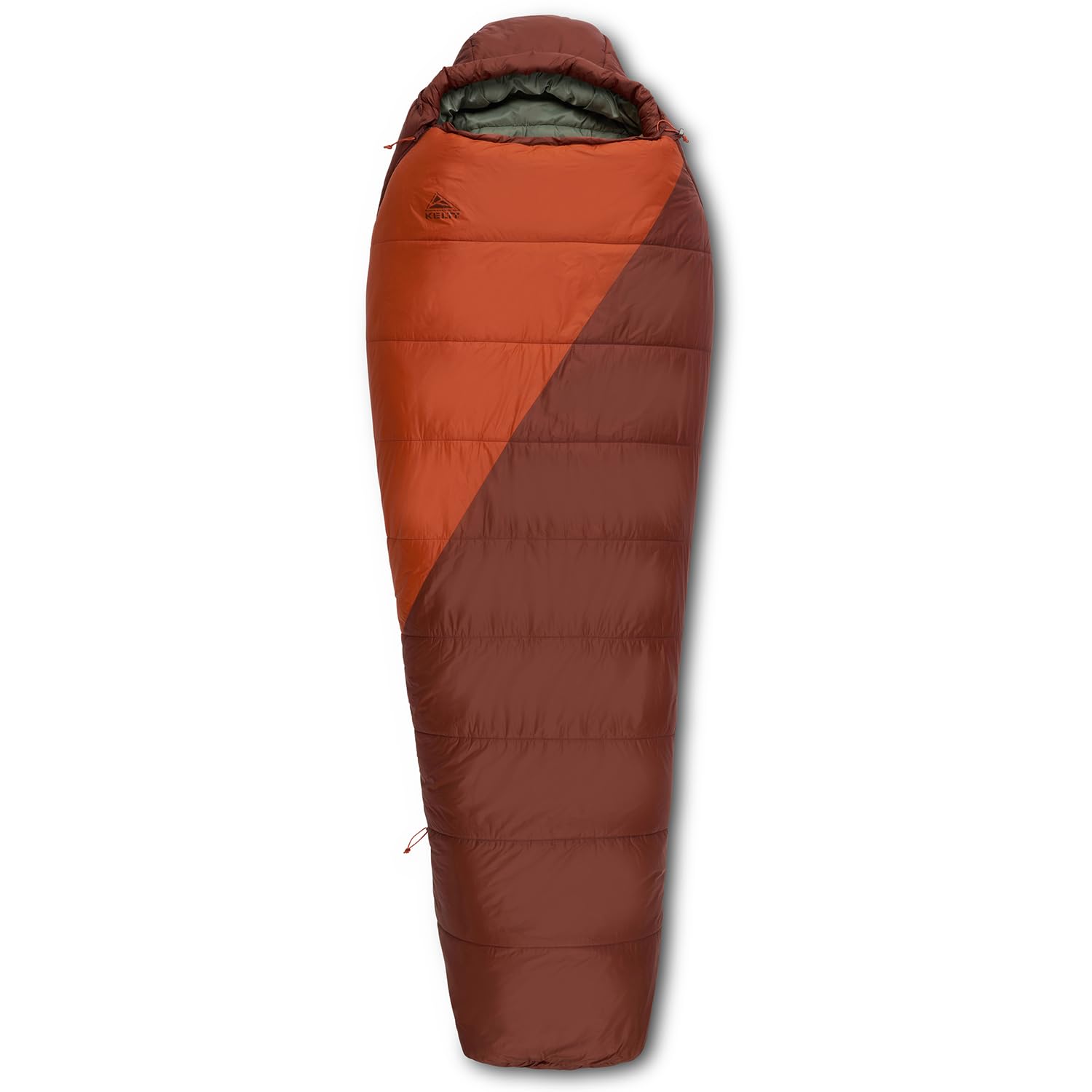
A 0°F synthetic that packs small and stays warm when damp.
Kelty’s Cosmic Synthetic hits the balance for backpackers: a 0°F rating that owners say keeps you alive at true zero, but with packability that synthetic bags rarely achieve. It weighs 4 lbs 6 oz in the regular size, and the integrated compression straps shrink it to 17 x 11 inches—approachable for real miles on your back.
The Cirroloft synthetic insulation (a polyester fill designed to maintain loft) provides reliable warmth in cold and damp conditions—the exact scenario where down fails. The natural fit with a spacious footbox gives your toes room to wiggle, and the exterior stash pocket keeps essentials close. Buyers report plenty of warmth in 20-degree weather, and the bag condenses down nicely into the included compression sack.
It’s note the zipper can snag a bit and feel cumbersome—a minor gripe that owners say doesn’t overshadow the warmth. It’s also definitely a cold-weather-only bag; even at low 40s°F it runs warm. For a 0°F synthetic that competes with down on packability, this is a strong pick.
What stands out
- 0°F rating with true sub-zero warmth per owners
- 4 lbs 6 oz with compression sack included
- Synthetic fill holds warmth even when damp
- Spacious footbox and exterior stash pocket
Minor notes
- Zipper snags and feels cumbersome at times
- Runs warm in mild weather—strictly a cold bag
Reach for it if: you need 0°F warmth you can actually carry into the backcountry.
Look elsewhere if: you want a bag for 3-season use—this one’s built for the cold.
7. Browning McKinley -30° Sleeping Bag

The -30°F monster that treats single-digit nights like a mild inconvenience.
This is the bag you bring when you expect brutal cold and want to sleep through it. Rated to -30°F, it’s the warmest non-military bag on this list, and the buyer feedback confirms it—a cold-sleeping 5’4″ owner stayed toasty in just pants and a tank top while others report cozy comfort at -8°F and -2°F. That’s Arctic-grade warmth for base camp.
The warmth comes from advanced TechLoft Silver insulation (a high-performance polyester fill) in a two-layer offset construction that eliminates cold spots. The 210T nylon diamond ripstop outer shell is tough, and the brushed polyester liner feels soft against the skin. At 90 x 36 inches, it’s roomy—buyers describe it as having the sleeping space of a twin mattress.
The massive trade-off is weight: 12.8 lbs. This is emphatically not a backpacking bag—owners say it takes up a car seat and compresses to about 1.5 times the size of older bags. It’s for truck camping, snowmobile trips, and base camps where you drive to the site. One owner warns the Velcro can shred the bag and recommends removing it immediately.
The verdict: If you drive to your campsite and want the warmest sleep possible in extreme cold, this is the bag—just don’t plan to carry it.
8. QEZER 600 Fill Down Mummy Bag
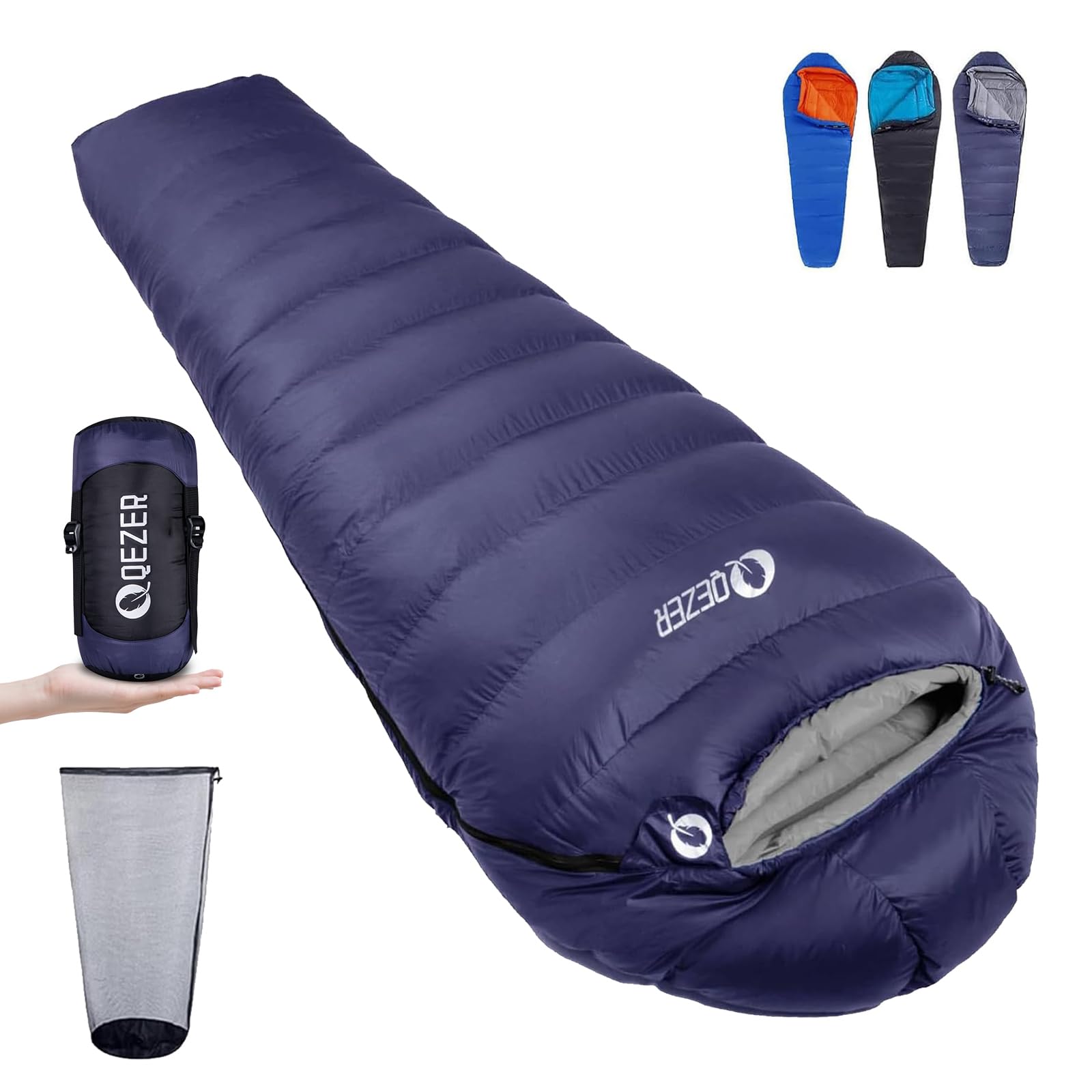
A 600-fill down mummy at 4.74 lbs that fluffs up warm in minutes.
This bag delivers real duck down warmth—3.3 lbs of 600 fill power down—in a lightweight package that’s about half the weight and volume of a comparable polyester bag. The comfortable temperature range is 0°F to 18°F, with a limit of -11°F, making it a genuine winter bag that compresses small enough for the trail. Owners confirm the warmth held through three months of tent camping across BC, Yukon, Alaska, Montana, and Wyoming.
The design features a snug mummy fit with a wide trapezoidal foot box (a foot area shaped like a trapezoid to prevent cramping), plus extra cotton at the chest for better thermal insulation. The 400T tear-resistant nylon fabric is ultra-high-density, which also prevents down from leaking out. Left and right zipper options let two bags zip together for couples, and the small inner pocket fits a phone.
The minor complaints: the inner mesh storage bag ripped on first use for one owner (the outer compression sack held up fine), and it’s a snug fit meant for warmer sleepers around 35°F and below. For a lightweight down bag that packs down smaller than a comparable Mountain Hardware model, this is solid value.
Why it earns its place
- 600 fill down at 4.74 lbs total weight
- Compresses smaller than a Mountain Hardware bag
- Comfortable down to 0°F, limit of -11°F
- Roomy enough for a 6’1″ sleeper
The small print
- Inner mesh sack ripped on first use for one owner
- Snug fit—not for restless sleepers who like to sprawl
Best for: backpackers who want real down warmth at 4.74 lbs without the premium brand markup.
Not for: those who prefer a roomy, loose fit—this is a snug mummy cut.
9. QEZER 650 Fill Down Mummy Bag
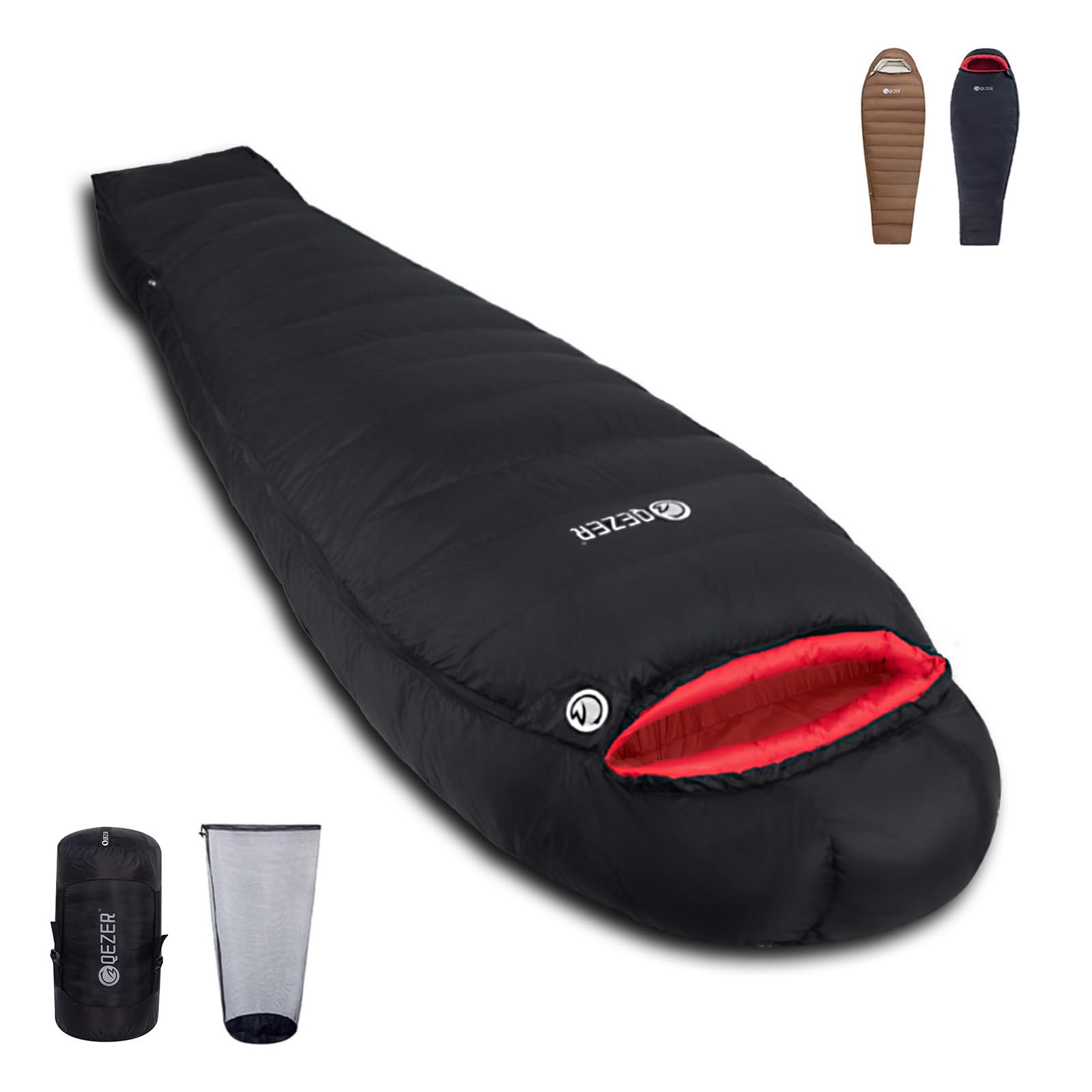
A 4.54 lb down bag with a saddle-shaped neck that locks in heat.
The upgrade on this QEZER is all about heat retention. The saddle-shaped neck (a curved, padded collar that wraps tightly around your neck) prevents heat loss at the top, while the ergonomic footbox gives your feet a natural, comfortable space. It’s rated to 0°F, and the buyer feedback is striking—one owner survived a -24°F Wisconsin winter night in a dome tent with body heat only. That’s a serious cold-weather pedigree.
At 4.54 lbs with a package size of 17.32″ x 10.24″, it’s ultralight enough for backpacking and the 650 fill power down (a higher-quality down that traps more warmth per ounce) keeps it compressible. The 88.58″ x 32.28″ cut is more spacious than many mummies, fitting campers up to 6’5″ comfortably—a 6’4″, 215 lb owner reports a great fit with room to spare. Owners also praise the material quality, noting it held up through 60 nights of use.
The honest caveats: the zipper quality is the recurring weak point, with some owners reporting occasional jams or breakage after several uses. And you’ll need an insulated sleeping pad underneath—that’s true of any down bag but worth repeating. For a spacious, lightweight down bag that’s survived real sub-zero conditions, this delivers.
The take: A spacious 4.54 lb down mummy with proven -24°F survival warmth—treat the zipper gently and it’ll serve you well.
Understanding the Specs
Temperature Ratings: Comfort vs. Limit
The number on the box is usually the limit rating—the temperature at which you’ll survive, not sleep comfortably. For a restful night, look for the comfort rating, which is typically 15-20°F higher than the limit. If you sleep cold, pick a bag rated 15°F colder than your expected conditions or bring a liner.
Fill Power: What It Means for Down
Fill power measures how many cubic inches one ounce of down occupies—higher numbers (600, 650, 800) mean more loft and warmth per ounce, so you need less weight. A 650 fill bag will be lighter and compress smaller than a 550 fill bag of the same warmth. Down is warmer for weight but loses loft when wet.
Draft Tubes and Collars
These are the unsung heroes of winter bags. A draft tube is an insulated flap running along the zipper that blocks cold air from seeping in through the zipper line. A draft collar is a padded tube that cinches around your neck and shoulders, preventing warm air from escaping out the top. Both are essential for keeping heat in on cold nights.
Shell Fabric: Denier and Ripstop
Shell durability is measured in denier (D)—the weight of the fabric. A 20D ripstop shell is lightweight and tear-resistant, great for backpacking. A 210T nylon diamond ripstop is heavier and tougher, built for base camp abuse. Higher numbers mean more durability and weight; lower numbers mean less weight and easier compression.
FAQ
What is the real difference between comfort and limit temperature ratings?
Is down or synthetic insulation better for winter camping?
How cold is too cold for a 0°F rated sleeping bag?
What does a 600 fill power down rating actually mean?
Will an 8.5 lb sleeping bag work for backpacking?
What is a bivy cover and do I need one?
How do I store a winter sleeping bag to keep its loft?
Can two sleeping bags be zipped together for couples?
What is a draft collar and why does it matter?
How many seasons can a 0°F bag cover?
Final Thoughts: The Verdict
For the majority of shoppers, the winter sleeping bag winner is the Military Modular Sleep System because one purchase covers every season from 50°F to -50°F—unbeatable versatility for the price. If you want a lightweight down option for backpacking, grab the Kelty Cosmic Synthetic for its 0°F warmth and packability. And for extreme cold car camping where weight doesn’t matter, the Browning McKinley -30° is the one to reach for.
How We Picked
We do not accept paid placement. Every pick is matched to a real buyer and a real use-case; we do not hands-on test units.
Sources & Methodology
Specifications: manufacturer listings and product documentation. Review insights: verified customer reviews, as of August 2026. Pricing: not shown on this page (it changes often); check the current price via the retailer link.
As an Amazon Associate, Calories Fit earns from qualifying purchases. This does not affect which products we feature.