
Our readers keep the lights on and the coffee maker working hard! As an Amazon Associate, I earn from qualifying purchases.
Specs are compiled from manufacturer listings and verified buyer reviews and can change over time — please confirm the key details on the product page before buying.
You need a bench that won’t wobble under heavy weight, and the picks here are judged on frame strength, position count, and buyer reports of stability over time. You’ll find clear choices for heavy lifters, tall lifters, space-savers, and budget-focused home gyms.
I’m Mohammad — the founder and writer behind Calories Fit. This guide is built by comparing the manufacturers’ published specifications and the patterns across verified customer reviews, so you get each pick’s real strengths and trade-offs instead of marketing spin.
We break down the best incline and decline workout bench options by weight capacity, adjustment range, and real-world stability so you can train with confidence.
Our Picks at a Glance

How To Choose The Best Incline and Decline Workout Bench
Most benches look the same in photos, but the differences show up in the first heavy set. The frame’s thickness, the width of the base, and how the backrest locks into each angle decide whether you get a stable platform or a shaky one.
Start with the weight capacity rating
The number printed on the box is the total the bench can support — your body weight plus the loaded bar. A heavier rating usually means a thicker steel frame and a wider base, which translates to less wobble even if you never come close to maxing it out.
Check the adjustment range, not just the count
Different benches list different numbers of backrest positions, but what matters is the angle range. You want a clear decline setting that drops below flat for sit-ups or decline presses, and a steep incline that lets you reach a nearly upright shoulder press position.
Consider how the seat and pad fit your height
The hinge point between the seat and the backrest is where most fit issues happen. Taller lifters sometimes find their hips land on the gap between the two pads. If you’re 6 feet or taller, look for a longer backrest and a headrest you can adjust.
Quick Comparison
| Model | Best For | Weight Capacity | Backrest Positions | Seat Adjustments | Amazon |
|---|---|---|---|---|---|
| pooboo 1500LBS★ Best Overall | Overall value and stability | 1,500 lbs | 8 | 3 | Amazon |
| TYRSEN 1200LBSTall Lifter Pick | Tall lifters needing headrest | 1,000 lbs | 8 | 3 | Amazon |
| HANDBOD 1500 lbValue Pick | Upright and steep incline work | 1,500 lbs | 7 | 3 | Amazon |
| MAJOR FITNESS | Zero-gap 90-degree angle | 1,300 lbs | 9 | 4 | Amazon |
| JOROTO MD80 | Wide pad for big users | 1,300 lbs | 7 | 2 | Amazon |
| JOROTO MD65Max | Removable foot catch | 1,500 lbs | 9 | 3 | Amazon |
| FLYBIRD | Competition-style 17.5″ height | 1,200 lbs | — | — | Amazon |
| HARISON Bench1000 | Leg extension and preacher pad | 1,000 lbs | 6 | 5 | Amazon |
| Keppi Bench3000 V2 | Full leg extension/curl attachment | 1,200 lbs | 12 | 3 | Amazon |
| Keppi Bench6000 | Serious lifters wanting 11+8 angles | 1,500 lbs | 11 | 8 | Amazon |
| RitFit 3-Section | Fine-tuned decline angles | 1,600 lbs | 10 | 3 | Amazon |
In‑Depth Reviews
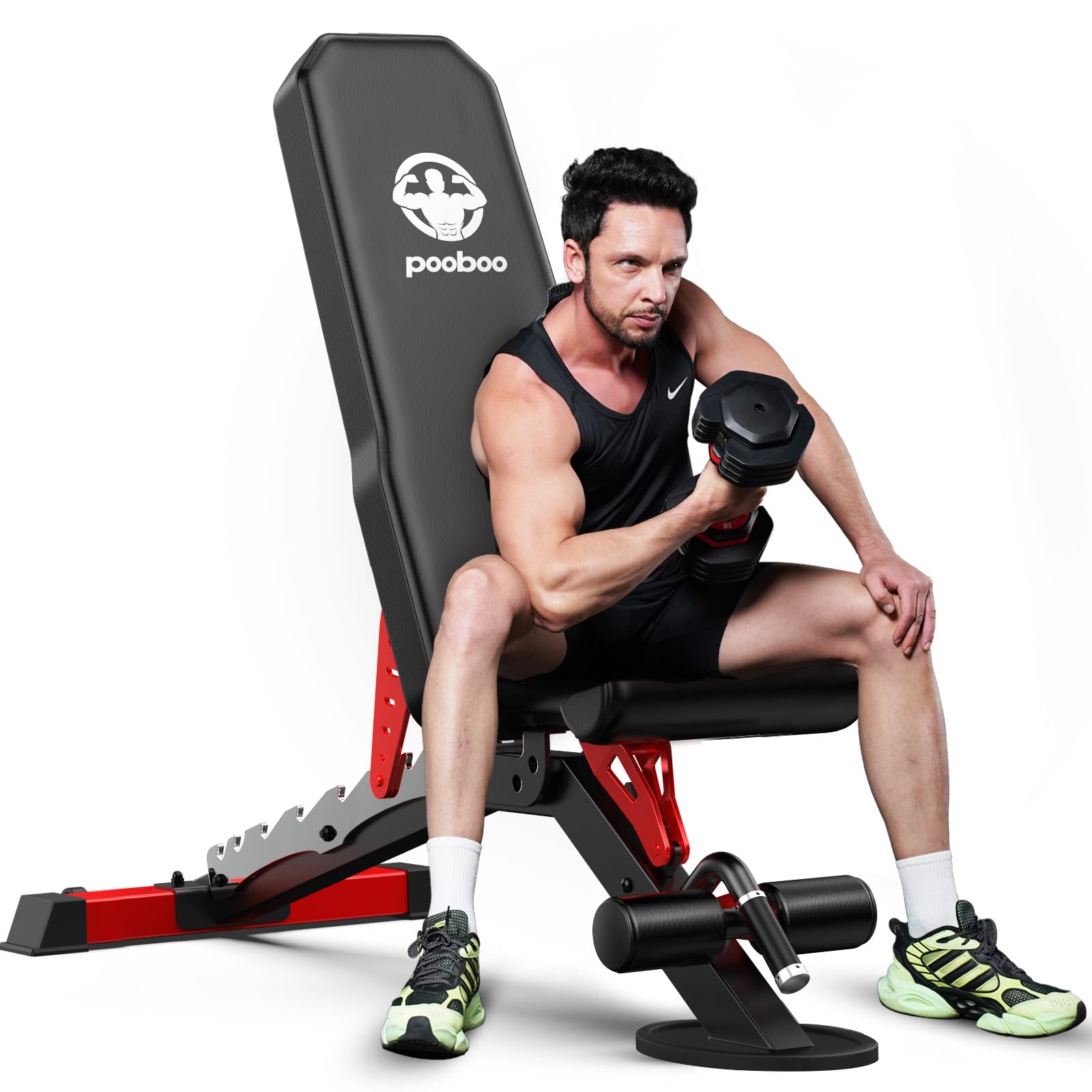
1. pooboo 1500LBS Adjustable Workout Bench
Our pick — over 4.5★ from 300+ verified ratings; the strongest balance of quality and price.
The crowd favorite that holds steady at 1,500 lbs, with 8 backrest positions to match.
Stability is the headline here. The commercial-grade square steel frame carries a 1,500-pound load capacity, and buyers repeatedly describe zero wobble even under heavy pressing. A triangular structure plus dual back supports attached to the main frame keep the platform planted on any surface, which is the core reason this is the best overall pick.
Adjustments are fast and tool-free. The C-shaped lock catch lets you push the backrest to your angle instead of pulling pins, and you get 8 backrest positions plus 3 seat settings to cover incline, flat, and decline work. The 2.5″ thick padding sits under a high-grade leather cover, with a 31.5″ backrest that keeps your waist and core stable during presses.
Assembly is genuinely short. It arrives 96% pre-assembled, and buyers report finishing the remaining steps in about 10 minutes using the numbered manual and video. The wheels and handle on the foot cushion make it easy to roll between rooms, and the 49.4-pound weight is manageable for one person to move.
The trade-off: some buyers found the padding slightly less firm than pricier benches, and one noted a small gap between the seat and backrest. A 220-lb lifter confirmed the frame stays durable and sturdy through regular use, which is the reassurance most home gym owners need.
What wins people over
- 1,500-lb capacity with a rock-solid, no-wobble frame
- 10-minute assembly thanks to 96% pre-built delivery
- Quick C-shaped lock adjustment on 8 backrest angles
Things to weigh
- Padding runs slightly softer than some prefer
- Small seat-to-back gap on certain settings
- Decline adjustment range is limited
Reach for this if: you want a proven, stable bench that handles heavy dumbbell and barbell work without breaking your back or your budget.
Look elsewhere if: you need a deep, precise decline angle or prefer an ultra-firm competition pad.
2. TYRSEN 1200LBS Adjustable Weight Bench Press
An adjustable headrest extends the pad to 36 inches for lifters up to 6’5″.
Height-adjustable headrests are rare at this price, and this is the defining reason to consider the TYRSEN. The backrest telescopes between 33″ and 36″ so taller athletes get support for both the back and the neck, which protects your spine during heavy presses. It’s a deliberate design choice that directly answers the “bench too short for my torso” complaint.
Beyond the headrest, the frame delivers a sturdy 1,000-pound capacity from commercial-grade widened square tube steel. The 23.6″ extra-wide base and anti-slip rubber caps keep it planted in lying, inclined, or declining positions. Buyers call the assembly straightforward, with the main body arriving pre-assembled, and they note the frame stays solid and wobble-free.
You get 8 backrest, 3 seat, and 3 leg positions, all locked by a thickened C-shaped latch instead of pin-pulling. The dual-bearing design is a clear step up from the wobbly pin-in-metal-tube adjustment you find on cheaper benches, and the 18″ height matches International Powerlifting Federation standards for proper leg drive.
The catch: a heavier lifter doing 300-350 lbs total reported that range is “pushing the limits,” and the cushions flex more than ideal against the frame. It’s a fit question, not a flaw — think of this as a stellar pick for tall, mid-weight lifters rather than a max-capacity power rack companion.
Best for the tall lifter: the 36″ extended backrest gives you head and neck support most benches skip entirely.
Think twice if: you regularly stack past 350 lbs, where the padded cushions start to show their flex.
3. HANDBOD 1500 lb Adjustable Weight Bench
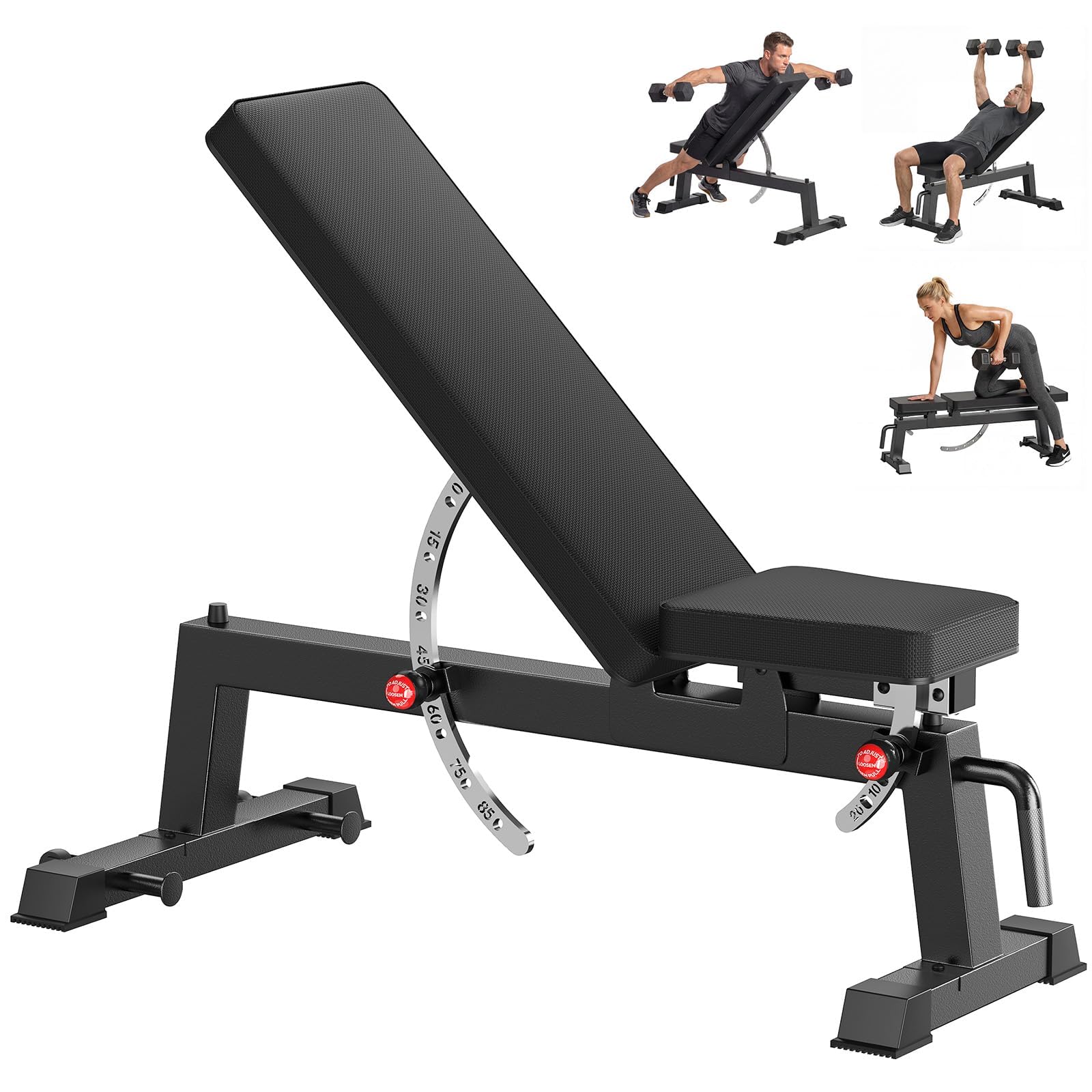
Seven backrest settings sweep from flat to a full 85-degree vertical press.
This is the bench for lifters who spend most of their session on incline and upright work. The 0 to 85-degree backrest range, paired with a seat that tilts from 0 to 20 degrees, gives you 21 position combinations that cover chest presses, shoulder presses, seated curls, and dumbbell rows in one compact frame.
The 1,500-pound rating comes from a reinforced frame of 1.5 mm square steel tubing, so the foundation is genuinely heavy-duty. Buyers describe the height as “nice,” the build as “very sturdy,” and the material as grippy enough that you won’t slide around mid-press. Assembly is quick, with one owner calling it “very easy to assemble.”
Comfort comes from 2.36 in quick-rebound foam under textured PU upholstery that wipes clean after sweaty sessions. The wheels and handle make it easy to tilt and roll into a corner, and the foldable design keeps floor space open between workouts.
One gripe to note: some units arrive with excess oil on the metal, which needs a 20-minute wash with dish detergent and leaves black marks on surfaces until cleaned. It’s an annoying first-day chore, but the performance after cleaning is exactly what owners expect.
Your pick if: shoulder presses and steep inclines are the backbone of your routine and you want 1,500 lbs of support.
Plan for: a quick oil wipe-down on delivery before the bench meets your floors.
4. MAJOR FITNESS 1300LBS Weight Bench
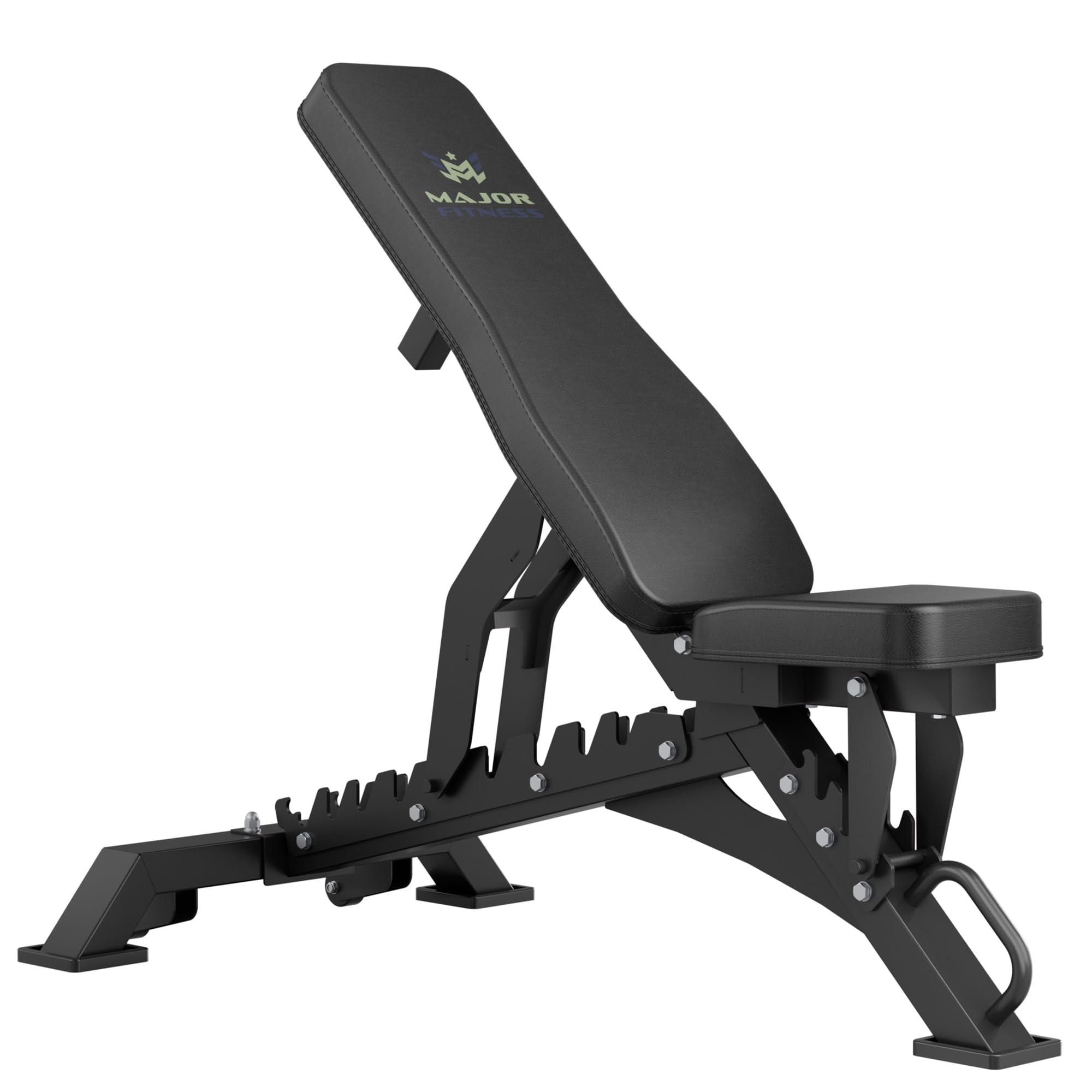
A 90-degree upright position and 4 seat angles make this the range king.
If you want the widest spread of angles, this is the one. The MAJOR FITNESS bench offers 9 backrest positions and 4 seat positions, and it’s one of the few that can hit a full 90-degree upright. That makes it an ideal incline bench for shoulder presses and ab work, plus decline and flat configurations for chest day.
The 1,300-pound capacity rests on a triangular structure built from commercial-grade square steel. A dual-track backrest support bar adds an extra layer of stability, and buyers verify it holds a 300-lb man plus loaded weight without a wobble. One owner even ran it through a 345-lb bench press with no flex.
Assembly is famously simple — owners mention it consists of just six bolts. The 2.5″ thick padding on a 31.5″ long backrest supports your head fully, and the PU leather cover resists water and wear. The extra handle and two wheels let you roll this bench wherever you need it.
Two honest notes: the cushion quality reads slightly lower than the frame’s, though it’s replaceable, and one tall buyer found the odd bench shape awkward for incline rows. A 6’2″ owner confirms it fits fine and remains stable, so height isn’t a dealbreaker for most.
Why it’s a range leader
- 90-degree upright angle for full shoulder press ROM
- 9 backrest and 4 seat positions to choose from
- Six-bolt assembly that buyers call straightforward
What to check
- Cushion quality trails the premium steel frame
- Unusual shape may not suit very broad or tall users
Choose it for: the widest angle variety, including a true 90-degree vertical press that most benches can’t reach.
skip it if: you expect competition-grade cushioning to match the tank-like frame.
5. JOROTO FID MD80 Adjustable Weight Bench
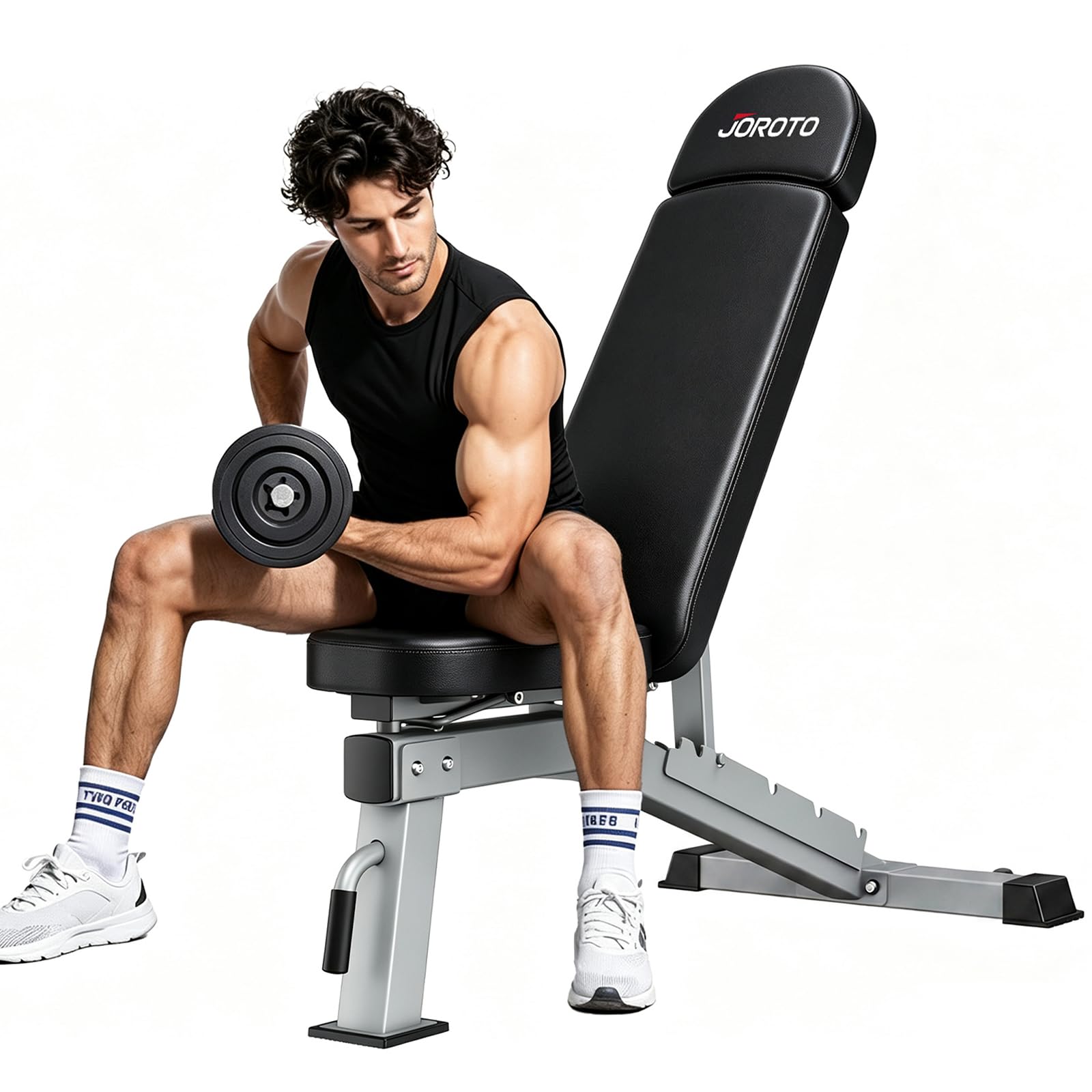
A widened backrest and thick pad give larger lifters room to press.
Bigger athletes often feel cramped on narrow competition benches, and this JOROTO addresses that directly. The widened backrest paired with high-density foam padding and sweat-resistant leather creates a platform that fits broad shoulders, and buyers confirm it handles body weights around 190 lbs plus barbell load without a hint of wobble.
The 1,300-pound safe capacity is built from high-grade alloy steel in a reinforced triangular design, load-tested to 1,500 lbs. It offers 7 backrest angles and 2 seat adjustments, covering flat, incline, decline, and upright positions that work with dumbbells, barbells, and power racks. The 17″ seat height suits most users and helps you drive through your legs.
Buyers describe the build as premium steel with tight welds and a thick, dense pad, and one long-term owner says it looks new after two years of use. Assembly is shockingly quick, with a 5-bolt setup, and the built-in transport wheels make moving it easy.
Two small quirks: there’s no footrest for decline work (though owners have workarounds), and the seat-to-backrest gap widens slightly when flat, though one 5’7″ owner found it unnoticeable. These are minor fit notes, not functional failures.
The wide-body pick: broad pads and a stable base make heavy pressing comfortable for bigger lifters.
Note the trade: you lose a proper footrest for decline sit-ups, so plan around it.
6. JOROTO FID MD65Max Weight Bench
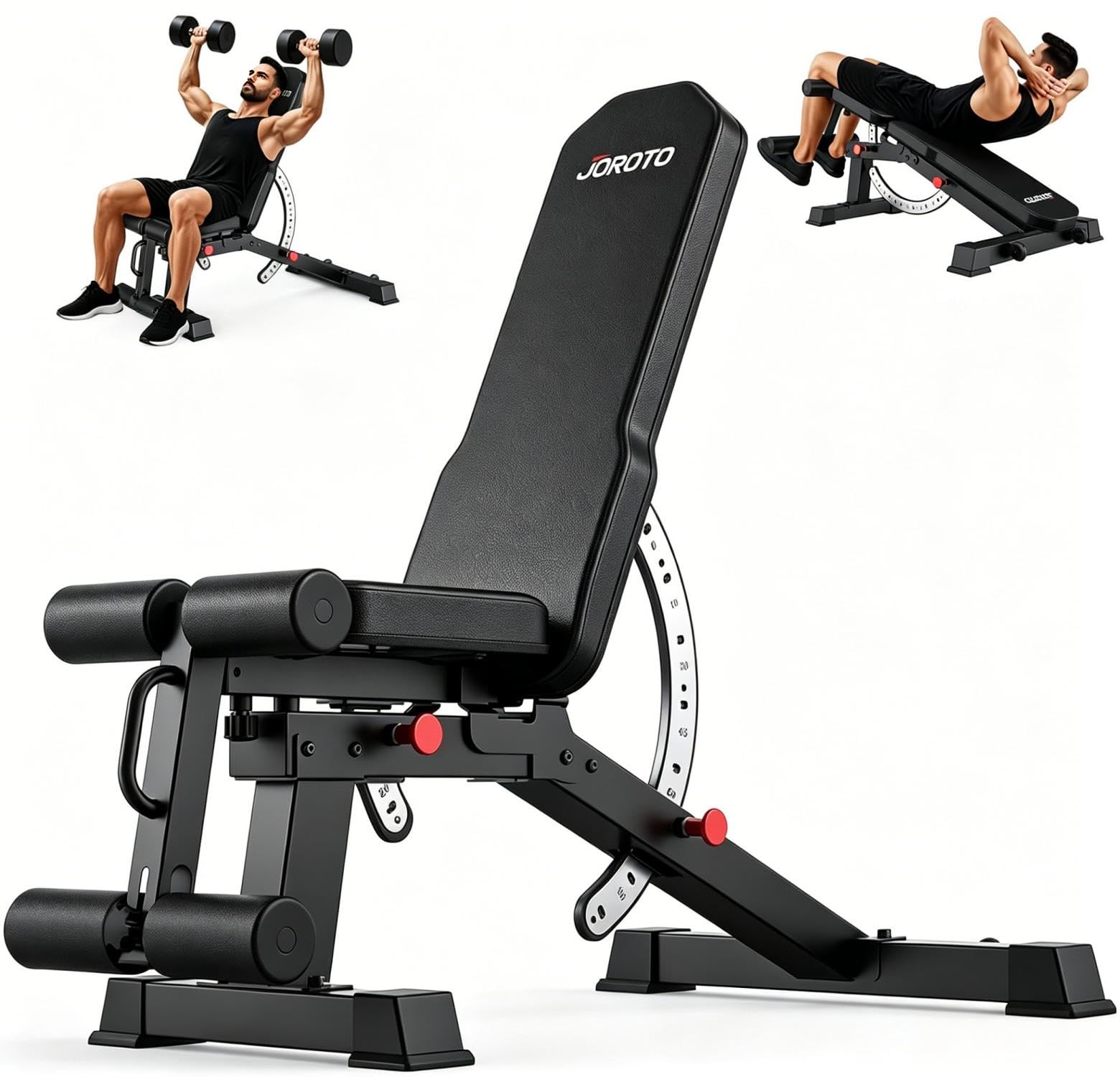
A fully detachable foot catch with soft foam rollers anchors decline presses.
Decline work is often an afterthought on adjustable benches, but this JOROTO makes it a specialty. The adjustable, detachable foot catch provides secure support during decline exercises, and the soft foam rollers reduce pressure on your legs and ankles. When you don’t need it, the whole assembly comes off for a cleaner flat bench.
Underneath, a 70mm reinforced steel frame with 1.5mm thick commercial-grade steel delivers a 1,500-pound capacity. The build is heavy-duty — customers note it stays stable and balanced during dumbbell presses, incline chest presses, and rows, though one honest owner notes it’s “not commercial grade but definitely heavy duty.”
You get 9 backrest and 3 seat adjustments, creating up to 27 combinations across incline, flat, and decline modes. The 40-pound frame rolls on built-in transport wheels with an ergonomic handle, and assembly takes about 10 minutes with the included tools and instructions.
The main fit caveat: a 6′ 245-lb owner found his hips landed in the gap between the seat and backrest because of the hinge position. That’s a real consideration for taller, heavier lifters. Also, the foam pads for foot support could be thicker, per one owner’s suggestion.
Built for decline days
- Adjustable detachable foot catch with soft rollers
- 1,500-lb capacity on a 70mm steel frame
- 9 backrest positions for 27 total combinations
Watch out for
- Seat-backrest gap can catch a 6′ lifter’s hips
- Foot support foam could be thicker
Pick this if: you want a dedicated, comfortable decline setup with a removable leg holder for flexibility.
Reconsider if: you’re 6 feet or taller and sensitive to seat hinge gaps.
7. FLYBIRD Adjustable Weight Bench
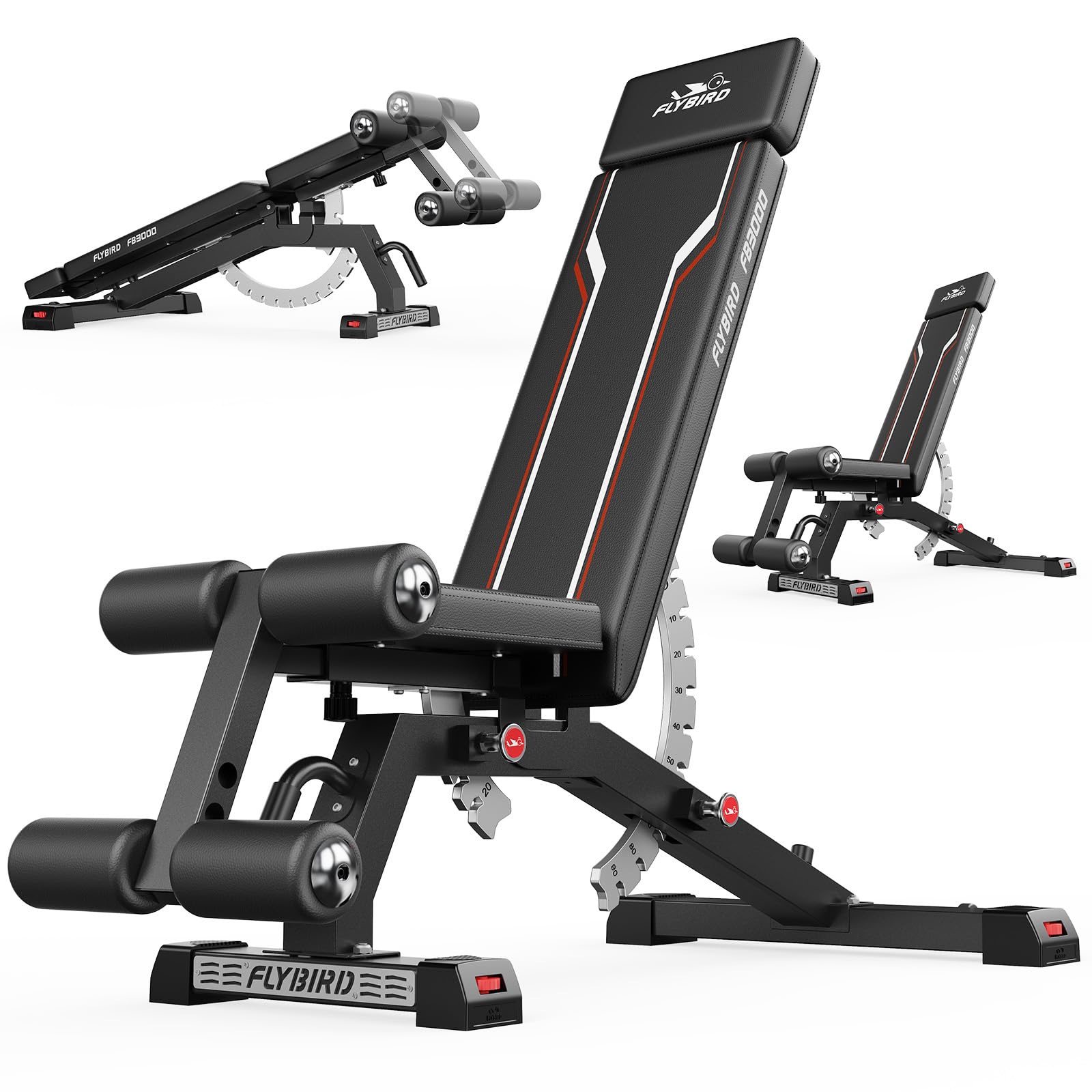
A 12-inch pad and IPF-standard height are built for serious bench press power.
For lifters who care about competitive bench specifics, the FLYBIRD checks the boxes that matter. The 12″ extra-wide back pad gives full scapula support with no wobble, and the removable headrest extends the pad to 40″ for complete back support under heavy loads. The 17.5″ height matches the IPF standard, locking your feet for maximum leg drive on every press.
Strength is rated at 1,200 lbs, backed by a one-piece steel frame, reinforced 2mm heavy-duty tubing, and a 5mm gear-lock support bar that survived 20,000 load cycles in testing. The 18″ front and 21″ rear base deliver what the brand calls 200% more stability than traditional single-point supports, and 4 height-adjustable TPR (thermoplastic rubber) feet level the bench on any floor.
Buyers consistently report a sturdy, non-wobbling bench with easy incline adjustments and fast assembly, with one noting it arrives pre-assembled. The high-density foam pad wrapped in soft-touch microfiber leather stays firm under heavy presses, and the bench stands upright to save 80% of floor space when stored.
Fit is where opinions split: seat size gets mixed feedback, with some calling it compact and others too narrow near the knee. Height opinions also diverge, with a few users calling it about an inch too tall and a 6’5″ lifter saying it’s just right. A 3-year guarantee backs the purchase.
The press-focused pick: wide pad, IPF-standard height, and stable base give you a competition-ready platform at home.
Fit first: the compact seat doesn’t suit every body, so check your hip width before buying.
8. HARISON Bench1000 MAX Weight Bench

A removable leg extension and preacher pad turn one bench into a full-body station.
Most benches just fold and recline; this HARISON brings attachments. The removable leg extension and preacher pad let you train your legs, arms, chest, shoulders, glutes, and abs on a single frame, which is a big space saver for a home gym. The barbell rack accepts both Olympic 2-inch and standard 1-inch plates, so your existing weights will fit.
The 1,000-pound capacity comes from a frame built with 2.8″ by 2.4″ commercial-grade thick steel and a triangular mechanical support design. Buyers call the build “solid” and “heavy metal,” noting it’s easy to lift and wheel on one end. Assembly takes under an hour, with a tip to avoid fully tightening bolts until the end.
Adjustments work via 6 backrest settings and 5 seat options, letting you find flat, incline, or decline positions by releasing metal locking pins. The rotating parts use industrial-grade bearings for smooth, snag-free movement during leg training, and the 65mm padded backrest with 5 layers of foam protects you through high-rep sets.
Two real-world notes: the leg curl attachment’s removal is awkward by design, and a few units arrived with a defective connecting frame — though those reviewers point out the company sent replacement parts within a day or two. The preacher pad is easy to remove when you want a clean bench.
All the extras included
- Leg extension and preacher pad included standard
- Fits both Olympic and standard 1-inch plates
- Industrial bearings keep leg movements smooth
Minor frustrations
- Leg curl attachment is awkward to remove
- Occasional defective frame part needs a replacement request
Buy it for: a single bench that also does leg extensions, preacher curls, and plate-loaded work.
Be ready for: a more involved assembly and the occasional need to contact support.
9. Keppi Fitness Bench3000 V2
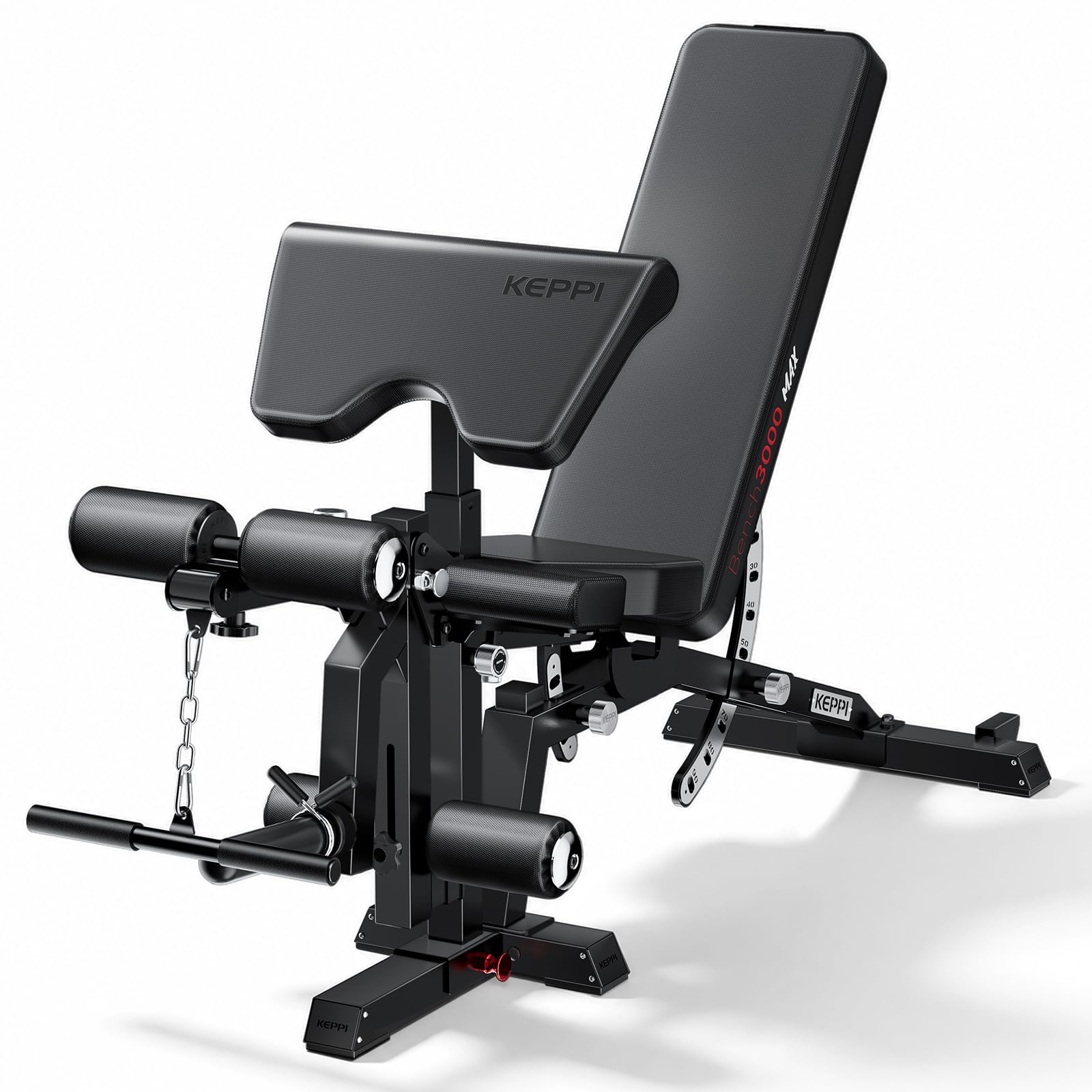
A 93-pound frame with 5 attachment adjustments for precise leg and arm isolation.
If you want machine-style isolation at home, the Bench3000 V2 delivers it with a highly adjustable attachment. You get 5 ROM angles (range-of-motion positions), 5 arm length settings, slot-adjustable top and bottom rollers, and 5 preacher pad heights — so you can match leg extensions, curls, and bicep work to your exact body proportions.
The 93-pound reinforced steel frame supports up to 1,200 lbs in the flat position, using 8/16-gauge steel and aluminum alloy components. Buyers verified zero flex under heavy weight with video proof, and the bench stores upright in just 3.5 square feet, with rear wheels and a built-in weight peg letting you tilt and roll it with one hand.
You get 12 backrest angles spanning -20° to 90° and 3 seat positions, covering full decline to upright. The 10° seat and oversized thigh pad deliver comfort during leg work, and the tool-free attachment removal uses a magnetic pin and spring pin so the bench converts back to a standard adjustable bench in about 30 seconds.
The honest trade-offs: the bench sits tall at 20″ (above the 16.5-17.5″ competition standard), which is fine for dumbbells but can be a safety issue for shorter lifters handling heavy barbells. The hamstring roller pads also run uncomfortable for some, easily fixed with a wider pad swap.
Buy it for: the deepest attachment customization available — leg, arm, and preacher work all in one.
Check before you commit: the 20″ height isn’t ideal for short lifters benching heavy bars.
10. Keppi Fitness Bench6000
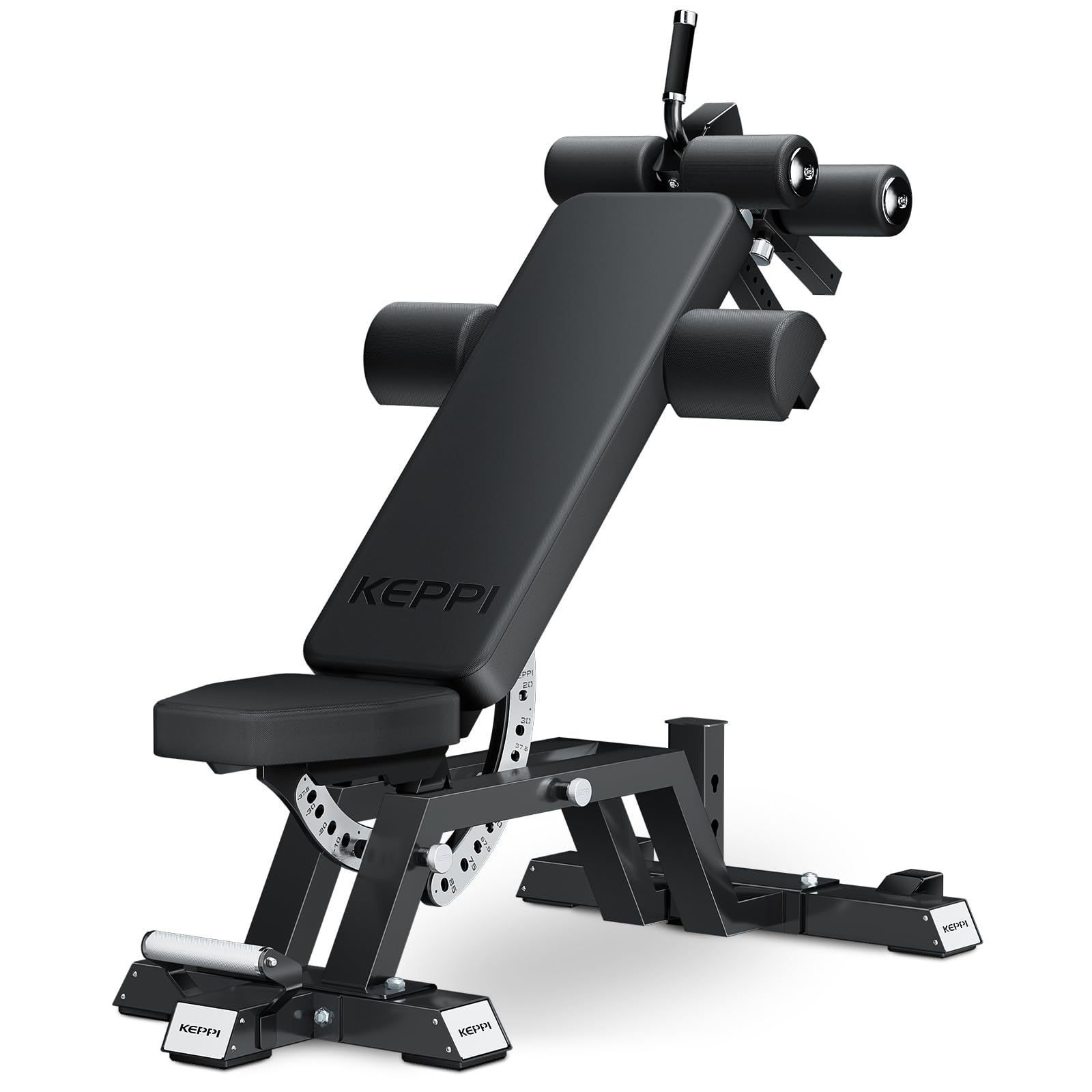
A 97-pound frame with 11 backrest and 8 seat angles for serious strength work.
When you’re moving serious weight, frame weight matters. This Keppi weighs in at 97 pounds of high-strength Q235 steel, which translates to minimal wobble and rock-solid stability under heavy presses. A buyer running heavy bench work confirmed it doesn’t sag, which is exactly what you want to hear from a 1,500-lb rated bench.
Versatility is the second headline. You get 11 backrest positions and 8 seat adjustments, letting you move from bench presses to Bulgarian split squats without leaving the station. The 2.75″ thick high-density pad uses Frict X PVC leather that grips and resists slipping, keeping you planted through every rep.
The 17″ height aligns with IPF competition standards, promoting proper foot placement and force transfer. A highly configurable leg hold-down attachment with 8+5+4+4 adjustments covers decline presses, sit-ups, Russian twists, and Nordic curls, while the bicep curl pad offers 5 height settings with a quick-lock design.
The honest notes: the leg attachment connection can feel “woggly” at its point, and the pop pins for adjustment aren’t the best quality, per one owner. The 97-pound weight is heavy to move, but rollers and a handle make it manageable, and it stores upright in just 3.5 square feet.
Built like a tank
- 97-lb Q235 steel frame with zero sag under load
- 11 backrest and 8 seat positions for total variety
- 17″ IPF-standard height for proper foot drive
Small compromises
- Leg attachment has slight play at the connection
- Pop pins feel less premium than the frame
Get this if: you’re a serious lifter who wants competition-standard height and the widest angle selection in this range.
pass on it if: you want a light bench to move constantly — this one is heavy by design.
11. RitFit 3-Section Adjustable Weight Bench
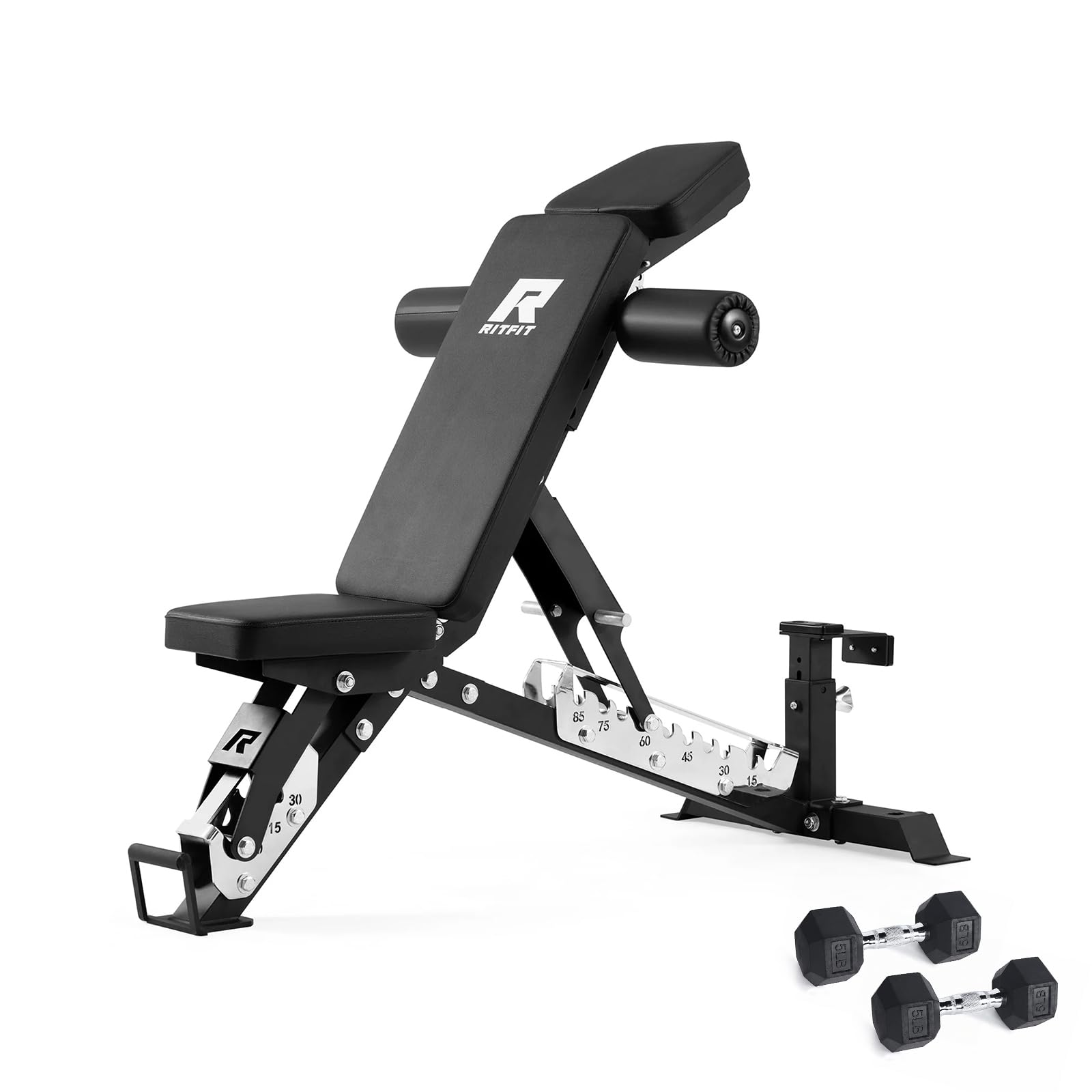
Three negative decline settings fine-tune sit-ups and decline presses to the half degree.
Most benches give you one generic decline position; the RitFit gives you three precise negative settings at -2.5°, -4.5°, and -7°. Combined with 10 backrest angles (0° to 85°), 5 headrest angles, and 3 seat angles, that’s 21 adjustable positions to fine-tune every exercise. The 3-section design with a folding headrest also enables chest-supported rows.
It holds the most weight here at 1,600 lbs, thanks to a 50 x 70 mm (2 x 2.8 in) 14-gauge steel frame with reinforced 1.8 mm tubing. The headrest is load-tested to 396 lbs, and the foam assembly to 176 lbs — so every part is rated, not just the frame. Buyers describe it as “thick, heavy, and sturdy” with excellent stability.
Comfort comes from 2.8 in (70 mm) thick high-density foam padding under sweat-resistant vinyl leather that wipes clean. The fully enclosed adjustment ladder, magnetic locking pin with safety rope, and anti-pinch system are genuine safety upgrades. It arrives 90% pre-assembled — one owner put it together with just 4 bolts and 4 nuts.
The only real caveat is value: this is a premium-priced bench, and shoppers say it’s worth it versus cheaper alternatives, with one noting it’s “better than cheaper bench.” For most home gyms, the extra decline precision is a luxury, not a necessity — so it’s not for you if you rarely train decline and want to save money.
The precision pick: three true decline angles and a 1,600-lb frame make this the most adjustable bench here.
Best for: lifters who want competition-grade build quality and will actually use the micro-adjustments.
Understanding the Specs
Weight Capacity
This number tells you the total load the bench can support, which means your body weight plus whatever you load onto the bar. A stronger rating usually comes from thicker steel and a wider base, so even if you never approach the max, a higher capacity often means a sturdier platform day to day.
Backrest and Seat Positions
More backrest positions means more angles to target different muscle groups, from flat presses to steep shoulder presses. The seat angle matters too — it controls how your hips sit relative to the backrest, which affects both comfort and how much leg drive you can generate. Look for a bench that hits the specific angles you use, not just the highest count.
FAQ
What is the difference between incline, flat, and decline positions on a workout bench?
How much weight capacity do I actually need in a bench?
Will a 1,300-pound bench work for a 300-pound lifter?
Are expensive benches with more backrest positions worth the extra cost?
How do I check if a bench will fit my height?
How long does assembly take for an adjustable workout bench?
Is a heavier bench always more stable?
Can I do leg exercises on an adjustable bench?
What does IPF-standard bench height mean?
How do I keep the bench pad from getting dirty or damaged?
Final Thoughts: The Verdict
For the majority of shoppers, the incline and decline workout bench winner is the pooboo 1500LBS because it pairs a 1,500-pound capacity with quick 8-position adjustments and a stable frame that buyers repeatedly confirm doesn’t wobble. If you want the widest angle range with a 90-degree upright, grab the MAJOR FITNESS. And for the most precise decline work with three negative angles, the RitFit 3-Section is the one to reach for.
How We Picked
We do not accept paid placement. Every pick is matched to a real buyer and a real use-case; we do not hands-on test units.
Sources & Methodology
Specifications: manufacturer listings and product documentation. Review insights: verified customer reviews, as of August 2026. Pricing: not shown on this page (it changes often); check the current price via the retailer link.
As an Amazon Associate, Calories Fit earns from qualifying purchases. This does not affect which products we feature.