
Our readers keep the lights on and the coffee maker working hard! As an Amazon Associate, I earn from qualifying purchases.
Specs are compiled from manufacturer listings and verified buyer reviews and can change over time — please confirm the key details on the product page before buying.
Recovering from an ankle sprain, knee surgery, or just noticing your balance isn’t what it used to be? A wobble board is one of the simplest tools a physical therapist will hand you, and the right one makes daily rehab feel less like a chore and more like a skill you’re rebuilding. You want a board that feels stable under your feet at first, challenges you as you improve, and doesn’t fall apart after a few weeks of daily use.
I’m Mohammad — the founder and writer behind Calories Fit. This guide is built by comparing the manufacturers’ published specifications and the patterns across verified customer reviews, so you get each pick’s real strengths and trade-offs instead of marketing spin.
Whether you’re in post-injury rehab or training for a sport, this guide cuts through the noise to help you find the wobble board for physical therapy that matches your recovery stage, strength level, and home setup.
Our Picks at a Glance

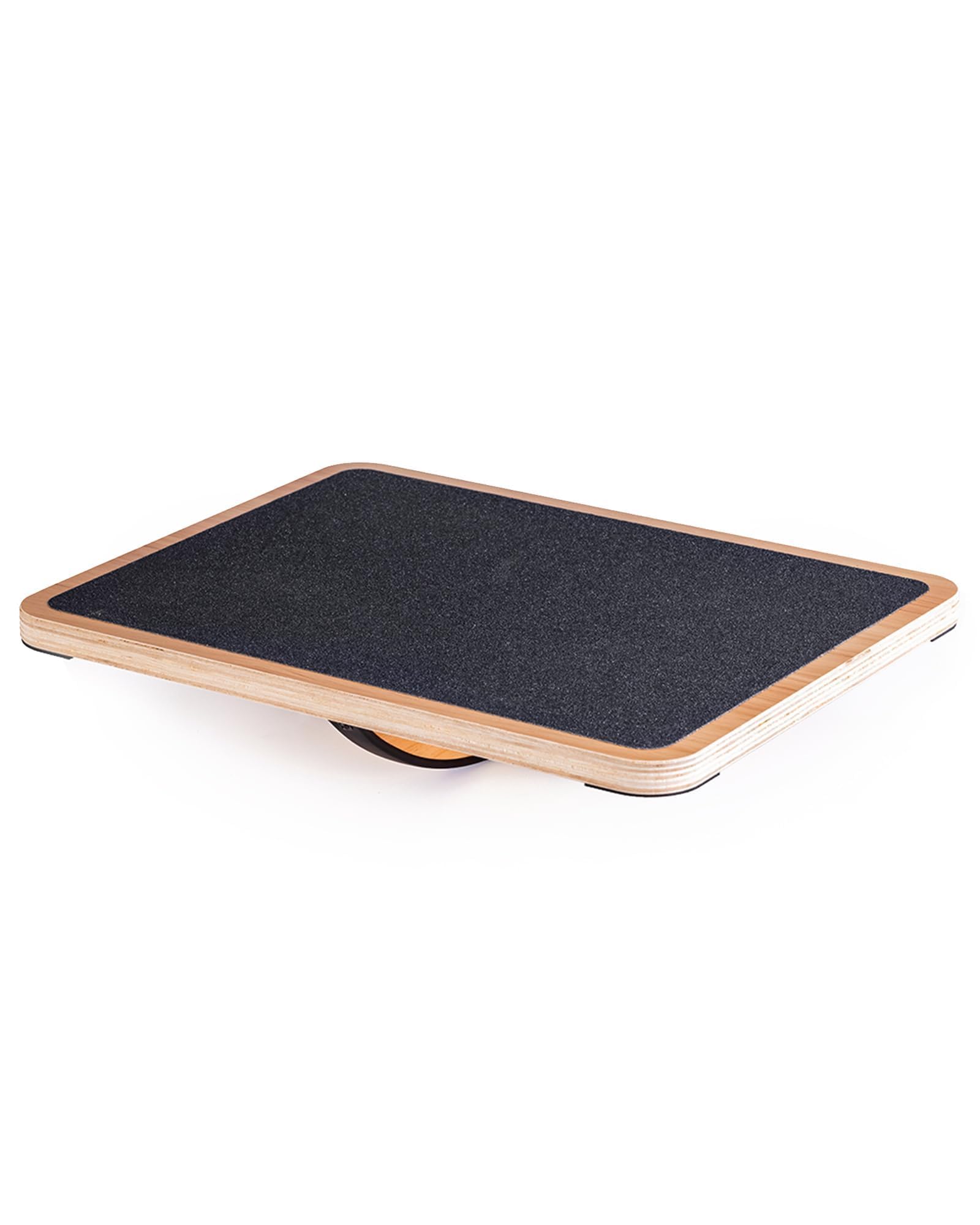

How To Choose The Best Wobble Board for Physical Therapy
Choosing a rehab board isn’t about picking the cheapest disc. Match the board’s motion type and tilt angle to your current recovery stage, leaving room to progress as you strengthen.
Match the Motion to Your Injury
A rocker board moves on a single plane — basically front-to-back or side-to-side — which makes it more predictable and easier for early rehab. A 360° wobble board tilts in every direction, demanding more from your ankles, knees, and hips at once. If you’re fresh out of a cast, a controlled rocker is usually the safer starting point.
Know Your Tilt Angle
The board’s “angle of deflection” is how far it tips from flat. Lower angles like 10-15 degrees are gentler on a recovering joint; steeper angles around 20-22 degrees are for when you want a serious challenge. Starting with too steep a tilt can strain a healing ankle, so begin gently.
Check Weight Capacity and Build
Boards typically list a maximum weight recommendation, often between 300 and 350 pounds. Heavier users need that headroom for confidence, and a board that feels solid under your full weight will be less wobbly in a bad way. Wood and molded plastic are the two main builds, each with a different feel underfoot.
Quick Comparison
| Model | Best For | Motion Type | Tilt Angle | Weight Capacity | Amazon |
|---|---|---|---|---|---|
| Fitterfirst Rocker Board 20″★ Best Overall | Clinic-grade ankle rehab | Rocker (single-plane) | 10°, 12°, 15° | 350 lbs | Amazon |
| StrongTek Advanced 360°Best Value | Standing desk & core | 360° wobble | Multi-directional | 350 lbs | Amazon |
| PROIRON UpgradedMost Portable | Portable 360° training | 360° wobble | 0°–22° | 330.7 lbs | Amazon |
| Woodure 2-in-1 Board | Balance + calf stretching | Rocker + slant | 4 incline positions | 350 lbs | Amazon |
| THERABAND Rocker Board | Budget-friendly lateral training | Rocker (single-plane) | 30° deflection | 150 kg | Amazon |
| Sportneer 7-Mode Trainer | Progressive at-home challenge | 360° + roller | 7 difficulty modes | 450 lbs | Amazon |
| THERABAND Wobble Board | Multi-directional core work | 360° wobble | 22° deflection | 130 kg | Amazon |
| Mobo Board | Foot & ankle strength | Rocker (toe-focused) | Anatomical Axis | 300 lbs | Amazon |
| Fitterfirst Balance Board 16″ | Lower-tilt ankle rehab | 360° wobble | 15°, 17°, 20° | 300 lbs | Amazon |
In‑Depth Reviews
1. Fitterfirst Professional Rocker Board – 20″
Our pick — over 4.5★ from 800+ verified ratings; the strongest balance of quality and price.
The clinic staple you’ll recognize from your PT’s office, built for serious ankle and knee rehab.
This is the exact board many physical therapists use in their offices — buyers report “I first used this board in physical therapy” — and it’s easy to see why it earns that trust. The 20″ width gives your feet a stable stance, and the two adjustable spheres let you change the difficulty as you heal. That single-plane rocker motion (forward and back) is the right kind of predictable for early-stage recovery.
The tilt adjusts between 10, 12, and 15 degrees, so you can start gentle and progress without buying a second board. It’s built from durable Baltic birch plywood, weighs 7.5 pounds, and supports up to 350 pounds. The trade-off vs a smaller board is footprint: at 20″L x 20″W x 4″H it’s noticeably larger than the StrongTek’s 17.5″L x 13.5″W x 3″H profile, so it needs dedicated floor space.
Feedback centers on balance improvement — the most-praised aspect — with owners noting results after just a couple of sessions and appreciating that it’s the same gear used in professional rehab settings. The value-for-money verdict is mixed for some, but for a tool this durable and this proven, it’s a buy-once proposition.
Why rehab pros trust it
- Adjustable 10°, 12°, and 15° tilt levels for progressive recovery
- 20″ wide platform feels stable underfoot
- Baltic birch plywood construction is built to last
- 350 lb weight capacity suits most adults
Who should think twice
- Large footprint needs dedicated floor space
- Rocker motion only — no multi-directional wobble
Reach for this if: you want the proven, clinic-grade tool for ankle, knee, or hip rehab with room to progress as you strengthen.
Look elsewhere if: you only have a small corner to train in or you specifically want 360° multi-directional movement.
2. StrongTek Wooden Balance Board, Basic Rocker or Advanced 360° Wobble
A wooden 360° board that bridges the gap between beginner rockers and hardcore round-base boards.
If the Fitterfirst rocker feels too limited but a full round-base wobble board feels intimidating, this StrongTek is the middle step. It delivers 360° directional wobble — tilting in multiple directions — but the cross-style base creates a larger floor contact area, so it feels more controlled and approachable than a traditional round base. The textured top keeps your feet secure as you shift weight.
For a standing desk, you want a board that fits underfoot without crowding your space. This one uses Lauan hardwood plywood, supports up to 350 pounds, and measures 17.5″L x 13.5″W x 3″H — noticeably smaller and lighter than the Fitterfirst 20″ rocker, which is why it’s a favorite for desk sessions. Buyers praise the “perfect height” for desk work and call it great value for the price. It also stands on its side for easy storage.
Balance and functionality are the two most-praised aspects, with owners using it for post-knee-surgery PT and core training alike. The honest caveat: some owners mention the rubberized corner pads’ adhesive isn’t sticky enough, with the pads occasionally peeling off — a minor fix, but worth knowing before you buy.
Smart middle ground: 360° challenge without the steep learning curve of a round base, at a price that undercuts pricier premium boards.
Grab this if: you want multi-directional training at your standing desk or in a small space, and you don’t mind a minor DIY fix on the corner pads.
skip it if: you need a true single-plane rocker for the earliest, most fragile stage of rehab.
3. PROIRON Upgraded Wobble Balance Board, 16.34″ TPE Non-Slip
A featherlight 360° trainer you can carry by its handles from the living room to the office.
At just 1.2 kg, this is the lightest board in this lineup — an 86% weight gap versus the StrongTek’s 2.23 kg — and the dual handles make it genuinely easy to tote anywhere. Its portability suits daily balance work at home or the office, especially for older adults. The 16.34″ platform is plenty for a normal stance.
The spherical base gives you 360-degree rotation with a tilt angle ranging from 0 to 22 degrees, which is a wide progressive range. It’s fortified with 12 screws connecting top and base — a design that avoids the fragile clip-on construction some cheaper boards use — and supports up to 330.7 pounds. The bump-textured top is meant to prevent slipping while offering a light foot massage.
Owners praise build quality first, and balance improvement second — customers note “This product has really improved my balance,” with several seniors in their 60s and 70s using it daily for ankle and core strength. The honest note: some find the surface a bit slippery, with one owner advising against using it in socks. Sturdiness feedback is mixed, so heavier users may want the higher-capacity StrongTek instead.
Portability win: the only board here with dedicated carry handles, making it the easiest to move between rooms or pack for a trip.
Best for: older adults or desk workers who want a lightweight, grab-and-go 360° trainer for daily balance work.
Think twice if: you plan to train in socks — the slippery top needs grip socks or bare feet.
4. Woodure 2-in-1 Professional Wooden Balance Board & Slant Board

Two rehab tools in one — a balance rocker that flips into a four-position calf stretcher.
Most boards do one job. This Woodure does two: it’s a balance board for weight-shifting rehab, then transitions into a slant board with four adjustable incline positions for calf stretching, Achilles work, and pre- or post-workout flexibility. That dual purpose makes it a smart buy if your rehab plan includes both balance work and daily stretching.
It’s a sturdy wooden build rated to 350 pounds, and the sandpaper-like frit on the foot area gives solid grip even with socks, which one owner specifically noted. Reviewers point out it’s effective for shin splints, calves, and foot fascia, and that it handles a 260+ pound user with total stability. The design is compact and collapsible for storage.
Quality is the standout aspect — the most-praised by far — with durability close behind. It earns glowing feedback for lunges, squats, and core strengthening, and a 62-year-old buyer called it a perfect morning routine that raises heart rate and aids breathing. The recurring criticism is the screw quality, with a few owners finding the hardware fiddly, so treat the adjustment screws gently.
Two-for-one value: if your PT plan combines balance and stretching, this replaces two separate pieces of equipment.
Pick this if: you want balance training plus a calf stretcher in one compact, budget-friendly wooden tool.
Pass if: you only need pure balance work and don’t want the extra slant-board functionality.
5. THERABAND Rocker Board, Wobble Balance Board, Core Strength Trainer
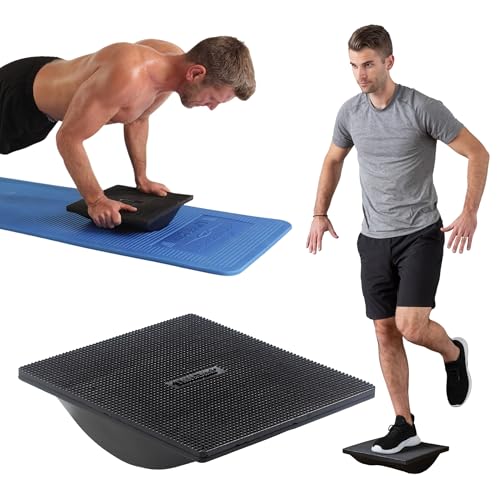
The trusted therapy brand’s entry-level rocker, light enough to toss in a suitcase.
THERABAND is an industry standard in rehab, and this rocker board lives up to that reputation at a friendly price point. It moves on one controlled plane at a time — forward/reverse or side-to-side — which is exactly the predictable instability you want in early balance work. At 3.5 pounds, it’s easy to carry, store, and take on trips so you don’t miss a daily session.
This board measures 13 1/8″ x 14″ with a 30° angle of deflection (how far it tilts from flat), and the molded plastic build is durable and lightweight. The top has a specially-designed tactile surface for grip, while the anti-skid bottom keeps it planted on smooth floors and even on rugs — one owner noted the non-slip bottom “works very well, especially on the rug.” It supports up to 150 kg (about 330 pounds).
Value for money is the most-praised aspect, with sturdiness close behind. A buyer recovering from knee surgery with a goal to paddleboard again called it “very sturdy & well made,” and another uses it exactly as their physical therapist prescribed for stretching “tight, achy feet.” It comes with an illustrated guide covering over 37 exercises. The caveat: some find it too small or want more instability, so it’s best as a beginner-to-intermediate tool rather than a max-challenge board.
Why it’s a smart first board
- Trusted THERABAND brand quality at a budget price
- 3.5 lbs and compact — easy to travel with
- Comes with a 37+ exercise illustrated guide
- Anti-skid bottom grips well on rugs and smooth floors
Consider the size
- Smaller surface may feel tight for larger feet
- Single-plane rocker only — not for 360° training
Choose this if: you want a trusted, low-cost, travel-friendly rocker for early balance rehab or daily foot stretching.
Move up if: you need a bigger platform or want 360° multi-directional challenge.
6. Sportneer Balance Board, 7-Mode Balance Trainer with Roller & Ball

A birch-wood trainer that grows with you, from wobbly beginner to rail-steady expert.
This is the board for people who get bored with a single challenge. It comes with a roller and a 2.8″ ball, plus four magnetic removable stoppers, open up 7 distinct challenge modes from beginner through expert. You can reconfigure the “fences” without any tools, so one session can be gentle rocking and the next can be a full 360° balancing act.
If you need maximum weight support, this board leads the lineup with a 450-lb capacity — beating the Fitterfirst and StrongTek boards at 350 pounds each. Built from high-quality birch wood, it has a textured non-slip EVA surface (a soft foam-like material) that gives a cushy grip whether you’re in shoes, socks, or barefoot, and it’s quieter than bare wood in use. Shoppers say the ball barrier is “a great challenge” and the foam top feels nice underfoot.
The padded surface is gentler on bare feet but less durable against hard shoes, so treat it as an indoor trainer. It’s lighter and easier to store than larger boards, though the half-circle rails can be a little hard to remove. It’s a versatile family pick and a solid ankle strengthener for surfers and snowboarders.
Progression built in: the 7 modes mean you rarely outgrow this board, making it the best long-term value for home users who want variety.
Reach for it if: you want a single board that scales from beginner wobbles to advanced roller challenges, for the whole family.
pass on it if: you need a pure clinical-style rocker for the earliest, most cautious rehab phase.
7. THERABAND Wobble Board, Round Balance Trainer
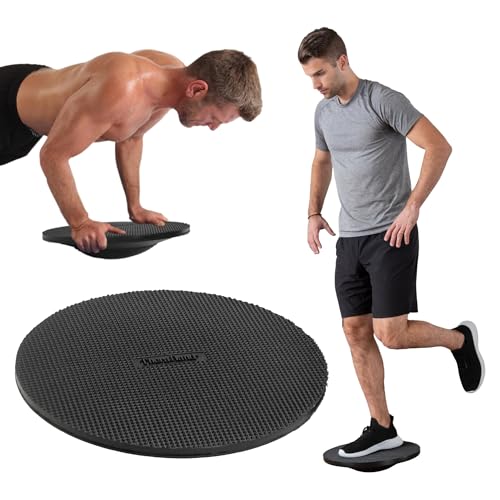
A low-profile round board that gives you the full 360° challenge on a confidence-building footprint.
Where the THERABAND rocker gives you one plane, this round wobble board provides multiple planes of instability for the most challenging training. It measures 16 1/8″ in diameter with a 22° angle of deflection, and that low-profile shape is designed specifically to build confidence in beginners, seniors, and people in recovery. It’s the brand’s step-up for when you’re ready to wobble in every direction.
The molded plastic build supports up to 130 kg, with a non-slip top and textured underside to stay steady on smooth floors. An owner who tested it at 250 pounds and used it near a support initially praised how well it engages the abdominal core — the 22° tilt forces your midsection to work constantly. It’s lightweight at 3.4 pounds and easy to store in small spaces.
Quality and balance training are the two most-praised aspects, and its versatility earns praise — one owner uses it at a standing desk, another for core work between sets, and a Pilates teacher even recommends it to chemo patients for foot stimulation. The honest caveat: the knurled surface (a textured pattern) can feel rough on bare feet, leaving “dimples” on your soles, so grip socks or shoes are a good idea. Some also find it takes practice to get comfortable on the 360° motion.
Core crusher: the 22° multi-directional tilt (tilting in all directions) engages your abdominals harder than any single-plane rocker in this guide.
Buy this if: you’re past early rehab and want a premium 360° challenge plus core engagement from a trusted therapy brand.
Pass if: you have sensitive bare feet — the textured surface is grippy but rough.
8. Mobo Board

Not just a balance board — a foot-architecture tool that builds a stable arch from the ground up.
Most boards train your balance. The Mobo Board trains your feet specifically, using something called Toe Box Technology and an Anatomical Axis to work with the natural architecture of your foot and build a stable arch. If your rehab or training goal is really about foot strength — plantar fasciitis, weak arches, big-toe stability — this is a different tool from the generic round boards above.
It’s rated to support individuals up to 300 pounds, and the natural bamboo build is high quality — owners describe the wood pieces as fitting together with precision. The board goes completely flat for travel, and the provided exercises cover a range of rehab needs. A plantar fasciitis sufferer reported less post-run pain and no limping after long runs, attributing the change to big-toe strengthening.
Balance and quality are the two aspects owners praise most. The results can be dramatic: A post-knee-replacement owner could wear 2.5-inch heels again after two months of use., and A 54-year-old runner went from struggling at short distances to completing pain-free 16-mile runs.. It’s designed by Jay Dicharry, a well-known physical therapist and author. The honest caveat: the rocker pieces lack grip and can slide on wood floors, so use it on carpet or a mat, and it’s a premium investment versus simpler boards.
Feet-first design: the only board here built around toe and arch mechanics, making it the pick for foot-specific rehab rather than general balance.
Choose this if: your priority is foot, ankle, or arch strength — plantar fasciitis, weak big toes, or post-injury foot rehab.
Look elsewhere if: you just want a general balance board and don’t need the foot-specific design.
9. Fitterfirst Professional Balance Board

A smaller Fitterfirst with a brilliant adjustment mechanism, chosen by ankle-rehab patients for its gentler tilt.
This is the round-base sibling to our Best Overall pick, and it serves a different purpose. At 16″L x 16″W x 4″H, it’s more compact than the 20″ rocker, and it’s a 360° wobble board rather than a single-plane rocker. Owners who’ve used it for ankle rehab specifically chose it for its lower tilt angles of 15°, 17°, and 20° — gentler than some steeper alternatives — making it a smart progression tool.
It weighs 1.88 kg and supports up to 300 pounds. The adjustment mechanism earns consistent praise — one owner called it “brilliant” — and kids reportedly find it fun to play on, which makes daily rehab feel less like a chore. A buyer recovering from a broken ankle confirmed it’s “exactly what they use at my physical therapist’s gym” and uses it daily to keep the joint moving and healing.
Balance is the aspect people praise most, with adjustability close behind. Owners note it’s “pretty enough to keep in the living room” and works on both carpet and tile. The honest trade-offs: the top surface can be too smooth for barefoot use, so grip socks or shoes are recommended, and athletic users may find it too easy at the lowest settings — the difficulty feedback is mixed, which actually speaks to its versatility across skill levels. One owner progressed from barely balancing to 2 minutes with few touches in just a week.
Adjustable 360° in a smaller footprint: the best choice if you want multi-directional movement with a gentler starting tilt than most round boards.
Pick this if: you want a compact 360° board from a clinic-trusted brand with adjustable difficulty for ankle rehab.
Consider the 20″ rocker instead if: you want the widest, most stable stance for early, fragile recovery.
Understanding the Specs
Rocker vs. Wobble Motion
A rocker board moves on one plane — basically front-to-back or side-to-side — which makes it more predictable and forgiving for early rehab. A 360° wobble board tilts in every direction, forcing your ankles, knees, and hips to work harder at once. Your injury stage should dictate the choice: start on a rocker, progress to a wobble.
Angle of Deflection
This is how far the board tips from flat, measured in degrees. Lower angles like 10-15 degrees are gentler on a healing joint; steeper angles around 20-22 degrees offer a serious challenge. The best boards, like the Fitterfirst, offer multiple adjustable angles so you can progress without buying new equipment.
Weight Capacity
Boards typically list a maximum weight recommendation, usually between 300 and 350 pounds. That number matters for two reasons: safety under your full weight, and confidence. A board 50-100 pounds over your weight feels reassuringly solid; one right at the limit can feel wobbly in a bad way.
Surface Grip
The top surface determines whether you train in bare feet, socks, or shoes. Textured or “tactile” surfaces work barefoot but can feel rough; smooth wood needs grip socks or shoes. The bottom surface matters too — an anti-skid base keeps the board planted on hardwood, tile, or rugs so you’re not chasing it across the room.
FAQ
What is the difference between a rocker board and a wobble board?
What tilt angle should I start with after an ankle injury?
How much weight can a wobble board hold?
Can I use a wobble board at my standing desk?
How long should I use a balance board each day?
Is a wooden or plastic balance board better?
Can I use a wobble board in socks or barefoot?
What is the best board for plantar fasciitis?
Final Thoughts: The Verdict
For most people, the clear wobble board for physical therapy winner is the Fitterfirst Professional Rocker Board 20″ — it’s the clinic-proven tool with adjustable 10°, 12°, and 15° tilt levels and a rock-solid 350-pound capacity. If you want a budget-friendly 360° option for your standing desk, the StrongTek Advanced delivers multi-directional training at a fraction of the premium price. And if your rehab is really about foot strength — plantar fasciitis or weak arches — the Mobo Board is worth the premium investment for its unique foot-focused design.
How We Picked
We do not accept paid placement. Every pick is matched to a real buyer and a real use-case; we do not hands-on test units.
Sources & Methodology
Specifications: manufacturer listings and product documentation. Review insights: verified customer reviews, as of August 2026. Pricing: not shown on this page (it changes often); check the current price via the retailer link.
As an Amazon Associate, Calories Fit earns from qualifying purchases. This does not affect which products we feature.