
Our readers keep the lights on and the coffee maker working hard! As an Amazon Associate, I earn from qualifying purchases.
Specs are compiled from manufacturer listings and verified buyer reviews and can change over time — please confirm the key details on the product page before buying.
Your garage floor is the most brutal surface you can train on — unyielding concrete that punishes knees on deadlifts, dulls your stability on lunges, and slowly chips away at your dumbbells every time they touch down. The right gym matting turns that cold slab into a proper training floor, absorbing shock, protecting your gear, and giving you grip when you’re sweaty. This guide cuts through the thickness and material confusion to match you with the best workout mats for garage settings — with a quick note up front: because garage layouts and equipment sizes vary wildly, the mats below use flexible size matching, so the nearest equivalent coverage serves the same purpose.
I’m Mohammad — the founder and writer behind Calories Fit. This guide is built by comparing the manufacturers’ published specifications and the patterns across verified customer reviews, so you get each pick’s real strengths and trade-offs instead of marketing spin.
Whether you’re building a corner lifting zone or flooring a full bay, these garage workout mats balance thickness, durability, and coverage to make concrete feel like a real gym floor.
Our Picks at a Glance

How To Choose The Best Workout Mats for Garage
Picking garage matting is a math problem about your own routine: what equipment you drop, how much floor you need covered, and whether your garage is a damp, dusty space or a finished room. Rather than guessing by brand, start by measuring the footprint of your rack or treadmill and your total training zone, then work backwards to the pack size that fits it.
Thickness is your knees’ best friend
The single biggest decision is how thick a mat you need. Thinner mats around 0.5 inches are fine for bodyweight work, yoga, and light dumbbells, but if you’re setting down heavy barbells or running a treadmill, you want closer to 0.79 inches or a full 1 inch of cushion. The extra foam compresses under impact, which keeps your joints from taking the force your garage floor would otherwise feed straight into your spine.
Rubber top, foam bottom — the two-layer logic
Most quality garage tiles combine a tough rubber surface with a softer EVA foam core. The rubber layer gives your treadmill or weight plates something they can’t scuff or punch through, while the foam underneath absorbs shock and deadens the noise that would otherwise echo off the garage walls. If your gear is heavy and stationary, a solid rubber roll is the tougher sibling; if you want a cushioned feel for bodyweight moves, the hybrid tile wins.
Coverage adds up faster than you think
A single 24×24 inch tile feels small, so always multiply: a 12-tile pack covers 48 square feet, a 24-tile pack reaches 96 square feet. Sketch your garage footprint on paper and count tiles before you order — most people discover they need two packs to make a proper deadlift platform or a full machine zone, and buying the right coverage the first time saves a frustrating second shipment.
Quick Comparison
| Model | Best For | Thickness | Coverage | Material | Amazon |
|---|---|---|---|---|---|
| Art3d 96 Sq Ft EVA Mats★ Best Overall | Large multi-zone garage floors | 0.5 inches | 96 sq ft (24 tiles) | EVA Foam | Amazon |
| HAPBEAR 0.56″ MatsBest Value | Heavy equipment with rubber grip | 0.56 inches | 24 sq ft (6 tiles) | Rubber Top / EVA Bottom | Amazon |
| Sivan Fitness 1/2″ MatsTop Performer | All-purpose hybrid home gym | 0.5 inches | 48 sq ft (12 tiles) | Rubber Top / EVA Foam | Amazon |
| Xspec 1″ Extra Thick Mats | High-impact floor work | 1 inch | 48 sq ft (12 tiles) | EVA Foam | Amazon |
| American Floor Mats 3/8″ Roll | Stationary heavy machines | 0.38 inches | 4′ x 6′ roll | 100% Vulcanized Rubber | Amazon |
| PRAISUN 0.6″ Rubber Mats | Balanced cushion & firmness | 0.6 inches | 48 sq ft (12 tiles) | Rubber / EVA Foam | Amazon |
| SUPERJARE 0.79″ Mats | Plush cushion for cardio & rowing | 0.79 inches | 48 sq ft (12 tiles) | EPDM Rubber / EVA Foam | Amazon |
| AIRHOP 0.79″ Mats | Snug-fitting heavy weight zones | 0.79 inches | 48 sq ft (12 tiles) | Recycled Rubber / EVA Foam | Amazon |
| American Floor Mats Stall Mat | Max durability under brutal loads | 0.5 inches | 4′ x 6′ mat | Solid Rubber | Amazon |
In‑Depth Reviews
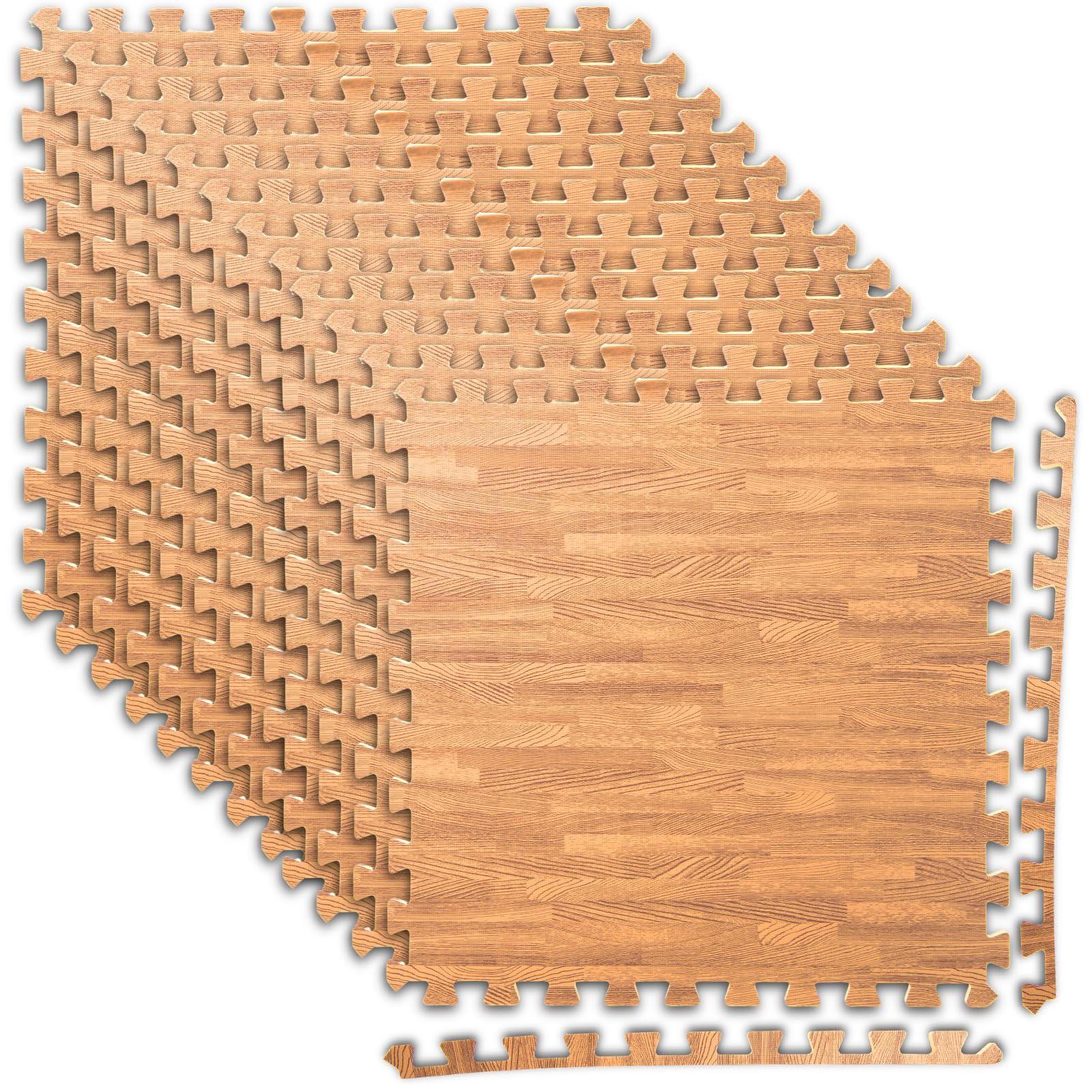
1. Art3d 96 Sq.Ft EVA Puzzle Exercise Mats
Our pick — over 4.5★ from 850+ verified ratings; the strongest balance of quality and price.
The crowd favorite that blankets a whole garage bay in one order.
No other pick matches the sheer square footage per box: this pack brings 24 interlocking tiles, each 24″ x 24″ x 0.5″ thick, for a total of 96 square feet of coverage — quadruple the 24 sq ft of the HAPBEAR set above, all in a single shipment. For a full garage floor that needs wall-to-wall padding, that means one box instead of four, and the math alone makes it the smartest buy for large spaces.
The build quality is the thing owners rave about most. The EVA foam is firm enough that buyers report it handles 50-lb dumbbells without marks or wear, yet cushioned enough to keep joints happy on hard floors. It’s BPA-free, slip-resistant, flame-resistant, and washable, and assembly is genuinely easy — the tiles lock together in a clean pattern that looks intentional, not thrown down. The teak color finish also hides the grime a garage gym accumulates better than plain black.
The honest trade-off: because the tiles are lighter-weight foam rather than a heavy rubber composite, they can drift apart slightly over months of use. Owners mention the connection isn’t identical to other tile brands either, though it still reads as a minor quibble rather than a dealbreaker. If your garage sees serious dropped-barbell work, treat this as the comfort layer of a two-part floor; for everything else, it’s the whole solution.
What wins people over
- 96 sq ft per box — the best coverage-per-purchase on this list
- 0.5″ cushioning that protects joints during lifts and cardio
- Easy wipe-down cleaning after sweaty sessions
Know before you buy
- Light foam tiles can drift apart over time
- Not the best for repeated heavy barbell drops
Grab it for: anyone flooring a whole bay or multi-zone garage who wants one shipment to do the job.
Think twice if: you’re mostly dropping heavy barbells — you’ll want a thicker, denser layer under the rack.
2. HAPBEAR 0.56” Thick 12 Pcs 48 Sq Ft Mats
The budget-friendly two-layer tile that shrugs off heavy equipment.
This is the entry-price pick with a serious upgrade: a dense, textured rubber top fused over a high-density EVA foam bottom. At 0.56 inches thick, it’s 12% more material than the 0.5-inch Art3d tiles — a small but noticeable bump in durability and cushioning that owners feel underfoot. It comes as 6 tiles covering 24 sq ft, so it’s built for equipment zones rather than whole-floor coverage.
What makes it a value standout is how it handles the heavy stuff. Customers note a whole patio lined with multiple boxes of these holding up under serious iron, and a Force USA C20 trainer sitting on them with no indentations. The rubber surface gives you non-slip grip even when you’re sweating, and the interlocking edges are flexible enough to configure around benches, racks, or a folding treadmill. It fixes slippery concrete floors — among the most common garage complaints — with remarkably easy, jigsaw-style assembly.
The budget reality shows in the numbers: at 24 sq ft per box, you’re buying roughly half the coverage of the Sivan set (48 sq ft) per order, so a larger garage needs multiple boxes. Some owners note the edge strips are less durable than the tiles themselves, though they’re rarely in the walking path. For a compact corner gym or a drop-zone pad under one machine, this is the best dollar-for-dollar pick here.
The core read: if your garage gym is a focused corner rather than a whole room, this rubber-topped tile delivers heavy-duty protection at a budget-friendly price, with the caveat that coverage per box is smaller than pricier options.
Best for: single-machine zones or compact garage corners where a tough rubber top matters more than total square footage.
Consider otherwise: if you’re flooring a large open area, the smaller per-box coverage means more orders and more seams.
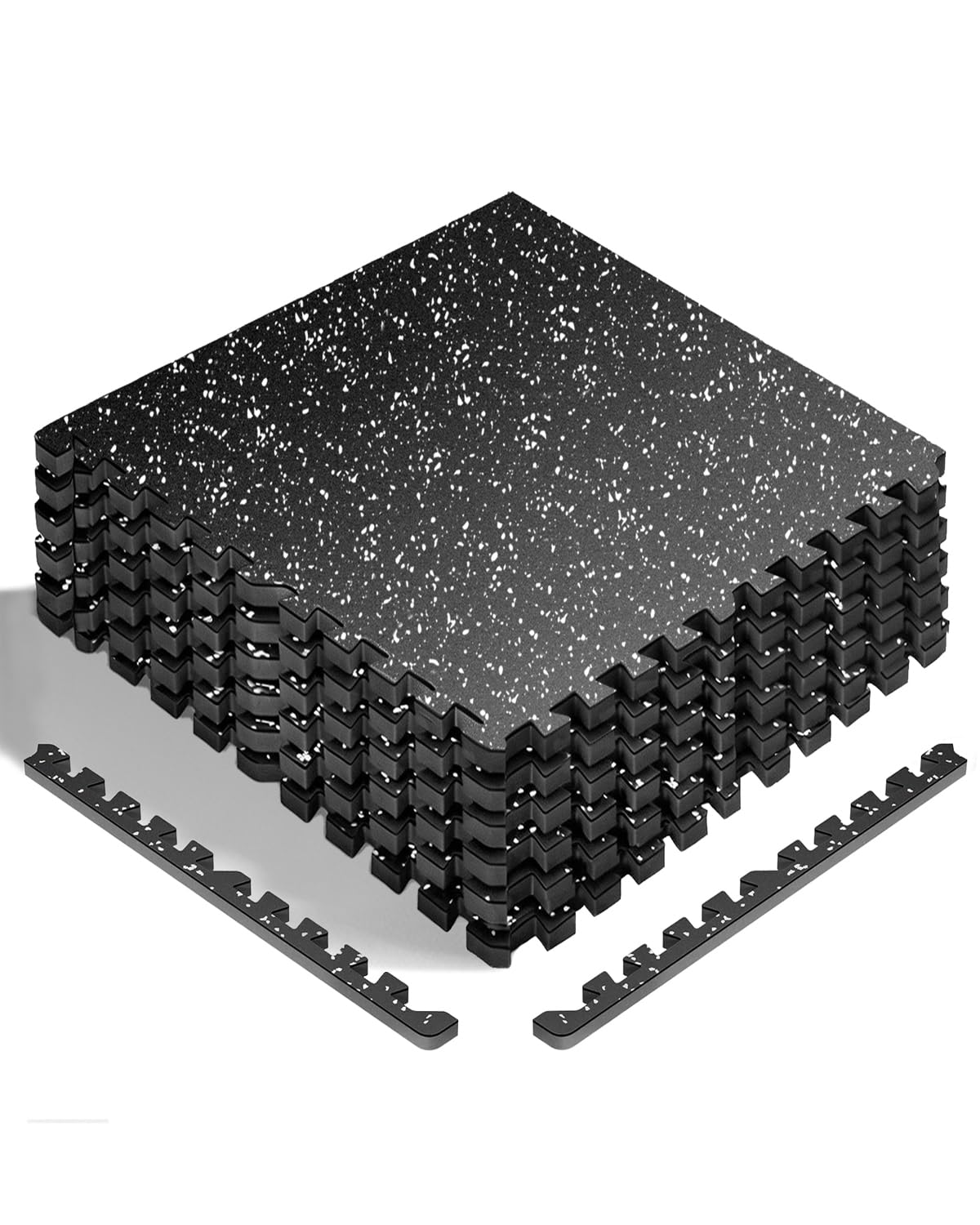
3. Sivan Fitness 1/2″ Thick Rubber Top Gym Flooring
The rubber-foam hybrid that outlasts cheap foam tiles season after season.
The defining trait here is the dual-layer construction: a rubber top that takes the abuse and an EVA foam core that keeps things comfortable, at 0.5 inches thick with 48 sq ft of coverage from 12 interlocking tiles. Owners describe it as the right middle ground — softer than all-rubber, sturdier than all-foam, and at a price that makes the upgrade to rubber feel worth it. It’s twice the coverage of the HAPBEAR set (24 sq ft) for a mid-range investment.
Durability is the headline. Reviewers point out daily floor work, yoga, and free weights for four months with zero separation between tiles, and one set from 2021 still looks perfect with newer additions blending in smoothly. The blue-speckled pattern gives garage floors a finished, intentional look that plain black mats lack, and the rubber surface sweeps clean with a broom even when it holds dirt from garage use. The detachable edge pieces let any tile become a corner, border, or centerpiece, so you can build outward to match your space.
The honest caveat is grip: feedback is split, with some owners saying tiles hold in place perfectly while others report pieces sliding around. If you’re mixing heavy equipment and bodyweight work in one zone, this is the most balanced all-rounder on the list.
The verdict: a durable, comfortable middle-tier tile that beats budget foam on toughness and beats solid rubber on price and cushioning — just plan the install so tiles stay put.
Reach for this if: you want one floor that handles both your squat rack and your yoga sessions without swapping mats.
Look elsewhere if: you need absolute grip on a slick, floating install — you’ll be adding tape underneath.
4. Xspec 1″ Extra Thick Reversible EVA Gym Foam Mats

The thickest comfort layer here, built for high-impact floor sessions.
At a full 1 inch thick, this is the most cushioning you’ll find anywhere on this list — double the 0.5-inch Art3d and Sivan tiles — and it changes the feel of everything you do on the garage floor. Bodyweight circuits, ab work, and stretching turn from “on concrete” to “on a proper gym floor,” and each 24″ x 24″ tile carries a steel-grip pattern on both sides so you can flip it when one face wears. Twelve pieces cover 48 sq ft.
Buyers lean on this extra thickness in smart ways: one uses it to protect a car from hail damage under a cover, another put it around a couch so kids hitting the floor had a soft landing, and a home gym owner reports a cable machine’s weight sitting on it without sinking. It’s BPA-free, non-toxic, and phthalate-free, and the reversible design means you get two colorways in one purchase. The puzzle connection is genuinely quick — owners describe clicking it together in minutes.
The trade-off is in the foam itself: EVA this thick accepts indents if you park something excessively heavy on it, and the manufacturer is upfront that it’s for indoor use only with carpet tape recommended to prevent slipping. Durability opinions split, mostly around how much weight you leave sitting on it long-term. As a comfort layer for bodyweight work, impact exercise, or family-safe floor zones, it’s excellent value.
Why it stands out: the 1-inch thickness delivers a level of joint protection no other pick here matches — for anything involving your body hitting the floor, this is the cushion to beat.
Choose this for: floor-heavy training, kid-safe zones, or any space where maximum cushioning is the top priority.
skip it if: you’ll park a permanently heavy machine on it — the foam will take a set over time.
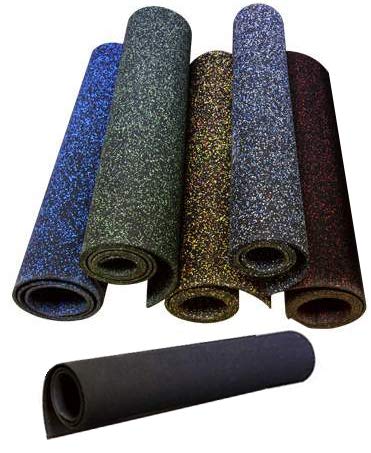
5. American Floor Mats 3/8in Heavy Duty Rubber Roll
A solid rubber slab that laughs at treadmills and stationary bikes.
Completely different from the tiles above: instead of foam puzzle pieces, this is a single 4′ x 6′ roll of 100% vulcanized rubber at 0.38 inches thick, built for one job — sitting under a heavy machine and never wearing out. It’s non-porous, slightly textured for grip, and dense enough that owners describe it as commercial-grade, with a 5-year warranty backing the claim. No assembly, no seams, no interlocking edges to come apart.
Buyers consistently call it heavy and solid, which is exactly the point. A Total Gym sits on it perfectly, treadmills and stationary bikes are the intended use, and shoppers say rolls lying flat almost instantly without curled corners — a common frustration with cheaper rubber. The 48-pound weight means it stays where you put it, protecting garage floors from machine vibration and scuffs. It also trims cleanly with a fresh razor blade, so custom-fitting around a rack or into a wall-to-wall layout is straightforward.
The real-world downsides are the nature of rubber. New mats off-gas a noticeable smell that needs a couple of days of airing out, and the solid black surface shows dust and dirt, with owners mentioning daily vacuuming to keep it presentable. At a 4×6 footprint it’s a targeted protection zone rather than full-floor coverage, and there’s a real shipping wait. For a rock-solid base under one heavy machine, this is the most durable answer on the list.
The core take: if you want a permanent, no-maintenance base under a treadmill or bike, this dense rubber roll is tougher than any foam tile and lays flat on day one.
Best for: owners of one heavy stationary machine who want zero fuss and decades of floor protection.
Not ideal for: full gym floors or bodyweight work — it’s a machine pad, not a comfort layer.
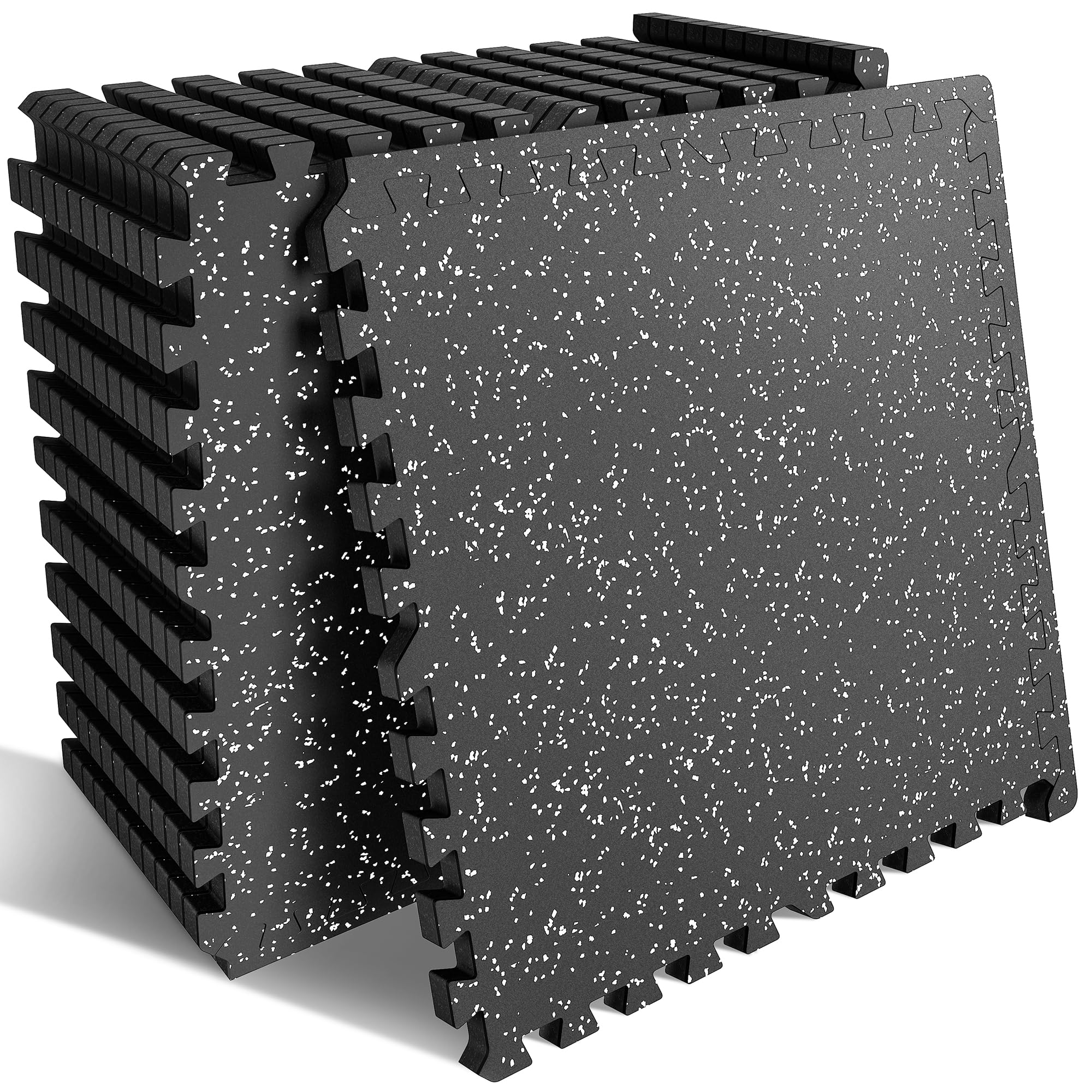
6. PRAISUN 0.6″ Thicker Rubber Top 48 Sq Ft Gym Flooring
The 3-layer design that balances softness and stability for any workout style.
This mid-premium pick uses a three-layer stack — a durable rubber top, a high-strength glue bond, and a high-density EVA foam base — at 0.6 inches thick, which the maker notes is thicker than most garage mats on the market. Twelve tiles cover 48 sq ft, and the Black/Grey finish gives your garage what one buyer called a perfect look for a mini-gym setup. If you’re torn between all-foam comfort and all-rubber toughness, this is the engineered middle.
The feedback centers on that balance. Owners highlight the perfect rubber-to-foam ratio — firm enough on the rubber layer for a smooth install and comfortable for everything from ab work to standing lifts — and one reviewer used it for a massive 1000+ sq ft basement project without complaint. The textured surface holds grip even when you’re sweaty, the interlocking puzzle design goes together in minutes, and the water-resistant rubber wipes clean easily. Shock absorption is the priority here, protecting both your joints and your garage floor from dropped weights.
Where it lands price-wise, it’s a step above the budget tiles, and buyers acknowledge you pay for the thicker build. A faint new-mat smell is common but fades within a day or so of use, per owner reports. If your garage mixes HIIT, yoga, and moderate weight work, this gives you the cushion of a premium tile without needing a separate yoga mat on top.
The read: the 0.6-inch three-layer construction is the smart upgrade for anyone who wants one floor that works for both high-impact and equipment-based training.
Pick this if: you want upgraded cushioning and a clean look without stepping up to the thickest, priciest tiles.
Settle for cheaper if: your garage routine is mostly light dumbbells and stretching.
7. SUPERJARE 0.79” Extra-Thick Exercise Mats
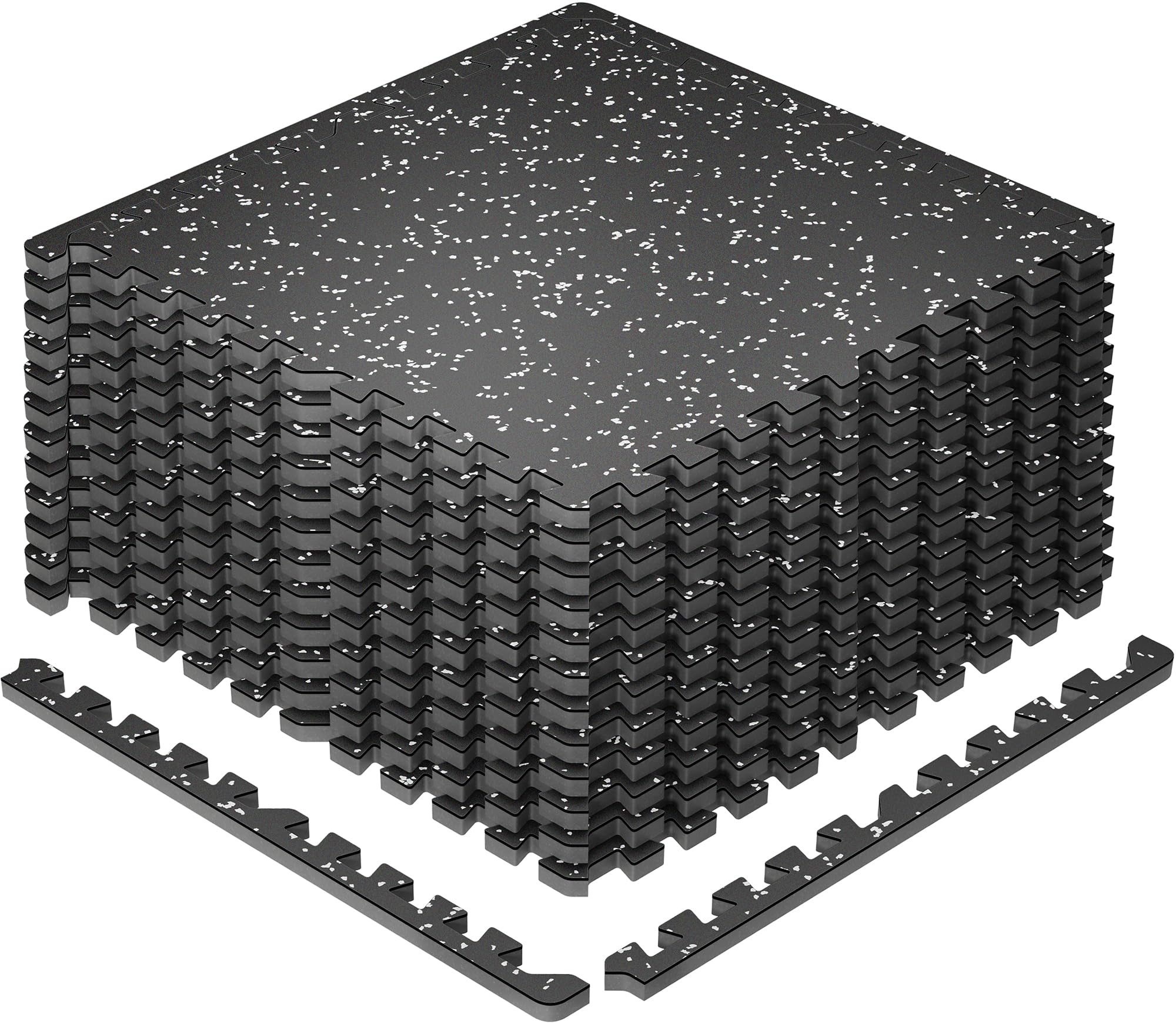
Seriously plush padding that quiets a rowing machine and softens every rep.
Jumping to 0.79 inches thick, this premium tile pairs a high-density EVA foam base with a sturdy EPDM rubber top, and the difference is felt immediately in cushioning. Owners describe it as super thick and plush, with one noting it muffles the sound of a rowing machine remarkably well — a huge win if your garage shares a wall with a living space. Twelve tiles cover 48 sq ft, and the Black/Grey pattern fits a clean gym aesthetic.
The standout is how the padding changes your workouts. Machines and weights sit on it without issues, it’s cushioned enough for deadlifts while still offering grip for landmine presses, and buyers report it’s excellent for yoga and stretching — the kind of all-in-one floor you’d expect to pay more for. The interlocking edges with 2 detachable borders per tile create a neat square or rectangular shape, and the rubber surface is waterproof and slip-resistant. The maker also upgraded the formula to avoid the harsh rubber odor that plagues some mats.
The honest trade-offs: the plushness that makes it great for rowing and bodyweight work is too cushy for a Peloton, which wobbles on it, and durability feedback is mixed — some owners mention tiles coming apart after a month of indoor use and warping after a week. It also ships with a strong initial smell that needs airing out for a week or more. This is the comfort-first premium pick, not the bombproof one.
Why choose it: no other tile here matches the plush, noise-dampening feel — if your workouts hit the floor hard, this is the softest landing.
Reach for this if: you row, stretch, or do bodyweight circuits and want serious cushioning with vibration control.
Look elsewhere if: you own a spin bike or want a seam-free, bombproof floor that won’t shift.
8. AIRHOP 0.79in Thick 48 Sq Ft Exercise Mats

Extra-tight interlocking locks that keep a heavy gym floor from shifting.
At 0.79 inches thick, this premium tile uses the same dual-layer recipe — textured rubber top over high-density EVA foam — but with one distinguishing upgrade: larger interlocking locks that owners say snap together very tightly. If you’ve ever cursed a tile floor that separates mid-workout, this is the direct answer. Twelve tiles give you 48 sq ft, and each piece comes with edge borders for a finished look.
The tight fit is the recurring praise. Buyers describe pieces fitting together nicely with a clean, professional appearance, and the rubber top holds up to heavy machinery while protecting floors from scratches, scuffs, and dents. One owner bought three sets for a full gym and expects them to last with the sturdy rubber top, while another notes the nearly 1-inch-thick feel provides extra comfort for training without needing an additional mat. It’s built from premium recycled rubber, PVC-free and BPA-free, and the waterproof surface wipes clean with a damp cloth.
The practical caveat: several owners note the foam can sink under very heavy dumbbells or squat/deadlift loads, so this is better for cardio, benches, and moderate weights than for max-effort barbell work. Odor opinions split, with some reporting a few days of smell and others none at all on opening. For a mid-to-large garage gym where you want tiles that stay put, this is the strongest-fitting option here.
The core advantage: the upgraded locking system means this floor stays together under foot traffic and equipment movement better than any other tile on this list.
Best for: garage gyms with cardio machines, benches, and moderate free weights where seam separation is your pet peeve.
Not for: dropping heavy barbells or parking a multi-hundred-pound rack in one spot long-term.
9. American Floor Mats Horse/Stable Stall Mat

The heavy-duty stall mat that was built for horses, not just home gyms.
This is the heavyweight champion of the list, literally engineered for horse stables — a single 4′ x 6′ mat of solid, US-manufactured rubber at 0.5 inches thick with zero rubber substitutes and no PVC, lead, or phthalates in the mix. If your garage gym means a power rack, a heavy treadmill, or anything that would crush a foam tile, this is the floor that takes the beating and asks for more. It’s the premium-priced pick for a reason.
Owners confirm the brute-force durability. One describes placing the 3/4-inch version under a power squat rack and noting “there’s nothing going through that mat,” while others report it handling heavy treadmill use and staying locked in place even when hauling horses across it. The dense rubber delivers stability that foam can’t approach, and the impervious surface wipes or brushes clean — liquids and solids don’t penetrate. It’s the same spec class as commercial gym rubber, sold with a “demanding needs” pedigree.
The trade-offs are real but predictable. At one mat per order, covering a full garage floor means buying several and managing heavy, unwieldy 4×6 slabs — these aren’t light. The weight is praised for stability but makes installation a two-person job, and some owners note the solid black surface sheds a bit when vacuuming. There’s also a mild new-rubber smell. If you want one zone of truly indestructible flooring under the heaviest thing you own, nothing else here matches it.
The verdict: the most durable surface on this entire list — if your main concern is a machine or rack punching through the floor, this is the one to trust.
Choose this for: a single heavy-equipment zone that needs commercial-grade, decades-of-use rubber.
pass on it if: you need cushioned comfort for bodyweight work or full-room coverage without busting your budget.
Understanding the Specs
Thickness (inches)
Thickness is the single biggest lever on how a garage mat feels. A 0.5-inch tile is fine for bodyweight work, yoga, and light dumbbells. At 0.6 inches you get noticeably more give, and by 0.79 inches to 1 inch you’re in serious cushioning territory that protects knees and absorbs dropped weight. The foam compresses under impact, so thicker means your joints take less of the force concrete would otherwise feed straight into your spine.
Coverage (sq ft per pack)
Coverage is where buyers get caught out. A pack of 6 tiles covers 24 square feet — about the footprint of a single treadmill. A 12-tile pack hits 48 square feet, roughly an 8×6 foot zone. The biggest packs reach 96 square feet, a full garage bay. Sketch your space and count tiles before ordering; most people need two packs to make a proper deadlift platform or machine area.
FAQ
Will these mats protect my garage floor from heavy weights?
How thick should garage gym mats be for deadlifting?
What’s the difference between EVA foam and rubber top mats?
How many mats do I need for a standard garage gym?
Do these mats have a bad smell when they arrive?
Can I use garage workout mats outdoors?
Will interlocking tiles separate during a workout?
What’s better for a garage gym: tiles or a rolled rubber mat?
Are garage mats easy to clean after sweaty workouts?
Do I need to tape the seams between garage mats?
Final Thoughts: The Verdict
For most people, the workout