
Our readers keep the lights on and the coffee maker working hard! As an Amazon Associate, I earn from qualifying purchases.
Specs are compiled from manufacturer listings and verified buyer reviews and can change over time — please confirm the key details on the product page before buying.
You want to know the real temperature outside without stepping out or trusting a shaky app forecast. The best wireless indoor-outdoor thermometer for you is the one that pairs honest accuracy with a way to actually see and use the data — and that balance is exactly what this guide sorts out for you.
I’m Mohammad — the founder and writer behind Calories Fit. This guide is built by comparing the manufacturers’ published specifications and the patterns across verified customer reviews, so you get each pick’s real strengths and trade-offs instead of marketing spin.
We compared the top-rated models by sensor precision, range, and everyday ease-of-use to find the wireless indoor-outdoor thermometer that quietly earns its spot on your shelf.
Our Picks at a Glance


How To Choose The Best Wireless Indoor-Outdoor Thermometer
Before you buy, know that sensor accuracy is the soul of this device. A thermometer that reads 5 degrees off is just a decorative clock. Look for a stated accuracy like ±1.8°F for basic models and ±0.36°F for premium lab-grade sensors — the smaller the number, the closer you are to the truth.
Range and signal type
Wireless range decides whether the sensor on your barn wall actually talks to the display in your kitchen. Basic models use 433 MHz radio frequency (RF) to reach about 200 feet. Higher-end units stretch to 1,000 feet or more, but walls and metal siding shrink that distance. Know that 5 GHz Wi-Fi is a common trap — check that your home router broadcasts 2.4 GHz, or the smartest thermometer will refuse to connect.
Extra sensors and smart alerts
Do you want to watch just the backyard, or also the basement, greenhouse, and baby’s room? Multi-sensor kits let you monitor several spots from one screen. If you travel, a Wi-Fi model pushes temperature and humidity alerts straight to your phone when things go out of range — a non-negotiable for wine cellars or reptile terrariums.
Quick Comparison
| Model | Best For | Temp Accuracy | Wireless Range | Remote Sensors | Amazon |
|---|---|---|---|---|---|
| X-Sense STH0A31★ Best Overall | Smart alerts & graphing | ±0.36°F | Wi-Fi (2.4 GHz) | 3 sensors | Amazon |
| AcuRite 00831A2Best Value | Barns and basic checks | — | 433 MHz | 1 sensor | Amazon |
| Geevon 3-SensorMulti-Room Pick | Whole-home coverage | ±1.8°F | 433 MHz / 200 ft | 3 sensors | Amazon |
| AcuRite 00754W4 | Daily high/low tracking | — | RF | 1 sensor | Amazon |
| TempPro TempAir PLUS | Extreme long range | ±0.5°F | 915 MHz / 1,000 ft | 1 sensor | Amazon |
| La Crosse 308-1415 | Bright, readable display | — | RF | 1 sensor | Amazon |
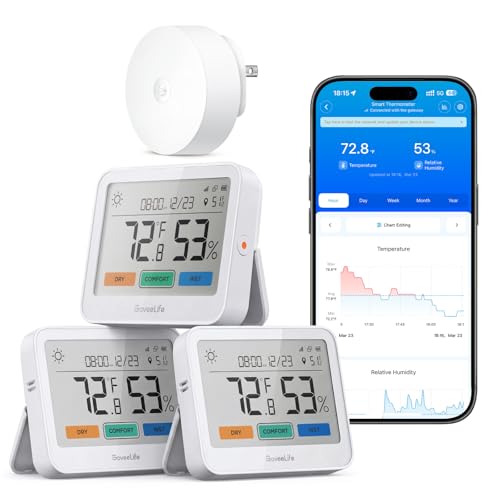
| GoveeLife H5107 | Weatherproof smart setup | ±0.54°F | Wi-Fi / 1,312 ft | 3 sensors | Amazon |
| GoveeLife H5220 | Largest display + forecast | ±0.36°F | Wi-Fi / 1,640 ft | 3 sensors | Amazon |
In-Depth Reviews
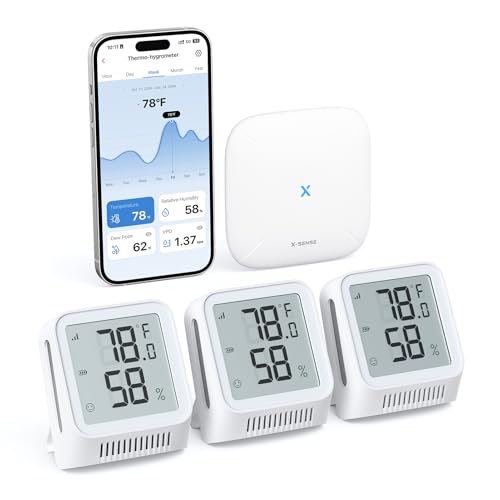
1. X-Sense Wi-Fi Thermometer Hygrometer with 3 Sensors
Our pick — over 4.5★ from 250+ verified ratings; the strongest balance of quality and price.
The smart pick that turns your phone into the display, with lab-grade Swiss sensor precision.
Its Swiss-made sensor delivers lab-grade precision that matches your thermostat. Its Swiss-made sensor reads temperature to ±0.36°F (between -4°F and 140°F) and humidity to ±2% — a five-fold accuracy jump over the Geevon’s ±1.8°F and a 2.5-fold edge on humidity. You feel that precision the first time you compare it to your thermostat and see them agree perfectly.
Setup is refreshingly quick — buyers report the whole system is running in under 30 minutes for four units. The base station links to your 2.4 GHz Wi-Fi (not 5 GHz), and a free app charts max, min, and average readings over time. You can invite up to 12 people to watch the same environment, which makes it a natural fit for checking on a wine cellar or a server closet from anywhere.
Alerts are genuinely useful: set a range and the base station sounds an alarm while your phone pings. It does not need a subscription, and the compact base is just 2.7″W x 3″H — smaller than the AcuRite 00831A2’s 5.5-inch length, so it tucks onto a shelf without dominating the room.
Why it wins: Functionality is what owners praise most here — and it shows in the app graphs, multi-user access, and reliable notifications that actually fire the moment conditions drift out of range.
Reach for this if: you want remote monitoring, history graphs, and phone alerts for a greenhouse, cellar, or home lab.
Think twice if: you only need a glanceable screen and never check a phone — this one shines through its app, not its buttons.
2. AcuRite 00831A2 Digital Thermometer
A no-frills workhorse that earns its keep in a livestock barn or on a workshop wall.
This AcuRite skips Wi-Fi and apps entirely, which is exactly the point. It shows indoor and outdoor temperature in Fahrenheit or Celsius with a trend arrow (a small icon telling you if temps are rising or falling) plus a daily minimum and maximum record. That is everything a barn manager needs before heading out in the cold.
The small outdoor sensor is easy to place, and the enhanced 433 MHz signal penetrates walls reliably. Owners mention it chugging along in livestock barns and gifting it to friends who just want to know the outside temp before opening the door. The display can be hard to read in some light, and accuracy gets mixed feedback, so treat it as a daily reference, not a lab instrument.
It answers the classic question “is it worth replacing just the sensor?” — customers note this full set costs barely more than a replacement sensor alone, making it the smart fix for a dead unit.
Best for: anyone who wants a simple, dependable readout without pairing, apps, or subscriptions.
skip it if: you need humidity readings or a backlit screen for a dark room.
3. Geevon Wireless Thermometer with 3 Remote Sensors
Three sensors on one 4-inch screen make this the affordable way to watch the whole property.
Most kits give you one remote sensor; this Geevon gives you three, each reading up to 200 feet away on a 433 MHz signal. That means you can watch the living room, the basement, and the backyard shed from a single 4″W x 5″H display. Each sensor has its own small LCD too, so you can peek at the number without walking to the base.
It tracks the past 24 hours of max and min records with trend arrows, and a comfort indicator flag tells you if a room is wet, comfortable, or dry. The outside sensor reads from -58°F up to 158°F, so it shrugs off brutal winters. Everything runs on 2 AA batteries in the base and 2 AAA in each sensor (not included).
The one recurring complaint is the lack of a backlight — the numbers are large and daylight-readable, but you will not be reading this one in a dark hallway. Owners running it in crawlspaces report remotes lasting 9–10 months before a battery swap.
What three sensors get you
- Watch 4 different places at once from one screen
- Audible hi/lo alarm on both temp and humidity
- Wide -58°F to 158°F outdoor measuring range
Where it stumbles
- No backlight on the display
- Accuracy is ±1.8°F, looser than premium rivals
Grab it for: whole-home or multi-building coverage on a budget, with audible alerts when the greenhouse gets too hot.
Pass if: you demand lab-grade precision for curing meats or a specific humidity target.
4. AcuRite 00754W4 with Self-Setting Clock
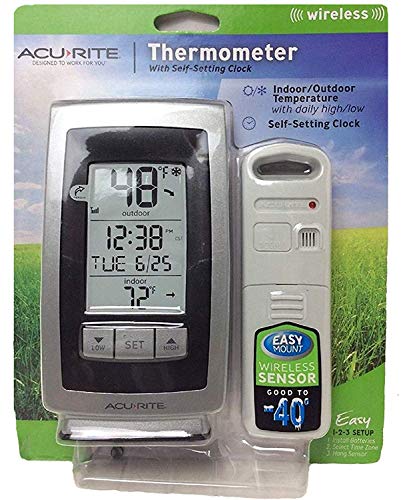
A trusted, repeat-buy favorite whose self-setting clock and daily records become a morning ritual.
This is the thermometer people buy twice. Owners describe starting their day with it, reading the daily high and low alongside a self-setting Intelli-Time clock and calendar (month, day, and day of the week) that adjusts itself for daylight saving — one less thing to fiddle with. The black-and-grey LCD keeps indoor and outdoor temperature in °F or °C, and it mounts on a tabletop or wall.
Long-term reviewers point out earlier versions lasting for years, which is why so many come back for another unit for a second room. Two units in the same house read consistently with each other, a quiet sign of dependable calibration. It is an outdoor-classified unit, so the sensor is built to sit outside and report back faithfully.
The flip side: it is a temperature-only device. There is no humidity reading and no backlight, so it is best in a well-lit spot where you glance rather than stare.
Pick it for: a dependable, self-maintaining clock-and-thermometer combo that has proven its longevity.
Move on if: you want smart alerts, humidity, or anything that connects to a phone.
5. TempPro TempAir PLUS TP260B
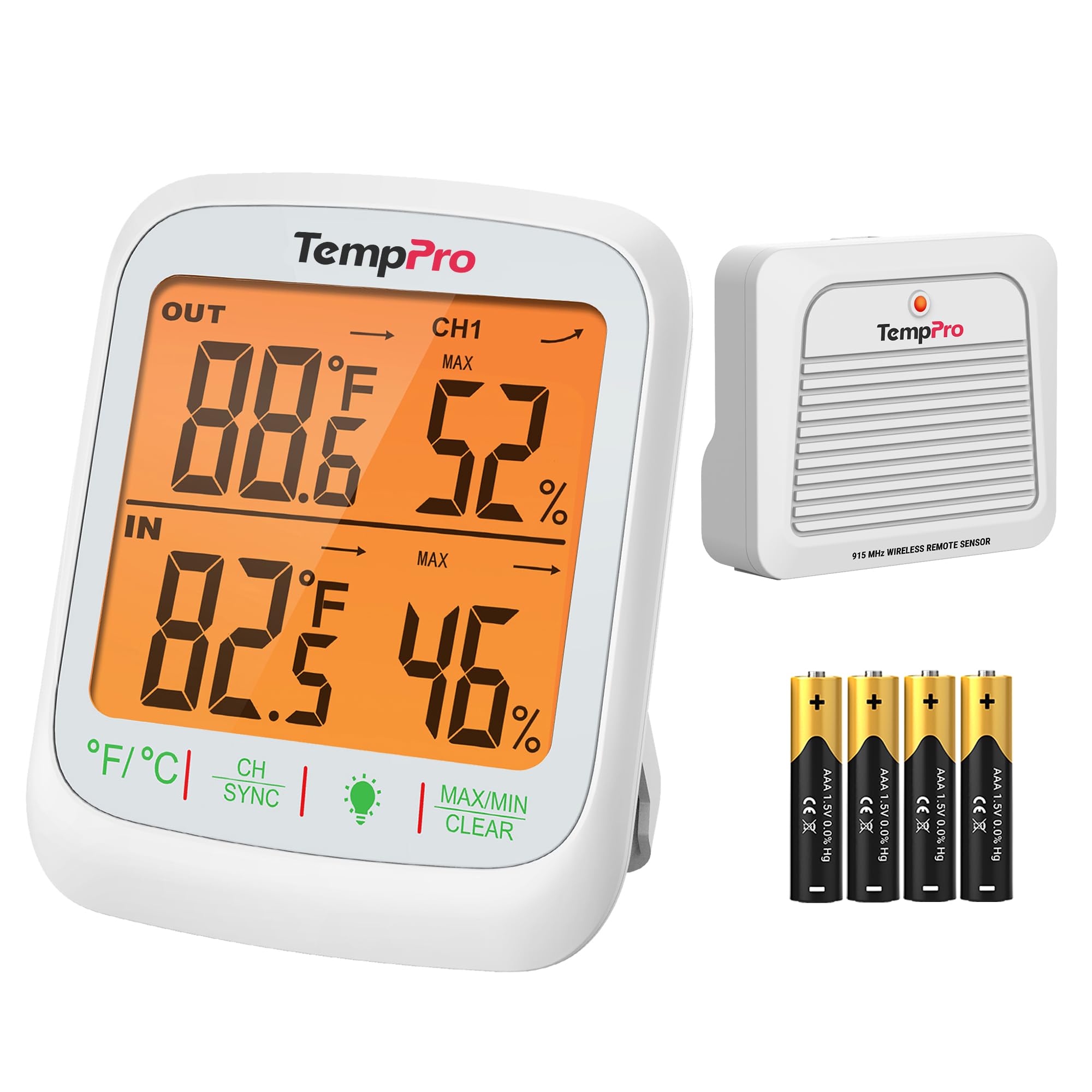
The long-distance champion that reaches the barn, greenhouse, or detached garage without a hub.
If range is your religion, this is your thermometer. It uses 915 MHz wireless to claim a 1,000-foot open-air connection, and owners confirm the hype — one runs it 125–140 feet through a house and greenhouse with no dropouts and no line-of-sight required. It locks on in under a minute, which is faster than most rivals.
Accuracy keeps pace with the reach: readings within ±0.5°F, which owners verify by matching NOAA weather station data within 1°F. A large backlit display (button-activated) keeps the numbers readable in a dark garage, and the built-in magnet, kickstand, and wall mount mean it sticks anywhere. Batteries for the sensor are included in the box.
The catch is real: the display runs on a built-in non-replaceable lithium battery that owners say needs a monthly recharge. That is fine for a desk, annoying for a wall you rarely visit. Humidity readings also run loose — as much as 10% off for some owners — so treat this as a temperature-first tool.
What wins people over: the range. Owners who watched three other brands fail are the loudest fans here — this one simply works where others drop.
Get it for: the far end of a big property, a greenhouse, or a camper where 1,000 feet of reach saves the day.
pass on it if: you hate recharging anything — the non-replaceable internal battery is a real chore.
6. La Crosse Technology 308-1415

A colorful, glow-in-the-dark display that you can read from across the room at midnight.
La Crosse builds this one to be seen. A multi-color LCD with an adjustable backlight (HI/LO/OFF) makes the large numbers visible in a pitch-dark bedroom, and owners say the colors and size beat the standard black-and-grey readouts. It is the rare thermometer you can read from across the room without walking over.
The outdoor sensor reads from -20°F with alkaline batteries and down to -40°F if you switch to lithium, so it holds up in genuinely cold climates. Indoor monitoring comes with trend arrows and daily high-low records. The base runs on the included 5.0V AC adapter with 4 AA batteries as backup — a thoughtful touch for power outages that owners specifically call out.
Accuracy earns mixed notes: most owners find it reliable, but a few report the outdoor reading drifting. A known quirk is the sensor occasionally dropping its connection at night; holding the minus button for 3 seconds re-pairs it. Treat it as a superb display-first thermometer for home or RV use.
Why the display wins
- Bright backlight with HI/LO/OFF settings
- Colorful, large numbers readable across a room
- AC adapter saves batteries, with AA backup
What to watch
- Sensor can drop connection at night occasionally
- Outdoor accuracy gets mixed feedback
Buy it for: a bedroom or living room where you want the temp visible at a glance, day or night.
Steer clear if: you need app access, humidity data, or multiple remote sensors.
7. GoveeLife Outdoor Indoor Wi-Fi Gateway Thermo-Hygrometer
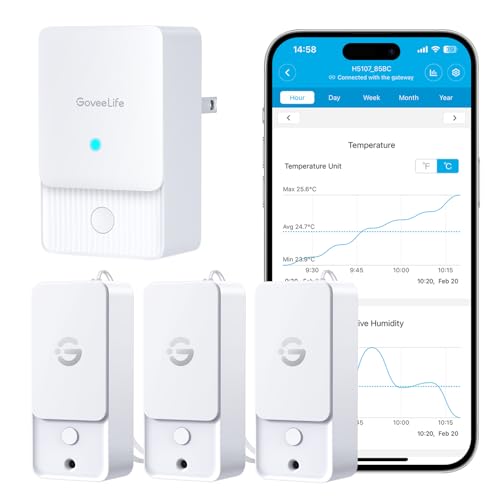
Weatherproof sensors that survive the rain and feed your phone from over 1,300 feet away.
This GoveeLife kit is built for the outdoors, literally. Each of the three included sensors carries an IP65 waterproof rating (meaning it shrugs off rain and hose spray) and uses LoRa technology to reach the gateway from up to 1,312 feet. Owners have put these in separate buildings and tracked each one from a phone — one runs it at -33.7°F in Alaska and reports it still working after four months of deep freeze.
Accuracy is strong at ±0.54°F for temperature and ±3% RH for humidity. The app sends instant alerts when your comfort zone is breached, and two AAA batteries are said to power each sensor for a year. A single gateway can pair with up to 30 sensors, so this scales from a backyard to a small farm.
The gateway is bulky and may block an adjacent outlet, and it requires 2.4 GHz Wi-Fi with a stable connection. Connectivity and accuracy both get mixed owner feedback, so count on it as a reliable daily monitor rather than a lab instrument.
What owners trust: reliability is the top praise here, with temperature monitoring across multiple buildings close behind — this is the set for people who need eyes on several structures.
Reach for it if: you want rugged, waterproof sensors on a patio, greenhouse, or outbuilding with phone alerts.
it’s not for you if: your Wi-Fi is weak or your outlet space is tight — the gateway is a real footprint.
8. GoveeLife WiFi Thermometer Hygrometer 5-in-1 H5220
A 5-in-1 station with a huge 3.7-inch screen, local weather forecast, and alerts on four channels.
This is the closest thing to a full weather station in the lineup. The “5-in-1” badge means one device handles real-time trends, a color-coded comfort indicator, and a local weather forecast (which needs the H5044 gateway) — replacing several gadgets on your shelf. The 3.7-inch high-contrast LCD is the biggest and most readable display here, with wide viewing angles that suit elderly family members who just want to glance at the wall.
Precision is the headline: a premium sensor delivers ±0.36°F and ±2% RH accuracy, measuring from -4°F to 140°F with a rapid 2-second refresh. That level of precision is why owners trust it for greenhouses, cigar humidors, and reptile terrariums. The range stretches to a class-leading 1,640 feet open-air through the gateway, penetrating thick walls and basements.
Alerts fire on four levels — push, app, email, and a gateway buzzer — so a dangerous swing in a wine cellar wakes you up no matter where you are. Two AA batteries are said to run it up to 2 years on Bluetooth or 1 year with the gateway. The trade-off: connectivity gets mixed feedback, with some owners reporting occasional sensor dropouts, so the wireless is great when it settles but can need a re-sync.
The station experience
- Biggest display in the lineup at 3.7 inches
- ±0.36°F accuracy with 2-second refresh
- 4-level alerts including email and buzzer
Know before you buy
- Connectivity is mixed — occasional sensor dropouts reported
- Local weather forecast requires the separate H5044 gateway
Choose this if: you want one premium station with a huge screen and lab-grade precision for a nursery or wine room.
Look elsewhere if: you are not ready to troubleshoot the occasional wireless hiccup — simpler RF models just work.
Understanding the Specs
Temperature accuracy (±°F)
This is the number that tells you how honest the reading is. A spec like ±1.8°F means the true temperature could be up to 1.8 degrees warmer or colder than shown. Premium sensors like the X-Sense and GoveeLife H5220 tighten that to ±0.36°F — a five-fold jump in trust that matters for wine cellars, reptile terrariums, and curing spaces.
Wireless range and signal type
Range is how far the outdoor sensor can sit from the display. Basic models use 433 MHz radio waves to reach about 200 feet. Long-range specialists like TempPro stretch to 1,000 feet on 915 MHz, and Wi-Fi gateways from GoveeLife push past 1,300 feet. Remember: walls, metal, and distance all shrink that number, so buy more range than you think you need.
RF vs Wi-Fi connectivity
RF (radio frequency) thermometers are the simple ones — the sensor and display talk directly to each other, no internet required, no app, no passwords. Wi-Fi models route through your home network and a phone app, which open up remote monitoring and alerts but adds a catch: they only work on 2.4 GHz Wi-Fi, not the faster 5 GHz band many modern routers use.
Hygrometer and multi-sensor kits
A hygrometer measures humidity, which matters for greenhouses, basements, and baby rooms where moisture swings are as important as temperature. Kits with 3 remote sensors let you watch multiple rooms or buildings from one display. Accuracy on humidity typically lands between ±2% and ±5% — the lower number is the premium grade.
FAQ
Will a wireless thermometer work through walls?
Why does my smart thermometer need 2.4 GHz Wi-Fi instead of 5 GHz?
How long do the outdoor sensor batteries last?
What does a trend arrow tell me?
Is a Wi-Fi thermometer worth it over a simple RF model?
What is the difference between temperature accuracy and humidity accuracy?
Can I use one thermometer to monitor multiple rooms?
How cold can the outdoor sensor get before it stops working?
What does a comfort indicator do?
Final Thoughts: The Verdict
For the majority of shoppers, the best wireless indoor-outdoor thermometer is the X-Sense STH0A31 because it pairs the tightest ±0.36°F accuracy with genuinely useful phone alerts, history graphs, and a free app — the crowd favorite for good reason. If you want a huge readable screen and lab-grade precision for a nursery or wine room, grab the GoveeLife H5220. And for the far reaches of a big property with zero apps to fuss with, the TempPro TempAir is the one to reach for. Pick the one that matches how you will actually check the temperature — glance, graph, or gadget — and you will not be disappointed.
How We Picked
We do not accept paid placement. Every pick is matched to a real buyer and a real use-case; we do not hands-on test units.
Sources & Methodology
Specifications: manufacturer listings and product documentation. Review insights: verified customer reviews, as of August 2026. Pricing: not shown on this page (it changes often); check the current price via the retailer link.
As an Amazon Associate, Calories Fit earns from qualifying purchases. This does not affect which products we feature.