
Our readers keep the lights on and the coffee maker working hard! As an Amazon Associate, I earn from qualifying purchases.
Specs are compiled from manufacturer listings and verified buyer reviews and can change over time — please confirm the key details on the product page before buying.
Rolling out pastry on a bare countertop is a messy gamble — dough sticks, flour scatters, and you have no guide for size. A dedicated wooden pastry board solves that, giving you a smooth, stable canvas with etched measurements that turn guesswork into precision. The best design keeps your knives sharp, your countertops clean, and your pie crusts perfectly round.
I’m Mohammad — the founder and writer behind Calories Fit. This guide is built by comparing the manufacturers’ published specifications and the patterns across verified customer reviews, so you get each pick’s real strengths and trade-offs instead of marketing spin.
Here are nine of the best current options on the market, from budget-friendly bamboo boards to heirloom-quality acacia slabs. Use this breakdown to find the right wooden pastry board for your baking style and kitchen space.
Our Picks at a Glance


How To Choose The Best Wooden Pastry Board
A wooden pastry board is more than just a flat piece of wood. It needs to be large enough for rolling dough, stable enough not to slide, and gentle on your knives. The right choice depends on wood type, dimensions, and extra features.
Wood Type: The Foundation of Performance
The wood determines hardness, moisture resistance, and how well the board stands up to daily use. Teak is naturally oily and water-resistant, making it low-maintenance and good for heavy chopping. Acacia is dense and tough with a dramatic grain pattern, but it needs regular oiling to prevent cracking. Bamboo is a renewable, hard-wearing material — though it can be harder on knife edges than softer woods. Rubber wood is a smooth, polished option that feels solid without being too heavy. Match the wood to your usage frequency, as each type feels different under the knife.
Board Dimensions: Size and Thickness Matter
A standard pastry board should be at least 18 inches long to roll out a full pie crust without dough hanging off the edge. Boards around 20 x 24 inches are ideal for bread bakers kneading large batches. A board 0.75 inches or thinner is lightweight and easy to store but may feel flimsy during heavy rolling. Boards over 1 inch thick feel solid and stable but are heavy and harder to wash.
Quick Comparison
| Model | Best For | Material | Dimensions | Thickness | Amazon |
|---|---|---|---|---|---|
| Socisen Teak Board★ Best Overall | Value | Teak | 17″ x 12″ | 0.8″ | Amazon |
| Totally Bamboo Baker’s BoardAlso Great | Baking & Carving | Bamboo | 18″ x 12.5″ | 0.63″ | Amazon |
| Ironwood Gourmet Acacia BoardPremium Pick | Heirloom Quality | Acacia | 24″ x 17.25″ | 1.25″ | Amazon |
| EDELHAUS Acacia Board | All-Purpose | Acacia | 17.1″ x 12.8″ | 0.8″ | Amazon |
| GAOMON Acacia Board | Extra Large Surface | Acacia | 24″ x 18″ | 1.2″ | Amazon |
| Conflech Teak Board | Large Batch Prep | Teak | 20″ x 14″ | 0.78″ | Amazon |
| Elihome Wood Fiber Board | Dishwasher Ease | Wood Fiber | 18″ x 15″ | 0.25″ | Amazon |
| Montex Rubber Wood Board | Precision Baking | Rubber Wood | 23.5″ x 19.5″ | 1.5″ | Amazon |
| Montex XL Pastry Board | Max Rolling Space | Rubber Wood | 24″ x 20″ | — | Amazon |
In‑Depth Reviews
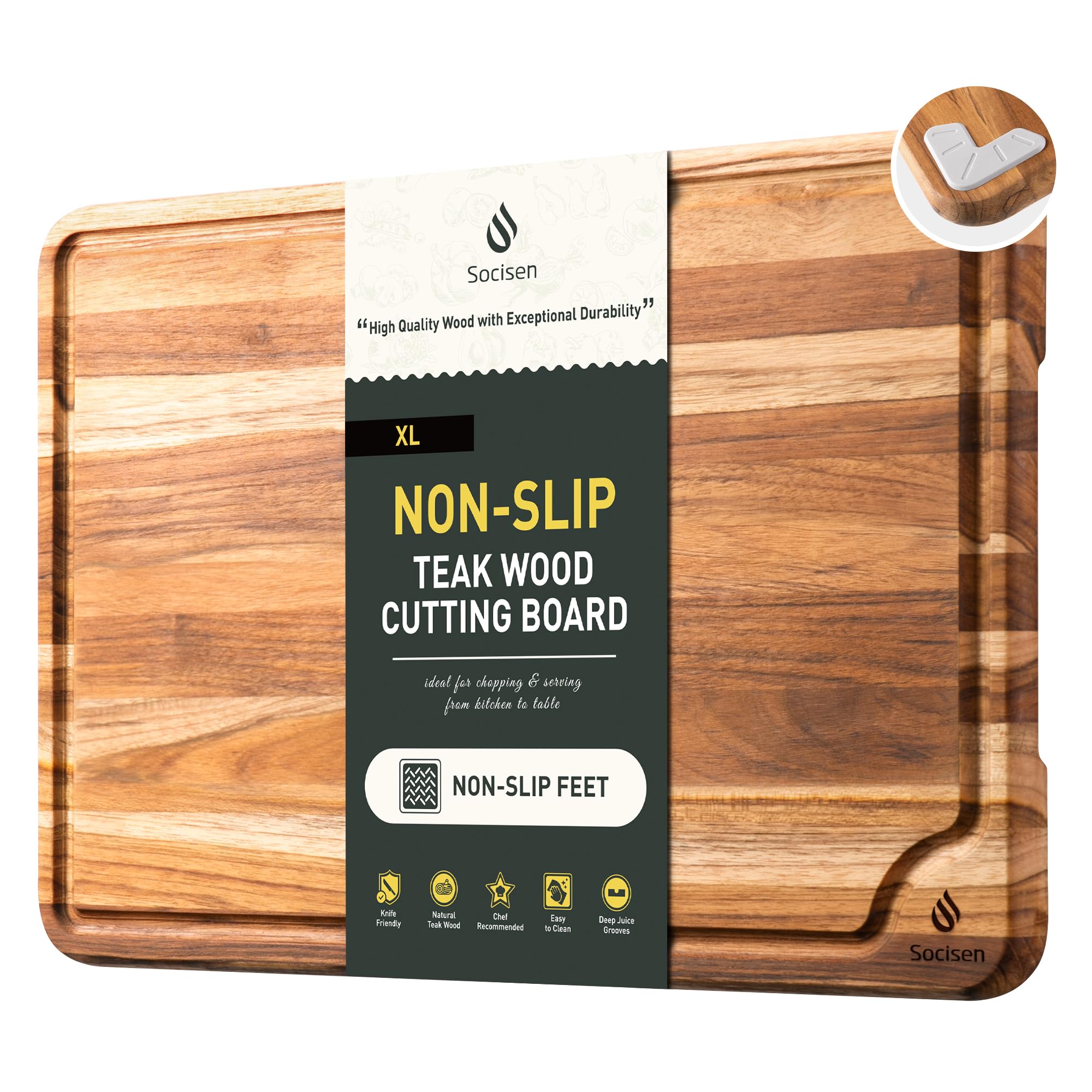
1. Socisen Teak Wood Cutting Board for Kitchen, 17″ x 12″
Our pick — 4.5★ from 600+ verified ratings; the strongest balance of quality and price.
Budget-friendly teak that outperforms many boards at twice the price.
Teak wood is naturally moisture-resistant and food-safe, and this board from Socisen gives you that tropical-wood advantage at a very accessible price point. It measures 17 inches by 12 inches with a 0.8-inch thickness — a solid, substantial feel without the weight of a thick butcher block. The board includes a non-slip base and rounded edges that are comfortable to grip, and buyers report it has deep juice grooves that work well for both carving and rolling dough. In fact, several owners mention they have used it “often since December” with no warping, calling it “high quality, thick, and sturdy.”
The FSC-certified teak means the wood comes from responsibly managed forests, which is a nice bonus for eco-conscious shoppers. The board is not dishwasher safe (hand wash only with regular dish soap), and occasional oiling is recommended to keep the teak looking fresh. Durability receives mixed feedback in the long term: while many say it should last a long time, a small number of owners mention cracking after a month of use. For the price, however, the build quality and aesthetics — a natural, warm wood grain — are tough to top. It is a strong mid-range option that punches above its price tier.
Value Proposition
- FSC-certified teak wood is naturally moisture-resistant and food-safe with no coatings or finishes.
- 0.8-inch thickness feels solid without being overly heavy or bulky.
- Non-slip feet keep the board stable during active chopping or kneading.
Watch Out For
- Hand-wash only and needs periodic oiling to maintain the wood and prevent drying.
- Durability is a mixed topic; a minority of customers note boards cracking within a month.
- At 17 inches long, it is a bit smaller than the Totally Bamboo board, which may feel tight for large pastry projects.
Best for: Shoppers who want genuine teak wood quality at a budget-friendly price — great for everyday chopping and occasional pastry work.
Not for you if: You need a larger rolling surface or want a board that is truly zero-maintenance without any oiling required.
2. Totally Bamboo Reversible Baker’s Board and Carving Butcher Block with Juice Grooves
The baker’s best friend — a reversible board that cuts and rolls in one piece.
This is the board that does double duty without compromise. One side is flat and engraved with measurement guidelines for rolling out pastries, much like a pastry mat, plus a conversion chart for common baking conversions. The reverse side features a built-in juice groove around the exterior to capture juices from meat and fruit, making clean-up easier after carving. At 17.95 inches long by 12.5 inches wide, the size is generous enough for most baking tasks without overwhelming your counter space, though it is narrower than the larger rubber wood boards on this list.
The board is made from Moso bamboo, a renewable resource that is incredibly durable yet lightweight — users note it is easy to lift and store. The 0.63-inch thickness strikes a nice balance of being substantial enough for kneading without being too heavy. Home bakers and pasta makers in particular praise its performance, with one noting they use it several times a week for all kinds of dough. The only minor complaint is that the printed measurement guides can be light and hard to read in dim kitchens. The quality and versatility make this the most practical choice for the average baker.
Baking-First Design
- Reversible: pastry measurements on one side, juice groove on the other for carving.
- Lightweight and scratch-resistant — easy to handle and maintain.
- Moso bamboo is a fast-growing, renewable material with a smaller environmental footprint.
Trade-Offs to Consider
- Measurement printing can appear faint, especially in low light.
- At 0.63 inches thick, it is thinner than premium wood boards, which some heavy rollers notice.
- Bamboo is harder than teak or rubber wood, so it may dull knives slightly faster over time.
The right board for: Home bakers who want one board for pastry rolling and carving — the versatility and lightweight feel win out over thicker, heavier options.
Think twice if: You do most of your baking under dim light where faint print is a problem, or you prefer a solid heft for aggressive kneading.
3. Ironwood Gourmet Double-Sided Countertop Lyon Pastry/Cutting Board With Gravy Groove
Heirloom acacia with a lip that locks onto your counter — no sliding, no fuss.
This is the board that feels like an investment. Crafted from sustainably harvested acacia wood with unique contrasting grain patterns, it measures 24 inches by 17.25 inches — an extra-large surface that gives you room to roll out full pie crusts or knead two loaves side by side. The defining feature is the attached wooden lip at the front and back that goes over the edge of your counter, keeping the board stationary while you work. This is noticeably more secure than relying on rubber feet, especially during vigorous kneading.
The reversible design gives you a flat side for pastry and a grooved side with a juice groove for carving meat. At 1.25 inches thick, it is substantial — it weighs 11.4 pounds, so storing it requires commitment. Owners praise the craftsmanship and appearance, calling it a “phenomenal product” for its solid wood construction and lifetime quality. The board does need periodic oiling with butcher block oil to preserve the wood, and some users note it can shift slightly on very smooth counters if the lip is not fully engaged. For serious bakers and cooks who want one board that does everything and lasts, this is the high-end choice.
Secure & Spacious
- Front and back counter lip prevents all sliding during use — a standout for kneading.
- Extra-large 24″ x 17.25″ surface handles large batches of dough and big roasts.
- Reversible with juice groove for carving; solid acacia wood with unique grain patterns.
Considerations
- At 11.4 pounds, it is heavy and not easy to store or wash in a sink.
- Acacia needs regular oiling to prevent cracking and maintain its appearance.
- On very slick countertops, some owners use a non-skid cloth underneath for extra grip.
Best for: Dedicated home bakers and cooks who want a large, stable work surface that doubles as a carving board — and who don’t mind the weight and maintenance.
Not ideal if: You have limited counter space or storage, or you prefer a lightweight board you can stow in a drawer.
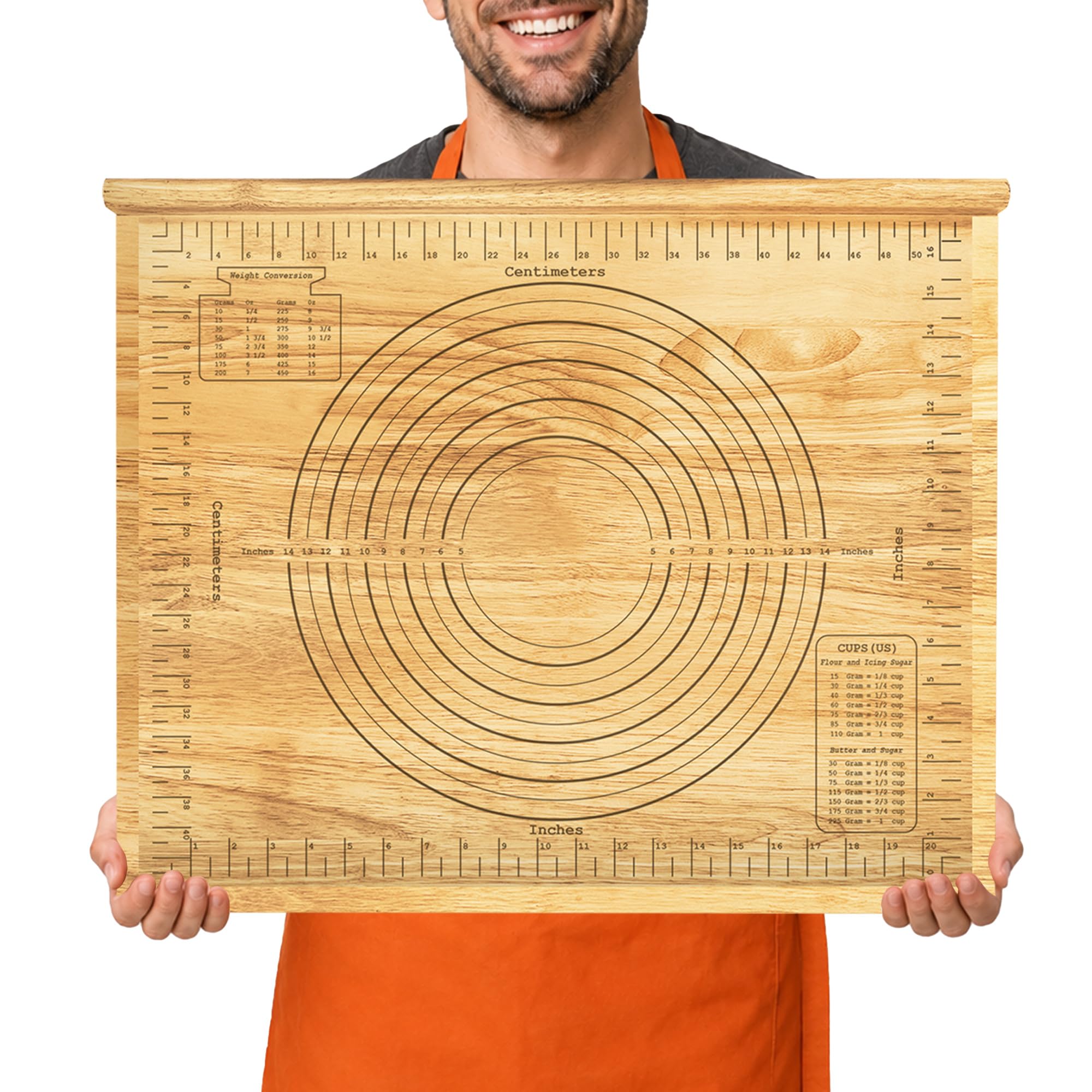
4. Montex Wooden Pastry Board with Measurement, 23.5″ x 19.5″ Kneading Board
A precision baking station with laser-etched measurements that eliminate guesswork.
Baking is about accuracy, and this board from Montex delivers with laser-engraved square and circular guides on one side — so you roll dough to the exact size your recipe calls for every time. It even includes reference conversions for flour and sugar (grams to cups) and weight (grams to ounces) baked right into the surface. The reverse side is a smooth, durable cutting board for chopping vegetables or slicing meat. In short, it packs a reference library into a single wooden surface.
Made from premium rubber wood, the board is 1.5 inches thick — one of the thickest on this list — giving it a satisfying, solid feel during heavy kneading. It measures 23.5 inches by 19.5 inches, so it is large enough to cover a glass cooktop or island. The sturdy side lip prevents the board from sliding and helps contain flour and loose dough. Some owners note that the raised markings on the measured side can imprint onto very soft dough, which is a trade-off for the precision. The performance is clear: multiple buyers call it a “standout” for dough work compared to standard counters, especially for bread and pie crusts.
Baking Precision
- Laser-etched measurements (square, circular, and gram/ounce conversions) built into the surface.
- Extra-thick 1.5-inch rubber wood provides a stable, non-bouncy surface for kneading.
- Side lip design prevents sliding and keeps flour contained on the board.
Points to Note
- Raised measurement markings can transfer onto very soft or wet dough.
- Heavy and large — washing it in a standard sink is a squeeze, and storage space is required.
- Some users found the board slides side-to-side on smooth counters; a silicone mat underneath solves it.
Reach for this if: You are a precision baker who wants measurement guides always in view — the laser etching saves time and reduces recipe errors.
skip it if: You need a lightweight board you can stash away, or you worry about dough sticking to the engraved surface.
5. GAOMON 24 x 18 In Acacia Cutting Board for Kitchen

A massive 24-inch acacia slab that doubles as a stove-top cover and pastry station.
If counter space is tight, this board is a space-maker: at 24 inches by 18 inches, it can sit directly over a gas or electric stovetop, giving you an instant extra work surface. It is made from acacia wood with a 1.2-inch thickness — the thickest board on this list at nearly an inch and a quarter — so it feels very solid and substantial under a rolling pin. The built-in juice groove along the edges catches liquids from cutting, and the reversible surface lets you chop on one side and roll on the other, reducing cross-contamination.
Owners appreciate the size for tasks from bread-baking to noodle-making, with one buyer saying it fits perfectly on their gas stovetop and is “perfect for increasing counter space.” The wood grain is attractive, though some boards may have color variations since each is made from real acacia. The recurring negative is durability: some reviewers point out the board coming apart at the seams or not being solid wood throughout, which suggests it is a glued-construction board rather than a single slab. Others find it heavy — it weighs over 9 pounds — so moving it around takes some effort. For the price, the sheer surface area is hard to match.
Massive Surface
- 24″ x 18″ surface fits over most stovetops, adding counter space where you need it most.
- 1.2 inches thick — very sturdy and stable for aggressive kneading and rolling.
- Reversible with juice groove; handles everything from pizza prep to turkey carving.
Durability & Weight
- Some shoppers say boards splitting or separating at glued seams over time.
- Heavy and cumbersome — not easy to wash in a sink or store in a standard cabinet.
- Acacia grain varies between boards, and some units arrive with lighter coloration than expected.
Best suited for: Home cooks who need a large, stable work surface and want to cover a stovetop — the size is the main draw here, and it delivers on that front.
Consider alternatives if: You want a solid single-piece board or need something light enough to move around the kitchen frequently.
6. Elihome Essential Baking Pastry & Cutting Board, Wood Fiber, 15″ x 18″

Wood fiber that goes in the dishwasher — no oiling, no warping, no microplastics.
Traditional wood boards require hand washing and regular oiling, but this board from Elihome is made from high-density wood fiber that is dishwasher safe and non-porous. It can withstand temperatures up to 350°F, so it doubles as a trivet for hot pots straight from the oven. At 18 inches by 15 inches, it offers a healthy work area without taking over your counter. The board features laser-engraved pastry measurements, a juice groove, and a roller pin rest groove that keeps your workspace tidy — flour, crumbs, and liquids stay captured rather than spilling over.
Non-slip feet on the ends keep it steady during use, and the material is knife-friendly while being harder than solid wood, so it shows fewer cut marks. Owners love the no-plastic construction and ease of cleaning, with one user saying it is “perfect for cutting veggies” and another calling it a “useful non plastic cutting board.” The board is thin — just 0.25 inches — which makes it lightweight (2 pounds) but it also creates a louder, bouncier sound when cutting compared to thick boards. Some users report visible slice marks on the surface, especially when wet, and it may dull knives over time. The 2-year warranty provides some confidence.
Low-Maintenance
- Dishwasher safe — no hand washing, no oiling, no special care required.
- Heat resistant up to 350°F, so it doubles as a trivet under hot pans.
- Laser-engraved pastry measurements and roller pin rest groove for cleaner baking.
Trade-Offs
- At 0.25 inches thin, it is less absorbent than solid wood but produces a louder cutting sound.
- Visible knife marks appear more easily on the surface, especially when wet.
- The wood fiber material can be harder on knife blades over prolonged use compared to teak or rubber wood.
Pick this if: You value convenience above all — the dishwasher-safe feature and trivet functionality make it a practical choice for everyday baking and meal prep.
Look elsewhere if: You prefer the traditional feel and sound of a thick solid-wood board, or you need a surface that absorbs impact for heavy chopping.
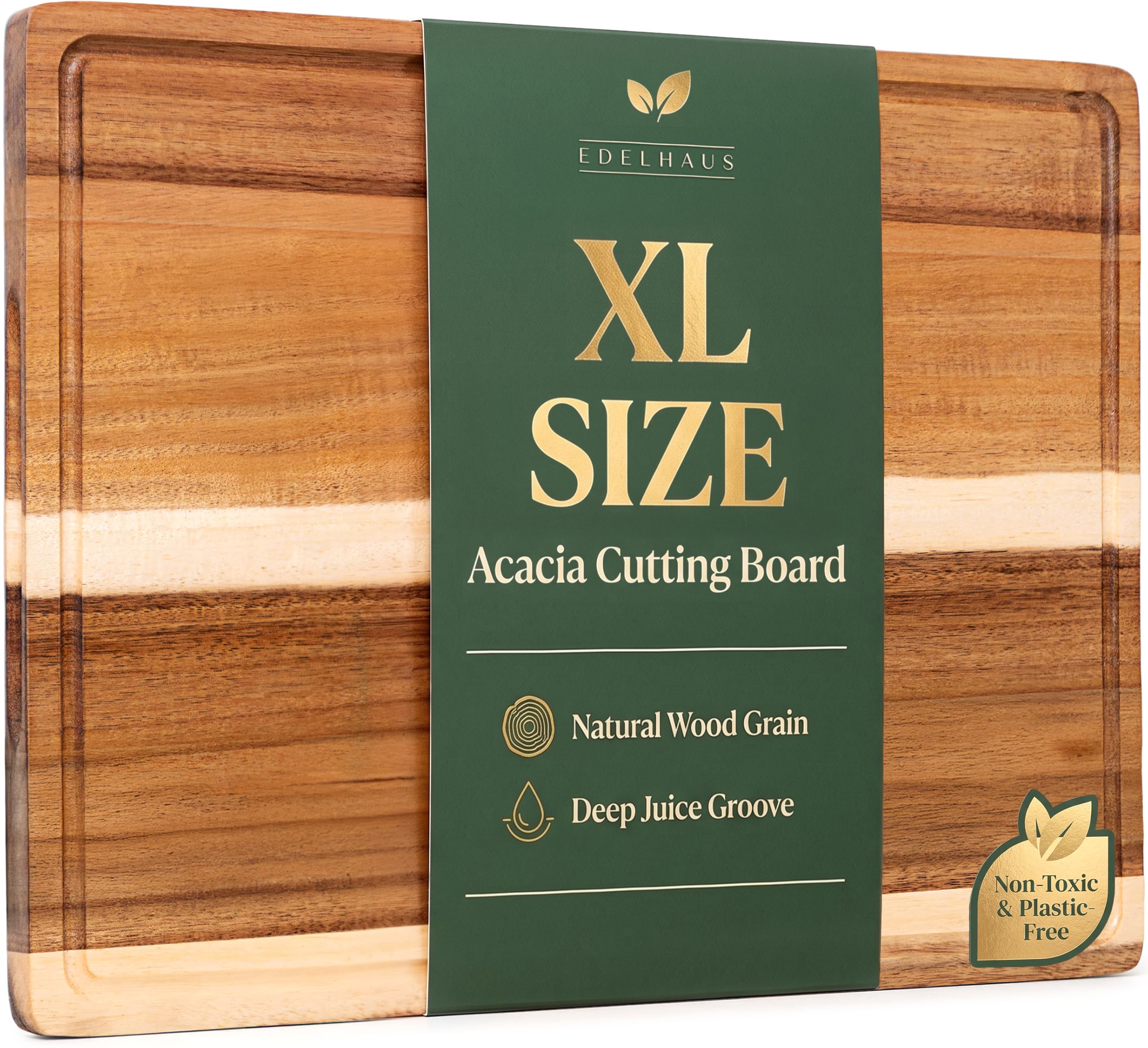
7. EDELHAUS Extra Large Acacia Wood Cutting Board 17×13, Juice Groove
Shoestring budget, rich acacia — the board that surprised everyone.
For under thirty dollars, this EDELHAUS board brings a 17.1-inch by 12.8-inch acacia work surface into your kitchen. It is 0.8 inches thick — the same thickness as the Socisen teak board — giving it a satisfying heft without being unmanageable. The board features a deep juice groove, non-slip feet, and side handle grooves that make it easy to lift and carry. It is double-sided, so you can use the juice groove side for carving and the flat side for rolling dough or chopping vegetables.
Acacia is naturally dense and moisture-resistant, and owners are overwhelmingly positive: one buyer sums it up by saying, “Literally could not be any happier! The wood grain, the thickness, the heaviness, the quality, everything is on point.” Another used this board for extending counter space in a travel trailer, which speaks to its versatility. The single-board design means you get one large surface rather than a multi-pack, so there is no backup board if you need to work with multiple ingredients. For the price, this is a genuinely impressive piece of kitchen gear that outperforms many boards costing three times as much.
Affordable Acacia
- Solid 0.8-inch thick acacia with a beautiful wood grain and deep juice groove.
- Non-slip feet and side handle grooves make it stable and easy to maneuver.
- Reversible surface — use the flat side for pastry, the grooved side for carving.
Keep in Mind
- Appearance gets mixed reactions; some buyers find the finish less attractive than expected.
- Single board — no multi-pack, so you only get one surface to work with.
- Acacia requires occasional oiling to maintain its resistance to moisture and cracking.
Buy this if: You are on a tight budget but want genuine acacia wood quality — the value-to-performance ratio here is excellent.
Pass if: You want a larger board for heavy pastry work, or you prefer a teak wood for its natural moisture resistance without extra maintenance.
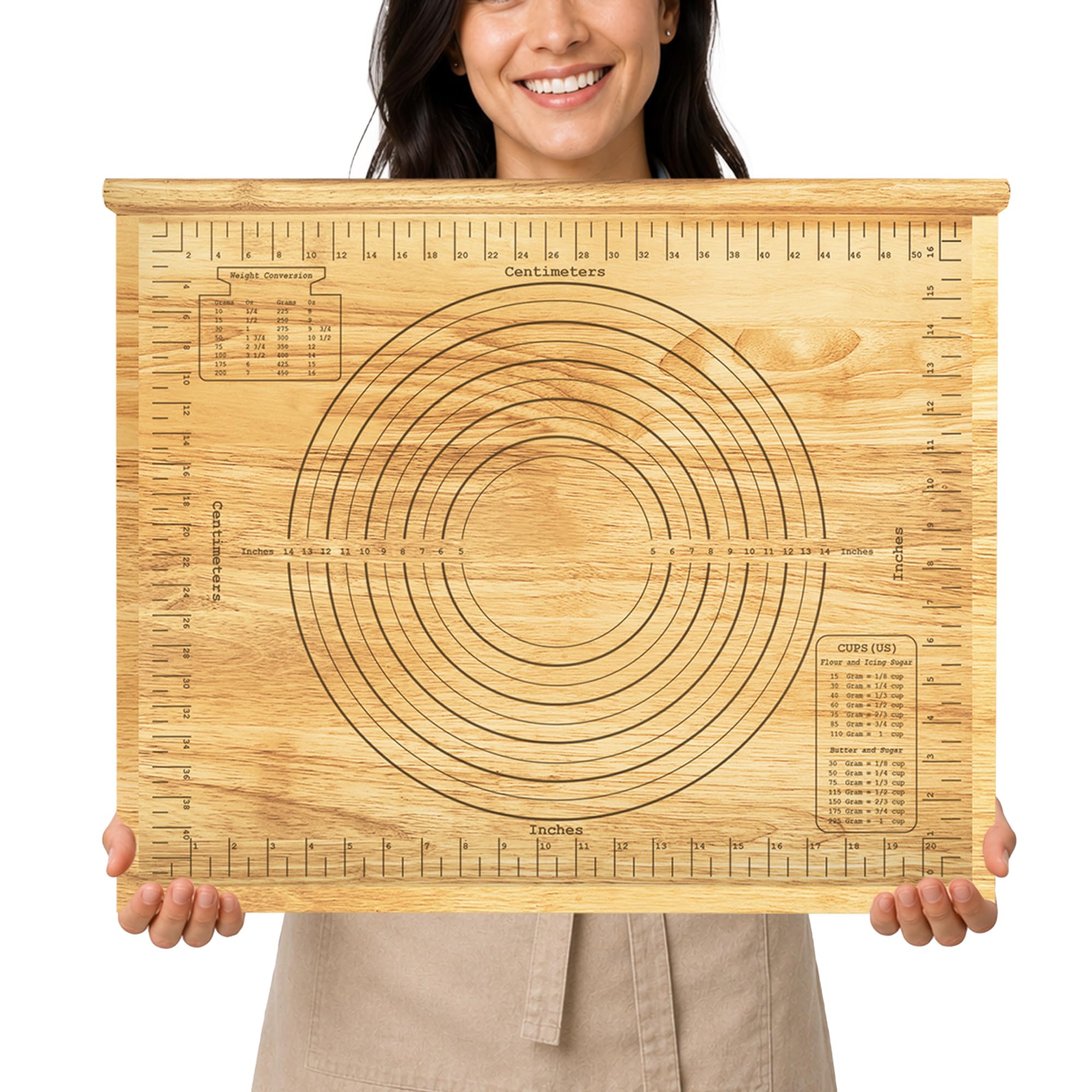
8. Montex Extra Large Pastry Board, 24” x 20” Wood Dough Rolling Tray
The biggest rubber-wood board in the lineup — a full 24 by 20 inches of rolling real estate.
If you have ever tried to roll out a pie crust on a cramped surface, this board is the solution. At 24 inches by 20 inches, the Montex XL offers the largest rolling surface in this roundup, giving you plenty of room for two-crust pies, large batches of pizza dough, or multiple cookie sheets worth of rolled dough. Like its smaller sibling from the same brand, it is made from rubber wood with a smooth, polished finish that is easy to clean and gentle on knives. The side lip design prevents sliding and keeps flour and loose dough contained.
The board includes laser-engraved measurements on one side with both square and circular guides, as well as flour/sugar gram-to-cup and ounces conversions. It is reversible, so the other side is a plain cutting surface. A handful of buyers reported minor rough spots that sanded down easily, but most agree this is a “good working surface in a good size.” It weighs more than 10 pounds, so it is not a board you will move around lightly. For bakers who value surface area above all else, this is the obvious choice.
Maximum Space
- 24″ x 20″ surface gives you the largest work area available in this list — ideal for big batches of dough.
- Laser-engraved guides and conversion chart on one side for precision baking.
- Sturdy rubber wood with a polished, easy-to-clean finish and a lip that stops sliding.
What to Expect
- Very heavy — expect to leave it on the counter rather than storing it away.
- Some boards may arrive with minor rough patches that need light sanding before first use.
- Similar to the smaller Montex board, the raised markings can imprint into soft dough.
Go for this if: You are a bread or pizza maker who needs every inch of counter space for rolling and kneading large batches.
pass on it if: You have limited counter space and a heavy, oversized board would become an obstacle rather than a tool.
9. Conflech XXLarge Teak Cutting Board, 20″ x 14″
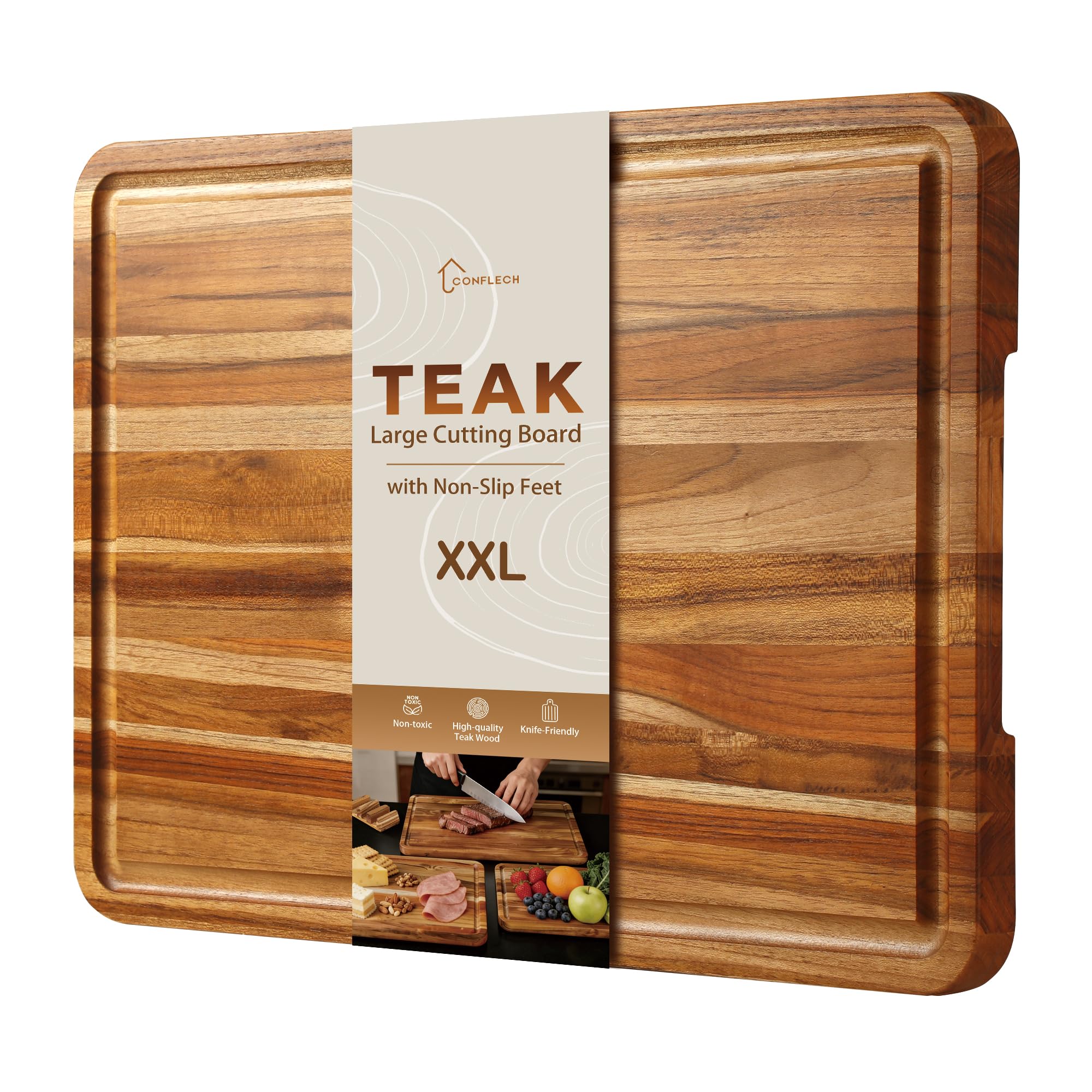
Teak that goes the distance — 20 inches of moisture-resistant work surface.
This Conflech board takes the advantages of teak — natural moisture resistance, food-safe without coatings, beautiful wood grain — and scales it up to a 20-inch by 14-inch surface. That is a significant upgrade over the 17-inch Socisen teak board, at 20 inches long versus the Socisen’s 17 inches, giving you more room for rolling out larger sheets of dough or handling a whole roast. The 0.78-inch thickness is nearly identical to the Socisen board, so that extra surface area does not come with a big weight penalty.
Like the Socisen board, it is FSC-certified and comes with a non-slip base for stability. Owners praise the appearance and quality, noting the beautiful wood color after oiling. The board does develop visible scratch marks over time — as wood boards do — but some units include sandpaper for smoothing things out. At this price tier, it sits between the budget Socisen board and the premium options, offering the size advantage for large-meal prep without the maintenance demands of acacia. For anyone who wants a mid-priced teak board with a bigger footprint, this is the balance.
Teak Advantages
- 20″ x 14″ surface is 6% longer than the Socisen board, giving more room for large batches.
- FSC-certified teak with natural moisture resistance and no added coatings or plastics.
- Non-slip base and rounded edges provide a comfortable, stable work surface.
Things to Note
- Teak will develop knife marks over time; some owners use included sandpaper to refinish.
- Hand-wash only and requires occasional oiling to keep the wood from drying out.
- Weight is moderate at 5 pounds, but the 20-inch length may not fit in all standard sinks.
Best suited for: Home cooks who want a larger teak surface for batch cooking and heavy chopping — the teak handles moisture better than acacia with less maintenance.
Consider alternatives if: You need a board small enough to stow easily, or you are looking for the absolute largest surface area (the Montex rubber wood boards offer more square inches).
Understanding the Specs
Wood Density & Knife Wear
Harder woods like bamboo and acacia resist scratches better but can dull knife edges faster. Softer woods like rubber wood are gentler on your knives but show cut marks more easily. Teak sits in the middle — it is dense enough to last but has natural oils that reduce friction on blades. If you use high-end knives, a rubber wood or teak board is often the better choice over bamboo.
Juice Grooves vs. Flat Surface
A juice groove is a channel cut around the board’s perimeter that catches liquids from meat, fruit, or vegetables. Boards with deep juice grooves are ideal for carving roasts or slicing juicy fruit. For pastry work, a flat surface is better — a groove can interfere with rolling dough evenly. Many boards are reversible, giving you a grooved side for meat and a flat side for dough, which is the most versatile configuration.
FAQ
What is the best wood for a pastry board?
How thick should a wooden pastry board be?
Can I put my wooden pastry board in the dishwasher?
How often should I oil my wooden pastry board?
What size pastry board do I need for a full pie crust?
Can I use a wooden pastry board for chopping meat and vegetables too?
What is the difference between a pastry board and a cutting board?
Do wooden pastry boards absorb odors or stains?
Are laser-engraved measurements on a pastry board permanent?
Can I cut directly on a wooden pastry board without damaging it?
Final Thoughts: The Verdict
For most buyers, the best wooden pastry board is the Totally Bamboo Reversible Baker’s Board because it packs pastry measurements, a juice groove, and lightweight bamboo construction into one versatile, affordable package. If you want a large, stable board for serious kneading and carving, grab the Ironwood Gourmet Lyon Pastry Board. And for those on a budget who still want quality acacia wood, the EDELHAUS Acacia Cutting Board delivers more value than its price suggests.
How We Picked
We do not accept paid placement. Every pick is matched to a real buyer and a real use-case; we do not hands-on test units.
Sources & Methodology
Specifications: manufacturer listings and product documentation. Review insights: verified customer reviews, as of July 2026. Pricing: not shown on this page (it changes often); check the current price via the retailer link.
As an Amazon Associate, Calories Fit earns from qualifying purchases. This does not affect which products we feature.