
Our readers keep the lights on and the coffee maker working hard! As an Amazon Associate, I earn from qualifying purchases.
Specs are compiled from manufacturer listings and verified buyer reviews and can change over time — please confirm the key details on the product page before buying.
Finding gear that survives the rough-and-tumble reality of motocross is only half the battle — it also has to fit a growing body that changes shape between seasons. The wrong youth riding gear leaves a kid either swimming in loose armor or fighting a helmet that pinches before the first lap. The best pieces fit so well that kids forget they’re wearing them.
I’m Mohammad — the founder and writer behind Calories Fit. This guide is built by comparing the manufacturers’ published specifications and the patterns across verified customer reviews, so you get each pick’s real strengths and trade-offs instead of marketing spin.
Whether your child is a first-timer or already clearing jumps, the right setup makes all the difference. — this breakdown of the best youth riding gear gives you the honest call on what protects best and what lasts longest.
Our Picks at a Glance


How To Choose The Best Youth Riding Gear
A kid’s first motocross season is a race against growth spurts, so picking gear that fits now and adjusts later saves you replacing everything in six months. Start by measuring your child’s head circumference, chest, waist, and inseam — these four numbers open up the size charts that brands use. Remember that a helmet must feel snug without pressure points, while pants and armor often leave intentional room for layering.
Safety Certifications Are Not Optional
A helmet stamped DOT (Department of Transportation) has passed a federal impact-and-penetration test, and the stricter European standard ECE 22.06 means it meets rotational-force requirements as well. Chest protectors and spine guards have their own designation — EN 14021 means they are certified as a stone shield for off-road use. A missing certification sticker is a hard pass, no matter how good the graphics look.
Weight and Mobility Matter More Than You Think
A helmet that weighs over 1.5 kg will strain a young neck by the end of a long ride, and stiff pants make it hard to grip the bike with their legs. Lightweight ABS shells, ventilated liners, and stretch panels in the knees and seat are the features that turn reluctant wearers into kids who suit up without a fight. The best proof of comfort is how naturally a child moves in the gear before the engine even starts.
Quick Comparison
| Model | Best For | Helmet/Pants Certification | Key Protection Feature | Closure System | Amazon |
|---|---|---|---|---|---|
| O’NEAL Element Youth Pants★ Best Overall | Everyday trail riding | Not applicable (pants) | Removable EVA foam hip protectors | Ratchet buckle | Amazon |
| MXJ Gear F001 Helmet SetBest Value Set | Complete all-in-one starter kit | DOT FMVSS-218 | Adjustable visor + washable liner | Chin strap | Amazon |
| Ridbiker Chest Spine Protector SetFull Body Protection | Full body protection for aggressive riding | Not listed | Detachable back armor + elbow/knee guards | Velcro waist | Amazon |
| Yesmotor 225 Helmet | Lightweight multi-sport helmet | DOT FMVSS-218 | Aerodynamic shell + quality release chin strap | Chinstrap | Amazon |
| Oumurs Dino Blue Helmet | Younger kids ages 5–14 | DOT FMVSS-218 | Lightweight (1050g ±30g) + UV goggles | Quick-release buckle | Amazon |
| O’NEAL Split Youth Chest Protector | Beginners and light trail riding | EN 14021 front & back | Detachable front/back half + bio-foam | Buckle | Amazon |
| Fox Racing Youth R3 Chest Guard | Growing kids ages 6–14 | CE EN 14021 certified stone shield | Low-profile shoulder cups + neck brace compatible | Slide-buckle waist | Amazon |
| MSR Youth M3X Boots | Entry-level motocross boots | Not applicable (boots) | Steel shank + reinforced padded ankle | Three-buckle closure | Amazon |
| Fox Racing V1 Helmet | Riders who want Mips protection | DOT + ECE 22.06 | Multi-directional Impact Protection System (Mips) | Double D-ring | Amazon |
In‑Depth Reviews
1. O’NEAL Element Youth Pants Villian
Our pick — over 4.5★ from 650+ verified ratings; the strongest balance of quality and price.
Youth pants that handle tumbling better than most adult motocross gear out there.
These O’NEAL pants are built from a stretchy fabric blend — 88% polyester, 6% rubber, and 6% cotton — that lets a young rider move freely on the bike without feeling restricted. A tapered lower leg prevents the pant leg from bunching up inside the boot, which gets rid of that annoying lump riders have to yank down mid-ride.
What really sets these apart is the removable EVA foam hip protectors tucked inside, giving you actual impact padding in a piece of clothing that most parents would just call “pants.” The elastic waist with a ratchet closure system cinches down securely even on smaller waists, and buyers report that ordering a size up leaves “lots of room to grow” without the pants falling off.
The thing everyone raves about is how well these hold up ride after ride — the fabric’s quality gets praise from dozens of owners, and they come clean easily after a muddy day. A common tip from the review pages is that the fit runs “a bit small,” so measuring your child’s waist and inseam against the size chart is the smartest way to avoid a return.
Built to outlast growth spurts: The adjustable waist clip and loose-leg cut let these work for a second season if you buy slightly large, and owners confirm kids from age 5 to 11 find their size without complaint.
The one catch: The snap closure orientation is front-facing, which some younger kids find fiddly at first — but once buckled, it stays put through any crash.
Grab these for: Any kid who needs pants that move like athletic wear but protect like armor — the EVA hip guards are a real safety upgrade over basic jeans.
Think twice if: Your child is between sizes and hates loose clothing; consider sizing down or trying them on over the intended base layer first.
2. MXJ Gear F001 Full Face Motocross Helmet Set
A full helmet kit that skips the cheap-plastic feel most budget sets deliver.
You get a DOT FMVSS-218 certified full-face helmet, a pair of goggles, gloves, and a carry bag all in one box — everything a new rider needs to pass the first day’s gear check. The ABS shell is far sturdier than the price suggests, with a fit that buyers describe as “very solid” for kids ages 7 to 9 when they follow the head-circumference size chart.
The adjustable sun visor screws into place securely and can be removed entirely for cloudy days. Inside, the liner is washable, which is a lifesaver after a sweaty afternoon on the bike. The chin strap closure is a traditional buckle-and-webbing setup, and owners mention the sizing runs true enough that a large fits a 7-to-8-year-old “good” without needing a return.
What wins parents over is the quality-to-value ratio — the helmet alone outperforms expectations, and the included goggles and gloves mean you are not making a second purchase before the first ride. The main practical note from the community is that the included accessories (goggles and gloves) are a single size, so bigger kids may need to swap them out separately.
Ready to ride in one box
- DOT safety certification gives real crash protection
- Adjustable visor blocks sun without obstructing vision
- Washable liner keeps freshness between rides
- Buyers rave about the “far sturdier than expected” build
Know before you buy
- Gloves and goggles are one-size — may be loose or tight depending on age
- Snug fit requires accurate head measurement; sizing up helps
Best for: A new rider ages 7–10 who needs helmet, goggles, and gloves out of one box — the DOT rating and sturdy ABS shell put safety first without blowing the budget.
Who should skip: Kids who need adult-size gloves or wide-oval head shapes; try on or measure carefully before you order.
3. Ridbiker Youth Chest Spine Protector Set
Seven-piece armor system that covers chest to shins without the bulky feel.
This Ridbiker set bundles a chest protector with spine plate, elbow guards, knee guards, and shin guards into one package — the closest thing to a full suit of motocross armor for youth riders. The back armor zips off completely, turning the jacket into a lighter piece for warm-weather practice, and the waistband uses wide Velcro panels with thickened EVA modules to support the lower back.
Customers note that a youth medium fits a 5-foot-tall grandson “perfectly,” and the adjustable straps throughout the arms and waist let the suit grow with the child for a season or two. The netting stretch fabric across the chest keeps airflow moving, and the armor shells cover the arms and torso without restricting the kind of movement a kid needs to handle a bike.
The recurring honest note from the review pages is that some owners find the split breastplate design less secure than a single solid chest plate, and a few report the Velcro front belt can loosen during aggressive riding. For beginners and intermediate trail riders, however, the protection-to-price ratio is tough to beat — and the detachable back armor means you can customize the weight per ride.
Protection that follows them: The spine protector is thick and has held up through real impacts without cracking, according to verified buyers — and the elbow and knee guards stay in place better than budget strap-on pads.
Honest trade-off: The Velcro waist closure can loosen over a long ride; some parents add a secondary belt or check tightness between motos.
Reach for this if: Your kid needs one-piece protection from chest to shins, and you value the option to remove the back armor on hot days — the adjustability stretches the usable life across two sizes.
skip it if: Your child is already a hard-charging racer who needs a single-piece roost guard; look for a buckled chest protector instead of Velcro.
4. Yesmotor Youth Full Face Dirt Bike Helmet

A 2.1-pound DOT helmet that breathes well enough for summer trail sessions.
The Yesmotor 225 uses an ABS outer shell with an EPS (expanded polystyrene) liner to meet DOT FMVSS-218 safety standards, and the aerodynamic shell cuts wind noise better than boxier helmet designs. Multiple air intakes (they call them “aspirail”) pull air through the interior, which makes a real difference for kids who complain about sweating inside their helmet.
The removable and adjustable sun visor lets you dial out glare or take it off entirely for overcast rides. A quality-release chin strap buckle means the helmet comes off quickly after a long ride — a small detail that parents appreciate when dealing with a tired, helmet-resistant child. The package also includes goggles, gloves, and a mask, so like the MXJ set above, this is a one-box solution for new riders.
Owners note that the fit runs a bit on the large side, which works well for kids who are between growth phases or who need room for a beanie underneath during colder months. A 9-year-old reportedly found the size “great,” and adults with smaller heads have grabbed these as lightweight commuter helmets. The main sizing caution is that the included gloves are one-size, which a few buyers considered too big for smaller hands.
Travel light, ride cool
- Weighs just 2.1 pounds — easy on a young neck for long rides
- Ventilation system keeps the interior from overheating on hot days
- DOT certification verified; meets FMVSS-218 testing standards
- Quality-release chin strap for fast removal after the ride
Watch the size chart
- Fits slightly large; measure head circumference carefully and consider sizing down for a snug fit
- Included gloves are one-size only, not adjustable for very small hands
Best for: Kids who do most of their riding in warm weather — the airflow and low weight make it the most comfortable lid for a full day on the trails.
Consider something else if: Your child has a very small head circumference that falls at the bottom of the size chart; the loose fit may shift during hard cornering.
5. Oumurs Youth Dirt Bike Helmet (Dino Blue)
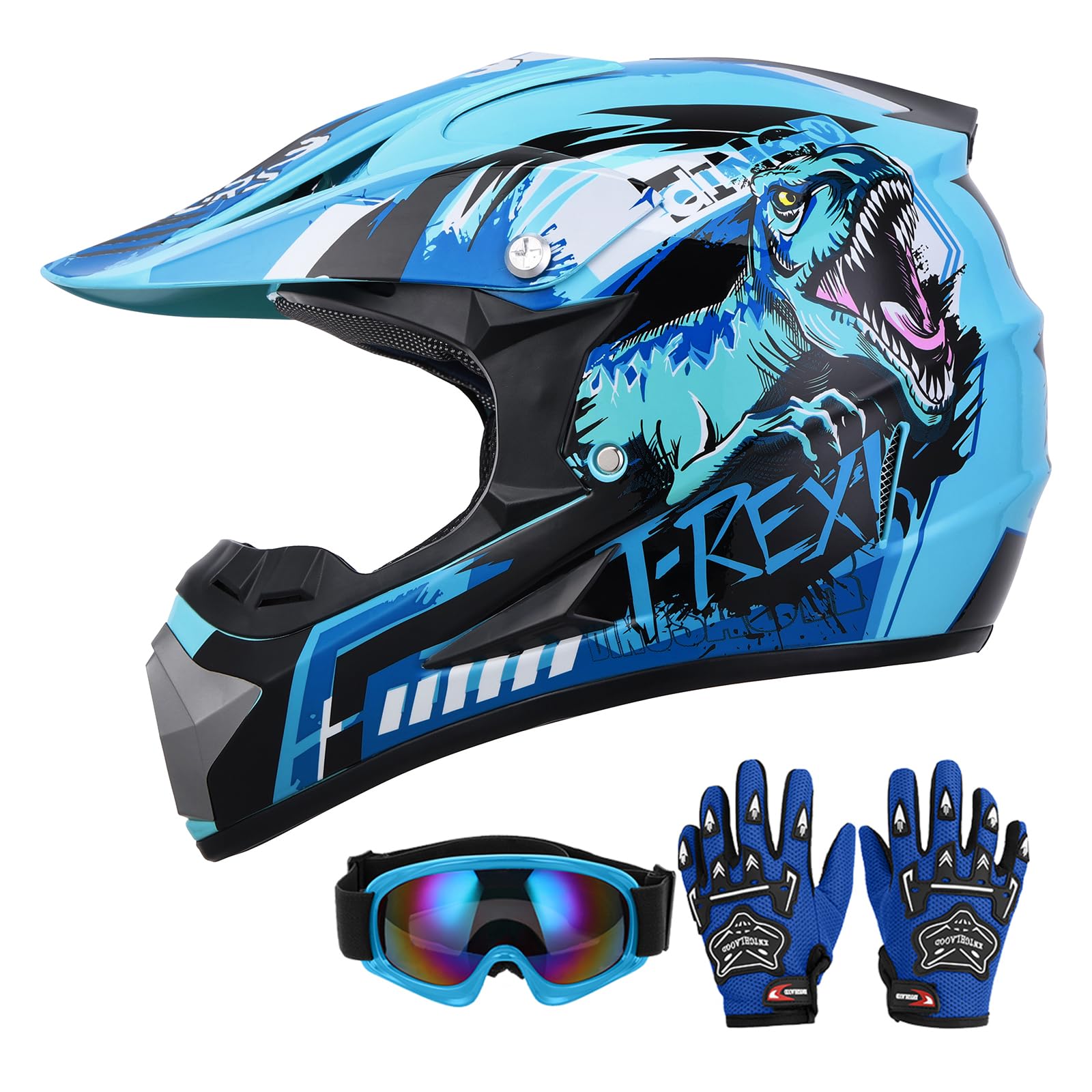
A 1050-gram helmet that bucks the trend of bulky youth lids.
Oumurs claims the smallest size of this DOT FMVSS-218 certified helmet weighs 1050g ±30g — up to 20% lighter than typical youth helmets — which makes a real difference for a 5-year-old whose neck muscles are still developing. The ABS shell wraps a high-density EPS liner, and the four available sizes cover head circumferences from 490mm up to 560mm, which roughly spans ages 5 through 14.
The included goggles offer UV protection, and the rotatable sun visor can be removed for low-light conditions. A one-hand quick-release buckle makes it easy for young riders to take the helmet off themselves, a small independence booster that busy parents appreciate. The Dino Blue graphics are exclusive decals that help the helmet stand out from the sea of black and white at the starting line.
A few detailed accounts from the review pages flag that one helmet cracked after a short drop from 1.5 feet, and another left a burn mark on a child’s forehead after a grass-hill fall — these are serious notes that suggest inspecting the unit’s edges and checking fit carefully. The majority of owners, however, praise the “quality, perfect fit, and weight” for the price point, and the quick-release buckle is a genuine convenience feature at this level.
Where it shines: The lightest helmet on this list by a clear margin, and the multi-size range from S to XL means a single brand can follow your kid from peewee to pre-teen.
An honest caution: A small share of owners reported durability concerns after low-speed impacts; if your child crashes often or rides aggressively, consider the Fox V1 or Yesmotor which have a longer track record.
Grab this for: A first-time rider who needs the lightest possible helmet — the 1050g weight makes it easy to wear without complaints on short rides.
Look elsewhere if: Your child is already hitting jumps or riding at speed; the mixed durability feedback makes a heavier, more battle-tested helmet a safer bet.
6. O’NEAL Split Youth Chest Protector Lite

A certified stone shield that lets beginners move freely without feeling armored-up.
This O’NEAL chest protector is certified to EN 14021 front and back — that is the official European standard for stone shields used in off-road motorcycling, meaning it is designed to deflect flying rocks and debris, not just padded fabric. The injected plastic parts are lightweight, and the bio-foam padding underneath keeps it comfortable against the chest even on warm days.
The clever part is the detachable front and back halves. You can wear just the front piece under a jersey for a low-profile look, or clip both halves together for full coverage. Reviewers point out that it fits “comfortably” and that kids say they can move well in it — a key check for any protector that might otherwise sit in the gear bag. The slim design also means it slides under or over a jersey without creating a bulky hump.
The wise word from the community is that this is “good for a beginner” but may not satisfy the needs of hardcore riders who hit big jumps at speed. At one size, it suits a narrower range of body types than an adjustable strap-on system, so measuring your child’s chest circumference before ordering is essential.
Certified and comfortable
- Front and back certified to EN 14021 stone shield standard
- Detachable halves let you choose coverage level per ride
- Bio-foam padding stays comfortable during all-day wear
- Slim enough to wear under a jersey without looking bulky
Not for everyone
- One-size design may not fit very small or very large kids
- Not intended for hardcore motocross racing; more of a trail-protection piece
Best for: Young riders who are just starting out and need a certified stone shield that does not feel like a strapped-on refrigerator — the fit is genuinely unobtrusive.
Think twice if: Your child is racing competitively or hitting big jumps; the plastic shell is not as thick as full-race models like the Fox R3 below.
7. Fox Racing Youth R3 Motocross Chest Guard

The chest guard that serious young racers wear because it actually stays tight to the body through a crash.
Fox designed the R3 with a youth-specific fit for ages 6 to 14, and the CE EN 14021 certification means it is an officially tested stone shield. The stand-out feature is the low-profile shoulder cups that do not interfere with a neck brace — a critical detail if your child progresses to racing where neck braces are recommended. The elastic slide-buckle waist closure pulls the guard tight against the torso, eliminating the loose-flap feeling that cheaper guards have.
Adjustable shoulder straps and waist straps let you fine-tune the fit as your child grows, and the polyester construction is lightweight enough at 1.2 pounds that kids do not fight wearing it. The community calls out that the guard fits larger kids particularly well, making it a good pick for a 12-year-old who is already outgrowing standard youth chest protectors. One buyer who got this for a grandson rebuilding a mini bike called it “the perfect protection he needs.”
The main sizing note to know is that several owners warn the “sizes run small,” so if your child is at the top of the age range, moving up a size is the safest bet. The Fox R3 is pricier than the O’NEAL Split above, but the neck-brace compatibility and the slide-buckle waist system justify the step up for competitive riders.
The race-day advantage: Designed from the ground up to work with neck braces and to stay put through hard impacts — the slide-buckle waist is a big upgrade over Velcro panels that work loose.
The sizing reality: Runs small on the upper end of the age range; measure your child’s chest and compare to Fox’s youth size chart, not their age chart.
Reach for this if: Your kid is already racing or plans to race soon — the neck-brace compatibility and snug fit make this the proper tool for the job.
pass on it if: You need a chest protector for a child under 6 or one who is very slender; the fit works best for average-to-large body types within the youth range.
8. MSR Youth M3X Motocross Boots
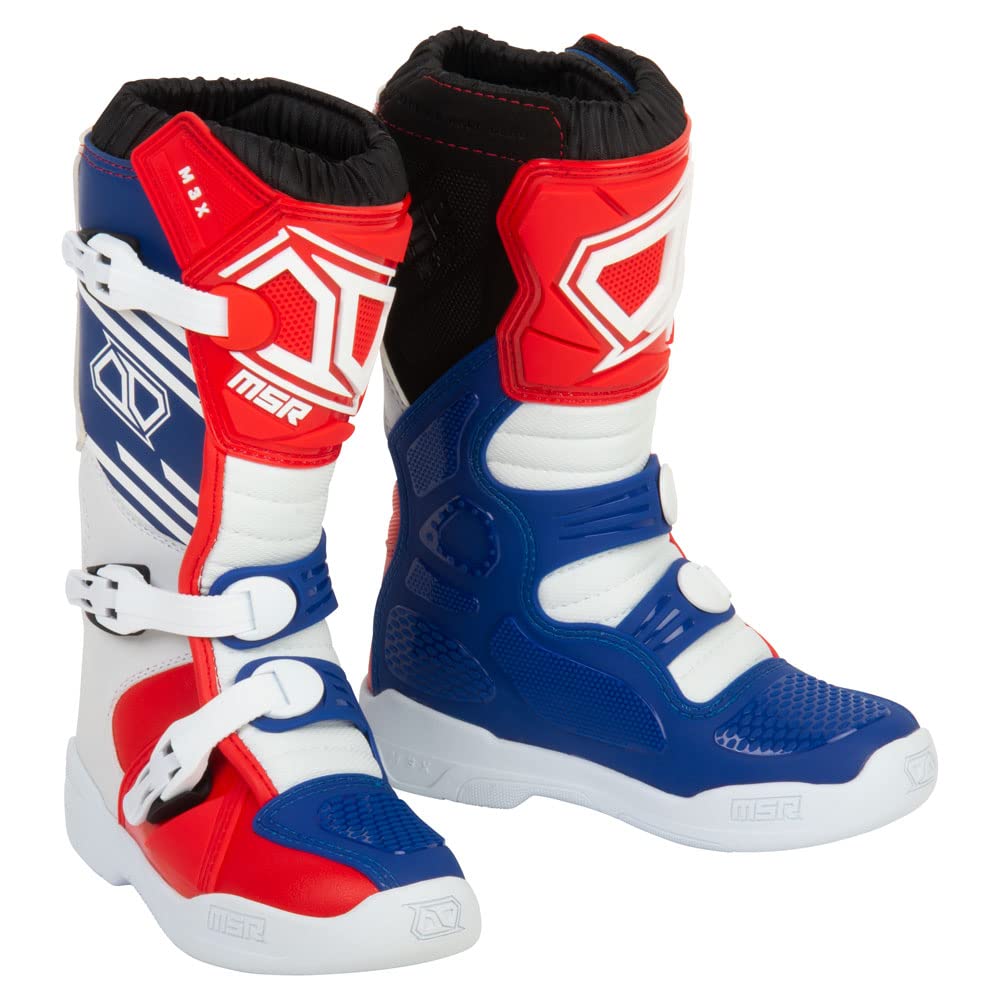
Sturdy micro-fiber boots that do not cost as much as the bike itself.
The MSR M3X boots use a durable micro-fiber construction with injection-molded plastic protection pieces, giving them a toughness that stands up to repeated contact with foot pegs and dirt. Inside, a reinforced padded ankle works with integrated flex panels to keep the boot comfortable while still supporting the joint in a tip-over. The steel shank underfoot provides maximum support when a kid stands up through a rough section.
A three-buckle closure system locks the boot on securely, and both the straps and buckles are replaceable — a practical detail because kids tend to break buckles by stepping on them. The elastic gaiter at the top seals out dirt and debris, so fewer rocks end up inside the boot mid-ride. Shoppers say that a pair lasted a daughter “over a year” of regular use and “held up great,” which is a meaningful durability claim at this price tier.
The molded sole gives a solid grip on and off the pegs, which helps when a rider is pushing the bike through a muddy section. Since these boots are a dedicated growth-stage purchase, the honest take from the community is that they offer “great quality for younger kids that will outgrow them in no time” — the price is low enough that replacing them when the next shoe size hits does not sting.
Built for real abuse
- Steel shank provides maximum support for standing up on rough terrain
- Three-buckle closure with replaceable straps and buckles
- Micro-fiber construction with plastic armor pieces holds up to repeated impacts
- Buckle system is easy for parents to fix without replacing the whole boot
Know the limits
- Sizing is youth-specific; not suitable for teens with adult-size feet
- Not as stiff or protective as premium race boots from Alpinestars or Sidi
Best for: Younger riders who need a proper boot that will last a full season — the steel shank and replaceable parts make these the smartest value in youth motocross boots.
Look elsewhere if: Your child has a wide foot or is approaching adult shoe sizes; these youth lasts are narrower than adult models.
9. Fox Racing V1 Motocross Dirt Bike Helmet
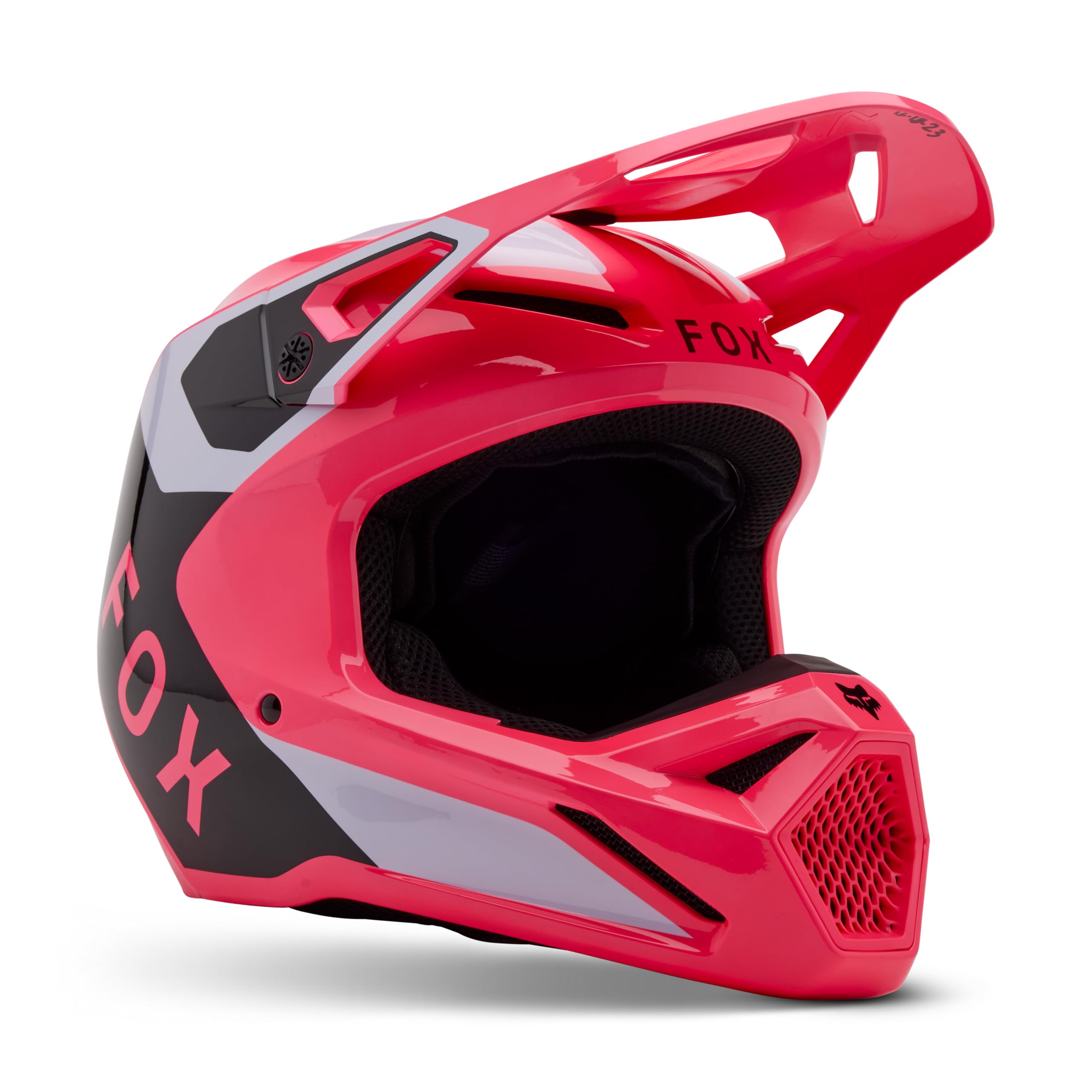
The first youth helmet to bring Mips rotational impact technology to the trail for under.
The Fox V1 is the only helmet on this list with the Multi-Directional Impact Protection System (Mips) — a low-friction layer inside the shell that allows the helmet to rotate slightly on impact, reducing rotational forces transferred to the brain. It meets both the US DOT FMVSS 218 standard and the tougher European ECE 22.06 standard, giving it the broadest safety certification in this lineup. The outer shell is 54% ABS, 16% EPS (the impact liner), 15% paint, and 15% polyamide (PA) for the hardware.
Available in youth sizes YS through YL as well as adult XS–XXL, the V1 uses a double D-ring closure that is the gold standard for race helmets — it never slips loose like a ratchet can. The aerodynamic shape slices through the air cleanly, and the adjustable visor stays put at highway speeds without fluttering. Owners praise the “superb airflow” and note that even on 85°F days, the ventilation keeps the interior from becoming a sweatbox.
The critical fit note from the community cannot be ignored: the V1 runs small. The fit aspect is the most-discussed topic, and owners consistently advise going up a full size from your normal measurement. The helmet does not come with goggles or a bag, so the purchase price reflects only the helmet itself. For a parent who values the latest brain-protection technology over budget, however, the Fox V1 is the clear head-and-shoulders leader in safety engineering here.
The safety benchmark
- Mips (Multi-directional Impact Protection System) reduces rotational crash forces — a feature absent from every other helmet here
- Dual certified: DOT FMVSS 218 and ECE 22.06, the strictest global standard
- Double D-ring closure stays secure through hard impacts
- Owners call it “very light and comfortable” with top-notch finish
Fit is the hard part
- Runs a full size small; measure carefully and size up — this is the most consistent buyer feedback
- Does not include goggles, gloves, or a carry case; buy those separately
- An occasional unit arrives looking pre-used, per a small number of reports
Grab this for: The rider who deserves the best available brain protection — Mips and dual certification make this the smartest safety investment on the list, provided you size up.
Think twice if: You need a ready-to-ride kit in one box; the V1 is a helmet-only purchase, and the need for goggles and gloves adds to the total cost.
Understanding the Specs
DOT vs. ECE Certification
A DOT (Department of Transportation) sticker means the helmet passed a federal impact test at set fall heights and speeds. ECE 22.06, the current European standard, is stricter because it also tests for rotational forces — a type of brain injury you want protection from. A helmet with both certifications, like the Fox V1, has passed the toughest available tests. A helmet with only a DOT sticker is still legal and safe for trail riding, but a dual-certified lid adds an extra layer of engineering.
Mips (Multi-directional Impact Protection System)
Mips is a thin slip-plane layer inside the helmet that allows the outer shell to rotate a few millimeters on impact. In a real crash, most hits happen at an angle, not straight-on — the rotational motion is what strains the brain’s connective tissue. Mips is designed to reduce that rotational force, and it is increasingly considered a baseline feature for serious riders. You will find it in higher-tier helmets like the Fox V1 but not in entry-level priced models.
EN 14021 Stone Shield Standard
This is the European standard specifically for off-road motorcycle chest protectors. A guard with EN 14021 certification — like the O’NEAL Split Youth and Fox R3 — has been tested against flying debris at known velocities. It does not mean the protector is bulletproof or that it will stop a big stick at speed, but it does mean the plastic shell and padding meet a repeatable, independent safety benchmark.
ABS Shell vs. EPS Liner
The vast majority of youth helmets use an ABS (acrylonitrile butadiene styrene) outer shell — a tough, impact-resistant plastic that is affordable and durable. Inside, an EPS (expanded polystyrene) liner acts like a styrofoam crush zone: it compresses on impact to absorb energy before that energy reaches the skull. Some premium helmets use a polycarbonate shell or a multi-layer composite, but for youth riders, ABS-plus-EPS is a proven, safe combination.
FAQ
How do I measure my child for a motocross helmet?
Is a DOT-certified helmet enough for a beginner, or do I need ECE?
Can my child wear a youth chest protector over a regular shirt or jersey?
How tight should motocross boots fit a kid?
Do youth riding pants really need hip protectors?
What is the difference between a chest protector and a roost guard?
Will a Fox Racing V1 helmet fit a child under 6?
How long should a set of youth riding gear last before a growth spurt?
Is it safe to buy youth riding gear used?
Final Thoughts: The Verdict
For most families, the youth riding gear winner is the O’NEAL Element Youth Pants because they deliver stretch mobility, removable hip armor, and a ratchet waist that accommodates growth — all in a fabric that survives real abuse. If you want the safest helmet available, grab the Fox Racing V1 for its Mips system and dual DOT/ECE certification. And for a new rider who needs everything in one shipment, the MXJ Gear F001 Helmet Set includes a DOT-approved lid, goggles, and gloves at a price that does not punish you for the inevitable growth spurt next season.
How We Picked
We do not accept paid placement. Every pick is matched to a real buyer and a real use-case; we do not hands-on test units.
Sources & Methodology
Specifications: manufacturer listings and product documentation. Review insights: verified customer reviews, as of July 2026. Pricing: not shown on this page (it changes often); check the current price via the retailer link.
As an Amazon Associate, Calories Fit earns from qualifying purchases. This does not affect which products we feature.