
Our readers keep the lights on and the coffee maker working hard! As an Amazon Associate, I earn from qualifying purchases.
Specs are compiled from manufacturer listings and verified buyer reviews and can change over time — please confirm the key details on the product page before buying.
You need a wooden walking cane that feels solid from the first step, but most guides only cover metal and adjustable frames. This one is different — it focuses only on timber canes that hold up for years, look right with a nice coat, and fit your height without guesswork. After comparing the specs and verified customer reviews for each model, the Bubba Stik Classic earns the top spot: it pairs a solid red oak shaft with a brass hame handle (a curved brass grip modeled after a horse harness fitting) that stops your hand from sliding forward. That alignment means more control and less wrist fatigue, no matter how long you walk.
I’m Mohammad — the founder and writer behind Calories Fit. This guide is built by comparing the manufacturers’ published specifications and the patterns across verified customer reviews, so you get each pick’s real strengths and trade-offs instead of marketing spin.
You will find a reliable option below — from brass-topped companions for daily stability to tall natural staffs for wooded trails. This is your concise look at the best wooden walking cane options available right now.
Our Picks at a Glance


How To Choose The Best Wooden Walking Cane
You get the right cane by matching three things: the height of the shaft, the type of wood, and the handle shape that suits your grip. Aluminum canes wobble and make a rattling sound with each step; a solid wood shaft dampens that vibration naturally, so your step feels quieter and more planted. You do not need a medical degree to get this right — just measure from your wrist crease (the small fold where your hand meets your wrist) to the floor while wearing your everyday shoes, and that number is your ideal cane length. The wood species (oak, willow, ironwood) decides the weight and the grain feel. A lighter willow feels easy to swing on a hike; a dense oak gives a planted, substantial feel for daily support indoors.
Handle Design and Grip Comfort
A crook handle (also called a shepherd’s hook) lets you hang the cane on your forearm when you need both hands free. A ball or knob handle gives a secure fist grip that many users with arthritis prefer because it does not require a tight pinch. The handle material matters too. A bare wooden handle feels warm but can be slippery when your hands are dry; a wrapped or contoured shape (like the ergonomic curve on the Vive) spreads pressure across your palm and reduces sore spots. If you plan to walk for longer than 30 minutes at a stretch, test the handle diameter — a grip that is too thick forces your fingers to splay, and that creates hand fatigue fast.
Tip Construction and Terrain Compatibility
The rubber tip at the bottom is the only part that touches the ground. A standard single-point tip works well on pavement and indoor floors. For grass, gravel, or icy sidewalks, look for a wider base or a steel-tipped insert that bites into loose surfaces. A dedicated support cane such as the Carex ships with a plain rubber tip, which is what you want for indoor floors and pavement. A worn-out tip is easy to replace, but the diameter must match your shaft — a 1-inch tip will slide right off a 1.5-inch stick. If you walk mostly on wet or uneven ground, plan to swap the stock tip for a quad base (a tip with four small feet that spread the load) once your original wears down.
Quick Comparison
| Model | Best For | Height | Wood Type | Shaft Diameter | Amazon |
|---|---|---|---|---|---|
| Bubba Stik Classic★ Best Overall | Everyday stability & style | 39 in | Red Oak | 1 in | Amazon |
| Vive Willow CaneBest Value | Ergonomic everyday support | 36 in | Willow | — | Amazon |
| RMS Nature StickBest for Trails | Lightweight hiking & balance | 48 in | Natural Wood | 1.5 in | Amazon |
| Carex Round Handle Wood Cane | Everyday mobility support | 36 in | Wood | 1 in | Amazon |
| Brazos Twisted Oak | Traditional crook style | 37 in | Oak | — | Amazon |
| Vive 55-in Hiking Staff | Tall terrain & posture | 55 in | Willow | — | Amazon |
| Brazos Ironwood Stick | Durable trail companion | 48 in | Ironwood | — | Amazon |
| Asterom Nutcracker | Defensive & rugged use | 36 in | Oak | 1 3/8 in (top) | Amazon |
| Asterom Lion Cane | Style & conversation piece | 36 in | Oak | 0.88 in | Amazon |
In‑Depth Reviews
1. Bubba Stik Classic Walking Stick
Our pick — over 4.5★ from 950+ verified ratings; the strongest balance of quality and price.
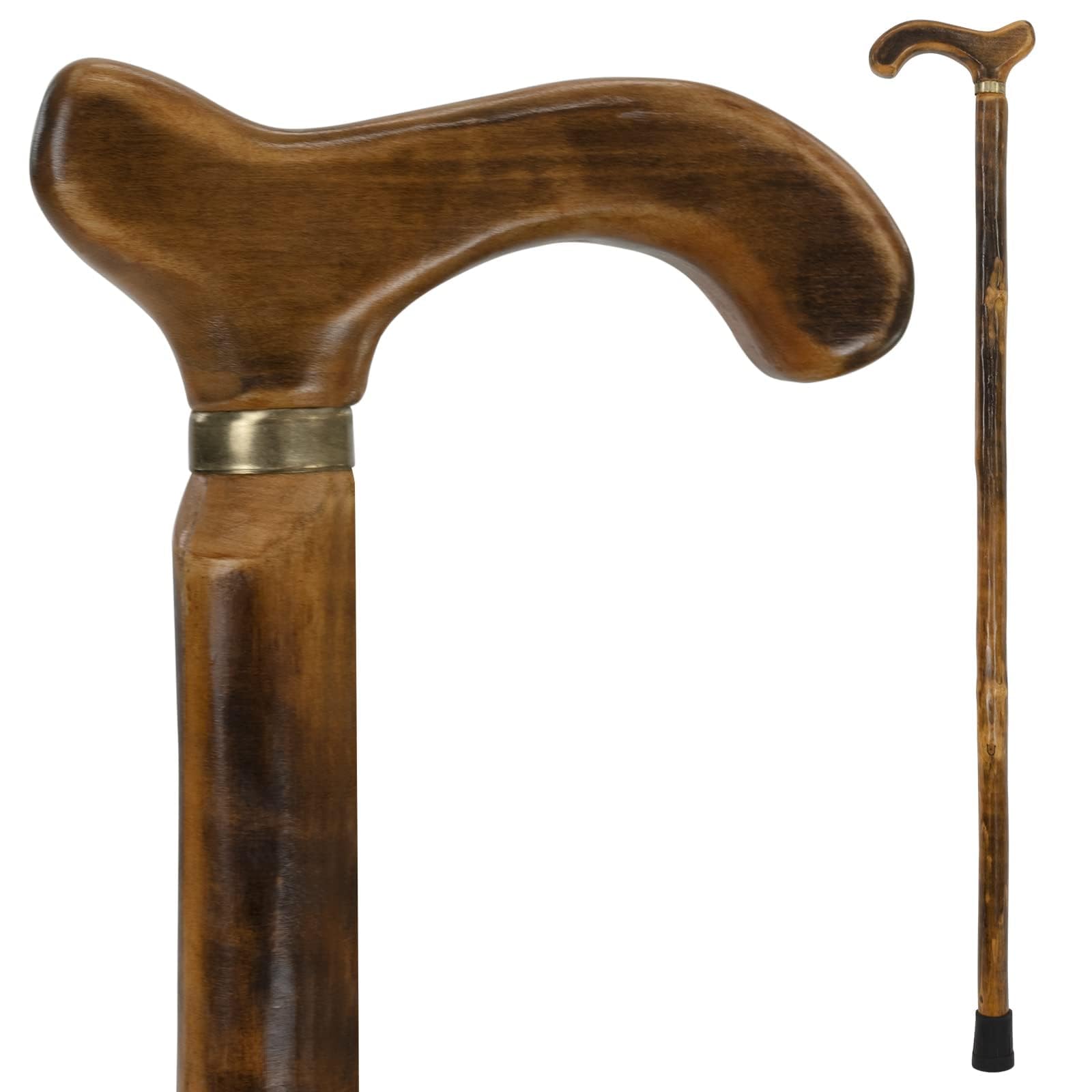
A solid red oak shaft paired with a brass hame handle — the curved brass grip stays locked in your palm so you do not lose control with each stride.
This cane is 39 inches tall and weighs 1.2 pounds, but it does not feel clunky. The weight lands in a balanced spot that absorbs road shock instead of jarring your wrist. The brass ball handle sits at an angle that naturally aligns your grip, so your hand does not slide forward over the first mile. Buyers report it “gives husband confidence after hip fracture,” which matches its 4.7 out of 5 overall score. The shaft diameter is 1 inch — narrower than the 1.5-inch RMS stick, so it fits smaller hands better without feeling fragile.
The ebony-stained American red oak carries a glossy finish that catches light, making it look more expensive than its mid-range position suggests. The shaft is branded with “Bubba Stik” — a small touch, and reviewers highlight it as a point of pride rather than a distraction. Some owners buy this longer than needed and cut it down to fit, which is a smart approach because you can dial in the exact height for your stride. If you prefer the look of a contoured ergonomic grip, the Vive Willow Cane has that curved palm support, but the Bubba Stik outshines it for sheer build quality and that classic brass-accented aesthetic.
Why it stands out
- Brass hame handle is angled for a locked-in palm grip — your hand will not slide forward.
- Solid red oak shaft dampens vibration better than hollow metal, so each step is quieter on pavement.
- Made in the USA by a small Texas workshop, which reviewers consistently praise.
One honest trade-off
- The rubber tip is fairly basic — you will want a wider quad base (a tip with four small feet) for wet concrete or uneven gravel to prevent slipping.
Your best bet if: you want a traditional brass-topped walking stick that feels substantial in the hand and draws compliments rather than stares.
Think twice if: you are 5’4″ or shorter — the 39-inch height may force you to cut the shaft, which removes the branded graphic and alters the balance slightly.
2. Vive Wooden Walking Stick Cane
A lightweight willow cane with a contoured handle that curves to match your palm — built to reduce wrist fatigue on long days.
At 1.1 pounds and 36 inches long, this is the lightest cane in the roundup. You notice the difference when you carry it hooked over your forearm between stops — it does not tug at your arm. The handle is contoured (shaped to match the natural curve of your palm), which is a genuine comfort upgrade over a straight ball-top grip. On the Bubba Stik, the brass ball keeps your hand from sliding forward, but the Vive’s ergonomic curve spreads pressure across your palm for longer walks. Quality is the top aspect owners mention, and the 4.5 out of 5 overall rating across a broad user base backs that up. One buyer summed it up: “This is a solid and ergonomically correct can with the handle that is solid for the grasp.”
The willow wood has a subtle grain pattern with a glossy finish that looks polished without being flashy. Some owners mention a slight curve in the shaft — that is the natural character of the wood, not a defect. It is HSA/FSA approved (qualifying as a medical expense under Health Savings Account and Flexible Spending Account rules), which makes the purchase easier if you have a flexible spending account.
The smart buy: The Vive gives you a comfortable, well-balanced 36-inch cane at a price that undercuts the premium picks by a wide margin, and the lifetime guarantee means you are not gambling on a low-cost stick.
Grab this if: comfort in the palm is your top priority and you stand between 5’5″ and 6′ tall.
Look elsewhere if: you need a longer reach — at 36 inches this tops out far short of the 55-inch Vive hiking staff or the 48-inch Brazos ironwood stick.
3. RMS Nature Wood Walking Stick
A 48-inch staff with a leather wrist strap and a hand-carved finish — built for dirt trails where a short cane forces you to hunch.
Many buyers turn to this RMS stick when they realize a standard cane (36 to 39 inches) makes them lean forward. The RMS measures 48 inches with a 1.5-inch diameter shaft, giving a fatter grip that suits larger hands. Compared to the 1-inch Bubba Stik, the RMS offers 50 percent more surface for your palm. A 69-year-old owner named it a better solution than a cane for balance issues in the yard. At 16 ounces (1 pound), it is light enough for a full afternoon hike, and the clear weatherproof coating keeps the grain safe from rain.
The leather wrist strap is stitched securely at the top — it keeps the staff from clattering to the ground when you let go. Some customers note the hand circumference is big for smaller grips: the 1.5-inch diameter is 50 percent wider than the 1-inch Bubba Stik. The 4.6 out of 5 rating is backed by hundreds of reviews, and the quality and appearance aspects lead the praise. This is the pick if you plan to cover uneven ground with a full-length striding pattern rather than a shuffle.
Trail winner: The RMS gives you the leverage of a 48-inch stick without the weight penalty of a thick oak branch, and the included strap means you will not lose it crossing a creek.
Reach for this if: you walk on grass, gravel, or packed dirt and want a staff that keeps you upright without feeling like a log.
skip it if: you have a smaller hand span — the 1.5-inch diameter may leave your thumb and middle finger barely touching.
4. Carex Round Handle Wood Cane

The plain, traditional support cane — 36 inches, round wooden handle, rubber tip — from a medical-equipment brand rather than a woodcarver.
Everything else in this guide leans decorative or trail-focused. This one does not: Carex Health Brands makes home medical equipment, and the Round Handle Wood Cane is the standard-issue mobility cane you would be handed at a clinic. It measures 36 inches tall on a 1-inch wood shaft, with a wooden round handle sized to sit in the crease of your wrist and a rubber tip on the ground end. It weighs 12.8 ounces, which is under a pound and lighter than any of the hiking staffs here.
It is the most-rated cane in this guide at 4.6 stars across 2,574 ratings, and it ships with a one-year limited warranty — unusual at this price and a reasonable proxy for how Carex expects it to hold up. The limitations follow from the design: the height is fixed at 36 inches with no adjustment, and the round handle is a traditional shape rather than an ergonomic moulded grip, so if you carry weight through the cane for hours you may prefer a contoured derby handle.
What makes it work
- A genuine mobility support cane at 36 inches — the height a cane is supposed to be.
- 4.6★ from 2,574 ratings, the deepest review record in this guide.
- 12.8 ounces, lighter than every hiking staff here, with a one-year limited warranty.
The catch
- Fixed 36-inch height with no adjustment — measure your wrist crease before ordering.
- Plain round handle, not an ergonomic or derby grip, and no decorative carving.
Buy this for: daily walking support indoors and on pavement, where you want a proven, light, no-nonsense cane.
Pass on it if: you want reach for trails or a handcrafted piece — this is a medical cane, not a staff.
5. Brazos Handcrafted Twisted Oak Cane

A twisted oak cane with a shepherd’s crook handle, handcrafted one at a time in the USA — the natural branch contour makes each one unique.
The signature twist spirals down the shaft — it is not a straight dowel but a natural branch contour that gives each cane a unique personality. The crook handle (a curved hook at the top) lets you hang the cane on a chair or your arm when you need both hands. At 37 inches and 1.3 pounds, it is the heaviest cane in the roundup by a small margin, but owners consistently call the weight reassuring rather than tiring. It is 3 inches shorter than the 39-inch Bubba Stik, so it suits users around 5’6″ to 5’9″ better straight from the start.
The rubber tip is standard but effective on most indoor surfaces. Some reviewers point out the finish is slightly rougher than the glossy Bubba Stik — more of a satin texture that feels natural under the palm. The 4.7 out of 5 rating is backed by hundreds of owners, and the quality and durability aspects lead the praise. This is the cane to pick if you want the traditional hooked look without a cheap veneer.
Traditional feel: The Brazos twisted oak delivers the classic crook silhouette with genuine hardwood grain, and the 37-inch height means most average-height users can use it right from the start without cutting.
Ideal for: daily walks on pavement, indoor use, and anyone who prefers the classic curved handle that hangs on a doorknob.
Not for you if: you need to adjust the height — this cane is not telescoping and must be cut with a saw.
6. Vive 55-Inch Wooden Walking Staff
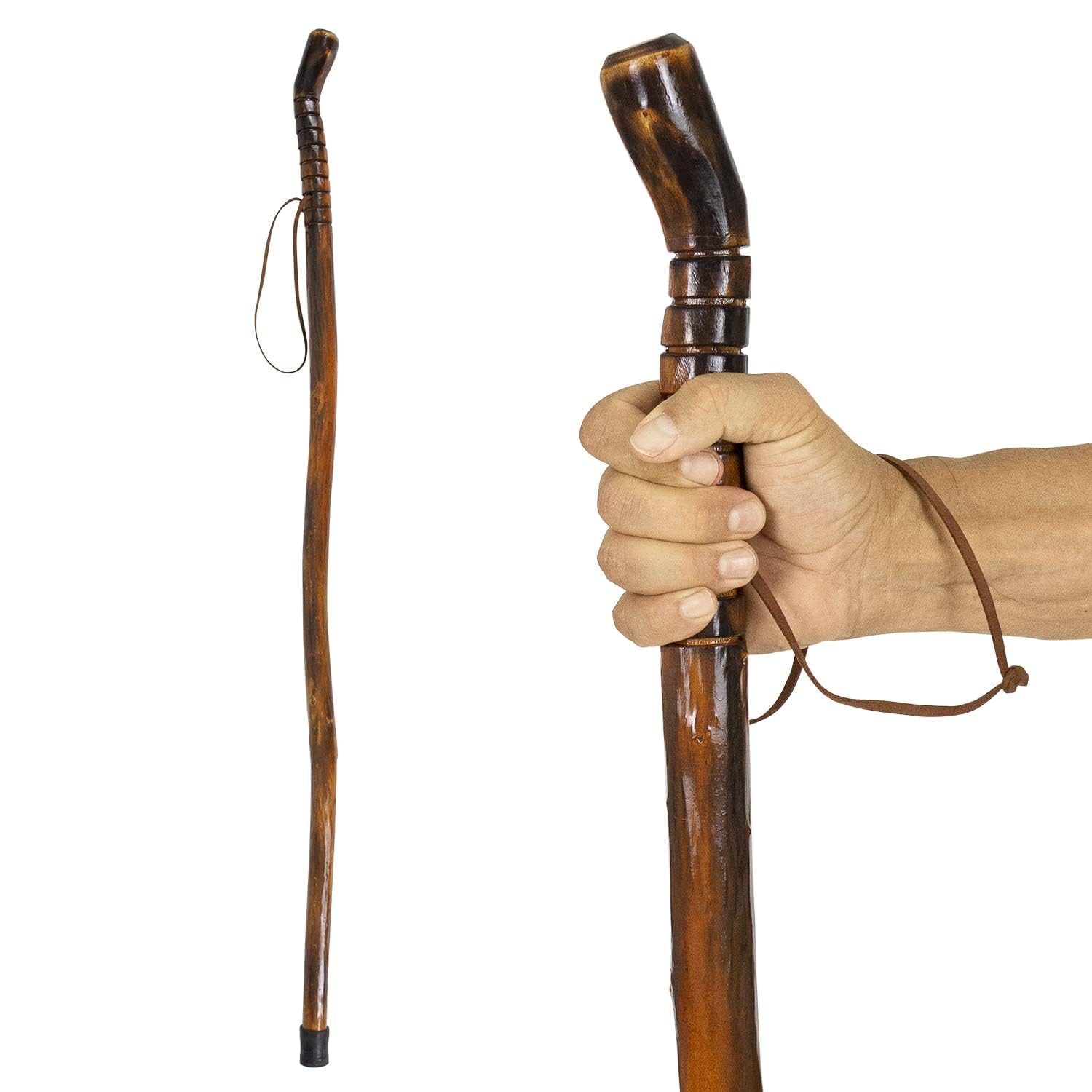
A 55-inch willow staff with grooved grip sections that encourage a natural upright walking posture — you stop hunching the moment you pick it up.
This is the tall version of the Vive brand — a 55-inch shaft cut from single-piece willow with a clear weatherproof coating. The grooved handle area near the top gives your fingers a natural resting spot without the full contour of the ergonomic Vive cane. Owners consistently note that the height forces you to stand straighter than a short cane, which reduces lower back strain over long walks. One buyer summed up the daily experience: “it’s supposed to keep you standing up straight rather than a cane and it does.”
The 4.7 out of 5 rating is driven by quality and sturdiness praise — the stick handles wooded and stony surfaces without flexing. The leather wrist strap is stout enough to bear the weight of the staff when you dangle it, but some owners find the horizontal grooves a bit aggressive on bare palms during extended carries. At 16 ounces (1 pound), it is light for its length, making it a strong option for weekend trail walkers who do not want the weight of a longer oak staff.
Why it works
- 55-inch height keeps tall users upright without a forward lean — better than the 36-inch Vive cane for back health.
- Single-piece willow construction is naturally shock-absorbent, so your wrist feels less jarring.
- Weatherproof coating protects the wood through rain and mud.
One thing to note
- The grooved grip can feel rough on bare skin after an hour — consider wearing a glove for long treks.
Choose this for: daily trails and yard work where a 36-inch cane would feel too short and force a stoop.
Avoid if: you need a wrist-friendly handle — the straight grooved shaft offers less palm support than the ergonomic Vive cane.
7. Brazos Rustic Ironwood Walking Stick

A naturally ridged ironwood staff that feels like a deer antler in the hand — it supports well over 200 pounds without cracking.
Ironwood is significantly denser than the willow used in the Vive and RMS sticks. This Brazos stick has a solid, planted feel without being clunky. The 48-inch height puts it right between the 39-inch Bubba Stik and the 55-inch Vive staff — a versatile middle-ground for users around 5’10” to 6’2″. The natural ridges along the shaft provide a built-in texture that keeps the grip secure even when your palms are sweaty, so you do not need foam wraps or tape.
The leather strap at the top is adjustable and does not slip. Owners praise the quality and sturdiness above all, with the 4.5 out of 5 rating backed by hundreds of reviews. Some shoppers say a slight kink near the bottom of the stick that takes a few steps to get used to, but that is the nature of a natural branch rather than a machined dowel. This stick holds an edge over the RMS for durability on rough scree or gravel because the ironwood resists denting better than softer woods.
Dense and dependable: The Brazos ironwood stick offers a thicker, more textured grip than the 1.5-inch RMS staff, making it ideal for users who want nothing between their hand and the raw wood grain.
Reach for this if: you want a natural-branch look with the durability to handle rocky trails and regular use without cracking.
Pass if: you prefer a smooth, uniform finish — the ridges and natural kinks give this stick a rustic character that not everyone wants.
8. Asterom Handmade Nutcracker Walking Stick

A solid oak stick with a skull paracord strap and a knob handle that doubles as a reliable walking aid and a conversation starter.
The Asterom Nutcracker is a single-piece oak cane with no joints, tapering from 1 3/8 inches at the top to 1 inch at the tip. At 36 inches and about 20 ounces, it is shorter and slightly heavier than the 36-inch Vive (1.1 pounds), but the weight is concentrated in the knob head, which gives it a balanced swing. The detachable paracord strap features a bearded skull charm — a decorative touch that has generated a lot of positive owner feedback. The 36-inch height is 3 inches shorter than the 39-inch Bubba Stik, so it works best for users around 5’4″ to 5’8″.
The 4.7 out of 5 rating across nearly 600 owners reflects a consensus on sturdy construction and reliable balance. Multiple owners mention using it for stability after surgery and finding the knob comfortable for a fist grip. The oak is unfinished, so it will benefit from occasional waxing (reviewers specifically recommend Howard’s Feed & Wax). This stick is a strong pick for someone who wants a compact, solid cane with a distinctive look — more rugged than the polished Asterom Lion Cane.
The strong points
- Single-piece oak construction has zero joints that could rattle or break.
- Knob handle gives a secure fist grip that works well for balance and defensive use.
- Paracord wrist strap is detachable and the skull detail is a genuine conversation starter.
Honest downside
- The 36-inch length is short for taller users — you will need to hold the shaft lower, which defeats the knob.
Grab this if: you want a compact, solid oak stick with a distinctive look that works equally well on a city sidewalk or a wooded path.
Not for you if: you need a taller staff — consider the 48-inch RMS or Brazos ironwood for a longer reach.
9. Asterom Lion Head Walking Cane

An oak cane topped with a carved lion head that turns a mobility aid into a statement piece — jewelry-quality carving you do not see on mass-produced sticks.
The lion handle is the reason this cane draws attention. It is a finely carved head with a walnut finish, and the ring around the neck adds a refined detail that stands out from the rest. At 36 inches and 1.1 pounds, the dimensions match the Vive cane, but the visual weight is entirely different. The 4.7 out of 5 rating across a massive base of owners is driven by craftsmanship (the top praised aspect by a wide margin) and appearance. Owners consistently call it “heirloom quality.”
The shaft is 0.88 inches in diameter — noticeably more slender than the 1-inch Bubba Stik or the 1.5-inch RMS. That makes it a good match for smaller hands but a less confident grip for heavy palm pressure. The manufacturer offers a one-year warranty and lifelong support, and the cane accepts replacement quad tips (four-foot bases) for added stability. Some owners cut 2 inches off the bottom for a custom fit, which is simple with a standard wood saw.
The craft pick: The Asterom Lion is not the most rugged cane, but the carving detail and walnut finish make it the most visually striking option in this lineup — owners wear it as much as they walk with it.
Choose this for: a formal occasion, a vintage-inspired wardrobe, or any situation where the cane will be seen as much as it is used.
Look elsewhere if: you need maximum grip width or a heavy-duty staff for uneven terrain — the slender 0.88-inch shaft is best suited to smooth pavement and indoor use.
Understanding the Specs
Cane Height and Your Stride
The height of your walking cane decides your posture and how much weight you can push through the shaft. When you stand in your everyday shoes, the top of the handle should line up with the crease of your wrist. A cane that is too tall hikes your shoulder up; one that is too short makes you lean forward, straining your lower back. The 36-inch models in this guide, including the Carex support cane, work for people around 5’5″ to 6’0″, while the 55-inch Vive staff is designed for taller users. If you are between heights, buy the longer option and cut it down — wood is easy to shorten with a fine-tooth saw and a sanding block.
Wood Species and Grip Feel
Different timber species change how the cane feels in your hand and how long it lasts. Oak (used in the Bubba Stik, Brazos, and Asterom models) is dense and heavy, giving you a planted, solid feel with excellent durability against impacts. Willow (used in both Vive models) is lighter and more flexible, absorbing shock well but needing a thicker shaft to match the strength of oak. Ironwood (the Brazos rustic stick) is the hardest option — it resists denting and scratching but can feel heavy for long carries. If you walk mainly on pavement, oak offers the most reassuring feedback; for trails, the lighter willow or ironwood reduces fatigue over miles.