
Our readers keep the lights on and the coffee maker working hard! As an Amazon Associate, I earn from qualifying purchases.
Specs are compiled from manufacturer listings and verified buyer reviews and can change over time — please confirm the key details on the product page before buying.
You want a yoga mat that protects your knees without making you wobble in standing poses. That is the thickness question. Get it wrong and every Downward Dog hurts, or every balance feels like a tightrope. This guide compares nine mats from a thin 5mm (0.2-inch) rubber roll to a thick 25mm (1-inch) foam cushion. You will learn which one keeps your joints safe and your feet stable, based on the specs and what buyers actually report, not marketing claims.
I’m Mohammad — the founder and writer behind Calories Fit. This guide is built by comparing the manufacturers’ published specifications and the patterns across verified customer reviews, so you get each pick’s real strengths and trade-offs instead of marketing spin.
This guide compares nine mats from 5mm to 25mm, giving you the specs and real-world owner experience to decide with confidence.
Our Picks at a Glance

How To Choose The Best Yoga Mat Thickness
This section breaks down the three most important factors so you can match a mat’s specs to your real needs.
Joint Protection vs. Stability
A plush mat (10mm to 25mm / 1 inch) feels wonderful on your knees in tabletop or kneeling poses, and it insulates you from a cold hardwood or tile floor. But that same soft foam can make standing poses like Warrior II or Tree Pose feel unstable, as if you are balancing on a mattress. Thinner mats (4mm to 6mm) give you a firm, grounded connection for balance work, but offer very little padding for bony pressure points.
Material Density Changes Everything
NBR foam (nitrile butadiene rubber, a soft synthetic rubber) is spongy; it squishes down easily, which is why a 10mm NBR mat feels plusher than most others but can also feel unstable. TPE (thermoplastic elastomer, a dense plastic-rubber blend) is denser and firmer, giving better spring-back and a more stable surface. Natural rubber and cork are the densest materials, providing a firm, heavy base that stays put on the floor. When you read about thickness, always check the material underneath the number.
Your Body Weight and Practice Style
If you do dynamic flows like Vinyasa or Ashtanga, you generally want a thinner, denser mat that will not buckle under foot transitions. If your practice is mostly yin yoga (slow, long-held stretches), restorative stretching, Pilates, or floor-based core work, a thicker mat is a clear advantage. Beginners also tend to prefer a thicker cushion because they spend more time on their knees and wrists in alignment drills.
Quick Comparison
| Model | Best For | Thickness | Material | Dimensions | Amazon |
|---|---|---|---|---|---|
| Gaiam Thick Yoga Mat★ Best Overall | Plush Joint Comfort | 0.39″ (10mm) | NBR Foam | 72″ x 24″ | Amazon |
| Amazon Basics TPE MatBest Value | Budget / Lightweight | 0.24″ (6mm) | TPE | 73.6″ x 24″ | Amazon |
| KEEP Extra Wide MatBest Wide Design | Wide Build / Crowded Room | 0.28″ (7mm) | TPE | 72″ x 32″ | Amazon |
| Retrospec Solana Mat | Maximum Plush Cushion | 1″ (25mm) | Foam | 72″ x 24″ | Amazon |
| Karma Fitness Large Mat | Wide TPE with Carry Bag | 0.39″ (10mm) | Double-Layer TPE | 72″ x 32″ | Amazon |
| YOTTOY Large Yoga Mat | Oversized / HIIT Workouts | 0.5″ (12mm) | TPE | 75″ x 52″ | Amazon |
| Hatha Yoga Extra Long Mat | Tall Practitioners | 0.5″ | TPE | 79″ x 40″ | Amazon |
| Body By Yoga Cork Mat | Eco-Friendly / Hot Yoga | 0.26″ (6.6mm) | Cork / Natural Rubber | 80″ x 26″ | Amazon |
| Manduka eKO Mat | Studio Grip / Durability | 0.2″ (5mm) | Natural Tree Rubber | 79″ x 26″ | Amazon |
In‑Depth Reviews
1. Gaiam Thick Yoga Mat, Exercise & Fitness Mat with Easy-Cinch Carrying Strap
Our pick — over 4.5★ from 46,000+ verified ratings; the strongest balance of quality and price.
The crowd-favorite thick roll that over 46,000 owners trust for joint-friendly cushioning on hard floors.
You get a 10mm slab of NBR foam (nitrile butadiene rubber) that cradles your knees and hips far better than a standard gym mat. This gives you about 0.39 inches of cushion, which is 63% thicker than the 0.24-inch Amazon Basics mat. The textured surface helps reduce slipping on hardwood, tile, and concrete. But the soft foam does come with a trade-off: some owners find standing poses like Tree or Warrior III feel wobbly. The texturing is designed for dry, low-impact routines, not sweaty hot yoga. Reviewers consistently praise the quality and thickness, calling it comfortable for floor work. The initial chemical odor is a recurring note, but owners say it fades after airing it out for a day or two.
Why 46,000+ Owners Agree
- The 10mm NBR foam cushions your joints better than a standard mat, making floor work and kneeling poses genuinely comfortable
- The adjustable carrying strap makes rolling and transporting this thicker pad reasonably manageable
- Buyers describe the mat as high quality with vibrant, lasting colors
The Honest Trade-offs
- The soft, sink-in feel reduces stability for balance poses like Tree or Warrior III
- Durability reports are mixed — some owners note the surface can tear or dent over time
- The initial chemical smell is strong enough to require 24 to 48 hours of airing before first use
Grab it if: joint pain or a hard floor is your main concern — this mat turns a cold, uncomfortable surface into a cushioned zone for recovery stretching and light yoga.
Think twice if: you rely on a firm, stable platform for fast Vinyasa flows or standing balance poses where the foam could feel unstable underfoot.
2. Amazon Basics 1/4 Inch Thick TPE Exercise Yoga Mat with Carrying Strap
A quarter-inch TPE mat that punches well above its price bracket for beginners who want a stable surface.
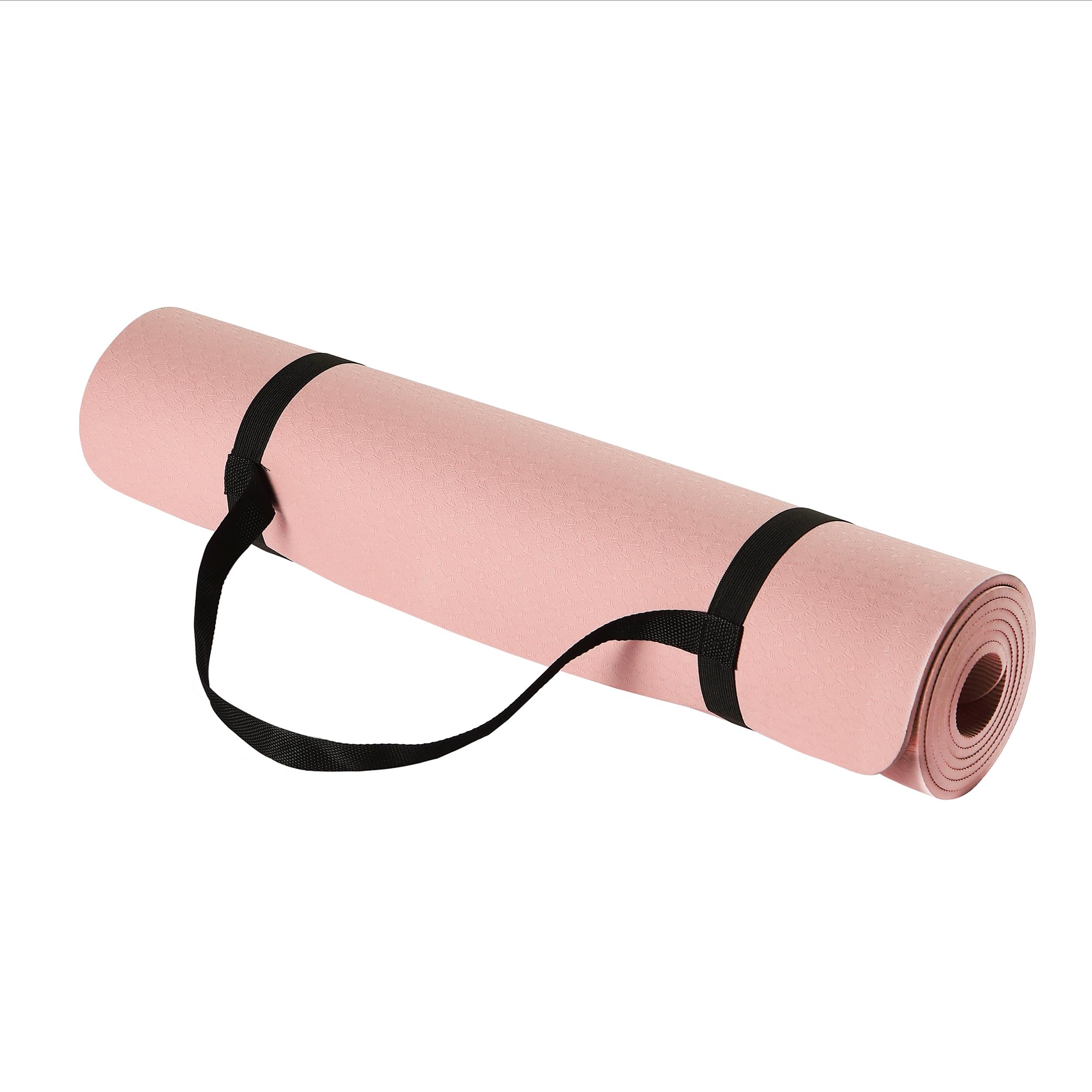
You get a dense TPE mat that resists compression underfoot, giving you a firm connection to the floor for standing poses. The 73.6-inch length is about 2% longer than the standard 72-inch mat, giving taller users a bit more room. The non-slip surface and easy cleaning (just wipe with a cloth) make it practical for daily home use. The leanness is an advantage for stability — it is 63% thinner than the Gaiam 10mm mat. But that same thin profile offers less cushion for your knees and hips in floor poses. Owners highlight the build quality as the top reason for their satisfaction, and note the lack of a strong chemical smell compared to some thicker NBR mats. The color in real life can differ slightly from the listing photos.
A Balanced Performer at the Lowest Entry Point: The TPE (thermoplastic elastomer) material avoids the sponge-like instability of cheaper NBR foam. This makes the mat a smart first purchase for someone who is not sure how committed they are yet, because it does not compromise on traction or durability the way a truly budget mat might. The included carrying strap keeps it portable — a roll that stays tight and compact.
The move for you: pick this when you prioritize a stable, non-slip foundation over plush joint padding and want a lightweight mat you can take to the gym.
Pass if: you have sensitive knees and do most of your work on a hardwood or tile floor — you will feel the hard surface through this mat quickly.
3. KEEP Extra Wide Yoga Mat, 7mm Thick 72″ x 32″ Exercise Mat
The 32-inch-wide TPE mat that fixes the one universal frustration of standard mats — rolling off the edge.
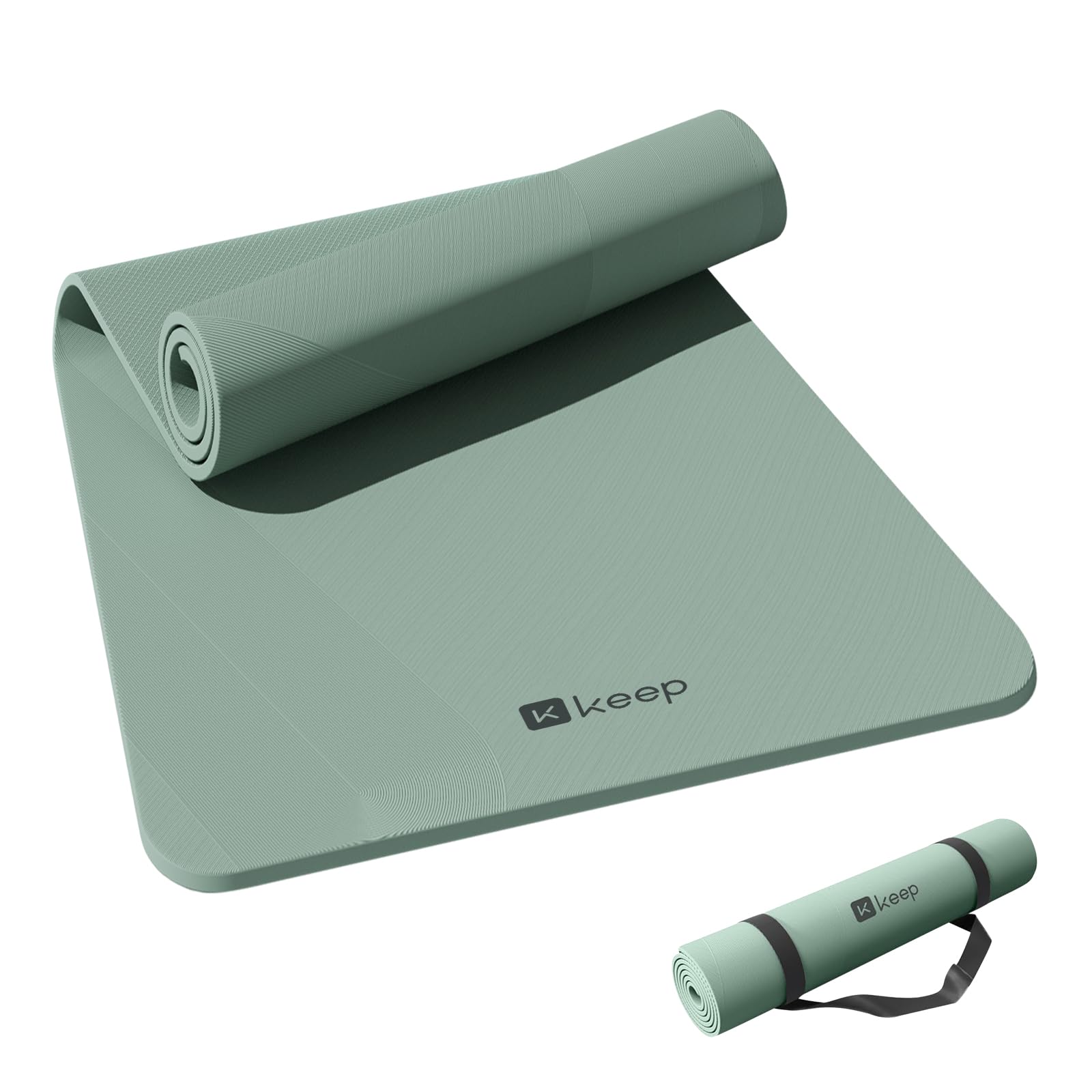
You get a mat that is 33% wider than the standard 24-inch models like the Gaiam and Amazon Basics. That means your hands and feet stay on the mat during wide-legged stretches. The 7mm (0.28-inch) thickness is a middle-ground — plusher than the Amazon Basics 6mm mat, yet firmer than the Gaiam NBR foam because of the denser TPE material. The double-sided anti-slip design uses a fingerprint-like texture on top and a full-coverage grip pattern underneath. Owners consistently praise the quality and the size. The slippage feedback is mixed, with some finding the surface grip adequate and a minority wanting more tack. The lighter TPE material can also wrinkle on carpet when stepped on.
The Real Advantage
- The 32-inch width gives you room for sumo squats and wide-legged forward folds without your hands touching the cold floor
- A 7mm thickness that owners call “medium” — enough cushion for knees without the instability of a thick foam mat
- The TPE material is free of plasticizers (additives that soften plastic) and formamide (a chemical), with a lighter environmental footprint than PVC (polyvinyl chloride) or NBR
What to Watch For
- The lighter TPE construction can wrinkle or not lay completely flat on a carpeted surface during use
- The grip is sufficient for dry yoga but may feel less tacky than a natural rubber mat for those who sweat heavily
Choose this if: you are tired of your hands or feet slipping off the sides during wide-stance poses, or you simply appreciate the extra real estate for dynamic movements.
Skip if: you practice primarily on carpet — the mat may not stay fully flat, which can be distracting.
4. Retrospec Solana Yoga Mat 1″ Thick With Nylon Strap

A full inch of foam that entirely changes the game for anyone with sore knees, a sensitive back, or a hard floor.
This is the thickest mat on this list by a big margin, at exactly 1 inch (25mm). It is the choice for anyone who finds even 10mm mats too thin for floor-based Pilates, physical therapy, or yin yoga. The thick foam absorbs shock completely and can protect your bony areas — owners describe it as the mat that finally lets them do a full session without pain. At 2.2 pounds, it is surprisingly light for its thickness, though the 24-inch width is standard. The nylon strap is a nice inclusion, but the elastic stretches over time and can make tight transport difficult. The most common negative is a strong initial chemical odor, which owners resolve by airing the mat out for a couple of days. The extra thickness can make balance poses more challenging, as the soft foam compresses unevenly underfoot.
The joint-saver verdict: Owners with chronic knee pain or hip sensitivity, and older practitioners, consistently report that this mat makes the difference between practicing and skipping a session. It is a recovery, Pilates, and floor-work specialist. The chemical odor is a known first-impression issue, but it dissipates with patience.
Reach for this: when your primary struggle is feeling every inch of the hard floor through your mat, or you spend most of your time in seated and lying postures.
Skip this: if you need a firm, steady platform for standing balances or arm balances — you will feel the foam compress under your weight.
5. Large Exercise Mat – Extra Thick 10mm Workout Mat (72″x32″) – Karma Fitness

A 10mm double-layered TPE mat that combines the wide footprint of the KEEP mat with premium portability and a carry bag.
You get a 10mm TPE mat with a double-layered construction that the brand claims provides better support and stability than single-layer NBR mats. At 32 inches wide, it matches the KEEP mat for roominess. The included carry bag with an over-the-shoulder strap is a nice portability bonus. The diamond-textured grip on both sides is designed for multidirectional traction during higher-intensity movements like HIIT (high-intensity interval training) or Pilates. Owners consistently praise the material quality and size. The main risk is quality control: a few reports mention the mat arriving with stains or small punctures, suggesting occasional repackaging issues. At just over 1.8 kg (approximately 4 pounds), it is heavier than the thinner TPE mats but still manageable for everyday transport.
What Stands Out
- The 10mm double-layer TPE material is denser than standard NBR, giving a more stable surface even at this thickness
- The 32-inch width and included carry bag make it a practical choice for gym-goers who need both space and portability
- The diamond-textured grip on both sides provides traction in multiple directions, useful for transition-heavy workouts
The Risk
- Quality control is inconsistent — a few owners have received mats with stains or small holes
- The mat is not quite as wide as the listing photos suggest; it is 32 inches, which is still generous but less dramatic than the imagery implies
Best for: someone who wants the joint-cushioning of a 10mm mat but also needs the denser feel of TPE for stability during strength-based movements like Pilates reformer work or bodyweight circuits.
Not for: shoppers who cannot risk receiving a blemished product — if a pristine first impression matters, consider a brand with tighter quality control.
6. YOTTOY Large Yoga Mat (75 * 52 * 1/2inch), Extra Wide TPE Exercise Mat
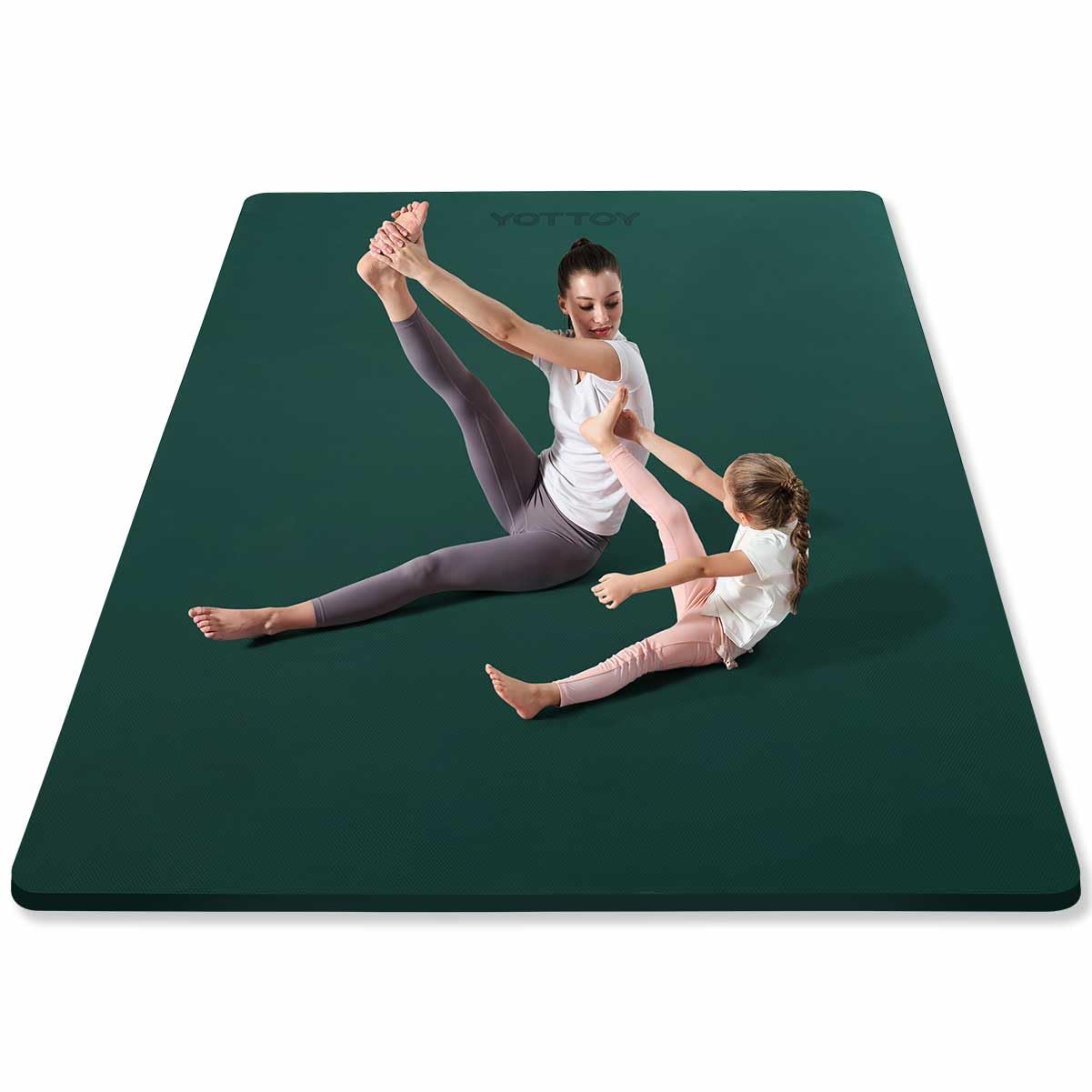
A half-inch thick, 52-inch-wide mat that gives you enough floor space for two people — or one person with a very wide stance.
You get a true oversized mat at 75 inches long by 52 inches wide. That width is more than double the standard 24-inch mat. At 12mm (half an inch), it offers the thickest cushion of any TPE mat in this selection — more padding than the 10mm Karma or KEEP mats, and a firmer feel than foam mats because TPE is denser. The granular bumps on the surface and the water-ripple texture on the bottom work together to provide grip in sweaty conditions, making this suitable for HIIT and barefoot training. The 3.5-pound weight is reasonable for a mat this large. The main negatives are that the grip can be mixed — some owners love it, while a few find it less secure than expected. The large size also takes up significant floor space, which may be an issue in a small apartment.
The extra-large experience: Owners uniformly praise the surface area, describing it as “double the width of a regular mat.” The 12mm cushioning is enough to support weight on a concrete floor without discomfort. The trade-off is mobility: while the included straps help, rolling and carrying a 52-inch-wide mat is more cumbersome than a standard roll.
Pick this if: you do HIIT workouts that involve jumping side to side, or you simply want a dedicated fitness zone large enough that you never have to check if your foot is on the mat.
Skip if: you have limited storage space or need a mat you can pack into a gym bag — this one is a home-gym fixture.
7. Hatha Yoga Extra Long TPE Yoga Mat 79″ x 40″ x 1/2″ Thick

A 79-by-40-inch TPE mat that finally gives tall and plus-size practitioners the room they need without feet dragging on the floor.
You get a mat that is purpose-built for people over six feet tall. At 79 inches long and 40 inches wide, it gives you an extra 7 inches in length and 16 inches in width compared to the standard Gaiam mat. The half-inch (12mm) thickness offers the same cushioning as the YOTTOY mat, but in a more conventional rectangular shape that is easier to fit in a home studio. The TPE material is odorless and recyclable, which is appreciated by owners sensitive to chemical smells. The non-slip surface uses a wave-pattern bottom that grips the floor, though some owners note it can slide on tile or carpet. At 6.1 pounds, this is a heavier mat best suited for home use.
The Size Advantage
- The 79″ x 40″ footprint means a 6’1″ practitioner can do full sun salutations without their hands or feet leaving the mat
- The 0.5″ TPE material provides good knee cushioning for side-lying stretches and floor poses without sacrificing stability
- No strong chemical odor — owners say it lays flat quickly and has a mild, temporary smell at worst
The Practical Limit
- At 6.1 pounds, this is not a mat you will sling over your shoulder for a spontaneous studio detour — it is a home-base mat
- The bottom can slide on smooth surfaces like tile or certain carpets, though the wave pattern helps on most floors
Ideal for: tall people, larger body types, or anyone who has ever been frustrated by a too-short mat during a class — the extra length and width here genuinely solve that pain.
Skip if: you need a lightweight, portable mat for commuting to a studio. This one stays at home.
8. Luxury Cork Yoga Mat – Body By Yoga
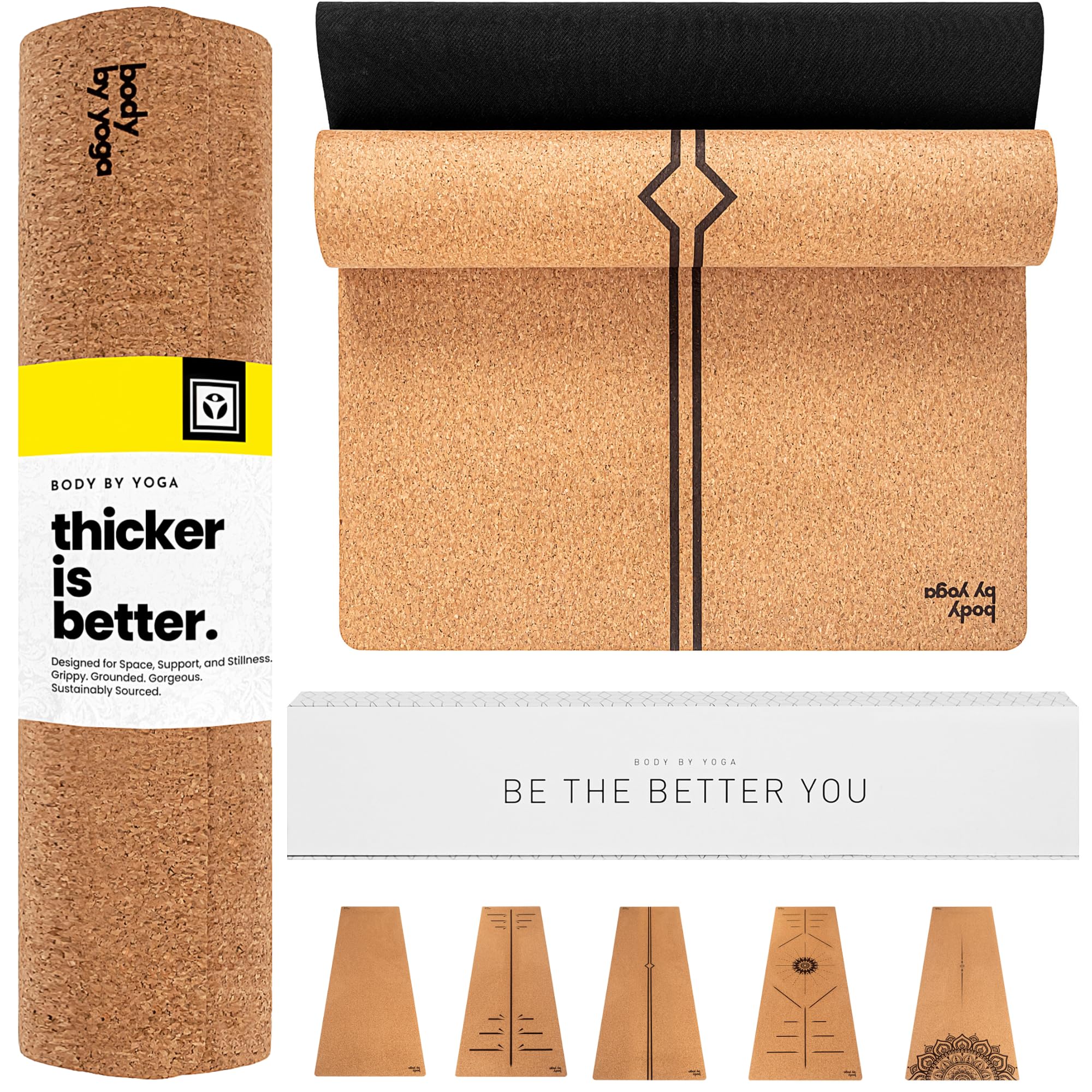
A natural cork surface that actually gets grippier as you sweat, built for hot yoga and eco-conscious practitioners.
You get a natural cork surface that becomes more tacky when wet, making this mat ideal for hot yoga or any sweaty practice where standard PVC (polyvinyl chloride) mats turn slippery. At 0.26 inches thick (about 6.6mm), it is not a plush cushion mat — it is significantly thinner than the 10mm NBR mats. But the stable, firm sensation it gives is exactly what experienced yogis want for standing poses and arm balances. The 80-by-26-inch dimensions give you more length than any other mat here, and the 26-inch width is 2 inches wider than standard. The weighted design (about 10 pounds) is intentional: the heavier natural rubber base keeps the mat planted on the floor. The negatives are the weight — at 10 pounds, this is a stationary home mat. Some owners also mention that the cork edges can be prone to chipping if not handled gently.
The wet-grip champion: Owners call the combination of thicker-than-average cork and a stable rubber base “excellent for sweaty palms and steady for standing poses.” The alignment lines on select versions help with consistency. The manufacturer describes the mat as “heavier than standard mats, by design.”
Perfect for: dedicated hot yoga practitioners who want a non-toxic, long-lasting surface that improves its grip with moisture, and who practice at home or drive to a studio.
Not for: anyone who needs maximum joint cushioning for floor work — the 0.26-inch cork is firm and stable — or anyone who needs to carry their mat on public transit.
9. Manduka eKO Yoga Mat – Natural Rubber
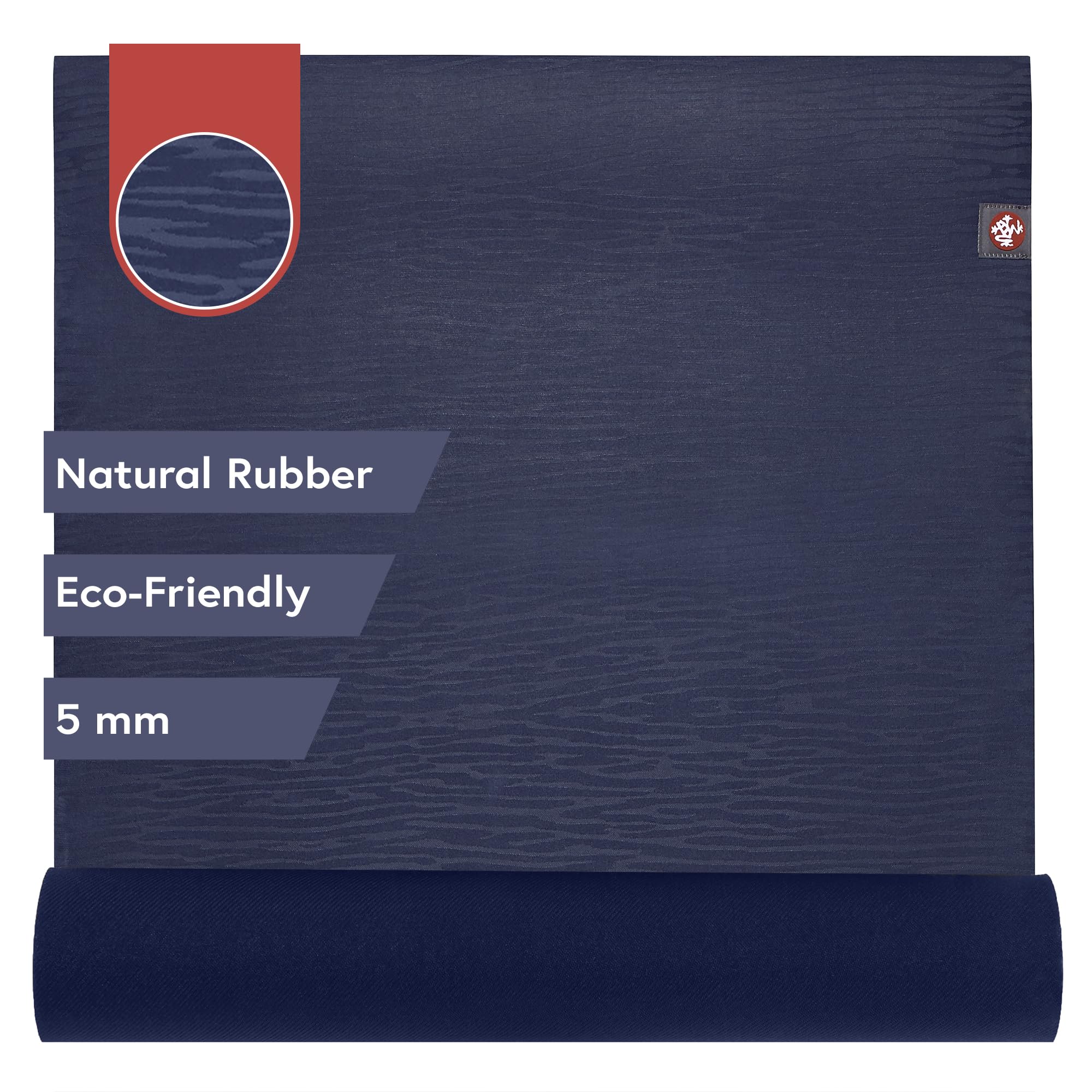
The 5mm natural rubber mat that serious yogis trust for its textured grip, long-term durability, and eco-friendly build.
You get a 5mm (0.2-inch) mat made from 100% natural tree rubber with a rippled catch-grip texture. It is the thinnest mat on this list, by design for experienced practitioners who want maximum ground connection. The closed-cell design — the surface is sealed to prevent moisture and bacteria from soaking in — makes it tear- and scratch-resistant for long-term use. The textured surface provides excellent grip for dry practice, but buyers report that sweaty hands can make it slippery — so a yoga towel is recommended for hot sessions. The mat is heavy at 7 pounds, and that weight gives it a stable feel on the floor. The odor from the natural rubber is a significant issue: some owners mention a persistent chemical smell that can cause headaches, while others say it fades after a few weeks. Durability is also mixed — while most users say it holds up well, a smaller number report surface blistering or separation over time.
The Grip and Ground Connection
- The rippled catch-grip texture delivers a stable, non-slip surface for flows and holds, and the 5mm thickness gives you the most direct connection to the floor of any mat here
- The 100% natural tree rubber construction is free of toxic glues and PVC, with a closed-cell surface that resists moisture buildup
- Owners consistently praise the quality and grip, calling the eKO superior to the brand’s PRO mat for traction
The Real Downsides
- The natural rubber can retain a strong odor for weeks or months, which some owners find overwhelming and headache-inducing
- Durability reports are split — some owners have surface blistering, though many others report years of daily use without issues
Choose this if: you are an experienced practitioner who values a firm, stable base with excellent grip for Vinyasa, Hatha, or Yin Yoga, and you can overlook the initial rubber smell for the long-term performance.
Think twice if: you practice hot yoga and sweat heavily — you will need a towel — or if you are sensitive to strong odors, as the rubber smell can be persistent for some buyers.
Understanding the Specs
Thickness: Millimeters vs Inches
Yoga mat thickness is measured in both millimeters (mm) and inches. A 6mm mat (about 1/4 inch) is standard studio thickness — stable enough for balance poses, but minimal cushion for bony areas. A 10mm mat (about 0.39 inches) is noticeably plusher and is where most casual home practitioners settle. A 1-inch (25mm) mat is a specialty option for people who need maximum joint protection for floor-based practices. Every millimeter increase adds more cushion but also reduces stability for standing poses. The best thickness for you depends on your body weight, your practice style, and whether you work on a forgiving carpet or a hard surface like tile or concrete.
Material: NBR, TPE, Rubber, and Cork
The thickness number alone is misleading without knowing the material. NBR (nitrile butadiene rubber) foam is very soft and airy. A 10mm NBR mat feels much more spongy and less stable than a 10mm TPE mat because TPE (thermoplastic elastomer) is denser and has a spring-back quality that resists compression. Natural rubber is the densest of the common materials, giving you a very firm feel even at thicknesses as low as 5mm. Cork sits on top of a rubber base and adds a unique texture that improves grip when wet. The general rule: a higher-density material at a lower thickness can feel more stable than a lower-density material at a higher thickness.
FAQ
What is the best yoga mat thickness for beginners?
Is a thicker yoga mat always better?
Does a thicker mat weigh more?
What thickness do yoga studios typically use?
Can a mat be too thick for yoga?
Should I get a mat with alignment lines?
How long does a thick yoga mat last?
Can I use a thick mat for other exercises like HIIT or strength training?
Why do cork mats get grippier when wet?
Final Thoughts: The Verdict
The Gaiam Thick Yoga Mat wins for most buyers because the 10mm NBR foam gives the best balance of joint comfort and everyday affordability, backed by tens of thousands of owners. If you want the extra width of a TPE mat without losing stability, the KEEP Extra Wide 7mm Mat is a smart mid-range pick. And for hot yoga or eco-minded buyers, the {“@context”: “https://schema.org”, “@graph”: [{“@type”: “ItemList”, “name”: “9 Best Yoga Mat Thickness”, “url”: “https://caloriesfit.com/best-yoga-mat-thickness/”, “numberOfItems”: 9, “itemListElement”: [{“@type”: “ListItem”, “position”: 1, “name”: “Gaiam Thick Yoga Mat, Exercise & Fitness Mat with Easy-Cinch Carrying Strap”, “url”: “https://caloriesfit.com/best-yoga-mat-thickness/#product-1”}, {“@type”: “ListItem”, “position”: 2, “name”: “Amazon Basics 1/4 Inch Thick TPE Exercise Yoga Mat with Carrying Strap”, “url”: “https://caloriesfit.com/best-yoga-mat-thickness/#product-2”}, {“@type”: “ListItem”, “position”: 3, “name”: “KEEP Extra Wide Yoga Mat, 7mm Thick 72\” x 32\” Exercise Mat”, “url”: “https://caloriesfit.com/best-yoga-mat-thickness/#product-3”}, {“@type”: “ListItem”, “position”: 4, “name”: “Retrospec Solana Yoga Mat 1\” Thick With Nylon Strap”, “url”: “https://caloriesfit.com/best-yoga-mat-thickness/#product-4”}, {“@type”: “ListItem”, “position”: 5, “name”: “Large Exercise Mat – Extra Thick 10mm Workout Mat (72\”x32\”) – Karma Fitness”, “url”: “https://caloriesfit.com/best-yoga-mat-thickness/#product-5”}, {“@type”: “ListItem”, “position”: 6, “name”: “YOTTOY Large Yoga Mat (75 * 52 * 1/2inch), Extra Wide TPE Exercise Mat”, “url”: “https://caloriesfit.com/best-yoga-mat-thickness/#product-6”}, {“@type”: “ListItem”, “position”: 7, “name”: “Hatha Yoga Extra Long TPE Yoga Mat 79\” x 40\” x 1/2\” Thick”, “url”: “https://caloriesfit.com/best-yoga-mat-thickness/#product-7”}, {“@type”: “ListItem”, “position”: 8, “name”: “Luxury Cork Yoga Mat – Body By Yoga”, “url”: “https://caloriesfit.com/best-yoga-mat-thickness/#product-8”}, {“@type”: “ListItem”, “position”: 9, “name”: “Manduka eKO Yoga Mat – Natural Rubber”, “url”: “https://caloriesfit.com/best-yoga-mat-thickness/#product-9”}]}, {“@type”: “Product”, “position”: 1, “name”: “Gaiam Thick Yoga Mat, Exercise & Fitness Mat with Easy-Cinch Carrying Strap”, “image”: “https://m.media-amazon.com/images/I/81k53EsViVL.jpg”, “brand”: {“@type”: “Brand”, “name”: “Gaiam”}, “url”: “https://www.amazon.com/dp/B07H9PZ42P/”, “offers”: {“@type”: “Offer”, “url”: “https://www.amazon.com/dp/B07H9PZ42P/”}}, {“@type”: “Product”, “position”: 2, “name”: “Amazon Basics 1/4 Inch Thick TPE Exercise Yoga Mat with Carrying Strap”, “image”: “https://m.media-amazon.com/images/I/71hF7T1-i7L.jpg”, “brand”: {“@type”: “Brand”, “name”: “Amazon”}, “url”: “https://www.amazon.com/dp/B0DM6C7TZ3/”, “offers”: {“@type”: “Offer”, “url”: “https://www.amazon.com/dp/B0DM6C7TZ3/”}}, {“@type”: “Product”, “position”: 3, “name”: “KEEP Extra Wide Yoga Mat, 7mm Thick 72\” x 32\” Exercise Mat”, “image”: “https://m.media-amazon.com/images/I/61KH78eW9lL.jpg”, “brand”: {“@type”: “Brand”, “name”: “KEEP”}, “url”: “https://www.amazon.com/dp/B0B74MRJS3/”, “offers”: {“@type”: “Offer”, “url”: “https://www.amazon.com/dp/B0B74MRJS3/”}}, {“@type”: “Product”, “position”: 4, “name”: “Retrospec Solana Yoga Mat 1\” Thick With Nylon Strap”, “image”: “https://m.media-amazon.com/images/I/71V-SIApxbL.jpg”, “brand”: {“@type”: “Brand”, “name”: “Retrospec”}, “url”: “https://www.amazon.com/dp/B092XZBXTF/”, “offers”: {“@type”: “Offer”, “url”: “https://www.amazon.com/dp/B092XZBXTF/”}}, {“@type”: “Product”, “position”: 5, “name”: “Large Exercise Mat – Extra Thick 10mm Workout Mat (72\”x32\”) – Karma Fitness”, “image”: “https://m.media-amazon.com/images/I/81xIFnHmUAL.jpg”, “brand”: {“@type”: “Brand”, “name”: “Large”}, “url”: “https://www.amazon.com/dp/B0BQZGJ1XQ/”, “offers”: {“@type”: “Offer”, “url”: “https://www.amazon.com/dp/B0BQZGJ1XQ/”}}, {“@type”: “Product”, “position”: 6, “name”: “YOTTOY Large Yoga Mat (75 * 52 * 1/2inch), Extra Wide TPE Exercise Mat”, “image”: “https://m.media-amazon.com/images/I/51j8Fwy5s3L.jpg”, “brand”: {“@type”: “Brand”, “name”: “YOTTOY”}, “url”: “https://www.amazon.com/dp/B0D3XDR3NN/”, “offers”: {“@type”: “Offer”, “url”: “https://www.amazon.com/dp/B0D3XDR3NN/”}}, {“@type”: “Product”, “position”: 7, “name”: “Hatha Yoga Extra Long TPE Yoga Mat 79\” x 40\” x 1/2\” Thick”, “image”: “https://m.media-amazon.com/images/I/61DzWc1c00L.jpg”, “brand”: {“@type”: “Brand”, “name”: “Hatha”}, “url”: “https://www.amazon.com/dp/B0D2XRG2B6/”, “offers”: {“@type”: “Offer”, “url”: “https://www.amazon.com/dp/B0D2XRG2B6/”}}, {“@type”: “Product”, “position”: 8, “name”: “Luxury Cork Yoga Mat – Body By Yoga”, “image”: “https://m.media-amazon.com/images/I/91Z8UsdOT1L.jpg”, “brand”: {“@type”: “Brand”, “name”: “Luxury”}, “url”: “https://www.amazon.com/dp/B07J55ZBLS/”, “offers”: {“@type”: “Offer”, “url”: “https://www.amazon.com/dp/B07J55ZBLS/”}}, {“@type”: “Product”, “position”: 9, “name”: “Manduka eKO Yoga Mat – Natural Rubber”, “image”: “https://m.media-amazon.com/images/I/81zG11iozuL.jpg”, “brand”: {“@type”: “Brand”, “name”: “Manduka”}, “url”: “https://www.amazon.com/dp/B09QSBCQ7F/”, “offers”: {“@type”: “Offer”, “url”: “https://www.amazon.com/dp/B09QSBCQ7F/”}}, {“@type”: “FAQPage”, “mainEntity”: [{“@type”: “Question”, “name”: “What is the best yoga mat thickness for beginners?”, “acceptedAnswer”: {“@type”: “Answer”, “text”: “Most beginners benefit from a mat in the 6mm to 10mm range. The extra padding in a 10mm mat makes kneeling and lying-down poses more comfortable, which helps you stay in the pose longer without joint pain. A 6mm mat is firmer and can give a better sense of ground connection, but it offers less forgiveness under the knees and hips.”}}, {“@type”: “Question”, “name”: “Is a thicker yoga mat always better?”, “acceptedAnswer”: {“@type”: “Answer”, “text”: “No. A thicker mat provides more cushioning, but it also reduces stability for standing and balancing poses because the foam compresses unevenly under your weight. For fast Vinyasa flows, a 5mm to 6mm mat is usually ideal. For restorative yoga or floor-based Pilates, a 10mm to 25mm mat is better.”}}, {“@type”: “Question”, “name”: “Does a thicker mat weigh more?”, “acceptedAnswer”: {“@type”: “Answer”, “text”: “Usually, but the material matters too. A 1-inch foam mat can weigh around 2.2 pounds because the foam is full of air pockets. A 6mm natural rubber mat can weigh 7 to 10 pounds because the material is much denser. If you plan to carry your mat, check both the thickness and the material to gauge actual portability.”}}, {“@type”: “Question”, “name”: “What thickness do yoga studios typically use?”, “acceptedAnswer”: {“@type”: “Answer”, “text”: “Most studios provide mats that are around 5mm to 6mm thick. This balances cushioning with stability. Studio mats are usually made from dense PVC or TPE foam so they can handle daily, high-traffic use. If you find studio mats uncomfortable on your knees, you may want your own thicker mat for class.”}}, {“@type”: “Question”, “name”: “Can a mat be too thick for yoga?”, “acceptedAnswer”: {“@type”: “Answer”, “text”: “Yes, for certain styles. A 1-inch thick mat can make standing poses like Tree Pose feel unstable because the soft foam compresses unpredictably under your foot. Arm balances like Crow Pose become more difficult. If your practice is primarily standing and balancing poses, a mat thicker than 10mm is likely not the best choice.”}}, {“@type”: “Question”, “name”: “Should I get a mat with alignment lines?”, “acceptedAnswer”: {“@type”: “Answer”, “text”: “Alignment lines can help beginners and experienced practitioners maintain consistent hand and foot placement. Some cork and rubber mats offer these lines. They are a helpful teaching tool but not essential. The lines can also help you center yourself on the mat quickly.”}}, {“@type”: “Question”, “name”: “How long does a thick yoga mat last?”, “acceptedAnswer”: {“@type”: “Answer”, “text”: “Lifespan varies by material. A soft NBR foam mat may begin to show surface indentations or tears within 6 to 12 months of daily use. A denser TPE mat can last 1 to 2 years. A natural rubber or cork mat can last 3 to 5 years or longer with proper care. Mats used primarily on carpet tend to wear faster than those on hard floors.”}}, {“@type”: “Question”, “name”: “Can I use a thick mat for other exercises like HIIT or strength training?”, “acceptedAnswer”: {“@type”: “Answer”, “text”: “Yes, but it depends on the exercise. A 10mm to 12mm mat is excellent for floor-based exercises like sit-ups, planks, or stretching on a hard floor. For standing exercises with jumping (burpees, jump squats), a thinner 6mm mat is safer because you are less likely to roll an ankle on the cushioned surface.”}}, {“@type”: “Question”, “name”: “Why do cork mats get grippier when wet?”, “acceptedAnswer”: {“@type”: “Answer”, “text”: “Cork is a natural material with a micro-textured surface. When your skin or the cork gets damp, the moisture creates a slight suction effect between the cork’s surface and your skin, increasing friction. This is the opposite of standard PVC or rubber mats, which often become slippery when wet, making cork a popular choice for hot yoga.”}}]}]}