
Our readers keep the lights on and the coffee maker working hard! As an Amazon Associate, I earn from qualifying purchases.
Specs are compiled from manufacturer listings and verified buyer reviews and can change over time — please confirm the key details on the product page before buying.
The real problem with wired smoke detectors isn’t whether they work — it’s that they scream at you over a seared steak or a steamy shower. You need an alarm that catches real danger fast without treating every kitchen experiment like a five-alarm fire, and the choice between sensor type and battery backup matters more than you think.
I’m Mohammad — the founder and writer behind Calories Fit. This guide is built by comparing the manufacturers’ published specifications and the patterns across verified customer reviews, so you get each pick’s real strengths and trade-offs instead of marketing spin.
After looking at the numbers and feedback for the most reliable models on the market, this is what actually separates a smart buy from a headache. Here is the definitive guide to best wired smoke detectors for your home.
Our Picks at a Glance


How To Choose The Best Wired Smoke Detectors
The most common mistake is buying the cheapest hardwired alarm on the shelf without checking the sensor type. An ionization sensor catches fast-flaming fires within seconds, but it is also the one that beeps when you open the oven door. A photoelectric sensor is better at catching smoldering fires (think a smoldering couch cushion) and is far less likely to nuisance-alarm over cooking. Many modern units combine both or use advanced detection that meets the newer UL 217 10th Edition standard — that is the gold stamp for cutting down on false alarms.
Battery Backup vs. Sealed 10-Year Battery
Every hardwired detector needs a backup battery so it still works when the power goes out — during a storm when electrical fires are most likely. The old standard is a replaceable 9V battery, which you must swap annually. The newer standard is a sealed 10-year lithium battery built into the detector. You never change it; when the battery dies, the whole unit beeps and you replace the alarm. That ends the 3 a.m. low-battery chirp for a decade.
Interconnection: Wired vs. Wireless
Interconnect means when one alarm detects smoke, every connected alarm sounds — so you hear the basement alarm from the second-floor bedroom. Hardwired interconnect uses a red traveler wire between units (up to 12 or 24, depending on the brand). Some modern alarms also support wireless interconnect, which is useful if you are retrofitting without running new wire. For new construction or a full rewire, stick with hardwired interconnect for the most reliable connection.
Sensor Type: Ionization vs. Photoelectric
Ionization sensors respond fastest to fast-flaming fires — paper, grease, a trash can fire. Photoelectric sensors respond fastest to smoldering fires — a cigarette burning in a sofa, an overheated wire behind a wall. Safety experts now recommend either a dual-sensor alarm or one of each type on every level of the home. Some modern alarms, like First Alert’s Precision Detection, combine both principles into one chip to catch both fire types while rejecting cooking steam.
Quick Comparison
| Model | Best For | Sensor Type | Backup Battery | Interconnect | Amazon |
|---|---|---|---|---|---|
| First Alert 9120BFF★ Best Overall | Crowd-Favorite Reliability | Ionization | 9V Replaceable | Up to 12 detectors | Amazon |
| First Alert SMI105-ACZero-Hassle Pick | Zero Battery Hassle | Precision Detection | Sealed 10-Year Lithium | Compatible First Alert | Amazon |
| SITERWELL GS562A | Budget Multi-Pack Value | Photoelectric | 9V Replaceable | Up to 12 detectors | Amazon |
| First Alert 9120BA | Rental Property Workhorse | Ionization | 9V Replaceable | Up to 12 detectors | Amazon |
| Kidde 20SAR | Fast Fire Detection | Ionization | 2x AA Replaceable | Kidde interconnect | Amazon |
| Kidde I12040 | Large-System Integration | Ionization / Photoelectric | 9V Replaceable | Up to 24 devices | Amazon |
| First Alert 9120BFF-12 | Whole-Home 12-Pack | Ionization | 9V Replaceable | Up to 12 detectors | Amazon |
In‑Depth Reviews
1. BRK First Alert 9120BFF Hardwired Alarm with Battery Backup
Our pick — over 4.5★ from 19,000+ verified ratings; the strongest balance of quality and price.
Nearly 20,000 owners agree this is the most trusted hardwired alarm on the planet.
This is the alarm that set the standard. You get a 120-volt AC-powered unit with a 9V battery inside so it stays awake during a blackout — when fire risk is often highest. That 85-decibel alarm is loud enough to wake the heaviest sleeper, and the ionization sensor (detects small smoke particles from fast-flaming fires) is designed to catch a grease fire or a trash can blaze in seconds. Because it is an ionization model, it can false-alarm from cooking steam or a hot shower more easily than a photoelectric unit — that is the trade-off baked into the technology.
The install time hovers around ten minutes per unit, according to the feedback. The side-load battery compartment and tamper-resistant locking brackets make it simple enough for a DIY swap, and it ships with a universal mounting bracket that fits most old-box footprints. One practical note from the owner community: the included 9V battery can arrive weak or dead — several buyers advise swapping in a fresh name-brand battery right from the start to avoid a chirping alarm six months later.
Reviewers report that over 1,100 owners single out how easy it is to put in, and nearly 1,000 more praise its daily functionality. That is a deeper satisfaction track record than any other model here, including the Kidde I12040 which costs more per unit.
Reliable AC Power
- Proven 4.7-star track record across thousands of homes
- 10-minute install with universal brackets and side-load battery drawer
- Links with up to 12 BRK or First Alert units for whole-home coverage
Battery Life Short
- Shipment batteries can fail early; replace them on day one
- Ionization sensor more prone to false alarms from cooking than photoelectric models
Best Overall: you want the single most popular, most-reviewed hardwired alarm that electricians and homeowners alike trust for replacement jobs.
Skip for Long Term: your kitchen is open-plan and you need an alarm that ignores seared steaks — consider a photoelectric or Precision Detection unit instead.
2. First Alert SMI105-AC Hardwire Smoke Alarm with 10-Year Battery
No more wrestling with a 9V battery on a ladder every year — this one is sealed for a decade.
The biggest pain point with hardwired alarms is the annual battery swap. The SMI105-AC eliminates that entirely with a built-in 10-year lithium battery. When the alarm reaches the end of its life, it beeps, and you replace the whole unit — no separate battery change needed in between. That is a real convenience for anyone who dreads balancing on a step stool with a 9V snap connector at 2 a.m. The mounting plate uses the same plug system as older First Alert units, which means it is a direct swap for many homeowners: pull the old detector off, plug in the new one, twist to lock.
This model also uses First Alert’s Precision Detection technology, which meets the newer UL 217 10th Edition standard. In plain terms, it is engineered to tell the difference between cooking fumes and actual smoke, reducing those nuisance alarms that make you want to disconnect the whole thing. The end-of-life warning and the alarm indicator that lights up on the initiating unit are small touches that add real confidence.
The thing owners praise most is how straightforward the installation is — 71 separate mentions of easy install, tied with 71 for reliability. A handful of buyers report that the adapter plug is not included for certain older wiring harnesses, so check your existing base before ordering. Unlike the 9120BFF, you do not need to worry about a chirping 9V battery after six months — the sealed lithium eliminates that entirely.
Best for Simplicity: anyone tired of changing 9V batteries, especially if you have high ceilings or mobility concerns — the sealed 10-year lithium solves that specific chore.
Skip for Multi-Room: if your home uses a non-First Alert wiring harness and you need a universal adapter kit, measure twice. Also, this model uses a replaceable alarm, not a separate battery — you will buy a whole new unit after 10 years.
3. Kidde I12040 AC Hardwired Interconnect Smoke Detector with Hush
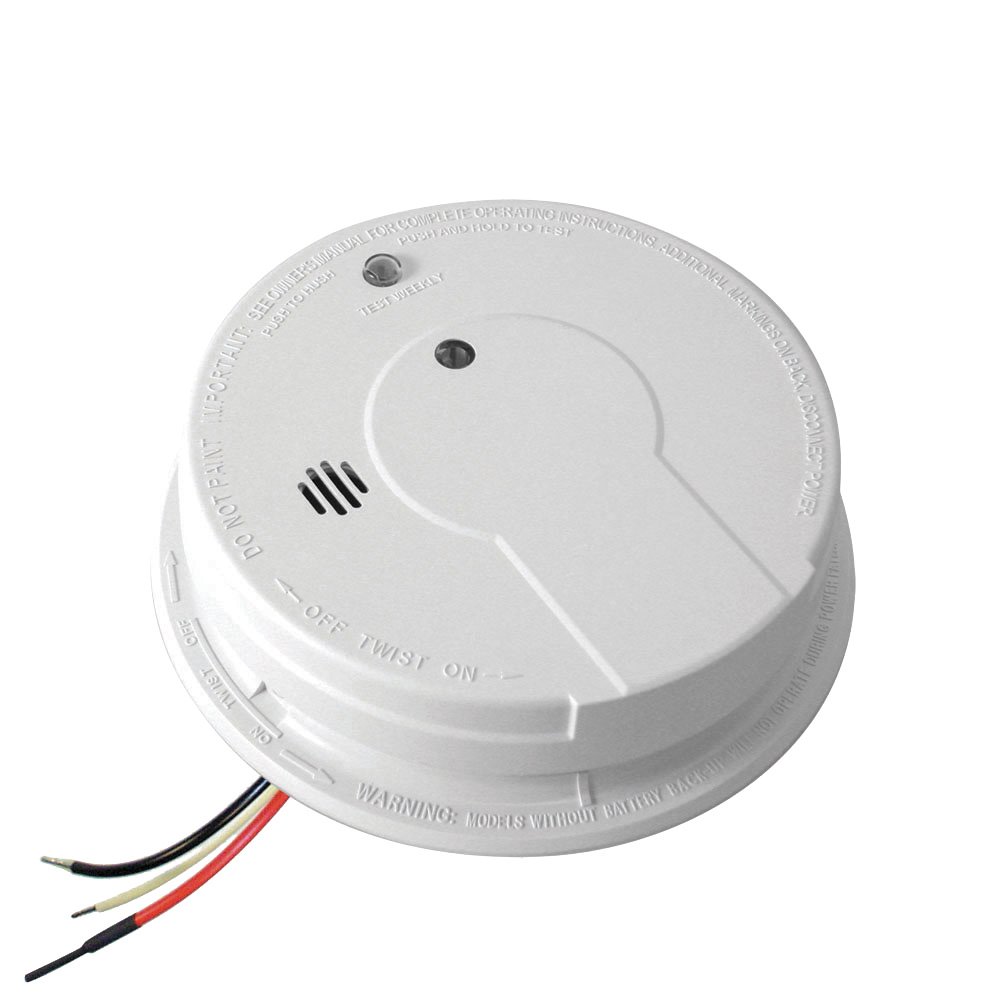
Links up to 24 devices — smoke, CO, and heat alarms — all from one system.
Most hardwired alarms stop at 12 interconnected units. The Kidde I12040 doubles that ceiling to 24 devices (18 of which can be initiating alarms), making it the right pick for larger homes or multi-zone installations where you want smoke, carbon monoxide, and heat detectors all talking to each other. The interconnect wiring uses a standard three-wire setup, and the pre-stripped harness with an easy-off cap means you do not need a wire-stripping tool — a small detail that saves time on a multi-unit install.
This model includes a Hush button: one press silences a nuisance alarm for several minutes without disabling the detector. That is a direct answer to the false-alarm headache that sends many buyers back to the store. The alarm memory feature flashes a red LED on the unit that *initiated* the alarm, so after an event you can see which room started it. The 9V battery backup is included, and the front pull tab lets you activate the battery without removing the alarm from the bracket — helpful on a vaulted ceiling.
Over 128 owners call out the ease of installation, and a similar number note it is a perfect replacement-quality fit for older Kidde units. The trade-off is that some units may not reach the full 10-year service life before nuisance alarms start — regular vacuuming of the sensor chamber is recommended. This interconnect capacity is double what the First Alert 9120BFF offers, but you pay for that flexibility with a replaceable 9V battery rather than a sealed lithium.
Best for Wiring: you are building or retrofitting a large system and want the most flexible interconnect ceiling — 24 devices covers almost any floor plan.
Skip for Tight Spaces: the backup battery is a replaceable 9V, not a sealed lithium, so you will swap it every year. For a zero-battery-hassle option, the First Alert SMI105-AC is a better fit.
4. Kidde 20SAR Hardwired Smoke Detector with AA Backup

The manufacturer claims it detects smoke over 25% faster than standard models.
The 20SAR uses advanced ionization sensing that Kidde says detects smoke 25% faster than conventional units. It sounds a loud 85-decibel alarm with a red LED strobe for a visual warning — helpful if someone in the home has hearing difficulty. The backup power comes from two AA batteries instead of the more common 9V, which is handy because AAs are everywhere in the junk drawer.
This unit is designed to reduce false alarms from cooking and steam using UL 217 10th Edition compliance, but the feedback shows it is a mixed bag. Reliability is the most-discussed aspect across the reviews, and while many owners mention flawless performance, a notable number experienced false alarms — particularly with construction dust or high humidity. One owner described the alarm as “loud, can hear it outside,” which is exactly what you want in a real emergency but can be jarring on a false trigger. The interconnect system works with other Kidde alarms, and the mounting plate is slightly larger than old units, which helps cover ceiling imperfections from previous detectors. Compared to the Kidde I12040, this one is faster on paper but less forgiving in dusty environments.
Best for Budget: homeowners who prioritize the fastest possible fire detection speed and want UL 217 10th Edition compliance for reduced nuisance alarms.
Skip for Advanced: your environment is dusty or steamy — the sensitivity can lead to repeat false triggers. For a more forgiving option in those conditions, the SITERWELL GS562A is a better match.
5. First Alert 9120BA Hardwired Ionization Smoke Alarm with Battery Backup

The same guts as the 9120BFF, sold without the fancy packaging — pure utility.
This is essentially the 9120BFF under a different model number, frequently bought by landlords and property managers who need consistent, code-compliant alarms across multiple units. It wires directly into 120V AC power, uses a 9V battery backup, and can interconnect with up to 12 other First Alert or BRK hardwired detectors. The ionization sensor catches fast-flaming fires, and the side-load battery drawer makes the annual swap painless.
The buyer feedback is consistent: these units last years with very few problems. Owners call them “a great staple” for rental properties and note they “last as long as they’re able to last.” The straightforward replacement process — twist off the old base, loosen two screws, attach the new base, tighten, twist on the detector — takes about a minute per unit once you have done it once. The 9120BA includes the 9V battery, so you are ready to install right from the start. Customers note it is a simpler path to the same reliability as the 9120BFF but without the consumer packaging that adds cost.
Best for Fast Fires: multi-unit property owners who need a no-fuss, consistent alarm they can order in bulk and install fast.
Skip for Kitchen: like all ionization alarms, it is more reactive to cooking smoke — place it well away from the kitchen. For a rental kitchen, the SITERWELL GS562A with photoelectric sensing is a smarter option.
6. SITERWELL GS562A Hardwired Photoelectric Smoke Detector
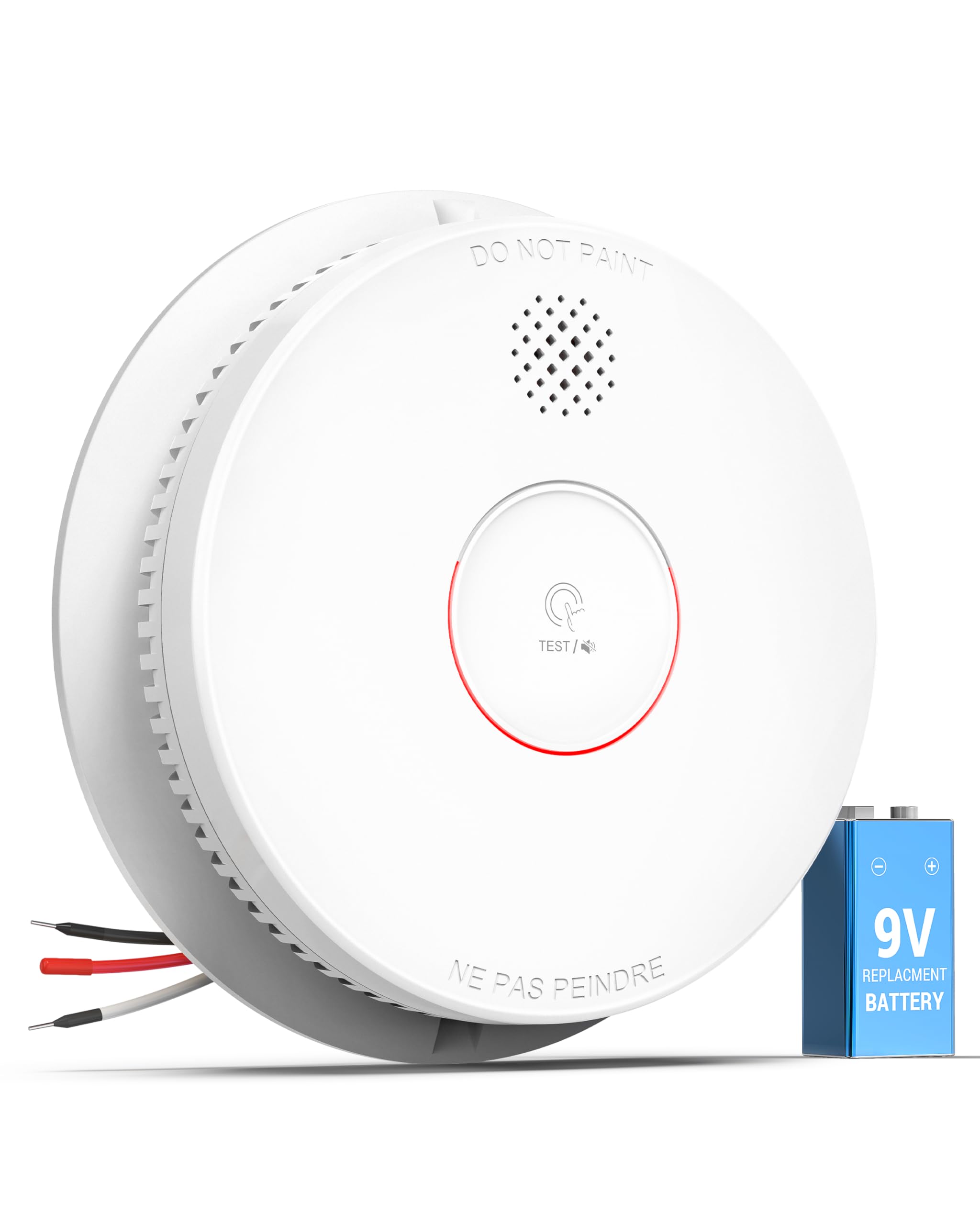
Photoelectric sensing means fewer false alarms from cooking — and a lower price to match.
At an entry-level price, the SITERWELL GS562A offers a photoelectric sensor (uses a light beam to detect thick smoke from smoldering fires), which excels at catching a slowly smoldering wire behind a wall and is much less prone to nuisance alarms from kitchen steam or burnt toast. This unit connects to up to 12 alarms in an interconnected system, uses a 9V battery backup, and meets the UL 217 10th Edition standard. For a kitchen or open-plan living area, this is a smarter choice than the ionization-based First Alert 9120BFF, which triggers more easily on cooking.
A thoughtful feature is the Do Not Disturb mode: if the detector senses a low-voltage condition or fault, pressing the test button silences the beeping for about ten hours so it does not wake you up at night while you wait to replace the battery. The green LED stays solid during normal operation, and the red LED flashes every 40 seconds to show it is powered. The wall plate fits most standard junction boxes, and the wire colors match the usual black/white/red pattern. The dimensions — 5.67 inches by 5.67 inches by 1.5 inches — mean it is slightly wider but shorter than the First Alert 9120BFF (5.6 x 5.6 x 2.2 inches), a 1% more in width than the BRK First Alert classic.
Owners consistently praise the easy installation and clean look. The recurring complaint is that the included 9V batteries often arrive dead; as one buyer put it, “all but 2 batteries were dead.” Buy a fresh pack of batteries with your order and you will be set.
Best for Smoldering: you want a photoelectric sensor to cut down on kitchen false alarms and are willing to swap the stock batteries on day one.
Skip for Open Areas: anyone who wants a sealed 10-year battery and no battery maintenance — this one uses standard 9V cells. The First Alert SMI105-AC is the better zero-hassle pick.
7. First Alert 9120BFF-12 Hardwired Smoke Alarm 12-Pack

A dozen alarms in one box — the simplest way to replace every detector in a large home.
If you own a multi-level house or you are a contractor doing a full retrofit, buying alarms individually is slower and more expensive per unit. This 12-pack of the same BRK First Alert 9120B model (ionization sensor, 120V hardwired, 9V backup) gives you a full house worth of detectors with one order. Each alarm ships with a 9V battery, mounting bracket, and hardware — twelve of everything.
The installation is identical to the single-pack: twist off the old base, disconnect the harness, plug in the new wiring (black/white/red), attach the new base, twist the alarm on. Owners estimate it takes about a minute per unit. The interconnected system links all 12 alarms so a detection in the basement sounds the alarm on every floor. The 85-decibel siren and ionization sensor match the specs of the best-selling 9120BFF exactly.
The main thing to watch for is the included batteries: a portion of reviewers point out that some units arrive with older stock batteries that cause the red LED to flash every minute. Swapping in fresh batteries at install time avoids the issue entirely. The 12-pack also represents the best per-unit price in this list, though you are paying more upfront. If you only need six detectors for a 2,000-square-foot home, the single 9120BFF is a better fit.
Best for Multi-Unit: whole-home replacement projects or property managers wiring a full building — the bulk pack saves per-unit cost and prevents shipping delays.
Skip for Single Use: you are committing to one sensor type (ionization) across every room; consider mixing in a photoelectric unit like the SITERWELL GS562A for the kitchen area.
Understanding the Specs
Ionization vs. Photoelectric Sensors
An ionization sensor uses a small amount of radioactive material to detect fast-flaming fires — think a grease fire or a paper fire that produces visible flames within seconds. It is extremely sensitive to small smoke particles. A photoelectric sensor uses a beam of light to detect smoldering fires — the kind that produce thick smoke before bursting into flames (a cigarette in the sofa, an overheated wire). The photoelectric type is far less likely to false-alarm from cooking steam or a hot shower. Safety experts recommend having both types in the home, or buying a dual-sensor alarm.
UL 217 10th Edition Standard
This is the current safety standard that smoke alarms sold in the U.S. must meet. The 10th Edition, enforced as of 2024, introduced stricter testing for nuisance alarm rejection. Alarms certified to this standard must demonstrate they can distinguish real smoke from cooking fumes, steam, and other common household triggers. If you are replacing an older detector, upgrading to a UL 217 10th Edition model is among the most effective ways to cut down on late-night false alarms.
Interconnect Capacity
Interconnect means when one alarm detects smoke, every alarm in the system sounds. The number of units you can link varies by brand and model: most First Alert and BRK models handle up to 12 detectors, while Kidde’s I12040 can connect up to 24 devices (including smoke, CO, and heat alarms). For a typical 2,000- to 3,000-square-foot home, 6 to 8 detectors are usually enough. The interconnect wire is the red traveler wire in the three-wire harness.
Decibel Rating (Siren Loudness)
Every alarm on this list produces at least 85 decibels at ten feet. That is louder than heavy traffic and well above the threshold needed to wake a sleeping person. A siren that is too quiet can be muffled by a closed bedroom door, so 85 dB is the industry baseline. Some alarms also include a flashing red LED as a visual cue for those with hearing difficulties.
FAQ
Can I replace an old hardwired detector with a different brand?
How often should I replace a hardwired smoke detector?
What does the red traveler wire do in hardwired interconnect?
Why does my hardwired smoke alarm chirp at night even with a new battery?
Are photoelectric sensors better than ionization for kitchens?
How many hardwired smoke detectors do I need per code?
Can I mix ionization and photoelectric alarms in the same interconnected system?
Do hardwired alarms stop working during a power outage?
What is the difference between a 10-year sealed battery and a replaceable battery?
Will a hardwired alarm work with old two-wire electrical boxes (no ground)?
Final Thoughts: The Verdict
Across the board, the wired smoke detectors winner is the BRK First Alert 9120BFF because it has the longest track record of owner satisfaction — a 4.7-star consensus across a massive number of homes, backed by over 1,100 praises for its install ease and nearly 1,000 for daily reliability. If you want a sealed 10-year battery and zero annual battery swaps, grab the First Alert SMI105-AC. And for a large whole-home retrofit with the best per-unit value, the First Alert 9120BFF 12-pack is the one to reach for.
How We Picked
We do not accept paid placement. Every pick is matched to a real buyer and a real use-case; we do not hands-on test units.
Sources & Methodology
Specifications: manufacturer listings and product documentation. Review insights: verified customer reviews, as of July 2026. Pricing: not shown on this page (it changes often); check the current price via the retailer link.
As an Amazon Associate, Calories Fit earns from qualifying purchases. This does not affect which products we feature.