
Our readers keep the lights on and the coffee maker working hard! As an Amazon Associate, I earn from qualifying purchases.
Specs are compiled from manufacturer listings and verified buyer reviews and can change over time — please confirm the key details on the product page before buying.
Finding a wooden compost bin that doesn’t rot, topple over, or take hours to assemble can feel like searching for a needle in a haystack. This guide cuts straight to the four models worth your time, comparing their build quality, capacity, and what real owners have to say about them.
I’m Mohammad — the founder and writer behind Calories Fit. This guide is built by comparing the manufacturers’ published specifications and the patterns across verified customer reviews, so you get each pick’s real strengths and trade-offs instead of marketing spin.
The models here range from a compact starter bin to a near-175 gallon behemoth, so you can find the right capacity for your yard. This is your complete guide to the best wooden compost bin for turning scraps into garden gold.
Our Picks at a Glance

How To Choose The Best Wooden Compost Bin
Picking the right composter is about balancing how much waste you generate with the space you have and how long you want the bin to last. The main things to consider are the type of wood, the thickness of the boards, the total volume, and how easy the bin is to put together and take apart for harvesting finished compost.
Capacity: How Much Compost Do You Really Need?
A small bin of around 70 to 80 gallons works well for a couple with a small garden. For a family kitchen and a medium-sized vegetable patch, you will want something closer to 170 gallons or in the range of 400 to 470 liters. Think of it this way: a bigger bin holds heat better, which speeds up the composting process, but it also takes up more floor space in your yard.
Wood Type: Cedar vs. Larch
Cedar is the gold standard for outdoor bins because it naturally resists rot and insects without any chemical treatment. Larch is a European softwood that is also very durable outdoors, offering a similar lifespan to cedar at a often slightly lower cost. Both allow the bin to “breathe,” which is essential for aerobic decomposition, but cedar is notably lighter for moving around. FSC certification (like on the dobar model) means the wood comes from sustainably managed forests, which is a plus for eco-conscious buyers.
Assembly: Tool-Free is the Goal
The best wooden bins use a simple slat-and-post system where boards lock into corner posts using spacers. You just need a rubber mallet — no screwdrivers or power drills required. This makes setup fast (under 30 minutes in most cases) and also makes it easy to take the bin apart if you ever need to move it to a new spot in the garden. A good assembly experience also means you are less likely to strip a screw head or split a board while building it.
Quick Comparison
| Model | Best For | Capacity | Wood Type | Board Thickness | Amazon |
|---|---|---|---|---|---|
| Greenes Fence 36″★ Best Overall | Large gardens & high volume | 173.92 gallons | North American Cedar | 3/4 inch | Amazon |
| Greenes Fence 24″ | Smaller spaces & bear resistance | 77.3 gallons | North American Cedar | 3/4 inch | Amazon |
| dobare Larch Composter | European value & plug-in assembly | 420 liters | FSC Larch Wood | Gap 3.5-4 cm | Amazon |
| SOCOME 130 Gallon Cedar | Budget large all-wood bin | 130 gallons | Canada Cedar | — | Amazon |
In‑Depth Reviews
1. Greenes Fence Premium Cedar Wood Composter, 36″ L x 36″ W x 31″ H
Our pick — over 4.5★ from 350+ verified ratings; the strongest balance of quality and price.
The heavy lifter that swallows yard waste whole without asking for a single screw.
If you have a large garden or a family that generates a lot of kitchen scraps, this 173.92-gallon bin is the one to beat. Made from 3/4-inch thick North American cedar boards, the material naturally resists rot and smells pleasant, unlike plastic bins that can get funky. The assembly is the standout feature here — you lock the boards into the corner posts using only a mallet, and buyers report finishing it in under 30 minutes. It is a leap in size over the Greenes Fence 24-inch model, offering 173.92 gallons versus the 77.3-gallon version, which is a massive advantage for serious composters.
The open-bottom design lets worms and microbes move in from the soil below, which drastically speeds up decomposition compared to sealed tumblers. Better drainage of excess moisture is a practical advantage if you tend to over-water your pile. The bin can also be expanded into a two- or three-bin system using add-on kits, giving you room to grow. The main trade-off owners point to is the sturdiness of the spacers; inserting the slats on a perfectly level surface is important to avoid any binding, but swapping a stubborn board to a different side usually fixes it. As owners mention: “Easy, tool-free assembly in under 30 minutes; lightweight parts; stubborn slats can be swapped to a different side.”
Buyers consistently praise how easy this bin is to assemble — it is the most-mentioned topic by a wide margin. Its appearance is the second biggest win, with some owners calling it “an elegant way to screen your outside air conditioner condenser,” meaning it looks good enough to sit right next to your patio. The 46-pound cedar frame gives you long-term durability, and customers note it “can be with me for quite a number of years.”
Why It Wins
- Giant 173.92-gallon capacity handles total yard volume.
- 3/4-inch thick cedar boards are naturally rot-resistant and durable.
- Tool-free assembly takes under 30 minutes with a rubber mallet.
- Expandable into a two or three-bin system for serious composting.
What to Watch
- Stubborn slats can bind if the ground is not perfectly level.
- At 46 pounds, it is heavy to move once assembled.
- Mixed feedback on long-term sturdiness of the plastic spacers.
Reach for this if: you have a big garden, a big family, and want the absolute best value in terms of capacity per dollar. It is the crowd favorite for a reason.
Look elsewhere if: your yard space is tight or you only need a small bin for a couple of plants.
2. Greenes Fence Premium Cedar Wood Composter, 24″ W x 24″ L x 31″ H
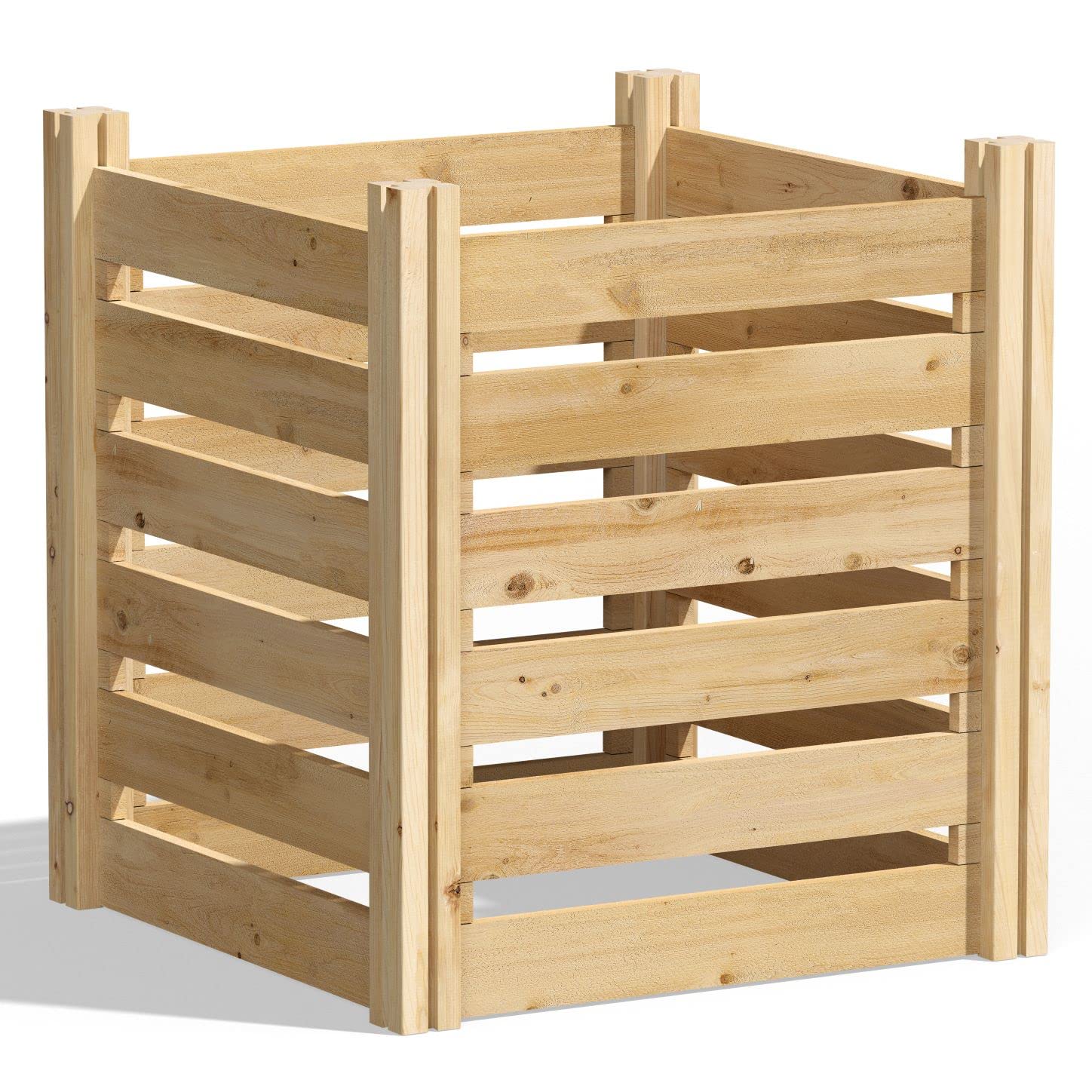
The compact cedar fortress that looks like garden furniture and resists the neighborhood bears.
This is the smaller sibling of the 36-inch Greenes Fence bin, with a 77.3-gallon capacity that fits neatly into tighter corners or smaller yards. It shares the same high-quality 3/4-inch-thick North American cedar boards and the same incredibly simple tool-free assembly. The 24 by 24-inch footprint is significantly smaller — at 24 inches square versus the 36-inch model’s 36-inch square — so it fits next to a shed or under a window without blocking the view. Owners consistently call it “well built and easy to put together,” with a few noting they hope to get “many years out of it.”
The sealed cedar construction and open bottom make it a promising option for those concerned with bears. Owners trying to bear-proof their bin find the wood, stone, and metal construction easier to reinforce than flimsy plastic tumblers. It comes with a free book on organic gardening from Mike McGrath, which is a thoughtful bonus for beginners. The biggest positive is the quality of the materials; after putting it together, the bin “looks nice looking” and is “not an eyesore,” which is a common complaint with black plastic composters.
The assembly process is the most-praised feature here as well, with owners reporting it takes just minutes to lock the boards into the posts. The sturdiness is the second biggest win, with the thick cedar boards providing a solid feel that cheaper pine bins lack. The main drawback is the small capacity; if you have a large garden, you will outgrow this model quickly and would be better served by the 36-inch version above. Also, one owner noted a single broken spacer in the box, though replacements were included.
Why It Fits
- Compact 24-inch footprint fits small gardens or tight corners.
- Same premium 3/4-inch cedar as the larger model, just scaled down.
- Tool-free assembly that buyers call “pretty easy” from start to finish.
- Sturdy enough for bear-resistant reinforcement projects.
Where It Cuts Corners
- 77.3 gallons, compared to the 36-inch version’s 173.92 gallons.
- Some units arrive with a broken spacer (though extras are packed).
- Open-bottom design may need a wired lid for ultimate bear security.
Grab this if: space is tight and you want the same quality cedar as the top pick, just in a smaller package.
Think twice if: you have a large household generating lots of food waste — you will fill this up fast and want the 173.92-gallon bin instead.
3. dobar® Green Label Larch Composter, 420 Liters

A smart European design that prioritizes quick assembly and sustainable forestry.
This dobar composter uses FSC-certified larch wood (a naturally durable outdoor wood) and a clever plug-in system that requires zero tools. At 420 liters (roughly 111 gallons), it gives you 420 liters versus the SOCOME Cedar bin’s roughly 492 liters, but still plenty for a medium-sized household. Its compact 79 x 79 x 79 cm cube shape makes it easy to place in a corner of the garden.
The plug-in system is the headliner here; reviewers point out it takes only a few minutes to assemble. The gaps between the boards are intentionally wide, at 3.5 to 4 cm, which provides excellent airflow for aerobic bacteria without allowing the contents to spill out. The key drawback is the thinness of the slats. One owner noted the “slats are thin and come apart too easily,” recommending you screw the top and bottom boards to the posts for extra stability. It is a 30-second fix that dramatically improves the long-term sturdiness. The larch wood comes untreated, which means it will weather to a natural gray over time, but it is not chemically treated, so it is safe for organic gardening.
European buyers praise its price-to-value ratio, calling it “good for the price” and noting it assembles “in a few minutes.” The main trade-off is the lack of a lid — many buyers buy a separate cover to keep rain out and heat in. This makes it more of a basic heap holder than a sealed composter, which works for cold composting but less ideal for hot composting methods that need to retain internal temperature. It is also a bit heavier at 23 kilograms, which gives it stability in the wind.
Why It Excels
- FSC-certified larch wood from sustainable forestry is an eco-friendly choice.
- Plug-in assembly that takes just minutes with zero tools.
- Generous 420-liter capacity for medium to large gardens.
- Wide board gaps (3.5-4 cm) provide excellent ventilation for fast composting.
What You Give Up
- Thin slats prone to popping out of their slots without reinforcement.
- No lid included — you will need to buy a separate cover for rain protection.
- European design means replacement parts can be harder to find in the US.
Best for: budget-conscious gardeners in Europe who want a large, sustainable bin and are happy to add a couple of screws for extra rigidity.
skip it if: you want a bin with a lid from the start or you prefer North American cedar over larch.
4. SOCOME 130 Gallon Canada Cedar Wood Compost Bin

A solid Canada-cedar composter with slatted airflow and a pull-out door — a genuine all-wood bin, no plastic.
This is a large-capacity bin, holding up to 130 gallons — roughly 492 liters — in a solid Canada cedar body measuring 31.5 by 27.5 by 35.4 inches. Unlike a plastic thermal composter, it is built entirely from wood, with strategically spaced slats that keep oxygen moving through the pile for faster, more even decomposition without the sealed-in heat of a plastic tumbler.
A pull-out door at the base makes maintenance easy: you can add fresh scraps, turn the pile for aeration, or harvest finished compost from the bottom without disturbing the top. The open, ground-contact design lets worms migrate up into the pile. SOCOME rates assembly at about 15 minutes with clear instructions, though gloves are recommended when handling the raw cedar slats during setup.
Buyer feedback is limited and mixed — the bin currently averages 2.9 stars across a small number of reviews, so its quality control is less proven than the Greenes Fence models above. Treat it as a budget route to a large, genuinely all-wood bin rather than a premium build, and inspect the panels and hardware on arrival.
Why It Stands Out
- Solid Canada cedar construction — all wood, no plastic.
- Large 130-gallon (about 492-liter) capacity for high-volume gardens.
- Slatted sides keep airflow moving for faster decomposition.
- Pull-out door makes turning and harvesting compost easy.
Important Caveats
- Limited reviews averaging 2.9 stars — quality is less proven than peers.
- Raw cedar slats call for gloves during assembly.
- Open-top design has no lid to keep out rain or pests.
- At roughly 31 pounds it is not light to reposition once assembled.
Reach for this if: you want a genuinely all-wood, high-capacity bin and are comfortable with a budget build you inspect on arrival.
Look elsewhere if: you want a proven, higher-rated bin — the Greenes Fence cedar models are the safer pick.
Understanding the Specs
Cedar vs. Larch Wood
Cedar is naturally rot and insect resistant, making it the top choice for outdoor bins that will be exposed to rain and soil. Larch is a European softwood with similar natural durability, often used for siding and fence posts. Both are excellent, but cedar tends to be lighter in weight and has a more pleasant aromatic scent.
Capacity in Gallons and Liters
Capacity tells you how much material the bin can hold at one time. A bin of 77 gallons suits a small household, while 173 to 470 liters (roughly 110 to 124 gallons) handles a busy family kitchen and a medium vegetable garden. Larger bins also retain heat better, which is essential for hot composting that breaks down material faster.
FAQ
Can I use a wooden compost bin for kitchen scraps like vegetable peels and coffee grounds?
How long does a cedar wood compost bin last before it rots?
Does a wooden bin need a lid to work properly?
Can I build a wooden compost bin into a two-bin system myself?
How do I stop animals from getting into a wooden compost bin?
Is a wooden compost bin better than a plastic compost bin?
Do I need to treat the wood on a compost bin to protect it?
What is the difference between cold composting and hot composting in a wooden bin?
Can I put grass clippings in a wooden compost bin?
How do I empty a stationary wooden compost bin to harvest the finished compost?
Final Thoughts: The Verdict
For the majority of shoppers, the best wooden compost bin is the Greenes Fence 36-inch model because it delivers a strong balance of massive capacity, premium North American cedar, and ridiculously easy tool-free assembly. If you are tight on space or need a bear-resistant option, the Greenes Fence 24-inch bin gives you the same quality in a smaller footprint. And for European buyers focused on sustainability and value, the dobare larch composter is the smart choice, just be ready to add a couple of screws to reinforce the slats.
How We Picked
We do not accept paid placement. Every pick is matched to a real buyer and a real use-case; we do not hands-on test units.
Sources & Methodology
Specifications: manufacturer listings and product documentation. Review insights: verified customer reviews, as of July 2026. Pricing: not shown on this page (it changes often); check the current price via the retailer link.
As an Amazon Associate, Calories Fit earns from qualifying purchases. This does not affect which products we feature.