
Our readers keep the lights on and the coffee maker working hard! As an Amazon Associate, I earn from qualifying purchases.
Specs are compiled from manufacturer listings and verified buyer reviews and can change over time — please confirm the key details on the product page before buying.
You need to know the exact temperature of your freezer, greenhouse, or vacation home the moment something goes wrong. But most wireless monitors lose signal the second they hit a wall, drain batteries every few months, or bury their alerts so deep you miss them. This guide cuts through the noise to find the systems that actually deliver real-time data, go weeks without a battery swap, and wake you up when it matters. The ideal setup balances reach, accuracy, and a dead-simple alert path — and the crowd favorite does exactly that.
I’m Mohammad — the founder and writer behind Calories Fit. This guide is built by comparing the manufacturers’ published specifications and the patterns across verified customer reviews, so you get each pick’s real strengths and trade-offs instead of marketing spin.
After digging through hundreds of owner experiences, the best wireless temperature monitoring system emerges as the one that combines a nearly unbreakable signal with a setup that works right from the start.
Our Picks at a Glance


How To Choose The Best Wireless Temperature Monitoring System
Every wireless monitor does the same basic job: take a temperature reading and send it to your phone. But the real-world experience varies wildly based on three factors that cut straight through the marketing.
The Wireless Range Trade-Off
WiFi-based sensors, like the GoveeLife and X-Sense options, tap directly into your home network. They are simple to set up if your router is nearby, but they fight with every other device on 2.4 GHz for airtime and struggle to reach through a brick wall into a basement or garage. LoRa-based systems such as the YoLink use a dedicated radio protocol that sips power and punches through concrete, steel siding, and even freezers at a range of up to a quarter mile in open air. The catch is you need a proprietary hub plugged in somewhere central. If your single greatest pain is coverage inside a metal-barn fridge or a concrete-root cellar, a LoRa hub system is worth the extra dock.
Alert Architecture — How You Get Woken Up
A temperature monitor is useless if the alert arrives after the freezer has thawed. The most reliable systems offer multiple notification paths: a push notification to your phone, a physical beep from the base station, an email, and possibly a text message. Systems like the MOCREO include a 95dB hub beep, which is loud enough to hear from the next room even if your phone is on silent. Some also offer “Critical Alerts” on iOS that bypass the Do Not Disturb setting. Pay close attention to whether the system allows you to set a delay on the alarm (an “anti-false alarm” timer) so opening the fridge to grab ice cream does not trigger a panic.
Battery Life and Power Backup
A sensor with a battery life measured in months rather than years is a maintenance problem waiting to happen. The best systems, like the YoLink, claim up to 5 years on a pair of AA batteries, which means they outlast the average freezers. The base station (the hub) is almost always mains-powered, which creates a single point of failure if the power goes out. The Necto cellular monitor solves this with a rechargeable internal battery that lasts up to 3 days, keeping the system alive during a blackout. When data integrity matters most — say, for a server room or a pet in an RV — the power backup of the hub is as important as the sensor itself.
Quick Comparison
| Model | Best For | Range | Sensor Accuracy (Temp) | Max Sensors | Amazon |
|---|---|---|---|---|---|
| YoLink 3-Pack★ Best Overall | Long-range whole home | Up to 1/4 mile | ±0.36°F | Unlimited per hub | Amazon |
| X-Sense 3-Sensor KitBest Value | Budget multi-room | Up to 1,700 ft | ±0.36°F | 10 | Amazon |
| X-Sense LCD KitBest Display | Easy-to-read displays | Hub range | ±0.36°F | 10 | Amazon |
| GoveeLife 2.0 3-Pack | Compact sensor placement | WiFi range | ±0.54°F | 10 | Amazon |
| GoveeLife Fridge 2-Pack | Freezer and fridge duty | Up to 197 ft | ±0.9°F | 10 | Amazon |
| YoLink X3 Probe | Water and outdoor probe | Up to 1/4 mile | Probe-based | Unlimited per hub | Amazon |
| MOCREO H5Pro Kit | Heavy-duty freezer monitoring | Up to 1/3 mile | ±0.9°F | 100 | Amazon |
| SensorPush HTP.xw | Professional accuracy logging | Up to 330 ft (Bluetooth) | ±0.1°F (rating) | Unlimited per app | Amazon |
| Necto Cellular Monitor | No WiFi locations | Nationwide cellular | Built-in sensor | N/A (standalone) | Amazon |
In‑Depth Reviews
1. YoLink Smart Wireless Thermometer Hygrometer, 3-Pack
Our pick — over 4.5★ from 700+ verified ratings; the strongest balance of quality and price.
The set-and-forget system that reaches a quarter mile through steel and concrete.
This is the rare monitoring system where the headline spec actually understates the real-world performance. While most WiFi-based sensors fight for bandwidth and drop out behind a freezer, the YoLink uses a proprietary LoRa radio protocol — a completely separate wireless radio — to punch through walls, outdoor sheds, and even a chicken coop at distances of up to a quarter mile. The unit is rated for a remarkably wide operating range from -4°F to 129°F (-20°C to 54°C), and the sensors are accurate to ±0.36°F in the zero-to-54°C band, so the readings for your freezer and your greenhouse are equally trustworthy.
The package comes with a hub and three sensors (you get four physical items). The sensor battery life is the real standout: up to 5 years on two AA batteries, which means you install them and basically forget they exist. If you own a home with hard-to-reach spots — a crawlspace, a barn, a concrete basement — the thing everyone praises is the reliability of that link. Owners have set these up in florida beehives, outdoor fridges, and humid storage rooms, with the app delivering alerts via text, email, or push notifications without any subscription fees.
The main trade-off is that you must keep the hub plugged into power and within range of your router. Unlike a pure WiFi sensor, this system cannot work without its bridge. But for anyone whose biggest headache is losing signal at the edge of the property, this is the best wireless temperature monitoring system on the market.
Why It Wins
- class-leading real-world range through obstacles like steel siding and thick concrete — the LoRa radio reaches where WiFi cannot go.
- Exceptional battery endurance — a 5-year life on two AA batteries means no sensor maintenance for half a decade in most conditions.
- Alert flexibility without a monthly fee — SMS, email, and push alerts, with 15 free SMS per month per system.
The Trade-Offs
- Requires the YoLink hub to function — if the hub loses power or network connection, all sensors go silent.
- The sensors themselves have no display — you must check the app for any reading; no glanceable screen at the sensor location.
Reach for this if: you have metal buildings, a long property, or hard-to-reach zones like a basement crawlspace where WiFi simply does not penetrate.
Look elsewhere if: you want each sensor to show the temperature on a local LCD screen without pulling out your phone.
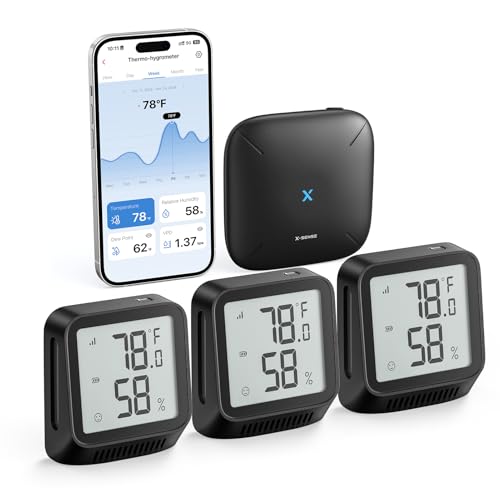
2. X-Sense Indoor Wi-Fi Thermometer Hygrometer, 3 Sensors & Base Station
The lowest-priced multi-sensor kit that still delivers a Swiss-made sensor chip for under forty bucks.
Few kits offer this level of precision at this price point. The X-Sense uses a Swiss-made high-precision temperature sensor that is accurate to ±0.36°F (±0.2°C) and humidity to ±2% RH, with an operating range from -4°F to 140°F (-20°C to 60°C). It is an indoor system that works best within home walls — the open-air transmission range is listed at 1,700 ft (500 m), though real-world results through wood-framed houses are typically lower but still reliable. Setup is famously fast, with owners reporting a three-minute process from box to app.
This system requires a 2.4 GHz WiFi network because it is incompatible with 5.0 GHz bands. The app stores and exports your data for free — you can retrieve up to a full year of past readings as a CSV file with no subscription. It also works with Alexa voice commands for quick status checks. The included base station plugs into AC power, which means the battery life of the individual sensors is excellent since the base does not drain them. An occasional owner mentions the app text can be small on some phones, but the setup reliability is a constant positive note in the feedback.
What Earns Its Spot
- Superb sensor accuracy for the price — the Swiss chip rivals systems costing twice as much.
- Completely free data storage and CSV export for a full year, with no hidden subscription.
- Quick and straightforward setup — the system connects to WiFi in minutes for most owners.
The Catch
- Only works with 2.4 GHz WiFi — incompatible with most modern mesh networks that push 5 GHz, requiring a network configuration change.
- The base station needs a constant wired power source, which limits its placement in a room without a nearby outlet.
Best fit for: homeowners or apartment dwellers who want accurate, shareable data for a basement, wine cellar, or a few rooms without spending over.
Not for: outdoor use — this is built for indoor environments with controlled temperatures.
3. X-Sense WiFi Thermometer Indoor Hygrometer with LCD Display
The same Swiss sensor and reliable app, now with a large LCD screen on each sensor for a quick glance.
This version of the X-Sense delivers the same ±0.36°F accuracy from the Swiss-made chip as its sibling, but adds a clear LCD digital screen on every sensor unit. You can stand the sensors on a tabletop or mount them on a wall, and the screen displays the current temperature and humidity with “Comfort Indicator Icons” — happy-face symbols that tell you at a glance if the room is in a comfortable range. The system is part of the same X-Sense ecosystem and works with the same free data-export app, storing and charting data for months. The base station includes a loud alarm that sounds on its own if the sensor readings drift beyond your set thresholds, giving you an immediate local alert in addition to the phone notification.
Like the other X-Sense model, this kit includes three sensors and one base station. It connects via 2.4 GHz WiFi and uses Bluetooth only for the initial setup step. The app lets up to 12 users monitor the same environment simultaneously, which is practical for a shared household or a vacation property with multiple caretakers. The feedback consistently points out that the setup time is under 30 minutes for all four units. A recurring positive is how well the system integrates if you already own other X-Sense devices, as all sensors can share a single base station.
Walk-up readout: Each sensor’s large LCD means you do not need to pull out the phone — a quick glance at the sensor itself shows the temperature and whether the room is in a comfortable zone.
Shared access: Up to 12 separate users can view the same data in the app, making it a strong pick for families or a property manager.
Grab this for: a cigar cellar, wine cabinet, or baby nursery where you want both a phone alert and a visible screen on the shelf.
skip it if: you need battery-only operation — the base station requires AC power, and the sensor screens use more battery than a non-display sensor.
4. GoveeLife 2.0 WiFi Hygrometer Thermometer with Gateway
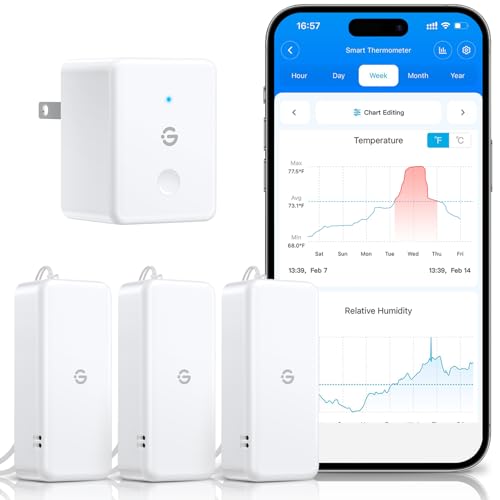
The smallest sensor in the lineup, designed to slip into drawers, wine cabinets, and guitar cases without being noticed.
The GoveeLife sensors are physically tiny and come with lanyards so you can hang them nearly anywhere. Each sensor uses a Swiss-made chip that delivers temperature readings accurate to ±0.54°F (±0.3°C) with humidity within ±3% RH. The data refreshes every 2 seconds, which is fast enough to catch a sudden temperature swing from a failing freezer compressor. The system requires a 2.4 GHz WiFi connection for the gateway, which can pair up to 10 sensors to a single unit. The gateway provides online data storage for up to 2 years and allows you to export the data as a file for analysis.
The compact size has a practical payoff: you can hide these inside a wine chiller, a reptile vivarium, or a cigar humidor without taking up shelf space. The battery life is rated at up to 2 years, depending on the reporting interval. The app sends push and email alerts when temperature or humidity exceeds your set range. Some buyers report that the initial WiFi connection can be tricky on certain dual-band routers, but the Govee customer support is described as helpful in those cases. For the size, the feature set is tough to top.
Concealable placement: The compact size and lanyard design let you drop these into a guitar case, a drawer, or a wine rack without the sensor being an eyesore.
Data depth: The system stores up to 2 years of data and refreshes every 2 seconds, so you can track environmental trends in granular detail.
Best for: a wine enthusiast who needs a sensor small enough to fit next to bottles, or an RV owner who wants discreet cabin monitoring.
Think twice if: your home network is strictly 5 GHz — this system requires a 2.4 GHz band for the gateway.
5. GoveeLife WiFi Refrigerator Thermometer 2-Pack with Gateway

A fridge-focused system with a wired probe that stays inside the freezer while the display sits outside in the light.
Unlike all-in-one sensor units that must stay inside the cold chamber (and drain their batteries faster at those temperatures), this GoveeLife kit uses a remote probe. The main display unit with its LCD screen stays magnetically attached to the fridge door or the wall next to it, while the slim probe wire slips under the door seal to sit directly inside the freezer. This design means your food never blocks the signal, the display is readable without opening anything, and the sensor uses standard AAA batteries. The measuring range spans from -40°F to 158°F with an accuracy of ±0.9°F / 0.5°C, making it capable of handling a deep freezer without issue.
The “Smart Anti-False Alarm” feature is uniquely useful here. It allows you to set a delay of 1 to 10 minutes after the temperature drifts out of range before the alert triggers. That means opening the freezer door to grab a bag of peas does not set off a panic alert. The gateway supports up to 10 sensors total, and the system sends app notifications and email alerts when the temperature stays out of range. The data chart is stored for up to 2 years and is accessible in the app. The hub has a range of up to 197 ft (60 m) in open air, which is plenty for a typical house.
Why It Stands Out
- The wired probe design eliminates signal drop inside metal freezer boxes and keeps the display at a readable height.
- The anti-false alarm timer prevents nuisance alerts from normal door openings, a common problem with cheap freezer monitors.
- Wide temperature range from -40°F to 158°F covers the coldest deep freezers and the hottest hot tubs.
Its Limitation
- The hub needs constant power with no battery backup, so a power outage leaves the system dark unless you have a UPS.
- The probe wire must be routed through the door seal, which can be tricky on some freezer gaskets.
A perfect match for: anyone with a garage freezer, a chest freezer, or a fish tank who needs reliable temperature alerts without false alarms.
Not for: dry indoor environments like a living room or nursery where a small all-in-one sensor is simpler.
6. YoLink Smart X3 Version Outdoor Temperature Data Logger with Probe
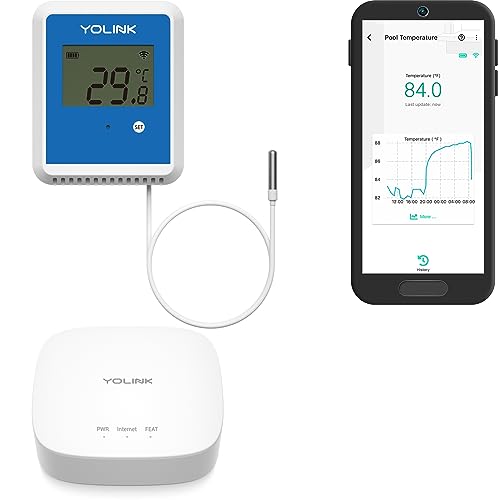
The one with the wired probe that sits in a fish tank, hot tub, or steam pipe while the sensor stays dry outside.
This is the specialty tool in the YoLink family, built for wet and extreme environments. The X3 version comes with a single sensor that has a wired probe, so you can place the probe directly in the liquid — a pool, a hot tub, a fish tank, a wood boiler, or a milk tank — while the transmitter electronics sit safely outside the water. The battery life is rated at 5+ years on two AA batteries, and the LoRa radio maintains the same quarter-mile open-air range as the standard YoLink sensor. The standout feature here is the “offline data logging” capability: the sensor can store readings even when it is not connected to the hub, and once it reconnects, the recorded data uploads to the app. This is invaluable for a vacation cabin with intermittent power.
The system sends alerts via SMS, email, push notifications, and even to a speaker hub. Each app account gets 5 free SMS per device per month. IFTTT and Alexa voice integration are supported, though triggering Alexa routines from the sensor alerts is not currently an option. The built quality is weather-resistant, and the probe cable is rugged enough for permanent outdoor installation. The only significant trade-off is that the package includes a hub and just one sensor, so if you need to monitor multiple locations, you will need to buy additional X3 sensors.
Versatile probe placement: The wired probe lets you monitor pool water, pipe glycol, or an aquarium while the transmitter stays dry and at room temperature, extending battery life.
Set and forget: 5-year battery life plus offline logging means you can leave this deployed in a remote location for years and still get data history when the hub reconnects.
Buy this for: a fish tank, hot tub, or wood boiler — any scenario where the sensor must be submerged or attached to a hot surface.
Do not buy for: general indoor room temperature monitoring, where a simpler air-temperature sensor is cheaper and easier to place.
7. MOCREO WiFi Remote Thermometer Freezer Alarm

The serious hub that supports up to 100 sensors and screams at 95 decibels when something goes wrong.
The MOCREO kit is built for situations where silence is not an option. The H5Pro hub features a 95dB internal beep that will cut through the background noise of a server room, a barn, or a workshop. The two included wireless sensors (LS1 model) are rated IP66 splash-proof, so they can handle the high humidity of a refrigerator and even outdoor exposure in a greenhouse or well house. The range is the second-best in this lineup at 1/3 of a mile in open air (1,640 ft), and the hub can communicate with up to 100 sensors, making it scalable for a large property or commercial operation. The temperature sensor is accurate to ±0.9°F and covers a range from -4°F to 131°F.
Setup is done via a smart app that connects over Ethernet or 2.4 GHz WiFi. The hub features an LCD that auto-syncs with time and weather over WiFi and cycles through each connected sensor. The system offers three alert paths: app notification, email, and the loud hub beep. A useful feature is the “Power Outage” and “WiFi Disconnect” alerts that notify you if the hub itself loses connectivity. The sensors have a 2-year battery life on three AAA batteries. One thoughtful touch is the ability to mute the hub beep directly from the app, so you do not need to walk to the unit to silence an alarm.
The Strengths
- Massive scalability — the hub supports up to 100 sensors for a large home, barn, or commercial site.
- The IP66 splash-proof sensor works inside a fridge or outside in the rain without damage.
- Self-detection alerts tell you if the hub goes offline or the power fails, not just the sensor.
The Weakness
- The sensor has a narrower temperature range than some competitors (-4°F to 131°F vs. -40°F in the GoveeLife), so it is not ideal for polar-level deep freezers.
- Sensor housings are larger than the pocket-sized Govee or SensorPush units.
Ideal for: a property manager, warehouse operator, or serious home hobbyist who needs to track many zones from a single screen with a loud local alarm.
Pass on it for: a single-room nursery — the hub and app power is overkill for a one-sensor job, and smaller units are simpler.
8. SensorPush HTP.xw Smart Temperature & Humidity Sensor

The data-obsessed sensor that tracks barometric pressure, heat index, dew point, and VPD with lab-grade accuracy.
This is not a system you buy to glance at the temperature. The SensorPush HTP.xw is designed for those who need the full environmental picture. It measures air temperature, relative humidity, heat index, barometric pressure, dew point, and Vapor Pressure Deficit (VPD) — the latter being critical for indoor gardeners and cigar aficionados. The accuracy is rated at a tight tolerance that owners consistently validate against professional instruments, often finding the SensorPush within 1°F and 1-2% RH of calibrated lab gear. The unit is tiny and weighs next to nothing at 0.01 kg, and it runs on a single CR2477 coin cell battery that lasts 1-2 years in typical use.
The catch is connectivity. This is a Bluetooth device with a maximum line-of-sight range of 330 ft (100 m). Without the separately sold G1 WiFi Gateway, you cannot access the data remotely. The sensor stores 30 days of data onboard and offers unlimited in-app storage, but you need to walk within Bluetooth range to sync it. The trade-off is that the setup is genuinely simple — seconds from unboxing to reading. It is splash-resistant and sits comfortably in a refrigerator, greenhouse, or humidor. For pure data integrity, owners of cigar shops, wine caves, and research cabinets swear by this unit.
Environmental full picture: In addition to temperature and humidity, it tracks barometric pressure and VPD, giving indoor growers and serious collectors the precise micro-climate data they need.
Bluetooth limitation: This sensor is not WiFi-native — you must add the G1 Gateway for remote access, which means a higher total cost if you need 24/7 off-property monitoring.
A must-buy for: a cigar humidor, grow tent, or controlled fermentation chamber where data precision and the number of tracked metrics matter more than a loud alarm.
Not a good fit for: a simple “is my freezer cold?” question — the simplicity of a MOCREO or GoveeLife probe system covers that use case for less money and with better remote connectivity.
9. Cellular Temperature Monitor – Necto Power Failure Alarm
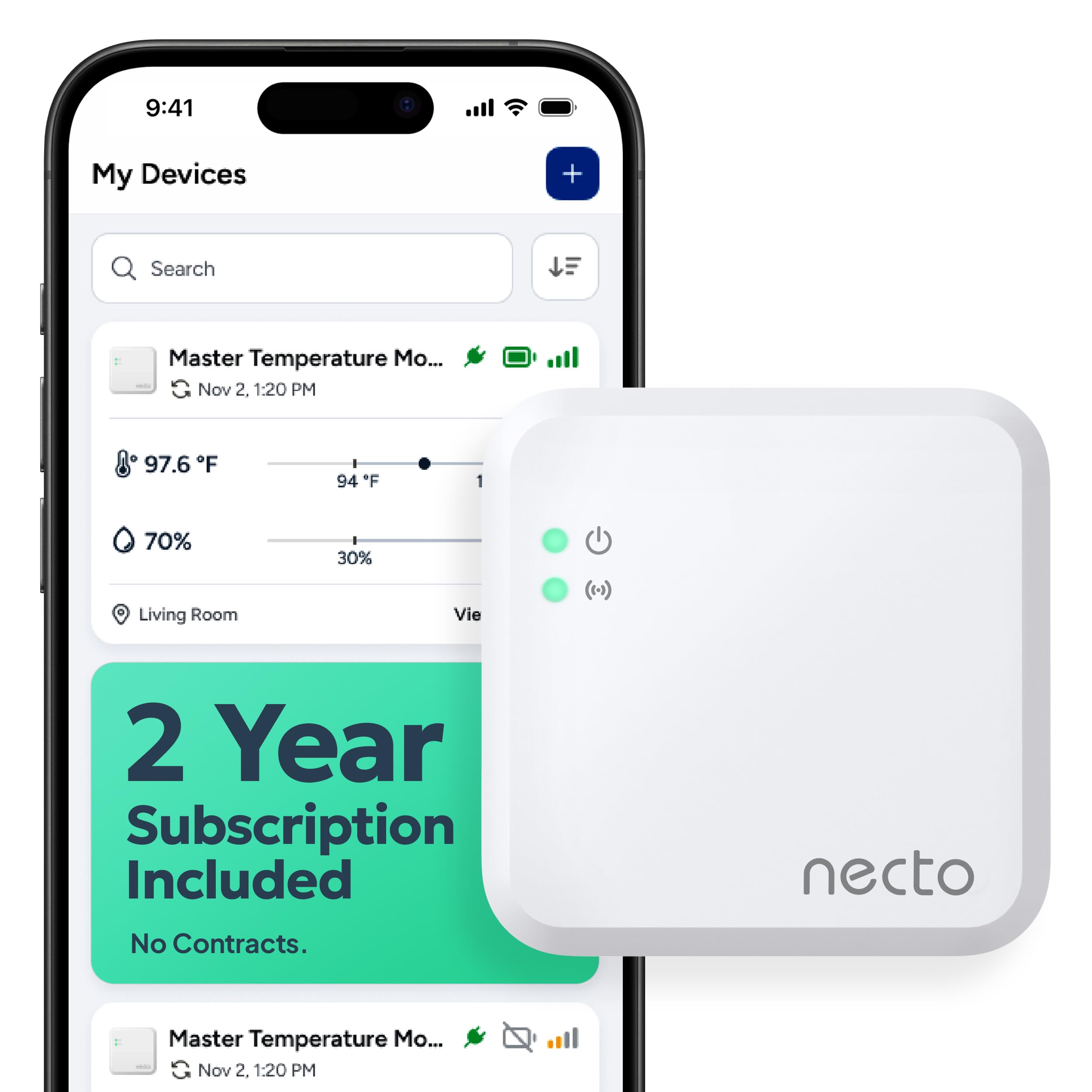
The only system here that works everywhere, with or without WiFi, using its own cellular data network.
The Necto solves the one problem every other sensor on this list shares: dependence on a home WiFi network. This unit uses a built-in 4G LTE SIM card that roams across multiple networks, so you can drop it in an unserviced RV, a cabin with no internet, or a friend’s vacation home and start receiving alerts immediately. The package includes 2 full years of cellular service with no hidden fees. After that, it renews at per month — a transparent cost compared to the free-but-WiFi-dependent alternatives. The sensor takes readings every 10 seconds and uploads the most recent reading every 10 minutes to an online portal.
It also detects power failures, which is a rare and valuable feature. If the wall outlet goes dead, the built-in rechargeable battery keeps the monitor running for up to 3 days and sends you an alert that the power is out. You can customize temperature and humidity thresholds for unlimited text and email alerts and add up to 5 contacts to receive them. The app and online dashboard store your data for free for one year, downloadable as a CSV file. The unit itself is small at 2.15 ounces and is designed for a standard wall outlet with an adhesive wall mount included. It is the highest-priced unit here, but for locations with zero internet, it is the only viable solution.
What Makes It Unique
- Operates anywhere with cellular coverage — no WiFi, no broadband, no router needed at the remote site.
- Built-in power failure detection with a backup rechargeable battery that lasts up to 3 days during an outage.
- Two years of cellular service are included in the product, with no upfront activation or contract to sign.
The Real Considerations
- Higher initial investment than every other system — you pay for the included cellular plan upfront.
- It is a single-sensor unit — if you need to monitor multiple rooms or appliances, you must buy multiple Necto devices.
Perfect for: an RV owner, a property with a vacation cabin, or any situation where there is no reliable WiFi network but you need continuous temperature and power loss alerts.
Not the right pick for: a standard home network setup where a WiFi or LoRa sensor system will cost less and cover more zones.
Understanding the Specs
Wireless Protocol: LoRa vs. WiFi
The biggest difference between these systems is how the sensor talks to the hub. “LoRa” stands for Long Range — it is a dedicated radio protocol (not WiFi) that sends data over a longer distance, uses very little battery, and penetrates obstacles like concrete, steel, and dense insulation. Systems such as YoLink and MOCREO use LoRa. WiFi-based sensors are simpler because they connect directly to your home router, but they share the 2.4 GHz band with everything else on your network and have a much shorter effective range inside a house. If you need to monitor a fridge that is 100 feet from the house, LoRa is the answer.
Temperature Accuracy and Range
Accuracy is listed as “±0.36°F” or “±0.9°F.” That number tells you how much the reading can drift from reality. A sensor rated at ±0.36°F is extremely precise and suitable for a wine cellar or scientific application. A ±0.9°F rating is perfectly fine for a kitchen freezer — you do not need to know the exact tenth of a degree when the question is “is my food staying frozen?” The operating range, listed as “-4°F to 140°F” or “-40°F to 158°F”, matters if you place the sensor inside a deep freezer (typically -10°F or colder) or in direct sunlight outdoors.
Data Storage and Export
Most systems record data to their cloud servers and let you view charts in the app. The key question is how far back the data goes and whether you can download it. Some systems, like the X-Sense and GoveeLife, offer up to 2 years of free cloud storage with CSV export. The SensorPush stores unlimited data in-app but only stores 30 days on the device. If you need to prove that a fridge was out of range for a warranty claim or a landlord dispute, free, accessible data export is a must-have feature.
Alert Methods
All these systems push alerts to your phone via the app. The difference is in the backup methods. A text (SMS) alert is the most reliable because it does not depend on your phone’s notification settings. Systems like the YoLink include a limited number of free SMS per month. Some hubs, like the MOCREO, also have a loud speaker (95dB) that sounds an alarm directly on the device. The Necto system offers unlimited text and email alerts to up to 5 contacts. For a critical application like a pet in an RV, you want at least two ways to be woken up — a phone push and a text message.
FAQ
Will a wireless temperature sensor work inside a metal freezer?
Can I monitor the temperature of my RV or boat without an internet connection?
How long do the batteries last in these sensors?
What is the difference between a WiFi temperature sensor and a LoRa temperature sensor?
Can these systems send alerts to multiple people?
Is the temperature data stored for free, or is there a subscription?
How accurate do I need the sensor to be for a wine cellar vs. a freezer?
Can I use these systems outdoors in the rain or snow?
What happens if the power goes out? Will I still get alerts?
Can I set different temperature thresholds for each sensor?
Final Thoughts: The Verdict
For most buyers, the wireless temperature monitoring system winner is the YoLink 3-Pack because its LoRa radio delivers a signal where WiFi sensors fail — through steel, concrete, and across a property — with a battery that lasts five years and alerts via text, email, and app. If you need an accurate indoor system for a few rooms and want absolute simplicity, grab the X-Sense 3-Sensor Kit. And for zero-WiFi remote locations like an RV or off-grid cabin, the Necto Cellular Monitor is the only safe way to get power-loss and temperature alerts without an internet connection.
How We Picked
We do not accept paid placement. Every pick is matched to a real buyer and a real use-case; we do not hands-on test units.
Sources & Methodology
Specifications: manufacturer listings and product documentation. Review insights: verified customer reviews, as of July 2026. Pricing: not shown on this page (it changes often); check the current price via the retailer link.
As an Amazon Associate, Calories Fit earns from qualifying purchases. This does not affect which products we feature.