
Our readers keep the lights on and the coffee maker working hard! As an Amazon Associate, I earn from qualifying purchases.
Specs are compiled from manufacturer listings and verified buyer reviews and can change over time — please confirm the key details on the product page before buying.
A pinhole leak in a supply line or a slow-drip from a failing dishwasher door can silently destroy your flooring, drywall, and cabinets before you even know it exists. A wireless water sensor is the low-cost, early-warning system that catches that first drop and fires an alert straight to your phone, giving you time to shut off the water rather than call a restoration crew. This guide picks through the real contenders — from multi-sensor kits to smart-home-integrated units — so you know which one truly belongs under your washing machine, behind the toilet, or next to the water heater.
I’m Mohammad — the founder and writer behind Calories Fit. This guide is built by comparing the manufacturers’ published specifications and the patterns across verified customer reviews, so you get each pick’s real strengths and trade-offs instead of marketing spin.
Whether you are a first-time buyer or a property owner managing multiple risks, understanding what separates a false-alarm-prone gadget from a trusty guardian is the key to picking the best wireless water sensor for your home.
Our Picks at a Glance


How To Choose The Best Wireless Water Sensor
The right sensor for you depends on where you need to place it and how much you care about smart-home integration. Three factors matter most: the type of wireless connection, the sensor’s physical design, and the alarm system.
Connection Type: WiFi, Hub, or Direct Radio
A sensor that connects directly to your home WiFi is the simplest option — no extra box required, just plug it in and pair it with the app. A hub-based system uses a central base station that connects to your router, often giving you longer range and the ability to add many sensors, door sensors, or motion detectors later. Some premium units use long-range radio like LoRa, which can reach through concrete and metal better than standard WiFi, making them the right choice for a detached garage or a deep basement.
Sensor Design: Floor Probes vs. Rope Cable
Most sensors use two or more metal probes on the bottom that detect standing water. A newer approach uses a rope-style sensing cable that you can snake around a water heater or under a washing machine — this covers a wider area and can detect water in tight crevices. A few models also place a probe on the top to catch drips from above, which is handy directly under a sink trap or a pipe joint.
Audible Alarm and App Alerts
An on-board siren rated between 100 and 120 decibels is loud enough to hear from another floor. Look for app-based push notifications, and check whether the app lets you mute the alarm temporarily (helpful for false alarms) and view an alert history. A few pricier units also send email or SMS alerts, which can be a lifesaver when your phone is in silent mode.
Quick Comparison
| Model | Best For | Decibel Alarm | Max Range | Number of Sensors | Amazon |
|---|---|---|---|---|---|
| X-Sense Ultra-Slim★ Best Overall | Multi-point home coverage | 100 dB | 1,700 ft | 4 | Amazon |
| Shelly Flood Gen4Best Range | Smart-home ecosystem integration | — | — | 1 (cable) | Amazon |
| Aeotec SmartThings Water Leak SensorSmart Ecosystem | SmartThings / Zigbee homes | — | 130 ft | 1 | Amazon |
| YoLink Water Leak Sensor 2 | Extreme long-range / outbuildings | 105 dB | 1/4 mile | 1 (expandable via hub) | Amazon |
| WiFi Water Leak Detector (Tuehakny) | Budget multi-room protection | 110 dB | 656 ft | 3 | Amazon |
| Winees WiFi Water Leak Detector | Value 3-pack with email/SMS | 100 dB | 656 ft | 3 | Amazon |
| Stechro Smart Water Leak Detector | Loudest alarm / large kit | 120 dB | — | 4 | Amazon |
| D-Link WiFi Water Leak Detector Starter Kit | No-hub simplicity + strobe light | 100 dB | 1,000 ft | 2 | Amazon |
| Proteus L5 Wi-Fi Water Level Monitor | Sump pump / tank level monitoring | — | — | 1 (up to 5 via splitter) | Amazon |
In‑Depth Reviews
1. X-Sense Ultra-Slim Wi-Fi Water Leak Detector, 4 Sensors + Base Station
Our pick — over 4.5★ from 650+ verified ratings; the strongest balance of quality and price.
A multi-sensor kit so slim it slides under any appliance and catches water just 0.4 mm deep.
This system gives you four sensors plus a base station that blasts a 100 dB alarm the instant water is detected. The real star is the range — the wireless link between sensor and base station reaches up to 1,700 ft in open areas, meaning you can toss one in a far corner of the basement or a detached outbuilding and still get the alert. Each sensor has six probes total (two on top, four on the bottom), so it senses both drips from above and standing water on the floor.
What wins people over is rock-solid reliability. The sense of security is backed by dozens of owners who report catching sump pump failures and AC overflows before they became disasters — the consensus is clear: when this sensor triggers, you know about it. The app lets you mute the alarm for a custom period (10 minutes up to 12 hours) and view an alarm history, which helps avoid nuisance during a false alarm. Compared to the Tuehakny kit below, the X-Sense has a stronger reliability reputation and a much longer connection range.
The units are just 0.7 inches thick, which is thin enough to fit under a dishwasher toe kick. Batteries are included AAA cells, and the base station plugs into a wall outlet. One trade-off: if you need a five-sensor system, you will need to buy a separate expansion pack, as this kit comes with exactly four.
Why Owners Love It
- Proven reliability — sensors rarely false-alarm and catch real leaks early
- Ultra-slim (0.7 in) profile fits in tight spots where fatter sensors won’t go
- Impressive 1,700 ft open-air range covers basements and outbuildings
- App includes flexible snooze and history features
One Thing to Watch
- Some owners mention that overflow detection in a deep sump basin may require careful placement; test positioning before finalizing
Your best bet if: you want a proven, multi-sensor system with an unbeatable combination of slim design, long range, and broad owner satisfaction.
Think twice if: you need a sensor that works without any hub or wall outlet — the base station must be plugged in.
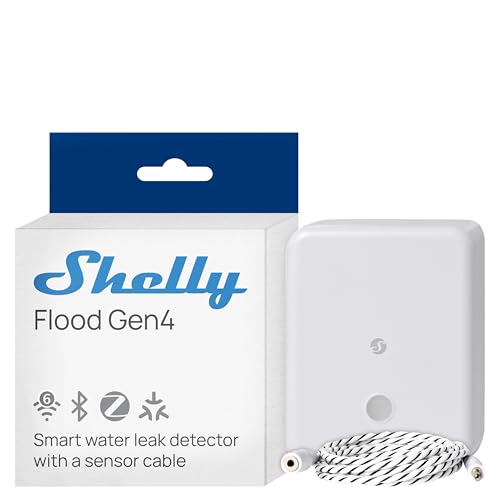
2. Shelly Flood Gen4, WiFi, Bluetooth, Zigbee, Matter Smart Flood Sensor with Leak Sensor Cable
A smart-home chameleon that speaks WiFi, Zigbee, and Matter so you can plug it into any ecosystem.
The Shelly Flood Gen4 is built for the buyer who already has a smart-home hub — or plans to build one. It comes with a 6.56-foot sensing cable that you can snake around a water heater base or along a basement wall, giving you coverage over a much longer line than a single probe sensor. The sensor itself is compact at about 3.8 inches across, though it is noticeably thicker than the X-Sense at 0.91 inches.
Setup can be finicky on the first try — a few buyers report it took multiple attempts to get the app to recognize the sensor on WiFi. Once paired, however, the detection is extremely sensitive, able to register a single drop of water. The unit is floor-mounted and battery-operated, using AA cells, which is handy for spots with no nearby outlet. An “Economic Alarm Mode” in the app extends battery life for seasonal properties like a vacation cabin, which is a thoughtful touch the Tuehakny and Winees kits lack.
Because it supports both Matter (via Thread) and Zigbee, you can tie it into Apple HomeKit, SmartThings, Google Home, or Alexa — a level of integration that matters if you want a leak sensor to automatically trigger a smart water shut-off valve. The trade-off is that this is a single sensor with a cable, not a multi-unit kit. For whole-home coverage you would need several units, which adds up quickly.
Ecosystem king: If you live in Apple HomeKit, SmartThings, or Alexa and want a sensor that plays nicely with automations, this is your pick. The cable-based detection covers a wider area than a puck-style sensor.
The hurdle: Initial app pairing can be frustrating, and the price per sensor is higher than multi-packs from other brands.
Reach for this if: smart-home automation (like triggering a shut-off valve or siren) is a must-have feature, not a nice-to-have.
Look elsewhere if: you want a simple, out-of-the-box multi-pack that works without any hub or complex pairing ritual.
3. Aeotec SmartThings Water Leak Sensor, ZigBee, Battery Powered
A tiny puck that slips into any SmartThings or Zigbee network and watches for water and temperature shifts.
If you already run a SmartThings hub or a Home Assistant setup with a Zigbee dongle, this Aeotec sensor is the closest thing to a plug-and-play water detector for that world. It is genuinely tiny — about 0.9 inches square — so it tucks under a fridge ice-maker line or behind a toilet base without being visible. Beyond water, it also monitors ambient temperature between 32 and 104 degrees Fahrenheit, and you can program automations to shut off a water valve or sound a smart siren when a leak is detected.
Owners consistently call it reliable and fast to respond, with many saying it outperforms the old round-style Samsung sensors it effectively replaces. The audible alarm on the unit itself is surprisingly loud given its tiny size. Battery life gets mixed marks — some replacements are expensive — but the sensor itself sips power, so a single battery tends to last a long time between changes.
The operating range is 50 to 130 feet depending on your home’s construction, which is shorter than the LoRa-based YoLink sensor but typical for Zigbee. You will need a compatible hub (like the Aeotec SmartThings Hub or Samsung SmartThings Hub Gen 3) — this sensor does not work on its own. This makes it a poor choice for someone trying to avoid a hub, but an excellent one for an existing smart-home household.
What Stands Out
- Extremely compact design fits in the tightest spaces
- Reliable water detection with rapid phone alerts via SmartThings app
- Adds temperature monitoring for freeze warnings
The Limitation
- Requires a Zigbee-compatible smart hub — not a standalone WiFi sensor
Grab this if: you already own a SmartThings hub or a Zigbee bridge and want a tiny, reliable sensor that can trigger automations.
skip it if: you want a sensor that works from the start with just your home WiFi and no additional hardware.
4. Proteus L5 Wi-Fi Water Level / Sump Monitor Sensor with Buzzer, Email/Text Alerts

A purpose-built sump pump sentinel that emails or texts you the moment the water rises above a safe line.
Most wireless water sensors sit on the floor and wait for a puddle to form. The Proteus L5 is different — it uses a contact sensor to monitor water level as it rises, making it the right tool for a sump pit, a water storage tank, or a flood-prone basement corner where you care about the depth, not just the presence, of water. It connects directly to your home or office WiFi with no hub or gateway. Setup is straightforward: plug the unit into a wall outlet, connect via the app, and set your threshold alerts.
What buyers love is the combination of email and text alerts (with an optional phone call at a few cents per call) plus the on-board buzzer. You can program alerts for high water, low water, power loss, and even Wi-Fi outage. The default delay for a power-loss alert is 30 minutes, which you can customize — a feature few other sensors in this roundup offer. One owner reported that the sensor caught two leaks within the first five months and alerted them via phone call before any water reached the floor.
The Proteus is not smart-home compatible from the start; it is a standalone cloud device. It also requires a wall outlet, so it is not suitable for a location with no power nearby. The sensor can support up to five probes via a splitter with cables up to 25 feet long, giving you flexibility for monitoring multiple points in one area. At this price point, it is a premium option best reserved for the specific job of sump pump or tank monitoring rather than general leak detection.
Perfect for the sump pit: If your main worry is the water level in your basement sump pit or cistern, this unit is purpose-built for that job and does it with reliable email/text alerts.
Not for general leak detection: This is a vertical-level monitor, not a simple floor puddle detector. If you just need to know if the dishwasher leaks, a puck-style sensor is simpler and cheaper.
Best for: homeowners with a sump pump, well tank, or cistern who want automated text/email alerts for rising water and power outages.
Not the right fit if: you are looking for a multi-sensor kit to place under every sink and appliance — this is a single-point monitor.
5. YoLink Water Leak Sensor 2, 1/4 Mile World’s Longest Range Smart Home Water Leak Sensor

A LoRa-powered sensor that reaches a quarter-mile and keeps working even when the internet goes down.
The YoLink uses LoRa radio technology, the same long-range, low-power wireless protocol used in industrial IoT, to deliver an open-air range of a quarter mile — far beyond what any standard WiFi or Zigbee sensor can manage. That makes it the right pick for a detached garage, a barn, a boat shed, or any building where your home WiFi signal barely reaches. It also uses a 4.2-foot rope-style sensing cable rather than metal probes, which lets you snake the cable around a water heater base or lay it in a line along a basement wall where water is most likely to run.
Perhaps the most unusual feature is the device-to-device (D2D) pairing, which allows the sensor to trigger a YoLink siren or shut-off valve directly, even if your WiFi is flaky, the internet is down, or the power is out. An owner who has been using these for three years reported zero false positives — they only trigger when real water is present. The battery life is rated at more than two years on a single set of cells, which is excellent for a sensor that is always listening.
The catch is that a YoLink Hub is required — it is not a standalone sensor. The hub acts as the bridge between the LoRa sensor and your home network. The app setup, while functional, gets called out by some buyers as a bit clunky. And while the cable is great for defining a specific detection zone, you may need to buy extension cables if your target area is wider than the included 4.2-foot cord.
Owners’ Favorite Things
- The longest range of any sensor here — a quarter mile in open air
- Rope cable design covers a defined area, not just a single point
- D2D pairing means it still works if the internet or WiFi goes out
- Remarkably low false-alarm rate; owners trust the alert
What to Know Upfront
- Requires a YoLink Hub (sold separately) — adds to the overall cost
- App setup is a bit less polished than the simpler WiFi-only kits
Ideal for: properties with detached structures, long driveways, or outbuildings where standard WiFi range falls short.
Probably not for you if: you want a simple sensor that connects directly to your router without any extra hardware — this needs a hub.
6. Winees WiFi Water Leak Detector for Home, 3 Pack Water Sensors with 100dB Adjustable Alarm

A three-sensor kit with a loud hub alarm and email/SMS backup that thousands of owners trust.
The Winees kit includes a central hub and three sensors that are pre-paired from the start, so you can have them running within minutes of opening the package — just plug in the hub, connect it to your 2.4GHz WiFi, and place the sensors where you need them. The sensors themselves are impressively thin at 1.8 mm, letting you slide them under a washing machine or refrigerator foot without raising the appliance. The hub alarm is adjustable across three volume levels and can be muted directly from the hub or the app.
Reliability is the single most-praised quality here — hundreds of owners mention that the sensors work flawlessly when water is detected, giving real confidence for basement sump pump failures or leaky water heaters. The kit also supports email and SMS notifications in addition to the standard app push, which ensures you get an alert even if the app notification gets buried. The hub-to-sensor range is listed at 656 ft (200 m), which is enough for a typical home, though not as far as the X-Sense kit above.
The main complaint from some users is that connectivity can be flaky — a small fraction of customers note the hub or sensors dropping offline. The sensors are rated IP66 waterproof, meaning they can handle high humidity and even direct water immersion without damage. If you want a straightforward, well-reviewed multi-pack without paying for features you will not use, this is a strong mid-range pick.
Solid, proven kit: Thousands of ratings confirm this is a reliable, easy-to-set-up system for covering the three most vulnerable spots in your home.
Range limitation: At 656 ft, you cannot put a sensor in a far detached building; this is best for inside the main house.
Reach for this if: you want a proven 3-pack with email backup and a loud hub alarm for a very fair price.
Think twice if: you need a sensor to reach a detached garage or an outbuilding beyond 200 meters.
7. Stechro Smart Water Leak Detectors for Home WiFi with App Alerts, 120dB Water Sensor Alarm, 4 Sensors & 1 Gateway
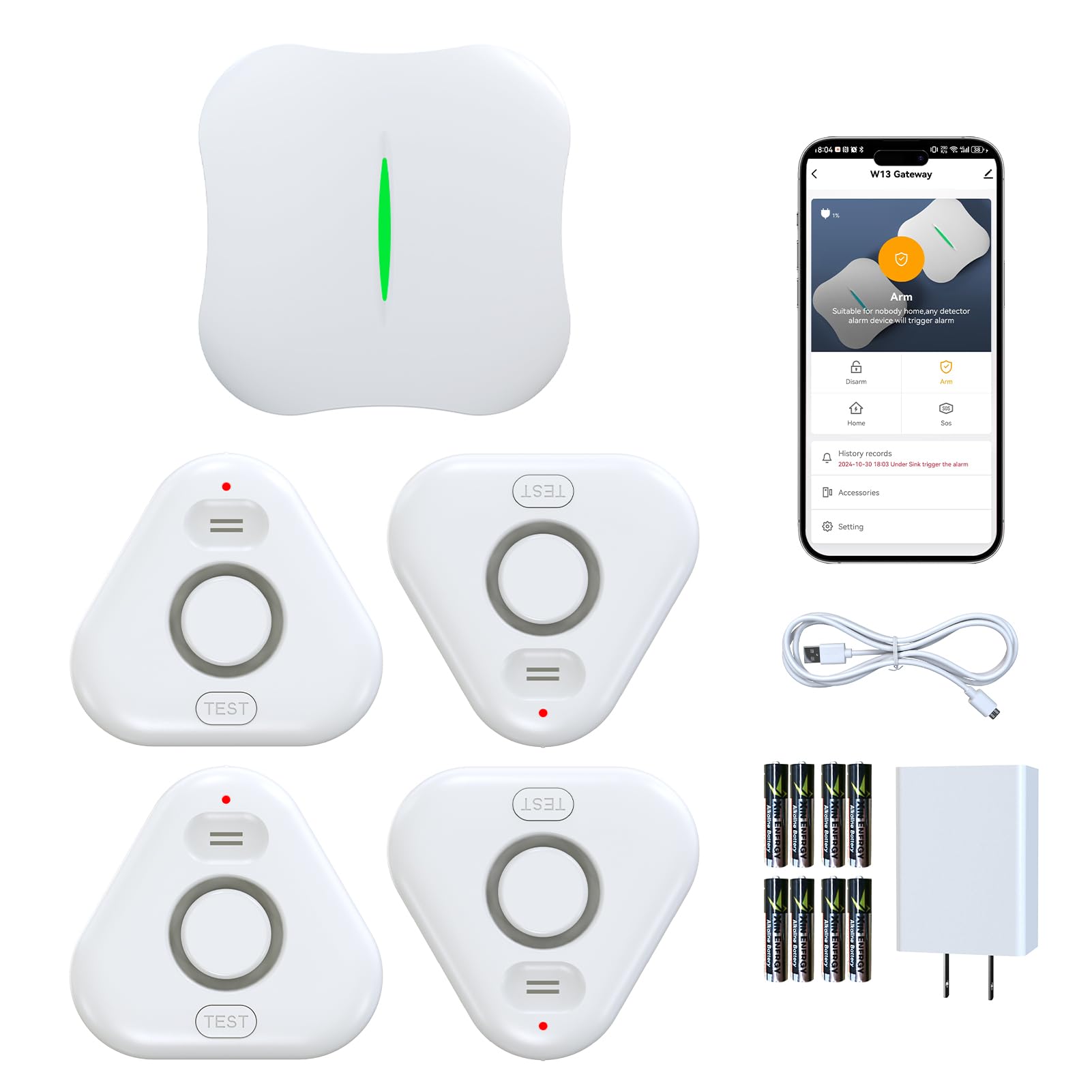
A 4-sensor kit with the loudest possible siren — 120 decibels — that you will hear from any floor of the house.
Stechro’s kit goes all-in on audibility. The included sensors have an adjustable alarm that tops out at 120 dB — noticeably louder than the 100 dB sirens on the X-Sense, Winees, and D-Link units. That extra 20 dB makes a real difference in a noisy basement with a running washer or furnace. The gateway supports up to 24 sensors, so you can expand the system far beyond the four sensors that come in the box.
The sensors detect water through four floor probes and an additional drip sensor on top, giving you detection from both standing water and overhead leaks. They are IP66 waterproof as well, so you can place them in consistently damp environments like a crawl space. The app uses the Tuya Smart platform, which is well-established and offers customizable sensor names, 32 ringtones to choose from, and the ability to mute alarms with a single tap. Low-battery alerts are included, and the sensors are rated for up to three years of battery life on AAA cells.
The downside is that the Tuya app push notifications are free, but SMS, phone, and email alerts require a separate subscription. Also, because the kit relies on a 2.4GHz WiFi gateway, it is not suitable for environments that use only 5GHz networks. A few reviewers point out that the plastic build feels a little less premium than the D-Link or X-Sense units, but the loud, reliable alarm more than makes up for it in functionality.
Why This One Stands Out
- Loudest alarm in the roundup at 120 dB — no chance of missing it
- Generous kit includes 4 sensors and a gateway that supports up to 24 sensors total
- Up to 3-year battery life on the sensors is class-leading
One More Thing to Note
- SMS/email alerts require a paid subscription within the Tuya app — free is push-only
Go for this if: you need maximum audible alert power for a noisy basement or shop, or you plan to expand to a large number of sensors.
Not the best if: you want free email/SMS alerts from the start — look at the Winees or Proteus instead.
8. D-Link Next-Gen WiFi Water Leak Detector Starter Kit with 2 Sensors, 100 dB Sound Alarm, LED Strobe Light
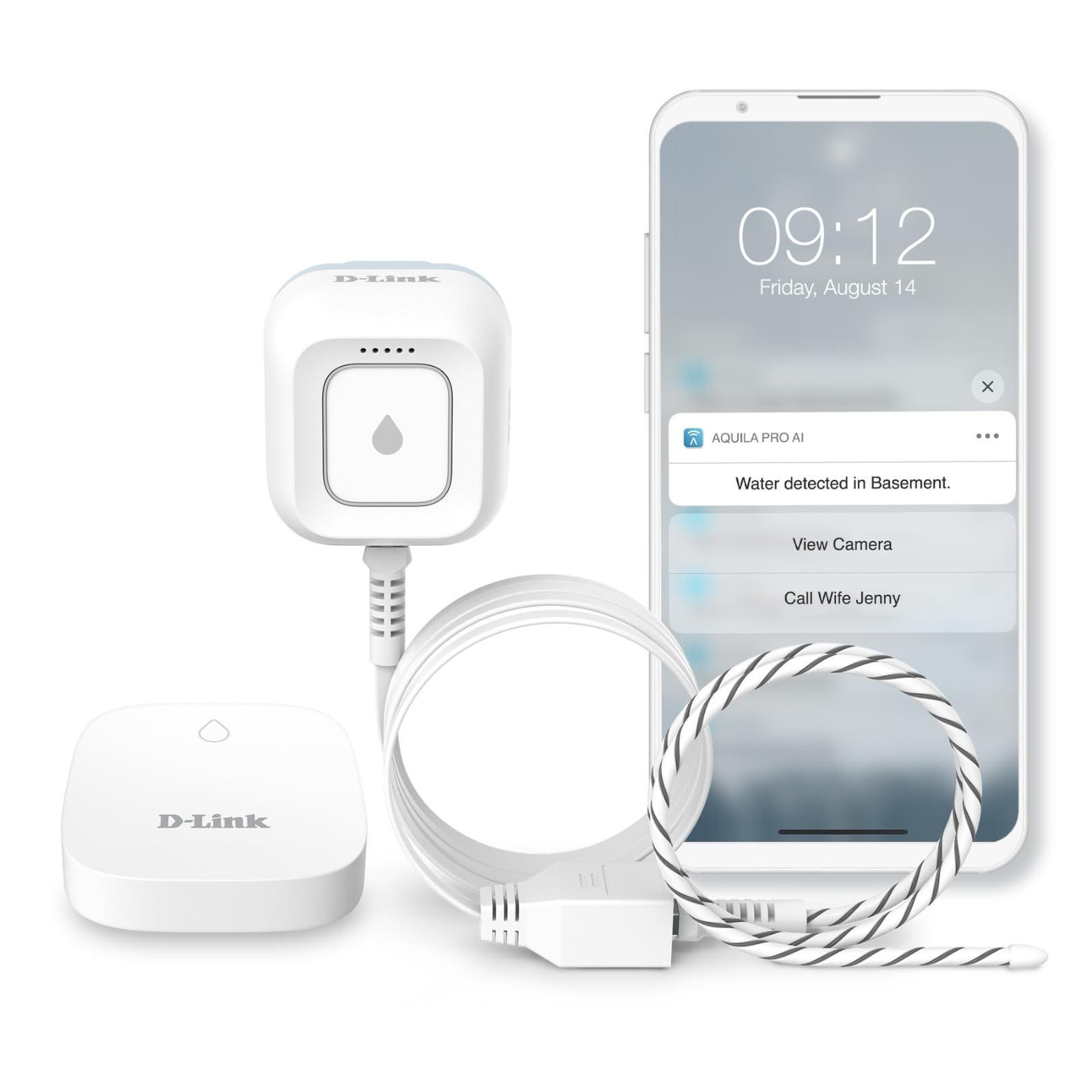
A plug-in master unit with a strobe light and 100 dB siren that connects directly to WiFi — no separate hub needed.
D-Link’s approach is refreshingly simple: you plug the master unit into a wall outlet, connect it to your WiFi, and place the included sensing pod (battery-powered) wherever you want to monitor. No hub, no base station, no gateway. The master unit itself packs a loud 100 dB siren and a bright LED strobe light, so if a leak happens while you are home, both audio and visual cues grab your attention. The starter kit covers two areas from the start: the master unit has a 1.5-foot water-sensing cable plus a 3-foot extension, and the separate pod works wirelessly.
The range is excellent for a hubless system — up to 1,000 ft in open space using a Sub-GHz wireless link between the master unit and the remote pod. You can expand the system to protect up to 17 areas by adding extra pods (model SW-A2). The pods run on AAA batteries and last up to 2 years. For Apple users, the system works with Google Assistant for voice alerts, but there is no native HomeKit support.
The catch: some shoppers say that after a power outage, the devices do not reconnect to WiFi without a manual reset. The app itself is functional but not feature-rich — reviews mention that notifications are minimal and easy to miss, and there is no email or text alert option. This is a straightforward, audible-and-visible alarm system that prioritizes local alerting over a polished app experience.
Best for simplicity: If you want to avoid a hub and prefer a plug-in device with an on-board strobe and siren, this is the cleanest solution here.
App needs work: The mydlink app is less refined than the Tuya or X-Sense apps, and post-power-outage reconnection can be inconsistent.
Choose this if: simplicity and local audio/visual alerts matter more than a polished app experience.
pass on it if: you want reliable email or SMS notifications, or if your WiFi signal is prone to outages.
9. Tuehakny WiFi Water Leak Detector, 3 Sensors, Smart Hub, 110dB, APP Monitor

A three-sensor kit with a whopping 110 dB siren that works without WiFi for instant local alerts.
This value-focused kit includes three sensors and a smart hub that screams at 110 dB when water is detected — and critically, it does not need WiFi to sound that alarm. You can start protecting your home right from the start as a standalone siren system, then add WiFi later for remote app alerts. The hub uses an external 433MHz antenna for better signal penetration through walls, which is a real advantage over units with internal antennas. The range is listed at 656 ft (200 m) in open areas.
Each sensor has flexible wired probes that can reach into tight crevices, which is useful for monitoring a pipe joint behind a wall panel or the inside of a sink cabinet where a puck-style sensor would not fit. The system is expandable to up to 30 sensors, giving you room to grow without buying a new hub. The Tuya Smart app gives you adjustable alarm volume, multiple ringtone options, and delayed alarm settings.
Reliability is the main area where this kit trails the X-Sense and Winees options. Some buyers report that the sensors work perfectly during setup but then fail to trigger consistently after a few days. The device uses a sleep/wake cycle to conserve battery power, which can introduce a delay in alerting when water is first detected. If your comfort zone requires absolute certainty that the alarm will sound, this may not be the right pick. But if you need a very loud, expandable system on a tight budget, it is hard to argue with the price per sensor.
What Gives It An Edge
- 110 dB alarm is one of the loudest in the budget tier — only Stechro is louder
- Works as a standalone siren without WiFi for instant local protection
- Flexible wired probes reach spots that puck sensors cannot access
Where It Falls Short
- Reliability is inconsistent — some sensors stop alerting after a short period of use
- Tuya app subscriptions needed for SMS/phone call alerts beyond push notifications
Best for: budget-conscious buyers who want a loud, expandable system and are willing to test placement carefully for consistent performance.
Not the right choice if: peace-of-mind reliability is your top priority — invest in the X-Sense or Winees kits instead.
Understanding the Specs
Decibel Rating (dB)
This number tells you how loud the alarm actually is. A 100 dB siren is roughly as loud as a chainsaw at close range — enough to hear from another floor in most homes. A 120 dB alarm, like the one on the Stechro kit, is rated at 120 dB, making it suitable for noisy basements, workshops, or for people who sleep with a white-noise machine. Every 10 dB increase is perceived as roughly twice as loud, so the difference between 100 dB and 120 dB is significant.
Wireless Range
The stated range is usually measured in open air with no walls in between. In a real house, expect the range to be cut by about 30 to 50 percent per wall or floor. A sensor rated for 1,700 ft in open air (like the X-Sense) might only reach 200 to 300 ft through multiple interior walls. For a detached garage or an outbuilding, look for a system that uses LoRa radio (like the YoLink, at a quarter mile) or has an external antenna (like the Tuehakny) rather than standard WiFi.
FAQ
Can a wireless water sensor work without the internet?
How far from the water source can I place the sensor?
Do I need a smart home hub to use a wireless water sensor?
How often do the batteries need to be replaced?
What happens if the WiFi goes out while I am on vacation?
Will the sensor detect a slow drip or just a flood?
Can I place a water sensor inside a sump pit?
What is the difference between a probe sensor and a cable sensor?
Can the same sensor detect both water leaks and ambient temperature?
How many sensors can I connect to one hub or gateway?
Final Thoughts: The Verdict
For most people, the best wireless water sensor is the X-Sense Ultra-Slim Wi-Fi Water Leak Detector because it combines four sensors, a proven reliability record, an ultra-slim design that fits anywhere, and a long 1,700 ft connection range, all at a fair mid-range price. If you need smart-home integration and want a sensor that can trigger automations, grab the Shelly Flood Gen4. And for sump pump or water tank monitoring with direct email and text alerts, the Proteus L5 is the one to reach for.
How We Picked
We do not accept paid placement. Every pick is matched to a real buyer and a real use-case; we do not hands-on test units.
Sources & Methodology
Specifications: manufacturer listings and product documentation. Review insights: verified customer reviews, as of July 2026. Pricing: not shown on this page (it changes often); check the current price via the retailer link.
As an Amazon Associate, Calories Fit earns from qualifying purchases. This does not affect which products we feature.