
Our readers keep the lights on and the coffee maker working hard! As an Amazon Associate, I earn from qualifying purchases.
Specs are compiled from manufacturer listings and verified buyer reviews and can change over time — please confirm the key details on the product page before buying.
If you have ever sliced into a roast hoping for medium-rare only to find it well-done, you know the frustration. A wired meat thermometer is the single tool that ends that gamble — it gives you a live, accurate reading of your food’s internal temperature from inside the oven or smoker, without ever opening the door and letting heat escape. This guide cuts through the clutter to find the simplest, most dependable models that actually deliver consistent results.
I’m Mohammad — the founder and writer behind Calories Fit. This guide is built by comparing the manufacturers’ published specifications and the patterns across verified customer reviews, so you get each pick’s real strengths and trade-offs instead of marketing spin.
Whether you are roasting a chicken for a weeknight dinner or smoking a brisket for a weekend cookout, these are the best wired meat thermometer options that owners rely on most for accuracy and ease of use.
Our Picks at a Glance
How To Choose The Best Wired Meat Thermometer
A wired meat thermometer is a simple device, but a few spec differences separate a model you will use every week from one that frustrates you on the first holiday roast. Focus on three things: the probe cable length, temperature range, and how you want to set your target temp.
Probe Count: One or Two?
A single probe tracks one piece of meat, which works perfectly for a roast or a whole chicken. A dual-probe unit lets you monitor two different dishes at once — or keep one probe in the meat and the other in the grill or oven to track ambient temperature. Dual probes are a step up in versatility but cost slightly more.
Temperature Range and Accuracy
Look for a unit that covers at least 14°F to 572°F, which handles everything from slow-smoking brisket at low temperatures to a high-heat sear. Accuracy claims of +/-1.8°F are typical, and you can verify that yourself with a simple boiling water or ice water test. Any model that reads within a couple degrees of 212°F or 32°F is performing well.
Display and Backlight
A large, clear LCD makes a difference when you are standing over a hot grill or checking the temp through an oven window. A backlight is a nice-to-have that becomes essential when smoking overnight or cooking in low-light kitchens. A magnetic back or a stand makes storage easy.
Quick Comparison
| Model | Best For | Probes | Temp Range | Display Features | Amazon |
|---|---|---|---|---|---|
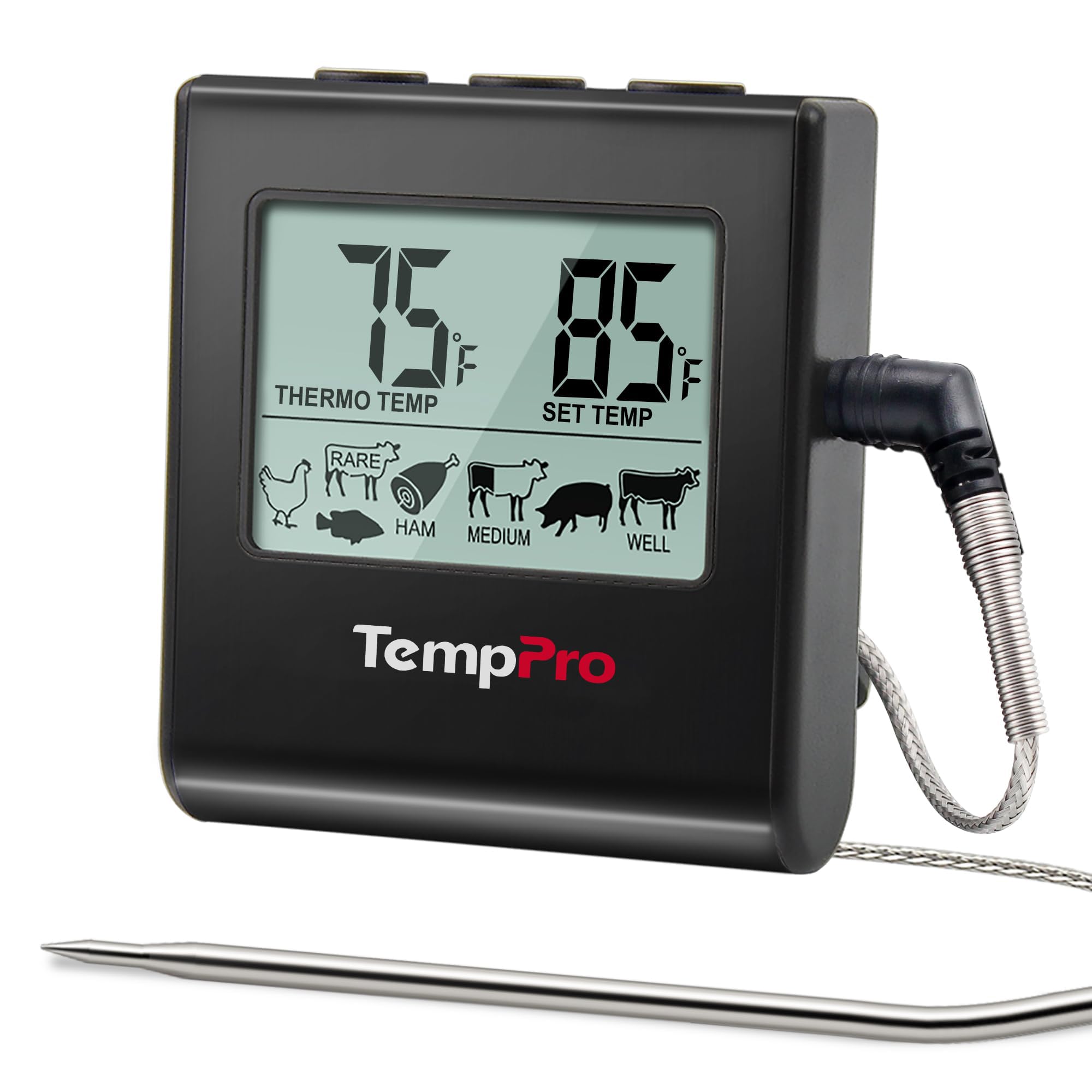
| TempPro TP16★ Best Overall | Simple single-roast cooking | 1 | 32°F to 572°F | Large LCD, magnetic back | Amazon |
| TempPro TP17 | Monitoring two dishes at once | 2 | 14°F to 572°F | Backlit LCD, strong magnet | Amazon |
| KitchenAid KQ906 | Stovetop cooking with presets | 1 | -40°F to 482°F | Digital display, silicone cord wrap | Amazon |
In‑Depth Reviews
1. TempPro TP16 Large LCD Digital Meat Thermometer
Our pick — 4.5★ from 50,500+ verified ratings; the strongest balance of quality and price.
The no-fuss single probe that handles a weeknight roast and a holiday turkey with equal ease.
This thermometer wins the top spot because it nails the two things that matter most: accuracy and readability. The large LCD shows bright, clear numbers, and the probe tip measures temperature precisely — as buyers report, the readings come “within 1 degree at 32 and 212,” meaning it passes the ice-water and boiling-water accuracy tests with flying colors. The stainless steel probe extends 6 inches deep, so you can reach the center of a large brisket or a whole turkey without touching bone.
The 40-inch stainless steel mesh cable is long enough to snake through the oven door without melting, and the probe wire can handle heat up to 716°F. The base itself has a magnetic back that sticks right to your refrigerator, keeping it handy between uses. It includes USDA preset temperatures for common meats, which you can customize to your own preference. The only recurring feedback is that the thin cable can kink if you are not careful, and some owners suggest calibrating it first — but the accuracy praise far outweighs those notes.
What owners praise most
- Accurate readings — within one degree at freezing and boiling points
- Large, easy-to-read numbers on the LCD screen
- Affordable price and simple operation without complicated menus
The honest trade-off
- Single probe means you cannot monitor two dishes at once
- The cable is thin and can kink if handled roughly
Who it fits: Home cooks who want one reliable thermometer for roasts, whole chickens, and smoking — no extra complexity needed.
Who might need more: Anyone who regularly cooks two different proteins at once and wants dual-probe convenience.
2. TempPro TP17 Dual Probe Digital Cooking Meat Thermometer
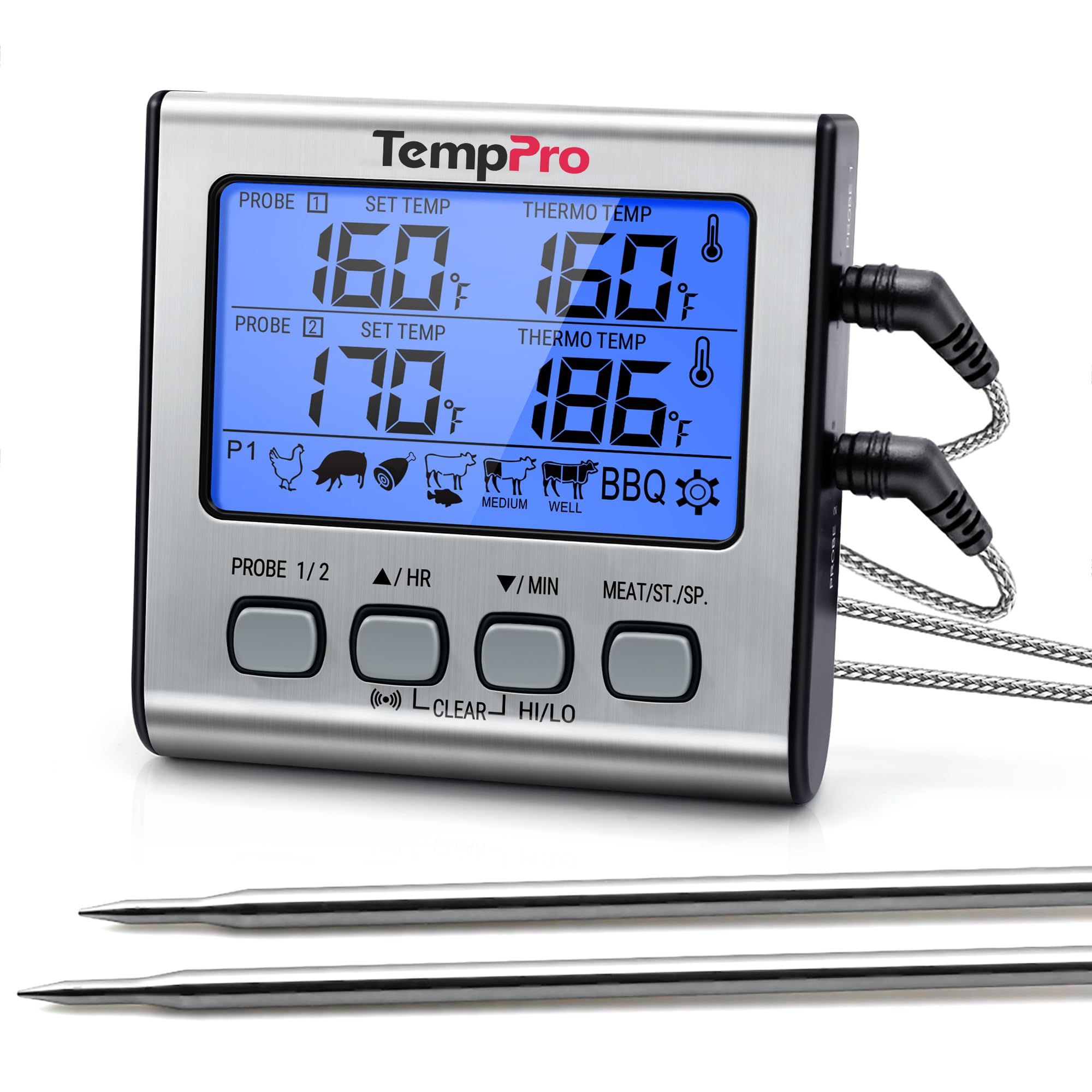
Two probes let you track the meat temp and the grill temp without swapping a single cable.
This is the upgrade for anyone who wants to monitor two things at once. The dual probes reach 8 inches deep — at 8 inches versus the TP16’s 6 inches — so they slide easily into a thick pork shoulder or a whole brisket. The large LCD is backlit, which owners say stays legible even in direct sunlight, making it a natural fit for outdoor smokers and grills. The unit also features a HI/LO temperature alarm that beeps if the grill temperature swings out of the range you have set, so you know when to add more charcoal without guessing.
The biggest reason people love this unit is reliability. Reliability leads the feedback with roughly 1,600 owners calling it out, and quality scores second with around 1,300 mentions. Accuracy, however, draws mixed results — some owners mention it reads consistently within specs, while a few note it can read roughly 10°F low inside the oven even if it passes the boiling water test. The dual probes are color-coded, making it easy to remember which wire is meat and which is ambient temp.
The crowd favorites
- Dual probes handle two dishes or one dish plus grill temperature
- Backlit screen stays readable in bright sunlight
- HI/LO alarms help manage smoker temperature without running outside every five minutes
The honest trade-off
- Accuracy can drift for some in actual oven use despite good water tests
- Backlight cannot be set to stay on permanently
Best suited for: Smoker owners and grillers who want to watch both the meat and the ambient cook temperature from one device.
Think twice if: You need pinpoint oven accuracy without any potential offset — the single-probe TP16 may give you more consistent results for your money.
3. KitchenAid Programmable Wired Probe Thermometer KQ906
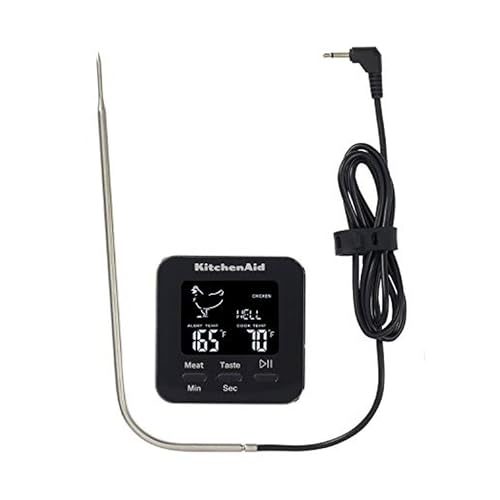
A KitchenAid that brings brand-trusted styling and programmable presets to your stovetop cooking.
This model stands out for its preset menu system. You scroll through options for beef, pork, fish, veal, lamb, chicken, turkey, hamburger, or a custom setting (PGM), and it beeps when the meat hits the target temperature. That makes it very approachable if you are not comfortable setting temperatures manually. The temperature range extends from -40°F to 482°F, meaning it works for deep-freeze checks on frozen food as well as roasting. The silicone cord wrap keeps the probe cable tidy during storage, a thoughtful design touch that the other models in this list lack.
The honest caveat here is the cord heat limit. The instructions say the cord itself should not be exposed to high temperatures, which directly contradicts the advertising claim that you can leave it in the oven without opening the door. Several owners note this, so this unit is best treated as a stovetop or pan-side thermometer. People who use it for deep-frying or stovetop roasts find it simple and effective — one owner sums it up saying they “use almost daily.”
What makes it click
- Preset meat types and doneness levels guide you step by step
- Silicone cord wrap keeps the probe cable neat in the drawer
- Wide temperature range down to -40°F for frozen food checks
The honest trade-off
- Probe cable is not rated for prolonged high oven heat — use on the stovetop or check quickly
- Timer only goes up to 99 minutes, 59 seconds, shorter than the other models
Reach for it if: You want a straightforward, brand-name thermometer for stovetop cooking with preset guidance for different meats.
Pass it by if: You need a probe that stays in the oven for hours of smoking — the TempPro models handle that heat exposure better.
Understanding the Specs
Temperature Range
The low end of the range tells you if the thermometer can handle frozen food or a slow smoke that starts well below freezing. The high end — typically 482°F or 572°F — tells you if it can survive a hot oven or grill without the internal electronics failing. A range beginning at 14°F is fine for most home cooking; a -40°F rating means you can check deep-freeze storage temperatures as well.
Probe Immersion Depth
This is the length of the metal probe tip that actually sinks into the meat. A 6-inch depth is enough for a turkey or a large pork shoulder. An 8-inch or 8.5-inch depth is better for brisket or very thick roasts because the temperature sensor sits closer to the middle of the cut. If the probe is too short, you may get a reading from near the surface rather than the true center.
FAQ
Can I leave a wired meat thermometer in the oven while cooking?
How do I test if my meat thermometer is accurate?
Single probe vs dual probe — which should I choose?
Why does my wired thermometer sometimes read differently from my oven thermometer?
What do USDA presets mean on a meat thermometer?
How long does the battery last in a wired meat thermometer?
Can I use a wired meat thermometer for deep frying?
Is a backlight necessary on a meat thermometer?
Will a wired thermometer fit through my oven door without damaging the seal?
Is the TempPro TP16 the exact same product as ThermoPro TP16?
Final Thoughts: The Verdict
For the majority of shoppers, the best wired meat thermometer is the TempPro TP16 because it delivers exceptional accuracy, a large reading panel, and a heat-resistant 40-inch cable at a no-nonsense price. If you want to monitor two dishes or track grill temperature alongside your meat, grab the TempPro TP17. And for stovetop cooks who want preset guidance and a trusted brand name, the KitchenAid KQ906 is the one to reach for.
How We Picked
We do not accept paid placement. Every pick is matched to a real buyer and a real use-case; we do not hands-on test units.
Sources & Methodology
Specifications: manufacturer listings and product documentation. Review insights: verified customer reviews, as of July 2026. Pricing: not shown on this page (it changes often); check the current price via the retailer link.
As an Amazon Associate, Calories Fit earns from qualifying purchases. This does not affect which products we feature.