
Our readers keep the lights on and the coffee maker working hard! As an Amazon Associate, I earn from qualifying purchases.
Specs are compiled from manufacturer listings and verified buyer reviews and can change over time — please confirm the key details on the product page before buying.
You want a machine that throws real strikes, survives the backyard abuse, and actually helps your young hitter build confidence without breaking your budget or your back hauling it to the field. the balance is matching speed, pitch type, and portability to your kid’s age and skill level.
I’m Mohammad — the founder and writer behind Calories Fit. This guide is built by comparing the manufacturers’ published specifications and the patterns across verified customer reviews, so you get each pick’s real strengths and trade-offs instead of marketing spin.
Every machine here was chosen because it fits young players specifically, with lower speeds, lighter builds, and designs that put reps ahead of raw power. if you need a plug-and-play option for the garage or a portable training partner for the diamond, this roundup of the best youth pitching machine choices will get you swinging confidently in the right direction.
Our Picks at a Glance


How To Choose The Best Youth Pitching Machine
Picking the right machine for your young athlete depends on understanding a few key specs that directly affect how much they’ll actually use it and improve. Focus on finding the machine that fits their size, skill level, and your practice space.
Match the Speed to the Player
A machine that throws too hard is as useless as one that’s too slow. Look for adjustable speed settings that cover a range. For a beginner (ages 5-8), something that starts around 15-30 MPH is ideal. As they grow, a machine that can reach 50-60 MPH gives you years of use without needing to upgrade. The best machines let you dial in small increments to gradually challenge them.
Portability and Power Source Matter
If you plan to haul the machine to the field or even just from the garage to the backyard, weight is a big deal. Some of the most popular models weigh under 10 pounds and can mount on a camera tripod, making them truly portable. Also, consider how it gets powered. Machines that run on batteries (rechargeable or disposable) give you the freedom to practice anywhere, while those that need a wall outlet tie you to a power source. Some offer both, which is the most flexible setup.
Ball Type and Compatibility
Not every machine throws a real baseball. Many youth machines use lighter plastic balls (often dimpled or wiffle-style) for safety and to prevent damage to bats. This is fine for hand-eye coordination and swing mechanics. If you need a machine that handles standard baseballs or softballs, you’ll be looking at a heavier, more expensive unit. Check what balls are included and whether replacements are easy to find.
Quick Comparison
| Model | Best For | Pitch Speed | Weight | Power Source | Amazon |
|---|---|---|---|---|---|
| Personal Pitcher Pro★ Best Overall | Versatile Indoor/Outdoor Training | 15-95 mph (simulated) | 6 lbs | Rechargeable Battery & AC | Amazon |
| Heater Sports Slider LiteCurveball Specialist | Auto-Feed Curveball Training | Up to 80 mph | 13 lbs | 110V AC | Amazon |
| Personal Pitcher Pro StarterComplete Kit | Complete Training Package | 15-95 mph (simulated) | 9 lbs | Rechargeable Battery & AC | Amazon |
| Furlihong Upgraded Elec. | Budget Beginner Training | 30 mph max | 4.3 lbs | 4 D Batteries or AC | Amazon |
| Furlihong 692BH | Hand-Eye Coordination Drills | 18 mph | 4.4 lbs | C Batteries or AC | Amazon |
| Heater Sports Power Alley Lite | Fielding & All-Round Practice | 40-80 mph | 12.5 lbs | 110V AC (or optional battery) | Amazon |
| MOXOW Sagitta | Portable No-Power Practice | Manual (user-powered) | 29.5 lbs | None (manual) | Amazon |
| Furlihong 4-in-1 Toss | Multi-Sport Beginners | Soft toss (low speed) | 7.9 lbs | AC adapter | Amazon |
| Mound Yeti | Serious Youth & Adult Practice | 30-60 mph | 50 lbs | 110V AC (works with power bank) | Amazon |
In‑Depth Reviews
1. Personal Pitcher Pro Pitching Machine
Our pick — 4.5★ from 150+ verified ratings; the strongest balance of quality and price.
The lightweight champ that brings big-league curveballs to your basement without breaking a sweat.
This is the machine that keeps coming up as the go-to for parents who want real versatility. Weighing just 6 pounds, it’s a featherweight that mounts onto a standard camera tripod, meaning you can set it up in a basement, a garage, or the backyard in seconds. It uses specially designed plastic golf-ball-sized spheres, and the included rechargeable battery lets you practice anywhere without hunting for an outlet.
The four speed settings simulate everything from a soft toss for a beginner all the way up to a serious fastball, and it throws both left and right-handed curveballs and sliders. That range alone makes it a machine you won’t outgrow for years. The built-in Pro Timing Light helps younger hitters learn to load and track the ball — a small feature that makes a big difference in building good habits.
Buyers report it works great for indoor setups, with one owner mentioning a 30-foot distance in the basement worked perfectly for an 11-year-old intermediate player. It’s not designed for regulation baseballs, and picking up the 48 lightweight balls after a session can be a chore, but for consistent, high-quality reps in a small space, it’s tough to top.
Why it earns the top spot
- Weighs under 6 lbs and mounts on any standard tripod for ultimate portability
- Four speed settings cover young beginners to advanced hitters
- Throws curveballs and sliders for both left and right-handed batters
- Includes a rechargeable battery and 48 lightweight balls to start training immediately
A few real-world limits
- Uses only its own small plastic balls, not standard baseballs
- Collecting the balls after practice is a bit tedious, as owners note
- The initial setup requires a separate camera tripod which is not included
Reach for this if: you want a quiet, portable, and versatile machine that grows with your kid from tee-ball through middle school, perfect for limited indoor spaces.
Think twice if: your player needs to practice with full-size regulation baseballs, or if you don’t want to manage a bucket of small plastic balls.
2. Heater Sports Slider Lite 360
A workhorse that throws consistent breaking balls, backed by an auto-feeder that keeps the reps coming.
The Slider Lite 360 is a step up in terms of dedicated baseball training. It uses a pivot head design to fire accurate curveballs alongside fastballs, which is a huge advantage for a young hitter learning to read spin. The automatic ball feeder loads lite balls continuously, so you aren’t stopping every 20 seconds to reload — your child gets into a rhythm and stays there.
It’s heavier than the portable options at 13 pounds, but it comes with sturdy tubular steel legs with rubber tips that hold it steady on any surface. The machine pitches lite balls up to 80 MPH from a distance of 46 feet, covering the distance you’d see in a real game. While the speed adjustment is a nice feature, some owners find the potentiometer can be touchy or fail over time, though the company is known for sending replacement parts at no cost.
A few reviews mention durability concerns — one owner saw a motor burn out after limited use — but widespread feedback points to machines lasting years with heavy summer use. It’s louder than some metal-framed competitors, but for the price, it delivers a smart mix of features that young players need to get game-ready.
The auto-feed advantage: The top-mounted feeder keeps balls flowing without a parent standing next to the machine, making solo practice sessions possible.
What to watch: The variable speed control has been a sticking point for some owners, and the plastic construction is noisier than premium metal units.
Great for: a dedicated young player (10U and up) who needs to face breaking balls and fastballs in a batting cage or net setup.
Not ideal for: absolute beginners who are still learning to track a straight fastball, as the learning curve on curveballs can be frustrating.
3. Personal Pitcher Pro Starter Package
Everything you need in one box — machine, tripod, and catcher’s training tools — for a fast start.
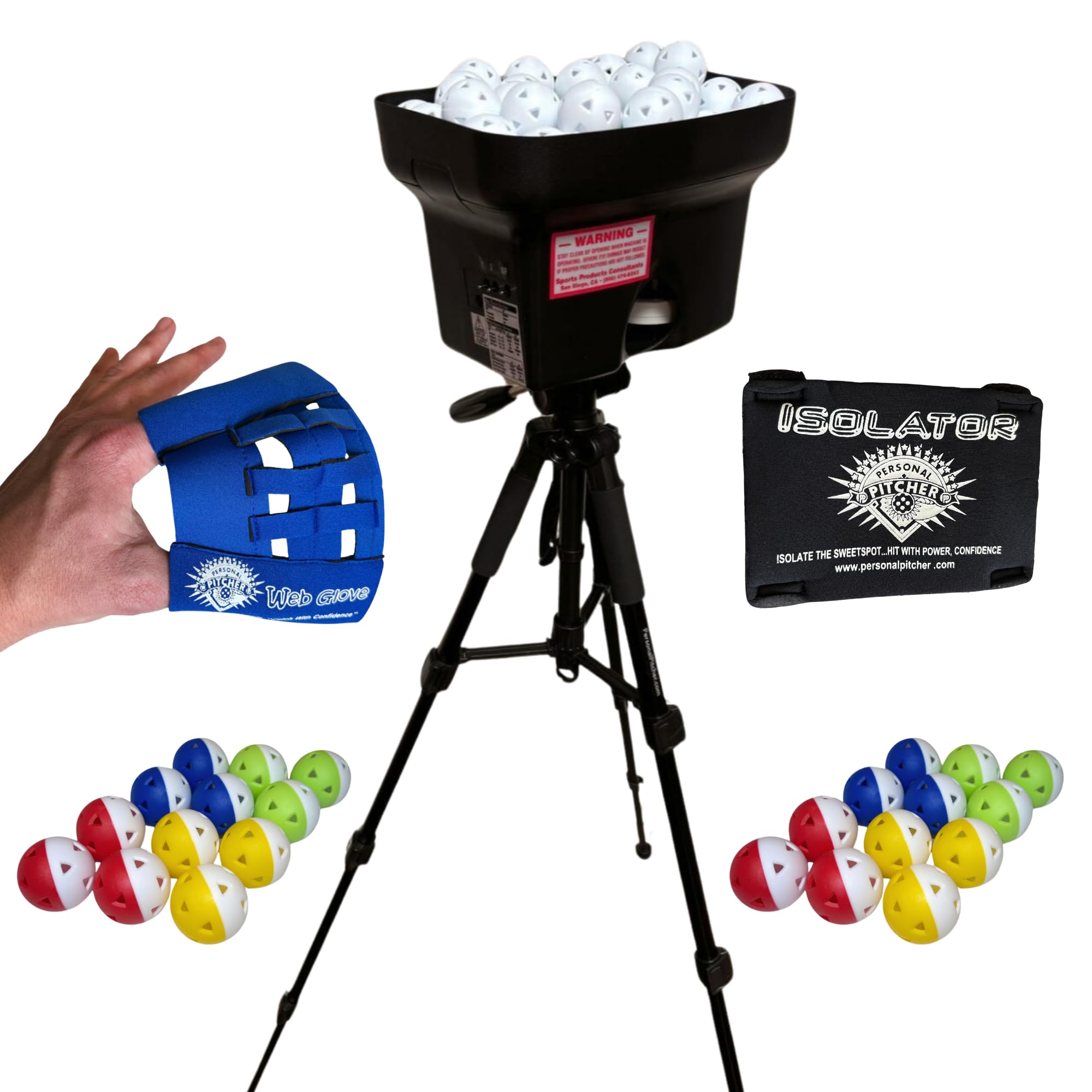
If you want to skip the shopping list of accessories, the Starter Package bundles the core Personal Pitcher Pro with a dedicated tripod, a WebGlov (a finger-mounted glove that teaches proper catching technique), and an Isolator Pad that straps to the bat and makes a pop sound on a clean hit. It’s a complete system designed to turn a single purchase into a full training session.
The machine itself is identical to the top-ranked model, meaning you get that same 6-pound weight, 4-speed settings, and rechargeable battery. The included tripod is built specifically for this machine so you don’t have to guess if a standard camera tripod will work. Owners consistently praise how easy it is to set up and how durable the package feels, with parents of 10-12 year olds reporting significant improvements in batting accuracy.
The WebGlov is a clever addition — originally created by a Major League player — that helps kids learn to catch with the proper web of the glove. It’s a small tool, but it makes a real difference for young catchers or outfielders working on fly balls. As owners put it: “still worth 5 stars” even with the occasional quirk of the feeder needing a reset.
Best for: parents who want a ready-to-go setup with training accessories that add real value, especially for catchers.
The catch: The sticker is higher than buying the base machine alone, so only go for this if you’ll actually use the WebGlov and Isolator Pad.
Go for it if: you want a turnkey youth training system that covers hitting, catching, and fielding drills from day one.
Skip if: you already have a tripod and just need the core machine, as the base model alone is a better value.
4. Heater Sports Power Alley Lite 360

A swivel-head workhorse that chucks grounders and pop flies just as reliably as batting practice.
The Power Alley Lite 360 is built for comprehensive training. Its swiveling head rotates to deliver fastballs, sliders, and curves for batting practice, then adjusts to fire grounders, line drives, and pop flies up to 200 feet for fielding drills. That makes it a much more versatile machine than a simple batting cage feeder — it’s essentially a coach in a box for a full practice session.
It runs on a 1/8 HP motor and pitches Heater Sports Lite Balls at adjustable speeds from 40 to 80 MPH. Many owners use it with a heavy-duty power bank for field use. The fully enclosed solid wheel design is a smart safety feature, especially when younger siblings are nearby. At 12.5 pounds, it’s heavier than the Personal Pitcher but still light enough to move from the car to the diamond without a struggle.
The feedback on speed control is mixed — some owners feel the low end is still too fast for young kids, and a few report units that never worked correctly from the start. However, for those who get a good unit, the accuracy and improvement in their child’s batting average is a consistent theme. It requires the specific lite balls, so factor that ongoing cost in.
Field versatility: Not just for hitting — you can run a full infield/outfield practice, which is rare at this price point.
Heads up: The speed adjustment isn’t infinite; a few owners note the slower settings are still too quick for 7-8 year olds, so test it first.
Best suited for: coaches or parents of 10-12U players who want one machine for batting practice and defensive drills at the field.
Look elsewhere if: you need a machine for a 6-8 year old beginner, as the speed range doesn’t dip low enough for the youngest hitters.
5. Mound Yeti 1-Wheel Pitching Machine
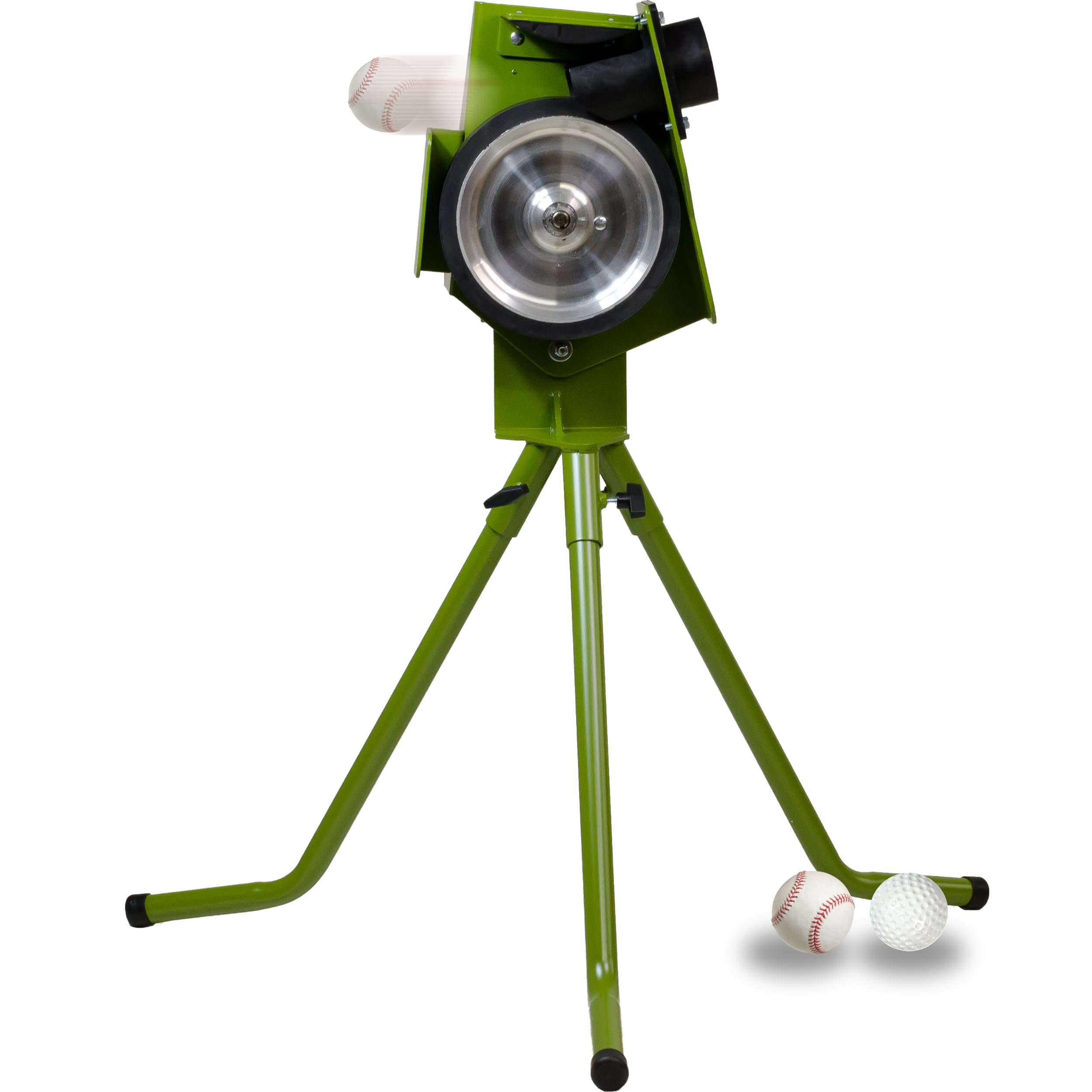
A steel-framed beast that throws real baseballs and softballs with pinpoint accuracy for serious training.
The Mound Yeti is in a different class. It’s built around a single wheel design with variable speed from 30-60 MPH, making it suitable for both machine-pitch leagues and older youth players moving into adult-level practice. The sturdy steel construction and reversible legs let you adjust the pitch height between baseball (37.5 inches) and softball (27.5 inches) settings — a handy feature for multi-sport athletes.
It comes with two separate chutes for alternating between baseballs and softballs, and it can handle standard hard baseballs (not just soft training balls). The 2-year limited warranty is a strong confidence signal from the manufacturer, and owners back that up, reporting excellent accuracy on both fastballs and pop flies. It weighs a substantial 50 pounds, so this is a machine that stays in the backyard or garage rather than moving around daily.
The speed knob is touchy according to owners — you need to turn it slowly to dial in the exact pace. A few mention the non-adjustable leg height can be tricky if you’re working with a batting cage that has a low opening. But for a family looking for a machine that can grow from 8U all the way through high school without feeling flimsy, this is the one to consider.
Real ball capability: Unlike most youth machines, the Yeti doesn’t need dimpled training balls — it fires standard baseballs and softballs, which is essential for older players.
The weight caveat: At 50 lbs, moving it around is a two-person job, so it’s best suited for a permanent practice spot.
Ideal for: a family with a dedicated practice area who wants a professional-grade machine that will last through multiple kids and age groups.
Not for: those who need a portable machine for the park or one that works indoors, as the weight and power requirements limit where you can use it.
6. MOXOW Sagitta Manual Pitching Machine
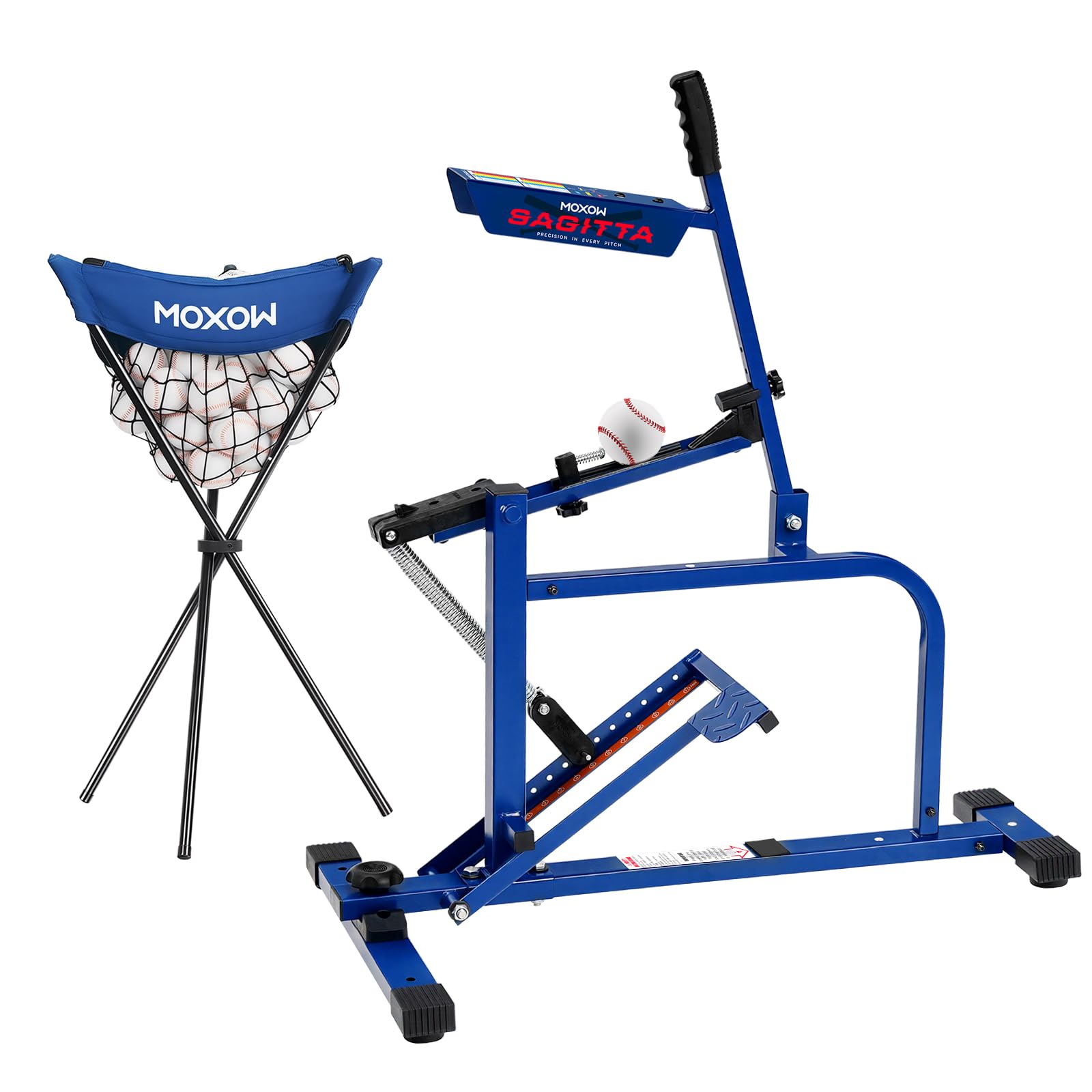
A manual machine that never needs batteries, making it the ultimate quiet, portable backyard trainer.
When you don’t have an outlet nearby and don’t want to deal with battery life, the MOXOW Sagitta steps in. This fully manual machine uses a color-coded speed guide and simple mechanical tension to launch strikes, grounders, and pop flies. It’s engineered with an anti-tilt bar to keep the base stable on uneven ground, and the reinforced frame doubles as a carry handle for easy transport.
The included ball caddy holds up to 50 baseballs or 30 softballs, which saves a ton of time during practice — you’re not bending over every few seconds. Owners consistently call it easy to set up and adjust for different ages, with one parent of a 6-year-old praising its consistent pitches and adjustable launch angle. The steel construction gives it a reassuring heft without being immovable.
There is a significant durability concern to be aware of: several owners mention that the spring pin broke after just a few uses, and getting a replacement part from the manufacturer can be difficult. It’s a risk with a manual machine that relies on mechanical tension, so treat the mechanism carefully. For casual backyard fun or early practice, it works well, but it’s not designed for the daily grind of a traveling team.
The independence factor: You can set this up in a field, a park, or a beach — no power source needed — and the ball caddy makes it easy to carry everything in one trip.
The mechanical risk: The spring mechanism is the weak point; it’s best for moderate, supervised use rather than non-stop machine-gun practice.
Perfect for: families who want a simple, no-maintenance machine for weekend backyard practice and who don’t mind a manual setup.
Better alternatives: If you plan on daily use or need something that can stand up to heavy practice, the electric machines offer better long-term reliability.
7. Furlihong Upgraded Electronic Pitching Machine

An entry-level electric thrower that’s perfect for teaching the absolute basics at a low entry cost.
This is the machine you buy when you want to test if your child is interested in batting practice without making a big investment. The Furlihong uses adjustable wheels to throw fastballs, curves, and sliders at a max speed of 30 MPH, making it safe for young beginners. It runs on either an AC adapter or 4 D batteries, giving you the flexibility to practice in the driveway or at the park without an extension cord.
It comes with 8 polyurethane dimpled balls that are sting-free and light, so they won’t dent bats or cause injury. The machine weighs just a few pounds and is a breeze to set up. Many owners of 6-8 year olds say it works perfectly for hitting and catching practice, and the ability to plug it into a wall or use batteries is a big plus for quick sessions.
The reliability is the main concern here. The owner experience is a genuine love-hate relationship: while many get a functional machine, a vocal number report units breaking after a month or two of daily use, with issues like the ball return failing or the speed adjustment not working. One owner summarized it as “fantastic for but in 3 months of nonstop daily use, I’m on my 3rd machine.” It’s a solid concept for light use, but it’s not built for the long haul.
The value play: At its entry-level tier, this machine gets the job done for occasional weekend practice and is forgiving enough for a 5-year-old’s first swing.
The durability limit: Daily heavy use will likely lead to breakage within a season, so consider this a short-term training aid rather than a permanent piece of gear.
Best for: parents on a tight budget who want to introduce a 5-9 year old to machine-pitch hitting without a big financial commitment.
Not for: serious players or those who need a machine that will survive a full season of regular practice, as the durability is inconsistent.
8. Furlihong 692BH Small Ball Pitching Machine

A tiny ball, a fast pace, and a big basket — this one sharpens visual tracking like nothing else.
The 692BH takes a distinct approach: it uses a smaller 5-inch circumference training ball that flies fast (18 mph) to force the hitter to really focus on the ball’s trajectory. It’s designed specifically for improving batting accuracy and hand-eye coordination rather than just swinging at a bigger target. The top basket holds up to 40 balls at once, so you can load it up and let the machine run through a full round without reloading.
It weighs just 4.4 pounds, making it one of the lightest electric options available. The gearless height adjustment is simple to tweak for different age groups, and the included 60 balls give you a solid practice stock from the start. Customers note seeing immediate improvement — one youth player went from 0-13 to 3-4 at the plate after consistent use. It’s especially popular for indoor use or with foam golf balls for a quieter, sting-free experience.
Quality control is a bit of a gamble. While the first unit one parent bought was “extremely helpful locking in my son’s hand eye connection,” the second one barely worked. The plastic build feels light and the long-term durability is unproven. If you get a good one, it’s a fantastic training tool. If you don’t, the return process is your friend.
Training specificity: No other machine in this range forces such precise visual tracking, which translates directly to better plate discipline in real games.
The consistency risk: The quality variation between units is the biggest drawback; buying from a retailer with an easy return policy is recommended.
Great for: 8-12 year old players who struggle with pitch recognition and need a more challenging, focused drill to sharpen their eyes.
Think twice if: you need a machine that feels solid and can withstand rough handling, as the plastic construction is on the delicate side.
9. Furlihong 4-in-1 Toss Machine
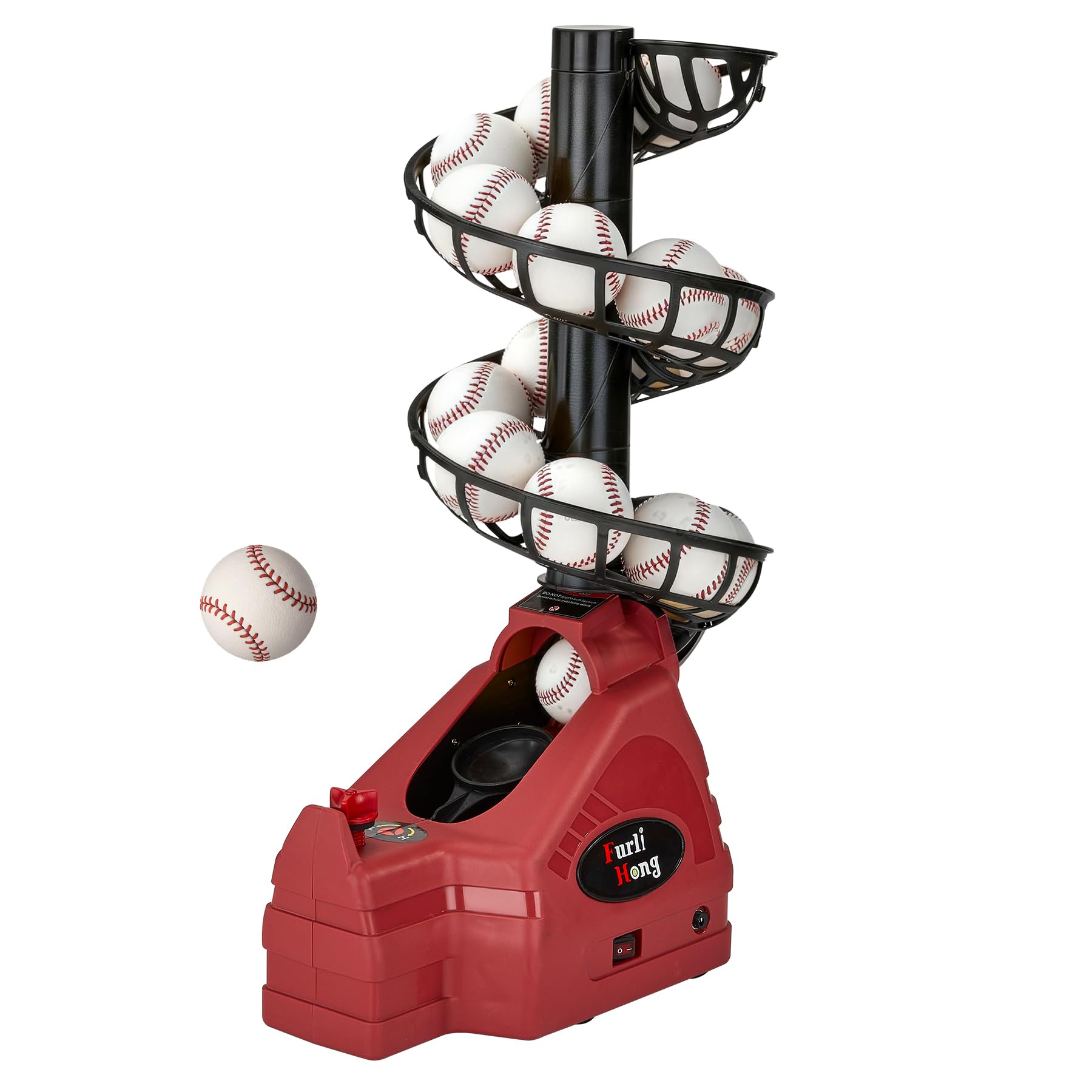
A gentle, introductory toss machine that switches from baseball to tennis to pickleball in seconds.
If you have a house full of kids playing different sports, this is a clever way to cover multiple bases with one device. The 4-in-1 is designed for baseball, tennis, pickleball, and cricket, using a soft toss launch mechanism that provides a gentle, controlled ball release. It’s ideal for absolute beginners who are still working on basic hand-eye coordination rather than high-speed batting practice.
Adjusting the height and distance is done with a single control knob, and it works with a variety of ball types — baseballs, tennis balls, pickleballs, and Furlihong’s own PU training balls. An 8-year-old owner is quoted as loving it, noting that the short throw distance means they stand about 5-6 feet away for hitting, and they use a porch for catching practice to get a bit more loft. It’s clearly a beginner’s tool, not a competitive training machine.
The flimsy ball hopper and the lack of a rechargeable battery (it needs an AC outlet or disposable batteries) are the main drawbacks. It’s also not meant for serious machine-pitch leagues; it’s a practice aid for younger kids to learn the feel of making contact. For an 8U or younger child who is just starting, it’s a low-pressure way to get them excited about the game.
Family value: One machine that serves baseball, tennis, and pickleball practice is a space and money saver for multi-sport households.
Not a pitcher: This is a soft toss machine, not a wheel-style pitcher, so it won’t prepare a player for fast machine-pitch leagues.
Ideal for: a 4-8 year old just starting out who needs a forgiving introduction to hitting, especially in a family that plays multiple sports.
Skip it for: any player already in organized baseball or softball who needs real pitching speeds and consistent strikes.
Understanding the Specs
Pitch Speed (MPH)
The speed at which the ball leaves the machine, measured in miles per hour. For young hitters, starting low — think 15-30 MPH for ages 5-8 — is crucial for building confidence and proper swing mechanics. A machine with a wide, adjustable range means it grows with your child, saving you from buying a new one every year. If the speed can’t go slow enough for your kid’s current level, they’ll develop bad habits by swinging too early or fearing the ball.
Ball Type and Compatibility
Youth pitching machines generally use one of three ball types: lightweight dimpled plastic balls (often called “lite” or “golf-size”), small wiffle-style balls, or standard regulation baseballs/softballs. The ball type determines safety, bat protection, and the feel of the hit. Machines that use regulation balls are heavier, more expensive, and typically reserved for older youth players. Always check what balls the machine is designed for — using the wrong type can damage the machine or the bat.
Weight and Portability
This is a make-or-break feature for most families. A machine that weighs under 10 pounds can be carried in one hand and set up on a tripod or a table in minutes. Machines in the 12-15 pound range are still movable but usually require a dedicated spot. Anything over 30 pounds is essentially a semi-permanent fixture. Think about who will be moving it (you, not your kid) and where you’ll store it. A portable machine gets used more because it’s less of a hassle.
Power Source
Machines run on AC power (wall outlet), batteries (disposable or rechargeable), or are fully manual. If you have a consistent power source in your garage or backyard, AC-only machines are fine. For taking the machine to a field or park, battery-operated or manual machines are essential. The best of both worlds is a machine offering both AC and battery options. Manual machines never run out of power but require resetting after each pitch, slowing down practice.